

Moving offices across Ontario is more than just packing boxes and driving a few hours. Long-distance commercial relocations require coordinated freight movements over extended distances that depend on complex transport networks, often spanning multiple provinces. For property managers, every kilometre adds layers of planning, risk, and operational complexity. This article clarifies what sets these moves apart and offers practical guidance for securing professional movers so your tenants experience minimal business disruption.
Table of Contents
- Long-Distance Commercial Moving Defined Clearly
- Types Of Commercial Moves In Ontario
- Essential Steps In Long-Distance Office Relocation
- Legal, Safety, And Insurance Requirements
- Risks, Costs, And Hidden Expenses To Watch For
Key Takeaways
| Point | Details |
|---|---|
| Understanding Long-Distance Moves | Long-distance commercial moving requires careful planning that includes logistics, specialized equipment, and compliance with regulatory standards. |
| Critical Planning Timeline | Initiate the moving process early, ideally 4-8 weeks in advance, to coordinate logistics and mitigate operational disruptions for tenants. |
| Comprehensive Budgeting | Detailed budgeting should account for hidden costs such as utility setup and infrastructure modifications to prevent financial strain. |
| Insurance and Liability | Ensure proper insurance coverage is in place for all parties involved, including commercial general liability and workers’ compensation, to safeguard against potential damages during the move. |
Long-distance commercial moving defined clearly
Long-distance commercial moving isn’t just relocating office furniture across town. It’s a coordinated operation involving the transport of goods, equipment, and assets over extended distances—often spanning multiple provinces or regions—requiring specialized expertise and logistics planning.
At its core, long-distance commercial moving means moving your office, warehouse, or business operations beyond the typical local service area. This type of relocation involves transporting not just desks and chairs, but sensitive equipment, confidential records, technology infrastructure, and inventory that keeps your business running.
What Sets Long-Distance Moves Apart
The key differences between local and long-distance commercial moves are significant:
- Distance threshold: Generally, moves exceeding 100–150 kilometres fall into the long-distance category
- Planning complexity: Requires detailed coordination, permits, and advance scheduling
- Equipment needs: Often demands specialized trucks, equipment movers, and trained personnel
- Timeline: Takes days or weeks rather than hours, affecting your business continuity
- Regulatory considerations: May involve cross-provincial requirements or compliance standards
When your Ontario office relocates hundreds of kilometres away, you’re managing coordinated freight movements over extended distances that depend on complex transport networks. This is fundamentally different from moving down the street.
Why This Matters for Property Managers
As a commercial property manager, you’re responsible for ensuring tenant transitions remain seamless. Long-distance commercial moving demands advance notice, strategic scheduling around business hours, and coordination with multiple stakeholders—your tenants, the moving company, IT departments, and utility providers.
Understanding the scope of a long-distance move helps you anticipate timeline delays, budget constraints, and potential operational disruptions. It also allows you to communicate realistic expectations to building occupants well in advance.
Long-distance commercial moves require weeks of planning, not days—start coordinating early to protect your tenants’ business continuity.
Key Elements of Commercial Relocation Services
Professional long-distance commercial moving includes several critical components:
- Pre-move consultation and site assessment
- Detailed inventory and asset tracking
- Specialized packing and protective equipment
- Dedicated moving crews trained for office environments
- Insurance coverage for high-value equipment
- Flexible scheduling to minimise downtime
- Setup and installation at the new location
These services ensure your tenants’ operations experience minimal disruption during the transition. When moving sensitive technology infrastructure or confidential document storage, specialised handling becomes non-negotiable.
Understanding what long-distance commercial moving entails helps you plan timelines, manage costs, and set appropriate expectations with your tenants. The difference between viewing it as “moving boxes” versus “relocating a functioning business operation” shapes everything about how the project unfolds.
Pro tip: Request a detailed scope of work from your moving company at least 60 days before the planned move date—this gives you time to identify potential conflicts, secure necessary approvals, and communicate the timeline to all affected tenants.
Types of commercial moves in Ontario
Ontario’s commercial moves aren’t one-size-fits-all. The province handles everything from small office relocations to massive warehouse transfers, each with distinct requirements, timelines, and costs. Understanding which type applies to your situation shapes how you plan and budget.
Commercial moves in Ontario fall into several categories based on distance, industry, and complexity. Your property’s tenants might experience anything from a local office shuffle to a multi-province expansion requiring specialized logistics.
Local Commercial Moves
Local moves stay within the same municipality or neighbouring areas, typically under 50 kilometres. These relocations happen quickly—often within a single day or over a weekend—minimising business downtime.
Local moves are ideal for:
- Relocating within the same office building or complex
- Moving to a nearby neighbourhood in the same city
- Quick tenant transitions with minimal planning
- Budget-conscious businesses seeking rapid turnover
Local moves generally cost less because they require fewer resources and shorter travel time. However, scheduling around business hours remains critical to protect tenant operations.
To clarify the distinctions between types of commercial moves in Ontario, review this comparison:
| Move Type | Typical Distance | Planning Timeline | Common Industries |
|---|---|---|---|
| Local Move | Under 50 kilometres | 1-2 weeks | Small offices, local retail |
| Long-Distance | Over 100 kilometres | 4-8 weeks | Headquarters, distribution |
| Interprovincial | Across provinces | 1-3 months | Manufacturing, corporate |
| Industry-Specific | Varies by requirement | Case-by-case | Tech, medical, finance |
Interprovincial and Long-Distance Moves
When your tenants expand beyond Ontario or relocate hundreds of kilometres away, you’re managing interprovincial freight via trucking and rail systems. These moves demand weeks of advance planning, specialized equipment, and coordinated logistics.
Interprovincial moves serve:
- Manufacturing firms opening branch facilities
- Wholesale and distribution centres expanding operations
- Corporate headquarters relocations
- Multi-location businesses consolidating offices
These relocations require cross-border compliance, specialized moving crews, and comprehensive insurance coverage. Timelines extend to weeks or months depending on distance and complexity.
Industry-Specific Commercial Moves
Ontario’s goods movement sector supports manufacturing, agriculture, and distribution industries, each with unique moving requirements. A tech company’s data centre relocation differs dramatically from a retail warehouse shift.
Common industry types include:
- Tech offices: Sensitive equipment, security protocols, minimal downtime tolerance
- Manufacturing: Heavy machinery, production line setup, extended closure periods
- Retail distribution: High-volume inventory, rapid restocking needs
- Medical/professional services: Compliance-sensitive operations, patient confidentiality
- Financial institutions: Secure document handling, regulatory compliance
Each industry demands different expertise, equipment, and operational knowledge from your moving partner.
Ontario’s commercial moves reflect the province’s diverse economy—one approach won’t work for every tenant relocation.
Choosing the Right Move Type for Your Tenants
Your role as property manager involves matching each tenant’s needs to the appropriate move type. A tech startup expanding locally needs different planning than a manufacturing facility opening an interprovincial satellite office.
Start by assessing distance, industry requirements, equipment sensitivity, and timeline constraints. This determines which moving services you’ll coordinate and which timelines you’ll communicate.
Pro tip: Classify each tenant relocation by distance and industry type early in the planning process—this lets you pre-qualify moving companies with relevant experience and provide realistic cost estimates and timelines.
Essential steps in long-distance office relocation
Long-distance office relocations don’t happen by accident. They require a structured approach with clear timelines, assigned responsibilities, and coordinated communication. Without proper planning, your tenants face operational disruptions, missed deadlines, and budget overruns.
The key is starting early and following a systematic process. Most successful relocations follow a month-by-month timeline that accounts for every detail.
Step 1: Assess Needs and Form a Relocation Team
Before anything moves, you need clarity on what’s actually relocating. Meet with tenant leadership to understand their space requirements, equipment needs, and operational constraints.
Your relocation team should include:
- Property manager (coordination lead)
- Tenant representative (decision maker)
- IT specialist (technology infrastructure)
- Facilities coordinator (physical space planning)
- Moving company liaison (logistics execution)
This team meets weekly to track progress and solve problems before they become crises. Clear communication among these stakeholders prevents costly delays.
Step 2: Budget Comprehensively
Detailed budgeting separates successful moves from financially painful ones. Account for moving services, equipment installation, downtime costs, and contingencies.
Typical cost categories include:
- Professional moving services
- Packing materials and labour
- Equipment transportation and setup
- IT infrastructure migration
- Facility modifications at new location
- Insurance and liability coverage
- Contingency buffer (15 percent minimum)
Underestimating costs creates mid-move financial stress. A professional moving company can provide accurate estimates based on your specific needs.
Step 3: Plan IT Infrastructure Migration
Technology represents the most complex relocation element. Scheduling IT infrastructure migration well in advance prevents business continuity disasters.
IT migration tasks include:
- Network infrastructure assessment at both locations
- Server and data centre relocation planning
- Communication systems setup timeline
- Cybersecurity protocols for transition period
- Staff technical support during cutover
IT cutover typically happens last, minimising downtime. Coordinate with your IT service provider at least 90 days before the move.
Step 4: Create Communication Strategy
Your tenants need clear, frequent updates. Develop a communication plan that addresses their concerns and sets realistic expectations.
Communication should cover:
- Moving timeline and key dates
- Employee responsibilities and schedules
- New office layout and amenities
- IT connectivity and support contacts
- Contact information for moving day questions
Clear communication prevents confusion and reduces relocation stress for your tenants and their staff.
Step 5: Execute Packing and Transportation
With a professional moving company, the actual relocation becomes manageable. Experienced commercial movers coordinate packing, loading, transportation, and unloading with precision.
Coordinate with your moving partner on:
- Packing timeline and crew schedules
- Inventory tracking and accountability
- Equipment handling protocols
- Delivery sequencing at new location
- Unpacking and setup assistance
Step 6: Settle and Monitor
After arrival, the real work continues. Verify that all items arrived, equipment functions properly, and staff can access necessary resources.
Post-move checklist items:
- Verify all inventory arrived intact
- Test IT systems and connectivity
- Check utility connections and HVAC
- Inspect for damage or missing items
- Address punch-list items promptly
Pro tip: Schedule a detailed walkthrough with tenant leadership 48 hours after move completion—this catches issues early and demonstrates your commitment to their successful transition.
Legal, safety, and insurance requirements
Long-distance office relocations involve more than logistics. They trigger legal obligations, safety responsibilities, and insurance requirements that protect both your property and your tenants. Overlooking these creates liability exposure and operational risk.
As a property manager, you must ensure compliance across multiple areas. This section breaks down what Ontario law requires during commercial office moves.
Insurance Coverage Requirements
Ontario businesses operating during relocations must maintain proper insurance protection. Commercial General Liability insurance covers bodily injury and property damage claims that arise during the moving process.
Essential insurance types include:
- Commercial General Liability: Protects against third-party injury or damage claims
- Commercial Property Insurance: Covers your physical assets and equipment during transition
- Workers’ Compensation (WSIB): Mandatory coverage for employee injuries during the move
- Moving Company Liability: Specialized coverage for goods in transit
Verify that both your business and the moving company carry adequate coverage. Request certificates of insurance before the move begins.
Workers’ Compensation and Employee Safety
Workers’ Compensation Insurance (WSIB) is legally required in Ontario for businesses with employees. This coverage protects staff injured during relocation activities—whether moving boxes, setting up equipment, or adapting to the new workspace.
Your obligations include:
- Maintaining current WSIB coverage throughout the relocation period
- Reporting any workplace injuries immediately
- Providing safe working conditions during the move
- Training staff on proper lifting and equipment handling
- Ensuring moving company employees also carry WSIB coverage
Failing to maintain WSIB coverage creates significant legal and financial penalties.
Safety Protocols During Relocation
Safety isn’t optional—it’s legally mandated. Develop a comprehensive safety plan addressing hazards specific to office relocations.
Key safety considerations:
- Identify potential hazards at both locations
- Establish clear pathways for equipment movement
- Restrict staff access to active moving areas
- Provide personal protective equipment where needed
- Document safety briefings and employee acknowledgements
- Assign a safety coordinator for the relocation period
- Plan emergency procedures and evacuation routes
Documentation protects you legally if incidents occur during the move.
Liability and Damage Claims
Damage happens. Equipment breaks, items go missing, or property gets scratched during transit. Clear liability agreements prevent disputes and protect your interests.
Establish written agreements covering:
- Responsibility for pre-existing damage
- Liability caps and coverage limits
- Claims procedures and timelines
- Inventory verification processes
- Dispute resolution procedures
Insurance and clear agreements protect everyone involved—your property, your tenants, and the moving company.
Regulatory Compliance and Permits
Long-distance moves may require permits or approvals, particularly for interprovincial relocations. Confirm requirements with your moving company and local authorities.
Potential regulatory requirements:
- Moving company licensing and credentials
- Commercial vehicle permits for interprovincial transport
- Load restriction compliance (weight, dimensions)
- Hazardous materials declarations if applicable
- Building permits for facility modifications at new location
Documentation and Record-Keeping
Maintain detailed documentation throughout the relocation. This protects you legally and resolves disputes quickly.
Documents to preserve:
- Insurance certificates and policies
- Moving company contracts and estimates
- Inventory lists and condition reports
- Damage documentation and photos
- Safety briefing records
- WSIB coverage verification
- Communication logs with tenants and vendors
Pro tip: Request proof of insurance from your moving company at least 30 days before the move, and verify coverage limits match your assets—don’t wait until moving day to discover coverage gaps.
Risks, costs, and hidden expenses to watch for
Long-distance commercial moves rarely stay within budget. What looks like a straightforward relocation often reveals hidden costs mid-project, straining your budget and frustrating tenants. Understanding these risks upfront lets you plan realistically and avoid unpleasant surprises.
Most property managers underestimate expenses because they focus only on moving trucks. The real costs hide in utility setup, infrastructure upgrades, and operational disruptions.
Common Hidden Costs
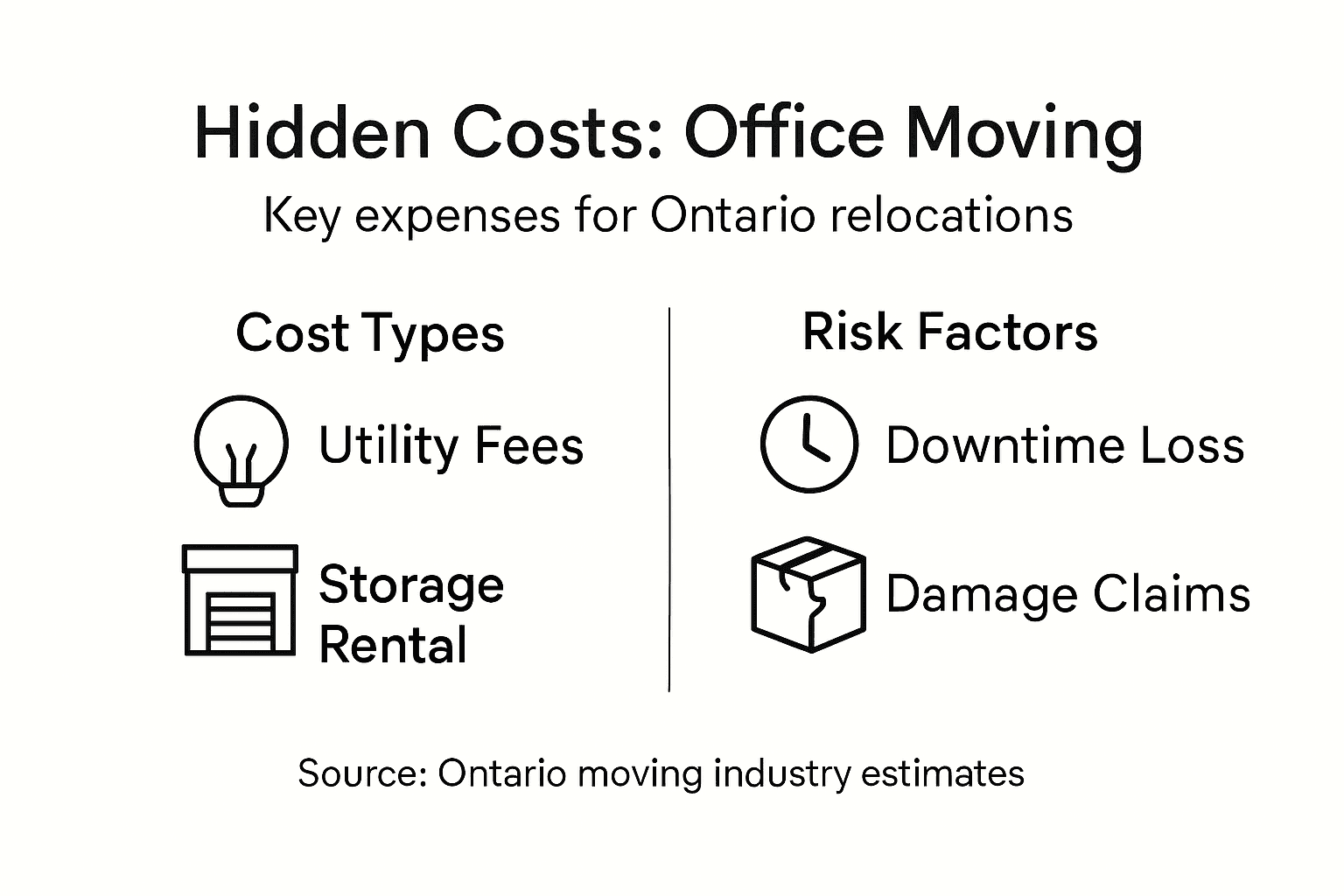
Hidden costs related to utility setup, infrastructure upgrades, and storage fees often exceed initial estimates by 20 to 40 percent. These aren’t line items on your first quote—they emerge during planning.
Typical hidden expenses include:
- Utility activation fees: Reconnecting electrical, natural gas, water, and internet systems
- Infrastructure upgrades: Network cabling, HVAC adjustments, security system installation
- Storage fees: Temporary storage when the new space isn’t ready on time
- Overtime charges: Weekend or evening moving work due to scheduling conflicts
- Equipment modifications: Installing specialized fixtures or adapting layouts
- Address and signage changes: New business signage, vehicle wraps, letterhead updates
- Permit and inspection costs: Building permits for facility modifications
These items add thousands to your final bill.
Here is a quick summary of hidden costs that often go overlooked during long-distance moves:
| Hidden Expense Category | Typical Amount Impact | Prevention Strategy |
|---|---|---|
| Utility setup/activation | $1,000–$5,000 extra | Confirm needs in advance |
| Storage fees | $500–$2,000/week | Align move-in/out dates |
| Overtime labour charges | +25%–50% on wages | Schedule for business hours |
| Permit/inspection fees | $200–$2,000 | Budget for regulatory costs |
Operational Disruption Costs
Downtime isn’t free. Every hour your tenant’s business sits idle costs money. Lost productivity, missed client meetings, and interrupted service delivery impact their bottom line—and your reputation.
Disruption costs include:
- Lost revenue during business closure
- Employee productivity gaps during transition
- Client dissatisfaction and potential account loss
- IT system downtime and data access interruptions
- Missed deadlines and contractual penalties
Minimising downtime requires careful scheduling and coordination with professional movers.
Insurance and Damage Risks
Insufficient insurance coverage leaves you exposed. Equipment breaks, shipments get damaged, or items vanish during transit—and if coverage is inadequate, you absorb the cost.
Common damage scenarios:
- In-transit damage: Equipment breaking during transport
- Loading/unloading damage: Items getting scratched or dented
- Lost inventory: Boxes that don’t arrive at destination
- Data loss: Corrupted files during server relocation
- Utility damage: Accidental damage to building systems during setup
Underestimated costs and insufficient insurance are the top reasons commercial relocations become financial nightmares.
Contingency Planning Gaps
Unexpected delays happen constantly. Weather, equipment failures, permit delays, or logistics problems extend timelines beyond original estimates. Without contingency plans, these delays cascade into overtime charges and extended downtime.
Plausible delay scenarios:
- Weather preventing safe transport
- Equipment breakdowns mid-move
- Permit processing delays at new location
- Utility company scheduling conflicts
- Workforce shortages for on-site setup
- IT infrastructure compatibility issues
Build 15 to 20 percent time and budget contingency into every estimate.
Avoiding Cost Surprises
Protect yourself by requesting detailed quotes that break down all costs. Don’t settle for rounded estimates—demand line-item specificity covering labour, equipment, materials, travel time, and contingencies.
Before signing any contract:
- Request itemised quotes from at least three moving companies
- Verify insurance coverage and liability limits
- Clarify responsibility for utility connections
- Define storage fees and duration policies
- Establish clear contingency timelines and cost caps
- Get everything in writing with signed agreements
- Plan realistic schedules with built-in buffer time
Pro tip: Budget 20 percent above the moving company’s quote for hidden expenses—this reserve covers utility setup, storage, permits, and unexpected delays without derailing your project.
Expert Support for Your Long-Distance Commercial Move in Ontario
Long-distance commercial moving involves careful planning, managing complex logistics, and navigating legal and safety requirements. If you are facing challenges like coordinating IT infrastructure migration, managing hidden costs, or ensuring minimal disruption for your tenants, you need a moving partner with proven expertise. Aleks Moving brings over 18 years of experience, flat-rate pricing with no hidden fees, and professional services tailored specifically for extended-distance relocations.
Key benefits of choosing Aleks Moving include:
- Detailed pre-move consultations and comprehensive planning
- Specialized commercial moving crews trained to protect sensitive equipment
- Transparent pricing that helps you avoid unexpected expenses
Are you ready to ensure a smooth and stress-free long-distance office relocation across Ontario? Visit our professional moving services page now to request a free quote and get customised solutions. Protect your business continuity while benefiting from our trusted moving expertise. Start your move today with Aleks Moving at https://aleksmoving.ca and experience commercial relocation made simple.
Frequently Asked Questions
A long-distance commercial move typically refers to relocating business operations over distances exceeding 100 to 150 kilometres, often involving complex logistics and detailed planning.
Long-distance commercial moves generally require comprehensive planning and can take anywhere from several days to several weeks, depending on the complexity and distance involved.
Key elements include pre-move consultation, detailed inventory tracking, specialized packing, dedicated moving crews, insurance coverage, and flexible scheduling to minimize downtime for tenants.
Common hidden costs may include utility activation fees, infrastructure upgrades, storage fees, overtime charges, and permit or inspection costs that can significantly impact the overall budget.