Skip to content


Moving within Ontario, whether you are relocating across the city or venturing between provinces, brings unique challenges and decisions. Understanding the differences between local and long-distance moves influences how you plan, budget, and select a service. With factors like pricing structures and legal protections varying by distance, this guide helps you make sense of transparent pricing and reliable moving options so you can approach your move confidently and with less stress.
Table of Contents
- Defining Local and Long Distance Moves in Canada
- Why Distance Matters More Than You Think
- What Makes Each Move Type Unique
- Key Differences in Process and Planning
- The Planning Complexity Factor
- Cost Structures and Budget Implications
- Understanding the Cost-Distance Relationship
- Legal Framework and Insurance Requirements
- How to Select the Right Moving Service
- Vetting Credentials and References
Key Takeaways
| Point | Details |
|---|---|
| Local vs. Long-Distance Moves | Understand the differences: local moves are short-distance within a city, while long-distance moves cover greater distances, often across provinces. |
| Cost Structures | Local moves typically charge hourly rates, while long-distance moves use flat rates based on weight and distance, affecting your budget significantly. |
| Planning Requirements | Local moves can be arranged in 2–4 weeks, whereas long-distance moves necessitate 4–8 weeks of detailed planning and comprehensive contracts. |
| Insurance Considerations | Check insurance coverage carefully; long-distance moves often require additional protection due to longer transit times and greater risk of damage. |
Defining Local and Long Distance Moves in Canada
Understanding what qualifies as a local move versus a long-distance move is your first step toward planning a successful relocation. The distinction affects pricing, timelines, logistics, and the complexity of your move.
Local moves typically involve relocating within the same city or region, covering short distances within urban or regional boundaries. These moves are generally completed in one or two days and keep your relocation simple and straightforward.
Long-distance moves cover greater distances, often crossing provincial or national boundaries. These moves involve significantly more logistical complexity and planning than their local counterparts.
Here’s how the two categories break down:
- Local moves: Within the same city or immediate area (typically under 50 kilometres)
- Long-distance moves: Across provinces, regions, or the country (typically over 50 kilometres)
- Provincial moves: From one province to another within Canada
- National moves: Across multiple provinces or vast distances
Why Distance Matters More Than You Think
Distance isn’t just about the number of kilometres on the odometer. The cost per unit distance decreases for longer hauls, making long-distance transportation more cost-efficient but considerably more complex to execute.
Local moves generally cost less overall because trucks don’t need to travel far, fuel costs are minimal, and movers can often complete the job in a single workday. Long-distance moves, despite being cheaper per kilometre, involve higher total costs due to multiple factors.
The distance effect fundamentally shapes your moving costs, timeline, and service requirements—understanding this distinction helps you budget accurately and choose the right approach.
What Makes Each Move Type Unique
Local moves require minimal planning but depend on quick execution and efficient packing. Your belongings don’t spend days in transit, reducing damage risk significantly.
Long-distance moves demand detailed planning and comprehensive contracts. Ontario regulations advise consumers to research movers by checking references and insurance coverage, which becomes even more critical for long-distance relocations where your possessions travel further from home.
Key differences at a glance:
- Timeline: Local moves completed in 1–2 days; long-distance moves take 3–14 days depending on destination
- Planning: Local moves need 2–4 weeks notice; long-distance moves require 4–8 weeks minimum
- Documentation: Local moves use simple agreements; long-distance moves require detailed contracts outlining service terms and conditions
- Insurance: Standard coverage works for local moves; long-distance moves may need additional protection
- Cost structure: Local moves charge hourly rates; long-distance moves typically use flat rates based on weight and distance
Choosing the right mover for each type isn’t complicated once you understand these differences. The key is matching your move’s scope with a company equipped to handle it properly.
Here is a concise comparison of key local and long-distance moving variables and what they mean for your move:
| Factor | Local Moves | Long-Distance Moves | Practical Impact |
|---|---|---|---|
| Time Commitment | 1–2 days | 3–14 days | Impacts disruption period |
| Upfront Preparation | 2–4 weeks | 4–8 weeks | Affects scheduling flexibility |
| Cost Calculation | Hourly rate | Based on weight & distance | Changes how you estimate total cost |
| Risk of Damage | Relatively low | Higher due to transit time | Influences need for insurance |
| Required Documentation | Simple agreement | Detailed contract | Impacts clarity and legal protection |
| Insurance Options | Basic suffices | Extra coverage suggested | Affects peace of mind |
Pro tip: Contact three moving companies and ask specifically whether they’re licensed for long-distance moves before getting quotes—not all local movers operate across provinces, and asking upfront saves time and frustration.
Key Differences in Process and Planning
Local and long-distance moves follow fundamentally different processes from start to finish. Understanding these differences helps you prepare appropriately and avoid surprises down the road.
Local moves follow a streamlined process. You call for an estimate, the company visits your home or provides a quote over the phone, and you schedule a moving date within days. Most local moves happen quickly with minimal back-and-forth communication.
Long-distance moves require a more structured approach. The process begins weeks in advance and involves detailed planning, multiple touchpoints, and comprehensive documentation. You’ll need detailed written contracts that outline exactly what services you’re receiving and what the mover is responsible for.
Here’s how the processes diverge:
- Estimates: Local moves use quick phone or walk-through quotes; long-distance moves require detailed in-home assessments
- Scheduling: Local moves booked within days; long-distance moves scheduled 4–8 weeks ahead
- Communication: Local moves involve minimal coordination; long-distance moves require regular updates and contingency planning
- Documentation: Local moves use basic agreements; long-distance moves demand comprehensive written contracts
The Planning Complexity Factor
Local move planning is straightforward because minimal coordination is needed. Your mover shows up, loads your belongings, and delivers them the same day or next day. Everything stays local and manageable.
Long-distance planning is more intricate. Detailed route planning, coordination between multiple locations, and adherence to provincial regulations become essential. Your mover must account for potential delays, vehicle maintenance, and contingency plans.
What this means practically for you:
- Flexibility: Local moves adapt to schedule changes easily; long-distance moves have fixed timelines
- Access to your mover: Local companies are nearby for follow-up concerns; long-distance movers may be hours away
- Due diligence needed: Local moves require basic reference checks; long-distance moves demand thorough verification of insurance coverage and company credentials
- Contract details: Local agreements are simple; long-distance contracts specify weight limits, delivery windows, and damage claims procedures
Long-distance moves require you to invest time upfront in research and planning—this effort pays dividends in reducing stress and preventing costly mistakes later.
Local moves reward quick decision-making. Long-distance moves reward patience and preparation. Neither approach is wrong; they’re just different.
Pro tip: For local moves, get quotes from two companies and book within a week; for long-distance moves, start researching movers at least six weeks ahead and request detailed written estimates before committing.
Cost Structures and Budget Implications
How you pay for your move depends entirely on whether it’s local or long-distance. Each has a distinct pricing model that affects your overall budget in different ways.
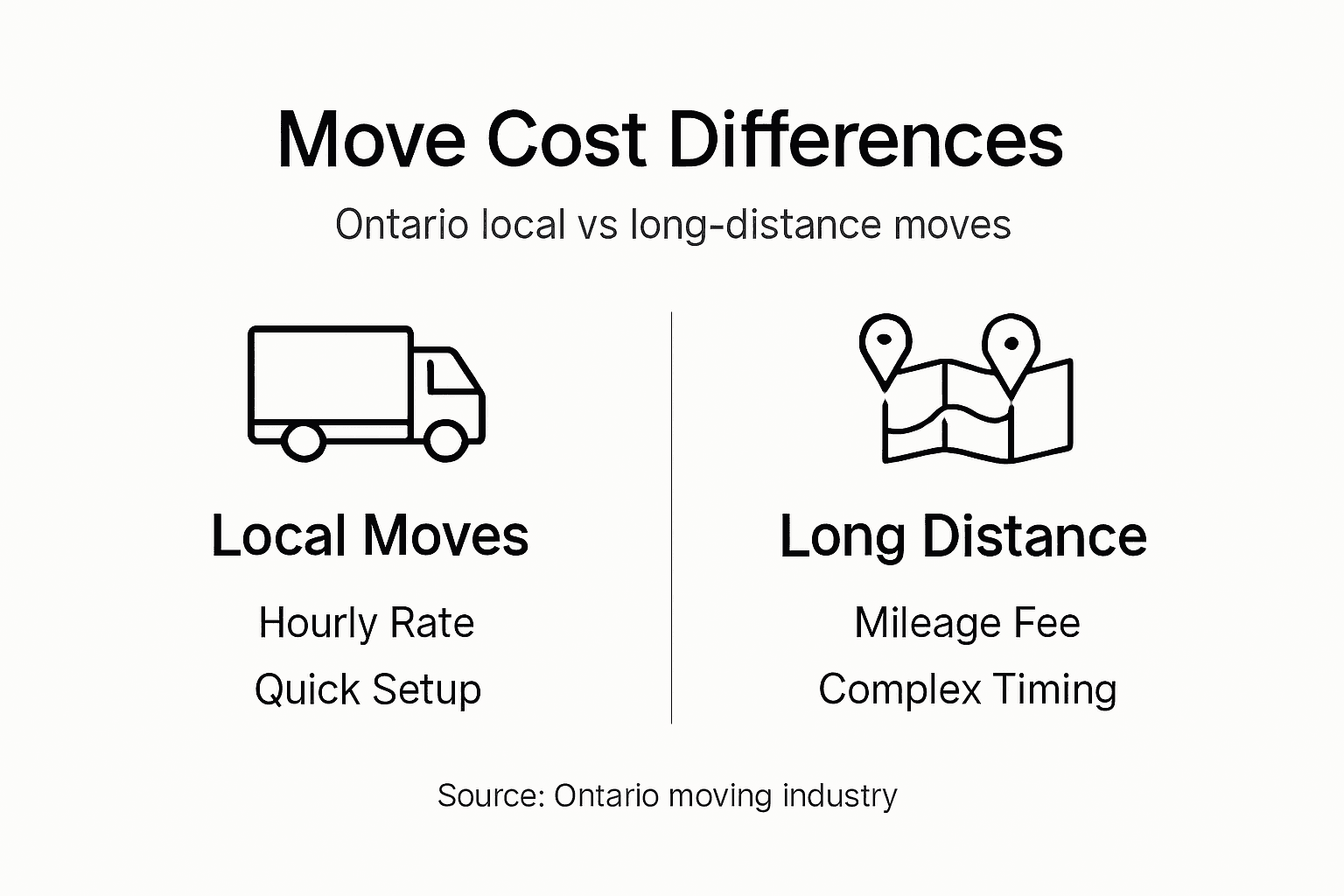
Local moves typically use hourly rates. You pay for the time the movers spend at your home, usually charged per hour with a minimum number of hours required. A two-bedroom apartment might cost $400 to $800 depending on how long the move takes.
Long-distance moves use fixed or semi-fixed rates. The cost depends on the weight of your belongings, the distance travelled, and various surcharges. You might pay $3,000 to $8,000 or more for a provincial move, but the price doesn’t fluctuate based on how slowly the movers work.
The pricing difference matters significantly:
- Local moves: Hourly billing (typically $150–$250 per hour per crew member)
- Long-distance moves: Weight and distance-based pricing with fuel surcharges
- Local efficiency bonus: Faster moves cost less because you pay fewer hours
- Long-distance value: Per-kilometre cost decreases at longer distances due to economies of scale
Understanding the Cost-Distance Relationship
Here’s where transport geography becomes practical. Fixed and semi-fixed costs for long-distance moves are influenced by distance bands, fuel surcharges, and provincial regulations, creating a pricing structure that changes at certain distance thresholds.
A 100-kilometre move costs proportionally more per kilometre than a 500-kilometre move. Moving companies build efficiency into longer routes, passing savings to customers. This is why a move across Ontario might seem expensive in absolute terms but is actually reasonable per-kilometre.
Hidden costs you should anticipate:
- Local moves: Travel fees if movers must return to their office; parking permits in dense urban areas
- Long-distance moves: Fuel surcharges (often 5–15% of base price); pickup and delivery fees; storage if timing doesn’t align; insurance for high-value items
- Both types: Packing material costs if not included; elevator rental fees in multi-storey buildings; specialty item handling (pianos, antiques)
Budget-friendly moves reward advance planning—book during off-peak seasons (September to May) and get quotes from multiple companies to compare total costs, not just hourly rates.
Local moves reward efficiency; packing well and being organized reduces billable hours. Long-distance moves reward early booking; rates lock in ahead of time, protecting you from price increases.
Use this summary to clarify which supplemental costs could apply to your move type:
| Cost Type | Local Moves Example | Long-Distance Moves Example |
|---|---|---|
| Travel Fee | Station-to-home fee | Intercity pick-up/drop-off fees |
| Fuel Surcharge | Normally included in rates | 5–15% extra on total bill |
| Packing Materials | Charged per box/supply | Often added to flat estimate |
| Insurance Upgrade | Typically optional | Recommended for high-value items |
| Storage Fee | Rare except for gaps | Common if move-in delayed |
Pro tip: Request detailed written estimates showing all costs including surcharges and fees before committing—comparing three quotes takes two hours but typically saves $500 to $1,500 on your total move.
Legal Framework and Insurance Requirements
Protecting yourself legally during a move matters whether you’re going across town or across the province. Ontario has specific rules that apply to all moving services, and understanding them prevents costly disputes.
Ontario’s Consumer Protection Act governs all moving contracts. Any contract over $50 must be written and clearly specify the scope of work, pricing, payment terms, and what the mover is responsible for. This applies to both local and long-distance moves.
Movers cannot charge more than 10% above the written estimate without your explicit written agreement. This protection shields you from surprise bills on moving day. If a mover claims they underestimated and demands extra payment, you have legal recourse.
Key contractual requirements include:
- Service description detailing what’s included and excluded
- Itemised pricing showing labour, materials, and any surcharges
- Payment terms and methods accepted
- Timeline for completion or delivery
- Cancellation and dispute resolution procedures
- Insurance coverage details and liability limits
Insurance Coverage That Protects You
Movers must disclose insurance coverage details and liability responsibilities in writing, giving you clarity before you commit. This disclosure is non-negotiable under Ontario law.
Standard moving insurance covers damage during transit, but coverage limits vary. Basic liability might only cover $0.60 per pound—meaning a $2,000 television is only covered for $60 if standard coverage applies. You need to understand exactly what’s protected.
Insurance options typically available:
- Carrier liability: Minimal coverage included by law; often insufficient for valuable items
- Full value protection: Mover is liable for replacement cost of damaged goods
- Third-party insurance: Purchased separately for additional protection on high-value belongings
Long-distance moves especially warrant additional coverage because your belongings spend more time in transit and travel further from your oversight. Local moves pose less risk but still benefit from clarified coverage.
Before signing any contract, ask your mover to explain exactly what happens if your items are damaged—get the answer in writing as part of your agreement.
Verifying credentials protects you further. While Ontario does not license individual movers, you should check that movers comply with consumer protection regulations and maintain adequate insurance policies. Request proof of liability insurance and verify it covers the estimated weight of your move.
Pro tip: Request the mover’s insurance certificate and policy details at least three days before moving day, then contact their insurer directly to confirm the policy is current and covers your specific move.
How to Select the Right Moving Service
Choosing the right mover can mean the difference between a smooth relocation and a stressful nightmare. The decision requires more than just picking the cheapest quote—it demands thorough research and careful evaluation.
Start by gathering at least three written estimates from different companies. Phone quotes aren’t enough; written estimates protect you legally and allow proper comparison. Each quote should itemise labour costs, materials, surcharges, and insurance options separately.
Communicate your moving needs clearly to each company. Tell them about fragile items, specialty pieces, storage requirements, and your exact timeline. Vague descriptions lead to inaccurate estimates and surprises on moving day.
Your selection process should include these essential steps:
- Request written estimates from at least three movers
- Check online reviews and ask for customer references
- Verify insurance coverage and liability limits in writing
- Confirm the contract includes all service terms and pricing
- Visit storage facilities if you’ll need temporary storage
- Ask about their experience with moves similar to yours
Vetting Credentials and References
Selecting the right moving service involves checking references, insurance coverage, and company reputation before committing. Don’t skip this step—it’s your primary defence against unreliable movers.
Call at least two references from recent moves similar to yours. Ask specific questions: Did the movers arrive on time? Were items handled carefully? Did the final bill match the estimate? Did they communicate throughout the move? References reveal patterns you won’t find online.
Insurance verification is equally critical. Ask your mover for proof of liability insurance and contact their insurer directly to confirm coverage. Verify the policy covers the weight and value of your belongings. Don’t accept vague assurances—get everything in writing.
Key verification points:
- Company name and years in business
- Insurance policy numbers and coverage limits
- Whether they’re registered with provincial regulatory bodies
- Complaint history and how disputes were resolved
- Specific experience with local or long-distance moves
A company with 18 years of industry experience and transparent flat-rate pricing protects you better than the cheapest option—verify these markers before deciding.
Understanding liability matters tremendously. Ask what happens if items are damaged and get a written explanation of how claims work. Long-distance moves especially warrant clarity because your belongings travel further and spend more time in transit.
Final selection step: review the contract line by line. Ensure it specifies what’s included, what costs extra, cancellation policies, and dispute resolution procedures. Never sign contracts with blank spaces or unclear terms.
Pro tip: Create a comparison spreadsheet listing each mover’s estimate, insurance coverage, years in business, and reference feedback—this visual comparison reveals which company offers the best overall value, not just the lowest price.
Make Your Local or Long Distance Move Stress-Free with Aleks Moving
Deciding between a local or long distance move in Ontario involves understanding distinct challenges like cost structures, insurance needs, and detailed planning timeframes. Whether you face tight schedules, concerns about your belongings’ safety, or navigating complex contracts Aleks Moving offers clear, flat-rate pricing with no hidden fees and over 18 years of trusted experience to guide you every step of the way. Our expertise in residential and commercial moves ensures your relocation is smooth and worry-free, no matter the distance.
Take the guesswork out of your move with Aleks Moving. Get your free detailed quote today and discover why customers across Ontario trust our professionalism and transparent approach. Visit Aleks Moving to explore our services for local moves or long-distance relocations and book with confidence now. Your stress-free move starts here.
Frequently Asked Questions
What qualifies as a local move?
Local moves typically involve relocating within the same city or region, usually covering distances under 50 kilometres.
How is a long-distance move defined?
A long-distance move generally refers to relocations that exceed 50 kilometres, often crossing provincial or national boundaries.
What are the key differences in planning a local versus a long-distance move?
Local moves require minimal planning and can be scheduled within 2–4 weeks, while long-distance moves demand comprehensive planning and should be scheduled at least 4–8 weeks in advance.
How are moving costs structured for local and long-distance moves?
Local moves are usually charged at hourly rates, while long-distance moves typically use flat rates based on weight and distance, which can include additional surcharges.