

Planning a move in Ontario can feel unpredictable when every quote seems different and hidden costs threaten your carefully made budget. Transparent moving estimates help homeowners see through common myths and confusing pricing, giving you a clear picture of what your relocation will truly cost. This guide unpacks the real factors behind moving quotes and explains how to compare estimate types, so you can make confident decisions and avoid financial surprises.
Table of Contents
- Defining Moving Estimates And Common Myths
- Types Of Moving Estimates Offered In Ontario
- How Moving Estimate Pricing Is Calculated
- Flat Rate Vs. Hourly Rate Comparisons
- Hidden Fees And Transparency In Moving Quotes
Key Takeaways
| Point | Details |
| Understanding Moving Estimates | Moving estimates provide a professional assessment of the costs and logistics involved in a relocation, helping homeowners budget effectively. |
| Types of Estimates | Homeowners should be aware of different types of moving estimates, such as non-binding and binding estimates, to choose the best option for their needs. |
| Requesting Estimates | Always request written estimates from multiple moving companies to compare services, costs, and potential additional charges. |
| Hidden Fees Awareness | Be alert to common hidden fees associated with moving quotes to ensure accurate budgeting and avoid unexpected expenses. |
Defining Moving Estimates and Common Myths
Understanding moving estimates is crucial for Ontarian homeowners planning a relocation. Moving estimates are professional assessments that predict the total cost and logistics of transferring your belongings from one location to another. These detailed projections help you budget effectively and avoid unexpected financial surprises during your move.
Moving estimates typically include several key components:
- Labour costs for professional movers
- Transportation expenses based on distance and truck size
- Packing materials and supplies
- Additional services like specialty item handling
- Potential extra fees for complex moves
While migration cost assumptions can often be misleading, moving estimates aim to provide transparent and accurate pricing. Many homeowners harbour misconceptions about these estimates that can lead to budgeting challenges.
Common myths about moving estimates include believing that all quotes are identical, assuming verbal estimates are legally binding, or thinking that the cheapest option is always best. In reality, moving estimates vary significantly based on multiple factors such as move complexity, distance, volume of belongings, and additional services required.
To protect yourself, always request written estimates from multiple moving companies, ask about potential additional charges, and carefully review the details of each quote. Reputable moving companies in Ontario will provide clear, itemized estimates that break down all potential costs.
Pro tip: Request at least three detailed written estimates and compare them side-by-side to understand the full scope of potential moving expenses.
Types of Moving Estimates Offered in Ontario
Moving companies in Ontario provide several types of estimates to help homeowners understand potential relocation costs. Expenditure assessment practices reveal the complexity of accurately predicting moving expenses, with each estimate type offering unique advantages and considerations.
The primary types of moving estimates in Ontario include:
- Non-Binding Estimates: Provides a rough cost projection without a guaranteed final price
- Binding Estimates: Locks in a specific price for agreed-upon services
- Binding Not-to-Exceed Estimates: Guarantees you won’t pay more than the initial quote, with potential for lower costs
- In-Home Estimates: Detailed assessments conducted by movers visiting your property
- Virtual Estimates: Online assessments using video consultations or detailed inventory lists
Non-binding estimates offer flexibility but lack price certainty. These preliminary quotes allow homeowners to get a general sense of moving expenses without committing to a specific company. Professional movers typically provide these estimates after a brief phone consultation or online inventory review.
Binding estimates provide more financial predictability. Binding moving estimates represent a contract where the moving company commits to a fixed price for specific services. This approach protects homeowners from unexpected price increases, though it may not account for last-minute changes or additional services.
The most consumer-friendly option is often the binding not-to-exceed estimate. This approach guarantees that you won’t pay more than the initial quote while allowing potential cost reductions if the actual move requires less effort or resources than anticipated.
Pro tip: Always request written estimates from multiple moving companies and carefully compare the type of estimate, included services, and potential additional charges.
Here’s how different types of moving estimates compare for Ontarian homeowners:
| Estimate Type | Price Certainty | When Used | Homeowner Advantage |
| Non-binding | No guaranteed final cost | Early research, flexible moves | Initial cost idea |
| Binding | Fixed price for defined job | Clearly defined, standard relocations | No surprise increases |
| Binding Not-to-Exceed | Max price set, may decrease | Moves with some variable factors | Pay less if scope drops |
| In-home | Highly accurate, detailed | Complex or large volume moves | On-site expert assessment |
| Virtual | Convenient, moderate detail | Smaller or straightforward relocations | Fast, remote accessibility |
How Moving Estimate Pricing Is Calculated
Moving companies in Ontario use sophisticated cost estimation methods to develop accurate pricing for relocation services. These calculations involve multiple complex factors that go beyond simple distance measurements, considering everything from labour rates to specific logistical challenges.
The primary components influencing moving estimate pricing include:
- Distance: Total kilometres travelled during the move
- Volume of Belongings: Cubic metres of items being transported
- Labour Hours: Number of movers required and time spent
- Special Item Handling: Additional costs for fragile or oversized items
- Season and Timing: Peak moving periods with higher demand
- Access Complexity: Challenges like stairs, long carrying distances, or elevator restrictions
Parametric estimation techniques allow moving companies to create preliminary price projections by using standard industry metrics. These calculations consider base rates, potential complications, and standardized pricing models that account for typical moving scenarios across Ontario.
Moving estimate pricing typically breaks down into three fundamental categories: direct costs (labour, transportation), indirect costs (equipment, insurance), and potential variable expenses. Professional movers carefully balance these elements to provide transparent and competitive pricing that reflects the specific requirements of each unique relocation.
Additional factors like fuel prices, equipment maintenance, and regional market conditions also play significant roles in final cost calculations. Movers must continuously adapt their pricing models to reflect current economic realities while maintaining fair and competitive rates for Canadian homeowners.
Pro tip: Request a detailed breakdown of your moving estimate to understand exactly how each component contributes to the total price.
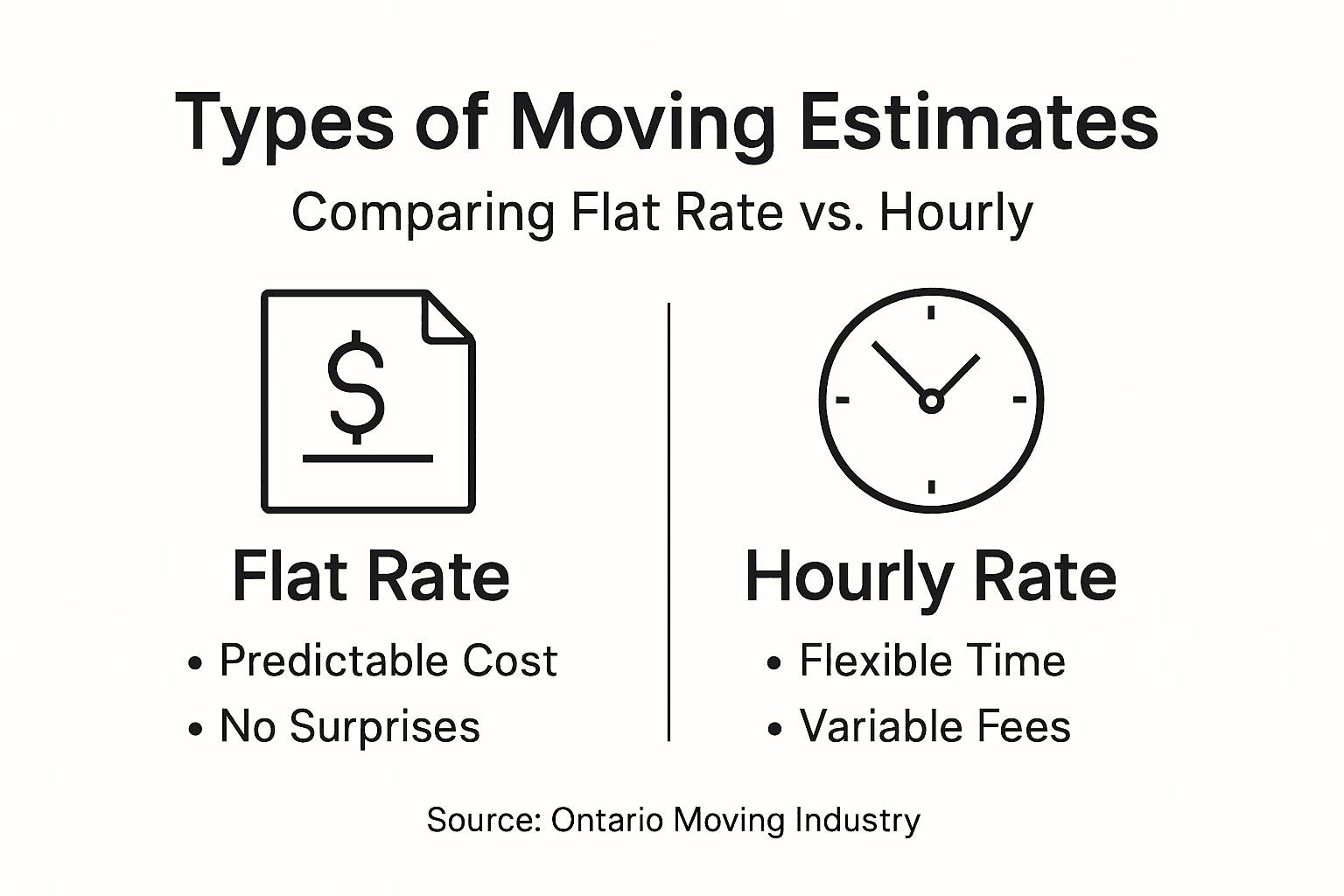
Flat Rate vs. Hourly Rate Comparisons
Moving companies in Ontario offer two primary pricing structures: flat rate and hourly rate, each with unique advantages and potential drawbacks. Labor compensation guidelines play a significant role in understanding these pricing models and their implications for consumers.
Key differences between flat rate and hourly rate moving estimates include:
- Flat Rate Pricing:
- Fixed total price for the entire move
- Predetermined based on estimated job complexity
- Provides clear, upfront cost expectations
- Motivates movers to work efficiently
- Hourly Rate Pricing:
- Charges based on actual time spent moving
- Typically includes:
- Number of movers
- Hours worked
- Travel time
- More flexible for complex or unpredictable moves
Flat rate pricing offers predictability for homeowners, allowing precise budgeting and eliminating surprises. The fixed price is calculated by considering factors like total volume of belongings, distance, and estimated complexity of the move. This method incentivizes moving teams to work quickly and efficiently, potentially benefiting both the customer and the moving company.
Hourly rate pricing provides more transparency in labour costs but can lead to uncertainty about final expenses. Complex moves with unexpected challenges like difficult access, multiple stops, or extensive packing can significantly increase the total cost. Professional movers typically provide detailed time estimates, but actual hours may vary depending on specific circumstances encountered during the relocation.
Pro tip: Request a comprehensive breakdown of potential additional charges for both flat rate and hourly pricing models to avoid unexpected expenses.
Hidden Fees and Transparency in Moving Quotes
Moving companies often incorporate complex pricing structures that can obscure true relocation costs. Consumer protection guidelines highlight the importance of identifying and understanding potential additional charges before finalizing your moving contract.
Common hidden fees that homeowners should watch for include:
- Access-Related Charges:
- Stairs fee
- Long carry distance surcharge
- Elevator usage fee
- Difficult parking or loading restrictions
- Item-Specific Fees:
- Heavy item handling
- Oversized furniture surcharge
- Speciality item packaging
- Disassembly and reassembly costs
- Logistical Expenses:
- Fuel surcharges
- Travel time between locations
- Packing material costs
- Weekend or peak season premiums
Transparent moving quotes require a comprehensive breakdown of potential expenses. Professional moving companies should provide detailed estimates that clearly outline every potential charge, ensuring homeowners can accurately budget for their relocation without unexpected financial surprises.
Most reputable moving services in Ontario offer binding estimates that legally protect consumers from arbitrary price increases. These documents should explicitly state all anticipated charges, including potential variable expenses, giving homeowners a clear understanding of total moving costs before signing any agreements.
Pro tip: Request a written, itemized quote that includes all potential fees and clarifies which charges are firm and which might fluctuate based on specific moving conditions.
Here’s a summary of common hidden fees you should clarify before finalizing a moving quote:
| Fee Category | Typical Charges | When They Apply |
| Access-Related | Stairs, elevator, long carry fee | Limited parking, high rises |
| Item-Specific | Heavy, oversized, fragile items | Moving pianos, safes, antiques |
| Logistical | Fuel, packing, weekend premiums | Long distances, busy move dates |
| Disassembly | Furniture split and assembly | Large beds, modular sofas |
Take Control of Your Move with Transparent, Flat-Rate Estimates
Moving can be overwhelming when hidden fees and unclear pricing stand in your way. This article highlights common challenges like confusing moving estimates, unexpected extra charges, and comparing flat rate versus hourly pricing. You deserve reliable, transparent cost breakdowns that empower you to budget confidently and avoid surprises.
At Aleks Moving, we specialise in providing clear, flat-rate pricing with no hidden fees backed by over 18 years of trusted moving experience across Ontario and Canada. Whether you require local or long-distance relocation, packing services, or specialty item handling we ensure you receive detailed written estimates that explain every cost element upfront. Our transparent approach aligns perfectly with the moving estimate types discussed in the article, including binding not-to-exceed quotes, so you can move forward stress-free.
Explore how Aleks Moving works and request your free, no-obligation quote today.
Simple, clear pricing awaits you Move with confidence

Don’t wait until moving day to discover hidden fees or confusing charges. Contact Aleks Moving now for a professional consultation and a transparent, written moving estimate tailored to your unique needs.
Frequently Asked Questions
What are the different types of moving estimates?
Moving companies typically offer non-binding, binding, binding not-to-exceed, in-home, and virtual estimates. Each type serves different needs, with binding estimates providing set prices and non-binding estimates offering more flexibility but without guaranteed costs.
How are moving estimates calculated?
Moving estimates are calculated based on several factors including distance, volume of belongings, labour hours, special item handling, seasonal demand, and access complexity. These variables help movers create a more accurate pricing model for the relocation.
What are common hidden fees associated with moving estimates?
Common hidden fees can include access-related charges (like stairs or long carry fees), item-specific fees (for heavy or oversized items), logistical expenses (like fuel surcharges), and disassembly costs. It’s vital to clarify these potential charges in your moving contract.
How can I ensure transparency in my moving estimate?
To ensure transparency, always request a written, itemized quote that outlines all potential costs, including any additional charges. Comparing estimates from multiple moving companies can also help you understand what is included and avoid unexpected expenses.