

TL;DR:
- Ontario categorizes emergency relocations into disaster evacuations, personal emergencies, and business moves, each with different protocols.
- Preparation involves saving key contacts, organizing essential documents, and creating a grab-and-go kit for quick response.
- Support systems vary; insurance covers most personal emergencies, while government assistance mainly applies to declared disasters.
A fire breaks out overnight. Floodwaters rise faster than expected. A landlord issues a sudden notice that gives you days, not weeks, to vacate. In Ontario, these situations happen more often than most people realise, and when they do, the scramble for shelter, storage, and support can feel completely overwhelming. Whether you are a homeowner, a renter, or a business owner, knowing exactly what to do and who to call makes an enormous difference. This guide walks you through the full emergency relocation workflow, step by step, so you can act quickly and confidently when it matters most.
Table of Contents
- Understanding emergency relocation in Ontario
- Preparation: What you need before and during an emergency
- Step-by-step emergency relocation workflow for homeowners, renters, and businesses
- Special cases, challenges, and recovery resources
- Our take: Why conventional relocation preparedness often falls short
- Need help with urgent relocation? Aleks Moving is ready now
- Frequently asked questions
Key Takeaways
| Point | Details |
|---|---|
| Know your workflow | Emergency relocation steps differ for disaster, personal, or business cases—use the right process for your situation. |
| Prepare essentials | Always have documents, contacts, and a go-bag ready for any sudden move or evacuation. |
| Use supports wisely | Seek insurance, government assistance, or legal aid quickly to minimize cost and disruption. |
| Document everything | Keep receipts, application copies, and communications for smooth claims or compensation. |
| Act before crisis | Pre-planning and strong communication help prevent confusion during real emergencies. |
Understanding emergency relocation in Ontario
To understand what you will face in an urgent relocation, let us start with how Ontario distinguishes and responds to different emergencies.
Not all emergency relocations work the same way. Ontario handles three broad categories, and each one follows a very different path. Knowing which category applies to your situation is the first and most important step you can take.
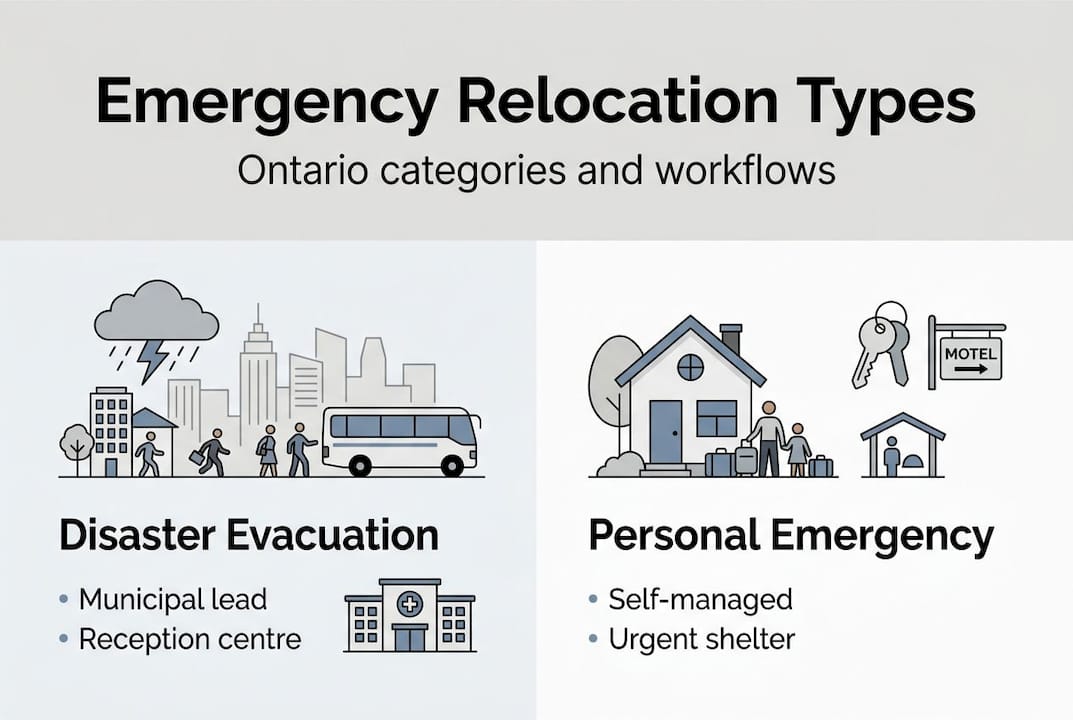
Disaster evacuations are the most structured. These are coordinated by municipalities and backed by provincial and federal plans. The Provincial Emergency Response Plan governs how evacuees are received and cared for, covering shelter, registration, food, and first aid at designated reception centres. This system is well-organised but applies only to declared emergencies.
Personal emergencies such as a house fire, a burst pipe, or a sudden eviction sit outside that structured system entirely. Here, your insurance policy and private support networks carry most of the weight. There is no single government office you call to handle everything for you.
Business relocations after a disaster fall under continuity and recovery frameworks. Government programmes may help with cleanup and repairs, but they do not physically relocate your business for you.
This distinction matters because many Ontarians assume there is one unified system to handle all of these cases. There is not. Here is a quick reference to orient yourself:
| Situation | Primary lead | Key contacts |
|---|---|---|
| Declared disaster/evacuation | Municipality and province | Local emergency management office, 211 Ontario |
| Personal emergency (fire, flood) | Homeowner/renter + insurer | Insurance company, Red Cross, 211 Ontario |
| Eviction or renoviction | Tenant and landlord | Landlord and Tenant Board, legal aid |
| Business emergency | Business owner | Insurance broker, BISA programme, private movers |
Key contacts to save before any emergency:
- 211 Ontario: Social services, shelter, and housing referrals, available 24/7
- Your insurance provider: First call for homeowners and renters after a loss
- Local municipal emergency management office: Coordinates disaster response in your area
- Red Cross Canada: Immediate needs like food, clothing, and temporary lodging
- Landlord and Tenant Board: For eviction and renoviction disputes
Familiarising yourself with Ontario move preparation steps in advance means you will not be searching for this information under pressure. And if speed is critical, knowing about last-minute moving services in Ontario can save you hours when time is short.
“The best emergency plan is the one you built before the emergency happened.”
Preparation: What you need before and during an emergency
Once you know your situation type, here is how to quickly prepare yourself for a smooth relocation when every minute counts.
Preparation is not about having a perfect plan. It is about having the right information within reach when stress is high and time is short. Two things matter most: your documents and your contacts.
Essential contacts to have saved
| Contact | Purpose | How to reach |
|---|---|---|
| 211 Ontario | Housing, shelter, social services | Call or text 211 |
| Your insurance company | Coverage and claims | Policy card or app |
| Your landlord or property manager | Access and next steps | Lease agreement |
| Municipal reception centre | Shelter and registration | Local emergency website |
| Red Cross Canada | Immediate relief needs | 1-800-418-1111 |
| Legal Aid Ontario | Tenant and housing rights | 1-800-668-8258 |
Steps to build your grab-and-go kit
- Gather government-issued ID for every household member (passports, health cards, driver’s licences).
- Collect insurance documents, your lease or mortgage papers, and recent utility bills.
- Pack essential medications, a three-day supply of food and water, and phone chargers.
- Include cash in small bills, since card readers may not work during power outages.
- Store everything in a waterproof bag or sealed container near your exit.
- Share your plan with a trusted neighbour or family member outside your home.
When a declared evacuation occurs, authorities direct evacuees to reception centres where registration, shelter, food, first aid, and personal needs are addressed. Arriving with your documents already organised speeds up that registration process significantly.
Pro Tip: Place your most critical documents, ID, insurance policy, and emergency contacts, in a waterproof envelope inside your grab-and-go kit. Review and update it every six months.
For more complex moves that follow an emergency, professional movers who support emergency relocation can reduce the physical and emotional burden considerably.
Step-by-step emergency relocation workflow for homeowners, renters, and businesses
With your essentials in hand, here is how to put your emergency relocation plan into action, tailored to your situation.
Homeowners
- Ensure everyone is safe and contact emergency services if needed.
- Call your insurance provider immediately. Additional living expenses during displacement are covered under most home insurance policies.
- Document all damage with photos and video before touching anything.
- Apply for the Disaster Recovery Assistance for Ontarians programme if your loss is uninsured or exceeds your coverage.
- Arrange temporary accommodation through your insurer, a family member, or a hotel.
- Contact a professional mover to retrieve and store belongings safely.
Renters
- Notify your landlord in writing and contact your tenant’s insurance provider.
- If displaced without insurance, call 211 Ontario for emergency shelter referrals.
- For evictions or renovictions, emergency housing options for tenants include transitional housing, the Rent Bank, and Ontario Works.
- Request written confirmation of any compensation your landlord is required to provide.
- Keep all receipts for temporary housing and moving costs.
Businesses
- Activate your business continuity plan and notify key staff and clients.
- Contact your commercial insurer to begin a claim.
- Apply for provincial recovery programmes. Federal disaster financial assistance guidelines note that programmes like BISA and MISA cover cleanup and repairs, not physical relocation.
- Arrange private commercial moving services to relocate equipment and inventory.
- Notify the Canada Revenue Agency if your business address changes.
Comparison of relocation workflows
| Factor | Disaster evacuation | Personal emergency | Business move |
|---|---|---|---|
| Who leads the response | Municipality/province | You and your insurer | You and your insurer |
| Government shelter available | Yes, reception centres | Limited, via 211 | No |
| Insurance covers relocation | Partially | Yes, with coverage | Yes, commercial policy |
| Eligible cost coverage | Up to 90% post-deductible | Policy-dependent | Policy-dependent |
Pro Tip: Document every receipt, every phone call, and every contact made during your relocation. This record is essential for insurance reimbursement, government assistance applications, and any legal disputes that follow.
For a detailed look at the residential moving process in Ontario or to understand business relocation cost examples, these resources will help you budget and plan more accurately.
Special cases, challenges, and recovery resources
Some situations require unique support or have extra legal and funding rules. Here is what you need to know about special cases in the emergency relocation workflow.
Not every emergency fits neatly into the standard categories. Ontario has several edge cases that require specialised knowledge and support.
- Nuclear emergencies: These follow dedicated provincial nuclear plans with specific evacuation zones, reception areas, and decontamination protocols. Residents near nuclear facilities should know their zone and the local plan in advance.
- First Nations communities: Evacuations from remote First Nations communities involve federal coordination, Indigenous Services Canada, and cultural support networks. These evacuations can last weeks or months and require long-term housing solutions.
- Renovictions: If a landlord evicts you to renovate, there are legal protections. In Hamilton, for example, a renovation licence and relocation process requires landlords to provide compensation and the right of first refusal to return.
- Insurance gaps: Some homeowners and renters discover their policy does not cover the specific cause of their displacement. In these cases, provincial disaster assistance programmes and community organisations fill part of the gap.
Municipal governments handle immediate response, while provincial programmes manage longer-term recovery funding. Knowing which level of government to contact for each need saves significant time.
“During the 2025 Kashechewan evacuation, over 1,700 evacuees were housed in Niagara Falls hotels, supported by local organisations and provincial coordination. It was a powerful example of what rapid, multi-agency response looks like in practice.”
Vulnerable populations, including seniors, people with disabilities, and newcomers, may need additional support navigating these systems. Legal aid, cultural organisations, and social workers can all play a role in bridging those gaps.
If you need to move quickly and do not know where to start, learning about last-minute moving solutions can help you understand your options and act without delay.
Our take: Why conventional relocation preparedness often falls short
Most Ontarians carry a quiet assumption that if something truly terrible happens, the government will step in and handle the logistics. We understand why that assumption exists. The disaster response system in Ontario is genuinely well-organised for declared emergencies. But the reality is that the vast majority of urgent relocations fall outside that system entirely.
A house fire, a sudden eviction, a burst pipe in January. These are personal emergencies, and the support available is fragmented. Insurance is the real safety net, but many people do not fully understand their own coverage until they need it.
We have seen this pattern repeatedly. People wait, hoping the situation resolves itself, and then scramble when it does not. The ones who navigate these moments best are those who treated preparation as a practical habit, not a one-time task. They knew their insurer’s emergency line. They had documents ready. They had already thought through who to call for a fast move.
Preparation is not about paperwork. It is about involving your support network early, knowing your rights, and having a full move preparation guide you can act on immediately. That kind of readiness is what turns a crisis into a manageable situation.
Need help with urgent relocation? Aleks Moving is ready now
If you are facing an emergency relocation right now, here is how Aleks Moving can help you restore stability fast.
When an emergency strikes, the last thing you need is to coordinate multiple services on your own. Aleks Moving has over 18 years of experience handling rapid home and business relocations across Ontario, with flat-rate pricing and no hidden fees so you always know what to expect.

From immediate packing and loading to secure short-term storage, our team supports the full response from the first call to the last box. We work with both trusted residential moving services and clients who need commercial moving expertise after an unexpected disruption. Contact us today for a free upfront quote and let our team help you move forward quickly and safely.
Frequently asked questions
Who pays for emergency relocation in Ontario?
Insurance is the first source of funding for homeowners and renters, covering additional living expenses during displacement. For uninsured or under-insured losses, the Disaster Recovery Assistance programme and municipal shelters provide additional support.
What should I bring to an evacuation reception centre?
Bring government-issued ID, insurance documents, vital medications, and essentials for at least 72 hours. Reception centres provide registration, shelter, food, first aid, and help with personal needs upon arrival.
How do renters get emergency housing after an eviction or renoviction?
Renters can access emergency shelters and transitional housing through 211 Ontario, apply for the Rent Bank or Ontario Works, and may be entitled to compensation. Tenant rights resources outline specific protections for renoviction situations.
Are businesses directly relocated by government programmes after a disaster?
No. Federal assistance guidelines confirm that programmes like BISA and MISA support cleanup and repairs, not physical relocation. Businesses must arrange their own move through private commercial services.
What resources exist for special cases like nuclear emergencies or First Nations evacuations?
These scenarios use specialised multi-agency plans involving provincial, federal, and Indigenous supports. The renovation licence process in cities like Hamilton also shows how specific local rules can apply, and longer-term cultural and housing supports are available for affected communities.
Recommended
- How to prepare for a move: Ontario’s essential guide
- Affordable Moving Guide 2026: Relocate Smoothly on a Budget
- Residential Moving Process: What Ontarians Need to Know
- Role of movers in Ontario relocation: 30% faster, 40% less damage
- Guide to relocation logistics: smooth and stress-free moves