

TL;DR:
- Commercial relocation involves maintaining operations, legal compliance, data security, and stakeholder communication.
- Effective planning, legal understanding, and employee engagement are essential for a successful move.
- Professional support helps manage logistics, compliance, and minimizes business disruption during the move.
Many businesses assume a commercial relocation is simply about getting furniture and boxes from one address to another. That assumption is where most moves go sideways. The real challenge sits far beyond the physical act of transporting equipment. It involves maintaining live operations, meeting Ontario-specific legal obligations, managing vendor relationships, communicating with staff and clients, and protecting sensitive data throughout the process. Whether you manage a single office floor or a multi-site facility, understanding what commercial relocation truly involves is the first step toward doing it right. This guide walks you through everything from core definitions to planning frameworks, legal requirements, and how to keep your people engaged every step of the way.
Table of Contents
- Understanding commercial relocation: more than moving offices
- Critical planning steps for a successful relocation
- Key legal and risk considerations for Ontario businesses
- Maintaining business continuity and employee engagement
- The uncomfortable truth most guides miss about commercial moves
- Get expert help for your next commercial relocation
- Frequently asked questions
Key Takeaways
| Point | Details |
|---|---|
| Commercial relocation complexity | Moving a business is far more complex than a simple office move, involving legal, logistical, and employee factors. |
| Early and detailed planning | Starting early with a structured plan helps avoid business disruptions and costly delays. |
| Legal compliance | Ontario businesses must ensure insurance and lease compliance before any move. |
| Employee and operational continuity | Keeping staff informed and operations running smooth is essential for successful relocation. |
Understanding commercial relocation: more than moving offices
Commercial relocation is the process of moving a business, including its people, equipment, technology, and operations, from one physical location to another. But that definition undersells the complexity. A true commercial move touches nearly every department in your organisation. It affects your lease agreements, your data security protocols, your IT infrastructure, your customer-facing operations, and your employees’ daily routines.
Unlike a residential move, where the main concern is protecting personal belongings, a commercial relocation must preserve business function. Every hour of downtime costs money. Every miscommunication creates risk. That distinction matters enormously for property managers and business owners in Ontario.
Here is what a full-scope commercial relocation actually covers:
- Physical logistics: Moving furniture, equipment, inventory, and specialised machinery safely
- Operational continuity: Keeping core services running before, during, and after the move
- IT and infrastructure: Disconnecting, transporting, and reconnecting servers, networks, and communication systems
- Vendor coordination: Managing movers, IT specialists, cleaners, and facility managers simultaneously
- Regulatory compliance: Meeting Ontario-specific labour, insurance, and tenancy requirements
- Stakeholder communication: Updating clients, suppliers, staff, and building management at every stage
The scope varies depending on your business type. Moving a retail unit is very different from relocating a data centre or a warehouse operation. Each comes with unique safety, timing, and equipment requirements.
“Methodologies emphasise early planning 3 to 12 months in advance, project management teams, vendor shortlisting, employee communication, weekend and after-hours scheduling, and post-move help desks.”
For Ontario businesses, this complexity is compounded by regional factors such as municipal building access restrictions, WSIB requirements for moving contractors, and the terms laid out in commercial lease agreements. Getting familiar with the full picture through a solid business relocation guide is one of the smartest things you can do before you start making calls.
What separates businesses that move smoothly from those that struggle is almost always preparation. The organisations that treat their relocation as a project, complete with defined milestones, assigned responsibilities, and a realistic budget, consistently get better results than those that wing it. That planning foundation is what we will cover next.
Critical planning steps for a successful relocation
Now that you know what relocation truly involves, let us walk through the critical planning process so you can avoid costly surprises. A well-structured plan is not a luxury. It is the single most reliable way to protect your business during transition.
Here are the essential steps every Ontario business should follow:
- Establish a timeline. Begin planning 3 to 12 months before your target move date. Larger organisations with multiple departments or specialised equipment need the full 12-month window.
- Assign a project manager. This person owns the move. They coordinate between internal departments, external vendors, building managers, and IT teams.
- Audit your current space. Catalogue every piece of equipment, furniture, and infrastructure. Know what moves, what gets disposed of, and what gets replaced.
- Set a detailed budget. Include moving costs, IT setup, new furniture, temporary storage, staff overtime, and contingency funds. Reviewing business moving costs specific to Ontario will help you budget accurately.
- Shortlist vendors early. Get quotes from at least three commercial movers. Verify their WSIB certification and commercial liability insurance before signing anything.
- Plan for after-hours and weekend moves. Scheduling critical moves outside business hours reduces disruption to both staff and clients.
- Create a communication plan. Inform employees first, then clients, then suppliers. Silence breeds anxiety and rumour.
Pro Tip: Begin your risk assessment at least six months out. Identify your top five operational vulnerabilities, including data loss, equipment damage, client communication gaps, and lease overlap costs, and assign a mitigation plan to each one before you engage any vendor.
Here is a quick comparison of what separates a basic commercial move from a thorough one:
| Planning element | Basic approach | Thorough approach |
|---|---|---|
| Timeline | 4 to 6 weeks | 3 to 12 months |
| Project management | Ad hoc internal | Dedicated project manager |
| Vendor selection | One quote | Three or more quotes with verification |
| Risk assessment | Informal | Formal written risk register |
| Employee communication | Last-minute notice | Phased updates from day one |
| Post-move support | None | Help desk active for two to four weeks |
The difference between these two columns is usually thousands of dollars and several weeks of unnecessary disruption. Thorough planning is not perfectionism. It is practical protection for your bottom line. A good starting point is reviewing Ontario move preparation practices that apply specifically to your region.
One often-overlooked element at this stage is involving your IT team from the very beginning. Technology infrastructure is frequently the most complex and most fragile part of a commercial move. Waiting until two weeks before moving day to think about server migration is a recipe for extended downtime.
Key legal and risk considerations for Ontario businesses
Proper planning is crucial, but so is understanding your legal and regulatory obligations as an Ontario business. Many property managers and business owners discover these requirements only after problems arise. Getting ahead of them protects you, your staff, and your business.
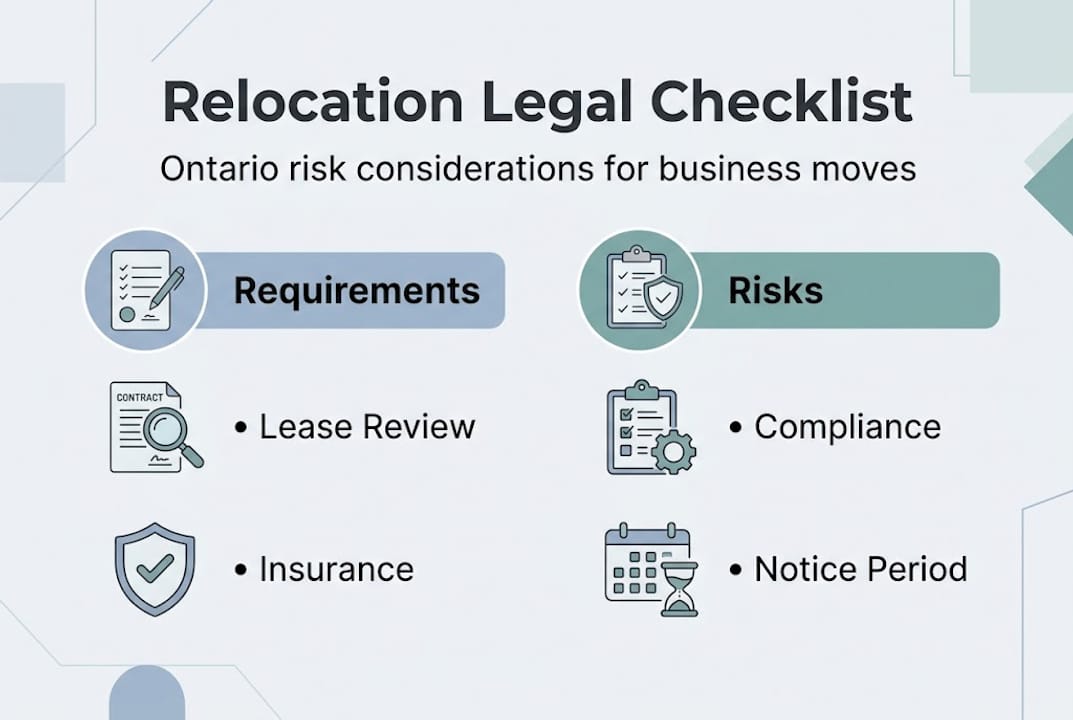
Here is a reference table of the most important legal and insurance requirements for Ontario commercial relocations:
| Requirement | Details | Why it matters |
|---|---|---|
| WSIB coverage | Mandatory for all contractors on-site | Protects your business from liability if a worker is injured |
| Commercial liability insurance | Required for moving contractors | Covers damage to property during transit |
| Data protection protocols | Chain-of-custody for sensitive files | Compliance with provincial privacy legislation |
| Ontario Commercial Tenancies Act | Governs lease terms and exits | Protects you from unexpected penalties or disputes |
| Building access permits | Required by many Ontario commercial properties | Prevents move-day delays from building management |
Beyond insurance and permits, there are several specific risk areas to address:
- Lease obligations: Your current lease may include a notice period of three to six months. Missing it can result in financial penalties or legal action under the Ontario Commercial Tenancies Act.
- Data security: Physical relocation of servers, hard drives, and filing systems must follow chain-of-custody procedures. Assign a staff member to supervise data-bearing equipment at all times.
- WSIB compliance: Any moving company you hire in Ontario must carry valid WSIB clearance. Ask for a clearance certificate before signing a contract. If a worker is injured on your premises and the mover lacks coverage, your business could be held liable.
- Full-value versus declared-value coverage: Full-value protection means the mover is responsible for replacing or repairing any damaged item at its current market value. Declared-value coverage is cheaper but limits the mover’s liability. For high-value equipment, full-value is the safer choice.
Pro Tip: Read your current commercial lease carefully before announcing a move date. Check for demolition clauses, notice periods, and any conditions around subletting or early termination. Many Ontario businesses have discovered unexpected costs only after they committed to a new address.
Understanding these obligations upfront also positions you to capture genuine relocation benefits in Ontario, such as accessing better-priced commercial space, improved transport links, or municipal incentives for businesses moving into certain districts. The legal groundwork makes those benefits accessible rather than blocked by avoidable disputes.
Maintaining business continuity and employee engagement
With legal and planning foundations in place, it is time to focus on keeping your business running and your people engaged during transition. This is the area where even well-organised moves can run into trouble.
Operational continuity means your clients and customers experience as little disruption as possible. That requires deliberate scheduling, clear internal coordination, and proactive communication. Here are the most effective practices:
- Phase your move over multiple weekends to avoid shutting down entire departments simultaneously
- Set up a temporary operations centre if your core systems will be offline for more than 24 hours
- Update your address and contact details across all digital platforms, directories, and client records before move day
- Test IT systems at the new location before transferring staff, not after
- Assign floor captains in each department to manage local logistics and serve as a point of contact for their teams
Employee engagement is just as important as operational logistics. A commercial move generates uncertainty. Staff members worry about longer commutes, unfamiliar surroundings, and disruption to their routines. Businesses that manage this well treat their employees as active participants rather than passive subjects of the move.
“Employee communication, vendor shortlisting, and post-move help desks are core elements of effective commercial relocation methodology.”
Share the timeline early. Explain the reason for the move and what it means for each team. Give people a chance to ask questions and raise concerns. If commute times are increasing for some staff, consider flexible start times during the transition period. These small gestures build trust and reduce resistance.
Post-move support is another area that separates good moves from great ones. Setting up a dedicated help desk for the first two to four weeks after moving in gives staff a clear channel to report problems. It also helps your project manager catch and resolve issues before they become expensive. Employee relocation in Ontario requires particular attention to these human factors, especially when staff are relocating across municipalities or regions.
Feedback loops matter too. Run a brief staff survey two weeks after the move to capture what worked and what did not. That information is invaluable for any future relocations and signals to your team that their experience is valued.
The uncomfortable truth most guides miss about commercial moves
Most commercial relocation guides give you a checklist and call it done. Follow these 20 steps, they say, and everything will go smoothly. After years of working with Ontario businesses through complex relocations, we have seen something different. The moves that genuinely succeed are not driven by better checklists. They are driven by better leadership and a willingness to adapt when things do not go to plan.
The biggest risks in any commercial move are cultural, not logistical. Staff resistance, leadership reluctance to communicate openly, and a lack of flexibility when timelines shift are far more likely to derail your move than a mislabelled box. We have seen organisations with perfect plans fall apart because their leadership team treated the move as an IT project rather than a people project.
The businesses that land well in their new space are the ones that stay curious, communicate honestly, and adapt quickly. They follow the plan, but they also know when to revise it. If you want to build that kind of resilience into your next move, start with practical relocation efficiency tips designed specifically for Ontario business environments.
Checklists are a starting point. Adaptability is what gets you across the finish line.
Get expert help for your next commercial relocation
Knowing what a successful commercial relocation requires is genuinely valuable. But putting it into practice under real-world pressures, tight timelines, and competing priorities is where professional support makes all the difference.

At Aleks Moving, we have worked with Ontario businesses and property managers for over 18 years. We handle the logistics so you can focus on keeping your operations running. Our flat-rate pricing means you will never face unexpected charges on move day. From compliance support to post-move setup, we are your dependable partner through every stage. Explore our ultimate commercial moving guide for a deeper look at our process, or get practical advice on planning a smooth office move tailored to your specific needs. Contact us today for a free upfront quote.
Frequently asked questions
What is included in a commercial relocation service?
Commercial relocation typically includes logistics planning, packing, transportation, unpacking, and support services like IT and furniture setup. Professional providers also coordinate vendor shortlisting and post-move help desks to support staff after the transition.
How far in advance should we plan a commercial relocation in Ontario?
Start planning at least 3 to 12 months in advance to allow for proper coordination and compliance. Early planning 3 to 12 months ahead is the industry standard for businesses of any size.
What legal documents are required for a business move in Ontario?
You will need proof of WSIB and commercial liability insurance, your current lease agreement, and any relevant permits. The Ontario Commercial Tenancies Act governs lease obligations and evictions, so reviewing it before committing to a move date is essential.
How can we reduce downtime during an office move?
Reduce downtime by scheduling after-hours and weekend relocations, maintaining strong employee communication, and staging your move-in across multiple phases rather than all at once.
Is insurance required for commercial relocation?
Yes. WSIB and commercial liability insurance are both mandatory for Ontario businesses, and any mover you hire must carry valid coverage before setting foot on your premises.