

TL;DR:
- Office relocation involves moving all business operations, technology, and assets, not just furniture.
- Effective planning, clear communication, and professional movers are essential for a smooth transition.
- Including a contingency fund and full insurance helps manage unexpected costs and risks.
Moving an office sounds straightforward until you’re three weeks in and realise your IT systems are down, half your staff don’t know where to sit, and a critical piece of equipment is missing. Office relocation is one of the most underestimated projects a business can undertake. It touches every corner of your operation, from technology and compliance to team morale and client communication. This guide breaks down what office relocation truly involves, the key steps to do it right, and the practical strategies that keep Ontario businesses running smoothly through the transition.
Table of Contents
- Understanding office relocation: The basics and significance
- Key steps in the office relocation process
- Budgeting and risk management: Costs, contingencies, and insurance
- Choosing professional movers: Services and selection criteria
- Organising your move: Labelling, communication, and minimising disruption
- A practitioner’s perspective: What most office relocations get wrong
- Take the next step with expert moving support
- Frequently asked questions
Key Takeaways
| Point | Details |
|---|---|
| Plan well in advance | Begin office relocation planning at least six months ahead to avoid disruption and delays. |
| Budget for surprises | Always include a 10-15% contingency in your budget for unforeseen costs. |
| Choose the right movers | Selecting experienced, insured movers is critical to a smooth and efficient relocation. |
| Label everything clearly | Use colour-coded labelling by zone and department to prevent lost or misplaced assets. |
| Minimize downtime | Schedule moves after hours or on weekends to keep your business running during the transition. |
Understanding office relocation: The basics and significance
Office relocation is not simply moving furniture and boxes from one address to another. It is a managed transfer of your entire business operations, including people, technology, physical assets, data systems, and workplace culture, from one location to a new one. The scope is far broader than most business owners initially expect, and treating it like a standard move is where many organisations run into serious trouble.
There are several common reasons businesses in Ontario choose to relocate. Growth is a frequent driver: your team has outgrown the current space and productivity is suffering. Lease expiry is another, often pushing businesses to reconsider whether the existing location still makes sense financially. Other motivating factors include cost savings from a more affordable area, access to better talent pools, proximity to key clients, and the desire to modernise a dated workspace that no longer reflects your brand.
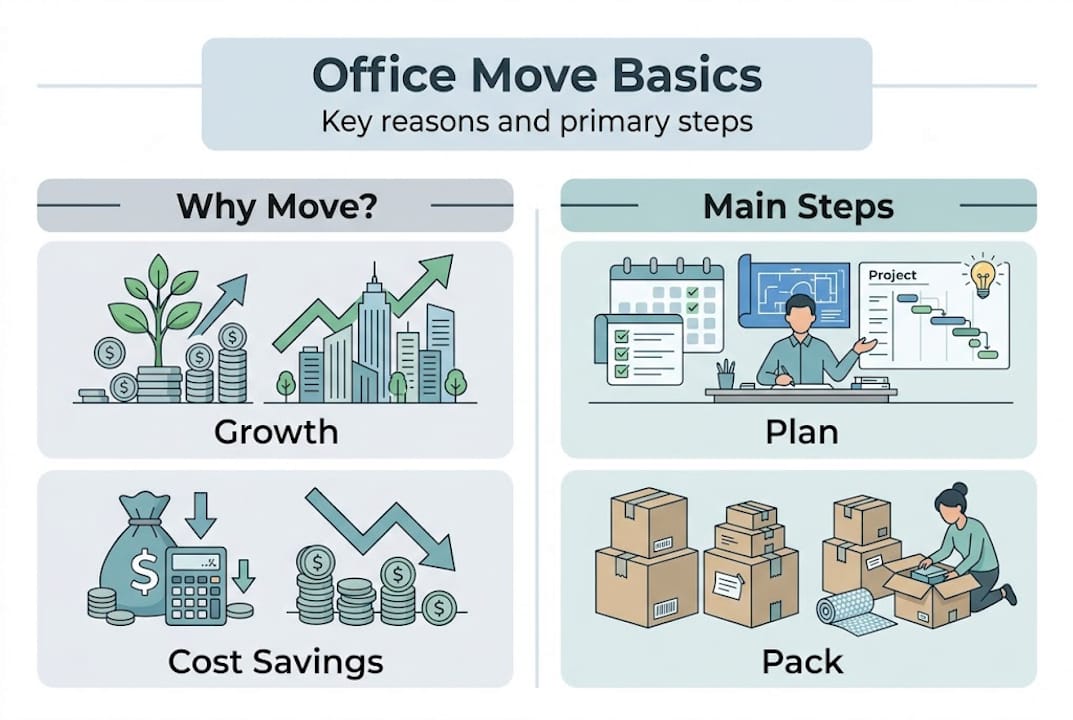
Each of these reasons carries a different level of urgency and complexity. A business relocating due to rapid growth may need to move quickly, while one planning ahead for a lease renewal has the luxury of time. Regardless of the reason, strategic planning is what separates a smooth transition from a costly disruption.
Consider what is actually involved in a full office relocation:
- Physical assets: desks, chairs, filing cabinets, storage units, reception furniture
- Technology infrastructure: servers, network cabling, computers, phone systems, security equipment
- Regulatory matters: updating your business address with the CRA, notifying clients and suppliers, revising lease agreements
- Staff logistics: communicating the move, managing commute changes, supporting team members through the adjustment
- Business continuity: ensuring operations continue with minimal interruption throughout the process
Understanding the essential role of movers in this context is critical. Professional movers are not just labour. They are partners in protecting your assets and timeline.
“Build a 10 to 15% contingency fund into your relocation budget for unseen expenses. Surprises during office moves are the rule, not the exception.” Source
Now that we have defined the concept, let’s break down the major steps involved in successful office relocation.
Key steps in the office relocation process
A well-run office relocation follows a clear sequence of phases. Skipping steps or rushing through them is where businesses lose time, money, and staff confidence.
- Assessment: Audit your current space. Document every asset, piece of technology, and departmental need. Know what you’re moving before you move it.
- Timeline creation: Set a realistic date for the move and work backwards. Identify key milestones such as lease signing, IT migration planning, mover booking, and staff communication.
- Budgeting: Establish a realistic budget that includes moving costs, packing materials, IT setup, potential downtime losses, and a contingency buffer.
- Service selection: Research professional moving companies, collect at least three binding estimates, and compare them carefully. Do not select solely on price.
- Staff communication: Inform your team early and often. Outline the timeline, address concerns, and assign responsibilities.
- Physical move execution: Execute the move according to the plan, using colour-coded labelling by department or zone to keep items organised and speed up unpacking.
- Post-move reintegration: Confirm all systems are operational, gather staff feedback, and address any outstanding issues promptly.
Planning a smooth office move requires particular attention to your IT migration, as technology disruption is consistently the biggest source of post-move downtime. Coordinate with your IT team or service provider well in advance.
The table below gives a practical sense of how timelines differ between office sizes.
| Office size | Recommended planning lead time | Estimated move duration |
|---|---|---|
| Small (1 to 10 staff) | 2 to 4 months | 1 to 2 days |
| Medium (11 to 50 staff) | 4 to 6 months | 3 to 5 days |
| Large (51 to 150 staff) | 6 to 12 months | 1 to 3 weeks |
Booking movers well in advance is critical, especially for moves in the spring and summer months when demand is highest across Ontario. Refer to essential relocation tips to avoid common scheduling pitfalls.
Securing binding estimates from movers protects you from unexpected price increases on move day. A binding estimate locks in the quoted cost, giving you reliable numbers for your budget.
Pro Tip: Schedule your physical move over a weekend or public holiday. This strategy minimises disruption to your clients and allows your team to return to a fully functional workspace by Monday morning.
With the process in mind, it’s important to understand how to manage costs and avoid expensive surprises.
Budgeting and risk management: Costs, contingencies, and insurance
Many businesses significantly underestimate the true cost of an office relocation. The moving truck is just one line item. When you map out all cost categories, the total can be substantially higher than your initial estimate.
Typical cost categories for an office relocation include:
- Professional moving services: Packing, transport, and unpacking
- Packing materials: Boxes, bubble wrap, tape, furniture blankets, and specialty containers for electronics
- IT migration and setup: Disconnecting, transporting, and reinstalling servers, computers, and telecommunications systems
- Downtime losses: Revenue or productivity lost during the transition period
- Lease overlap: Costs associated with paying rent on both properties simultaneously during the move
- Staff time: Hours your team spends preparing for, executing, and recovering from the move
- Contingency fund: A reserve for unexpected costs
Building a 10 to 15% contingency buffer into your total budget is not optional. It is a professional standard. Unexpected costs during an office move are almost inevitable: a damaged item, a delay in building access, a last-minute technology issue. Without a buffer, these surprises can put your budget and your timeline under serious strain.

Comparison of moving insurance options:
| Coverage type | What it covers | Limitations |
|---|---|---|
| Basic carrier liability | Minimal compensation based on weight | Often inadequate for high-value items |
| Full-value insurance | Repair or replacement of damaged items at current value | Requires documentation and may have a deductible |
Understanding commercial moving insurance is one of the most important steps you can take before signing any contract. Many businesses skip full-value insurance thinking it won’t be needed, and some later face significant losses with no meaningful recourse.
Review your existing business insurance options to understand whether your current policy covers goods in transit or if a separate rider is required. Confirm all coverage terms in writing before your moving date.
Pro Tip: Ask your mover specifically what their liability is for electronics and high-value equipment. Get the answer in writing before committing.
Preparing your budget carefully is crucial, but selecting the right support partners is equally important in ensuring a seamless transition.
Choosing professional movers: Services and selection criteria
Not all moving companies are equipped to handle a commercial relocation. Office moves involve specialised equipment, tight timelines, and the kind of accountability that a residential move simply does not require. Choosing the wrong mover can cost you far more than the price difference between quotes.
When evaluating moving companies for your office relocation, look for these core service capabilities:
- Full-service packing: The ability to pack and protect all office contents, including fragile electronics and large furniture
- Specialist equipment moving: Experience with heavy items such as safes, server racks, and boardroom tables
- Technology relocation support: Careful handling and transport of computers, monitors, and telecommunications equipment
- Temporary storage: Access to secure short or medium-term storage if your new space is not ready on time
- After-hours and weekend scheduling: Flexibility to move during off-peak hours to protect your business operations
Selecting professional office movers with direct experience in commercial moves means they understand the pressures you face. They know how to work quickly and carefully, and they can adapt when situations change on move day.
Critical questions to ask potential movers before booking:
- How many commercial moves have you completed in Ontario?
- Do you carry full-value insurance for goods in transit?
- Can you provide binding estimates in writing?
- Are you available for weekend or after-hours moves?
- Do you have experience moving IT and server equipment?
- What is your process when something is damaged during the move?
Strong logistics solutions rely on coordination and transparency. The same applies to office moves. A mover who communicates clearly before the job almost always performs better on the day.
According to industry best practices, businesses that use colour-coded labelling by zone or department and schedule moves during after-hours windows consistently experience shorter recovery times and fewer operational disruptions.
Once you have found knowledgeable movers, practical office labelling and organisation will set your relocation up for success.
Organising your move: Labelling, communication, and minimising disruption
The physical move itself is only part of the challenge. How well your organisation is prepared internally will determine how quickly you return to full productivity after move day.
Colour-coded labelling is one of the simplest and most effective tools available. Assign each department or work zone a distinct colour. Apply coloured labels or tape to boxes, furniture, and equipment. Provide your movers with a floor plan of the new space showing where each colour goes. This small investment of preparation time can save hours of confusion during unpacking and setup.
Here are the key elements of a strong internal communication plan:
- Announce the move early: Give staff as much notice as possible. Uncertainty breeds anxiety.
- Hold regular updates: Weekly check-ins in the weeks leading up to the move keep everyone aligned.
- Explain the why: Help your team understand the reasons behind the relocation. Engagement increases when people feel informed.
- Address commute concerns: Some staff may face longer travel times. Acknowledge this openly and explore flexible arrangements where possible.
- Create a post-move feedback loop: Invite staff to flag issues after the move so they can be resolved quickly.
Including employees in your relocation planning raises morale and accountability. When staff feel part of the process, they are more likely to support the move and adapt quickly to the new environment.
Your IT changeover schedule deserves particular attention. Coordinate the disconnection, transport, and reconnection of your systems to minimise the window where your team cannot access critical tools. Consider using expert labelling techniques to keep every cable, device, and component clearly identified for your IT team.
Consult a detailed office relocation guide to confirm you have covered all the logistical and communication milestones before move day arrives.
Industry guidance consistently highlights that clear departmental organisation and scheduled IT changeovers are among the highest-impact factors in reducing post-move disruption.
Pro Tip: Appoint a “move champion” in each department. These individuals act as the point of contact for their team, collect and report issues, and help coordinate the unpacking and setup in their area. This distributed responsibility dramatically speeds up reactivation in the new space.
With the key strategies and expert insight covered, it’s time for a candid perspective on what really matters in an office relocation.
A practitioner’s perspective: What most office relocations get wrong
After many years helping Ontario businesses move, we have noticed a consistent pattern. The companies that struggle most are not the ones with the smallest budgets or the tightest timelines. They are the ones who treat the relocation as a purely logistical problem and ignore the human element entirely.
Staff are rarely consulted meaningfully before decisions are made. They find out about the move through a company-wide email and are expected to simply adapt. This approach breeds quiet resentment, lowers engagement, and creates friction that lingers long after the boxes are unpacked.
We also see businesses routinely skip full-value insurance to save a few hundred dollars, only to face losses that far exceed what they saved. And phased or after-hours moves are dismissed as “too complicated,” resulting in days of operational downtime that cost far more than the extra planning would have.
The truth is that the small details are where office relocations succeed or fail. Clear labelling. Realistic timelines. Honest communication. A properly funded contingency. These are not glamorous items, but they are the difference between a move that builds confidence in your leadership and one that shakes it.
The mover-led success stories we are most proud of share a common thread: they were built on preparation, collaboration, and honest expectations on all sides.
Take the next step with expert moving support
Your successful relocation journey begins with an informed partner who understands the Ontario business environment.
At Aleks Moving, we have supported Ontario businesses through commercial relocations for over 18 years. We offer flat-rate pricing with no hidden fees, full-value insurance options, and flexible scheduling including weekends and after-hours moves. Whether you are relocating a small office or a multi-floor operation, our experienced team tailors every move to your specific needs.

Start with our commercial moving guide to understand the full scope of what we offer. Review our moving tips for Ontario businesses to prepare your team and budget, and use our detailed resources to plan a smooth office move from the very first step. Reach out today for a free, no-obligation quote and let us handle the complexity while you focus on your business.
Frequently asked questions
What does office relocation include?
Office relocation includes planning, packing, moving, and reinstalling all business operations and assets from one location to another. According to industry standards, it also involves staff communication, IT migration, insurance coverage, and post-move reintegration.
How far in advance should I plan an office move?
You should begin planning your office move 6 to 12 months in advance for optimal budgeting and organisation. Smaller offices can sometimes work within a 2 to 4-month window, but earlier planning consistently produces better outcomes.
What is the main benefit of using professional movers for office relocation?
Professional movers minimise downtime, protect assets, and manage the complex logistics involved in office transitions. Their experience with after-hours scheduling and zone labelling directly reduces the operational impact on your business.
How can we reduce downtime during an office move?
Relocating after hours or on weekends, plus clear colour-coded labelling and strong internal communication, keeps your operations running smoothly. Binding estimates and full-value insurance also reduce the risk of costly surprises that extend your downtime.