

TL;DR:
- Relocation planning in Ontario involves managing legal, logistical, financial, and emotional tasks well before moving day. Proper sequencing, clear responsibilities, and professional support help families avoid chaos and ensure continuity in school, healthcare, and routines. Implementing structured plans with decision governance and early professional assistance leads to smooth and confident moves.
Moving to a new home in Ontario involves far more than loading boxes onto a truck. There are legal notice requirements, utility transfers, school registrations, healthcare switches, and an emotional adjustment period that can catch families completely off guard. For Ontario renters, the process typically begins at least 60 days before you hand over the keys, and it follows a timed sequence of tasks that, if missed, can create real consequences. This guide walks you through every stage of relocation planning so you can move with confidence, not chaos.
Table of Contents
- What does relocation planning mean?
- Core steps of effective relocation planning in Ontario
- Balancing logistics, wellbeing, and continuity
- Why professional help and structured planning matter
- A common mistake: focusing only on checklists misses the big picture
- Make your Ontario move stress-free with expert support
- Frequently asked questions
Key Takeaways
| Point | Details |
|---|---|
| Plan beyond boxes | Relocation planning means covering legal, emotional, and continuity steps, not just packing belongings. |
| Sequence your move | Structured, step-wise planning prevents last-minute stress and missed requirements. |
| Prioritize family adjustment | Supporting health, schooling, and emotional needs ensures a truly successful move. |
| Get professional support | Expert guidance reduces risk and manages timelines, especially for complex Ontario moves. |
What does relocation planning mean?
Relocation planning is the structured process of organising, sequencing, and managing every task required to move your household from one location to another, well before moving day arrives. It goes far beyond deciding what to pack first. It means understanding your legal obligations as a tenant or homeowner, managing your family’s emotional readiness, arranging service transfers, and building a clear timeline that keeps everything on track.
For Ontario residents specifically, relocation planning carries a distinct set of considerations. Renters must follow provincial rules around notice periods and documentation. Families must arrange school registrations, healthcare provider transfers, and insurance updates. Even something as routine as changing your mailing address requires a deliberate plan to avoid missed bills or important correspondence.
Here is what effective relocation planning actually covers when you are preparing for a move in Ontario:
- Legal obligations: Providing proper notice to your landlord, completing the correct provincial forms, and understanding your rights under the Residential Tenancies Act
- Financial planning: Setting a realistic moving budget, comparing moving quotes, and accounting for hidden costs like deposits or storage
- Administrative tasks: Updating your address with the Canada Revenue Agency, Service Ontario, your bank, and subscription services
- Healthcare and schools: Transferring medical records and registering children at new schools well ahead of the start date
- Logistics: Booking movers, arranging packing materials, scheduling utility transfers, and confirming move-in details with your new landlord or property manager
- Emotional preparation: Having honest conversations with children and other family members about the change
“Relocation planning for families should treat school and healthcare continuity as core parts of the plan, not afterthoughts.” This is a reminder that the human side of moving deserves just as much structure as the logistical side.
When you approach the move this way, you replace last-minute scrambling with a calm, confident process. That is the whole point of planning properly.
Core steps of effective relocation planning in Ontario
Understanding what relocation planning means is one thing. Putting it into a usable sequence is another. The following steps reflect the typical order Ontario residents should follow to keep their move organised and legally sound.
- Give legal notice as early as possible. Ontario renters generally need to provide 60 days written notice to their landlord using the correct form, such as Form N9 for those ending a fixed-term tenancy.
- Set your key dates. Confirm your move-out date with your current landlord and your move-in date with your new property manager or seller. Write these down and share them with everyone involved.
- Create a shared checklist. Put all tasks in one place and assign responsibility for each item. Whether you use a spreadsheet or a family group chat, visibility matters.
- Book your movers early. Reputable moving companies in Ontario get booked quickly, particularly around month-end and summer. Secure your date at least four to six weeks in advance.
- Begin decluttering and sorting. Start with rooms you use least. Sell, donate, or discard anything you do not plan to take with you.
- Arrange utility transfers. Contact your electricity, gas, internet, and water providers to schedule disconnection at your current address and connection at the new one.
- Update your address. Notify the Canada Revenue Agency, Service Ontario, your bank, employer, and any subscription services. Canada Post offers a mail redirection service that buys you additional time.
- Pack systematically. Label every box by room and contents. Pack a separate “first night” bag with essentials like medications, chargers, toiletries, and a change of clothes.
- Complete your move-out inspection. Document the condition of your current home with photos and keep copies of all correspondence with your landlord.
- Settle in and follow up. After moving in, check that all utilities are active, confirm your new address is updated everywhere, and introduce yourself to neighbours.
Here is a practical overview of timing across a typical Ontario move:
| Timeframe | Key tasks |
|---|---|
| 8 to 10 weeks before | Give notice, set dates, book movers, begin decluttering |
| 6 to 8 weeks before | Pack non-essentials, arrange utility transfers, update address |
| 4 weeks before | Confirm mover booking, pack most belongings, notify schools |
| 1 to 2 weeks before | Pack final items, prepare first-night bag, do move-out inspection |
| Moving day | Oversee loading, check all rooms, hand over keys |
| First week after | Confirm utilities, unpack essentials, register at new school or clinic |
Reviewing a full Ontario moving checklist can help you spot tasks specific to your situation that a generic guide might miss. For broader advice on reducing anxiety around the process, our stress-free moving tips offer practical guidance suited to both renters and homeowners.
Pro Tip: Document every communication with your landlord in writing, even conversations that started verbally. A simple follow-up email stating “As discussed, I will be vacating on…” creates a paper trail that protects you if disputes arise later.
Balancing logistics, wellbeing, and continuity
A move can go off without a single logistical hiccup and still feel like a failure if the family is struggling to adjust. This is a reality we see often. The boxes get unpacked, the internet is connected, and yet something feels unsettled. That unsettled feeling is almost always linked to overlooked transitions in school life, healthcare routines, and daily emotional rhythms.
School and healthcare continuity must be treated as core planning priorities, not items to sort out after the move. Waiting until you are already in your new home to register children at school can mean weeks of disruption to their learning and social life. Similarly, leaving healthcare transfers until after the move can result in gaps in prescriptions, missed specialist appointments, or delays in finding a new family doctor.

Here is a comparison of two common approaches to these transitions:
| Approach | School registration | Healthcare transfer | Emotional support |
|---|---|---|---|
| Reactive (post-move) | Delayed start, social disruption | Risk of prescription gaps | Addressed when problems arise |
| Proactive (pre-move) | Registered before move date | Records transferred in advance | Conversations happen throughout |
The proactive approach takes more effort upfront, but it creates continuity that children and family members notice immediately.
Practical wellbeing steps to include in your plan:
- Contact the new school board well before moving to understand registration requirements and deadlines
- Ask your current family doctor to prepare a referral or summary letter for your new healthcare provider
- Involve children in age-appropriate decisions, such as choosing how to decorate their new room
- Visit the new neighbourhood together before moving day to reduce anxiety about the unknown
- Plan a familiar outing or family activity for the first weekend in the new home to re-establish a sense of normalcy
The first two weeks in a new home are often the hardest. Maintaining consistent meal times, bedtime routines, and family rituals helps children and adults alike feel grounded during the transition.
Pro Tip: Create a “comfort box” for each child with their favourite books, a small toy, or a family photo. Load these boxes into the car rather than the moving truck so they are immediately accessible on arrival.
Why professional help and structured planning matter
There is a point in almost every move where things become genuinely complicated. A scheduling conflict with the landlord. A piece of furniture that will not fit through the door. A sudden change in closing dates. These are the moments where professional support pays for itself.
Professional movers reduce risk through coordinated planning, clear responsibilities, and practical contingency for the kinds of issues that catch DIY movers by surprise. They bring the right equipment, understand how to handle fragile or oversized items, and carry liability coverage that protects your belongings during transit. Trying to move a piano, a large sectional, or an antique armoire without professional guidance is a common source of property damage and personal injury.
Structured planning, particularly the kind that assigns clear responsibilities and decision points, is equally important. When every task has an owner and a deadline, the entire household moves in the same direction. When tasks are vague or unassigned, they get missed.
Key advantages of combining professional movers with a formal plan:
- Coordinated timing: Movers arrive when the elevator is booked, the truck fits the driveway, and the building superintendent is available
- Risk reduction: Professional handling of fragile, heavy, or specialty items significantly reduces breakage and damage claims
- Timeline management: An experienced team keeps the day on schedule, reducing costly overtime or last-minute surprises
- Accountability: When something goes wrong, there is a clear process for resolution rather than a chaotic free-for-all
- Peace of mind: Knowing qualified professionals are handling the heavy lifting allows you to focus on your family and the transition itself
If your move is urgent or unexpected, specialised support becomes even more critical. Our guide on emergency move planning outlines a step-by-step workflow for situations where the usual timelines simply are not available.
Appointing one person in your household as the relocation coordinator, the person who owns the master checklist and follows up on open items, is one of the most effective things you can do. It prevents tasks from falling into a gap where everyone assumes someone else handled it.
A common mistake: focusing only on checklists misses the big picture
Here is something worth saying directly: a checklist is a tool, not a strategy. We see families invest real effort into building detailed moving lists and still end up overwhelmed on moving day, or worse, weeks after settling in, when something important was missed not because it was not on the list, but because nobody managed the dependencies between items.
Successful relocation outcomes depend on sequencing, decision governance, and managing the relationships between tasks, not just completing individual items. Consider this example: You book movers, update your address, and confirm your utility transfers. But you forget that the utility transfer depends on confirming your move-in date, which depends on your landlord’s availability, which depends on you giving notice first. Miss one link in that chain and the whole sequence breaks down.
Real planning means asking: “What does this task depend on, and what depends on it?” It means identifying who makes the final call when two priorities conflict. It means having a fallback when the moving company cancels or the closing date shifts by a week.
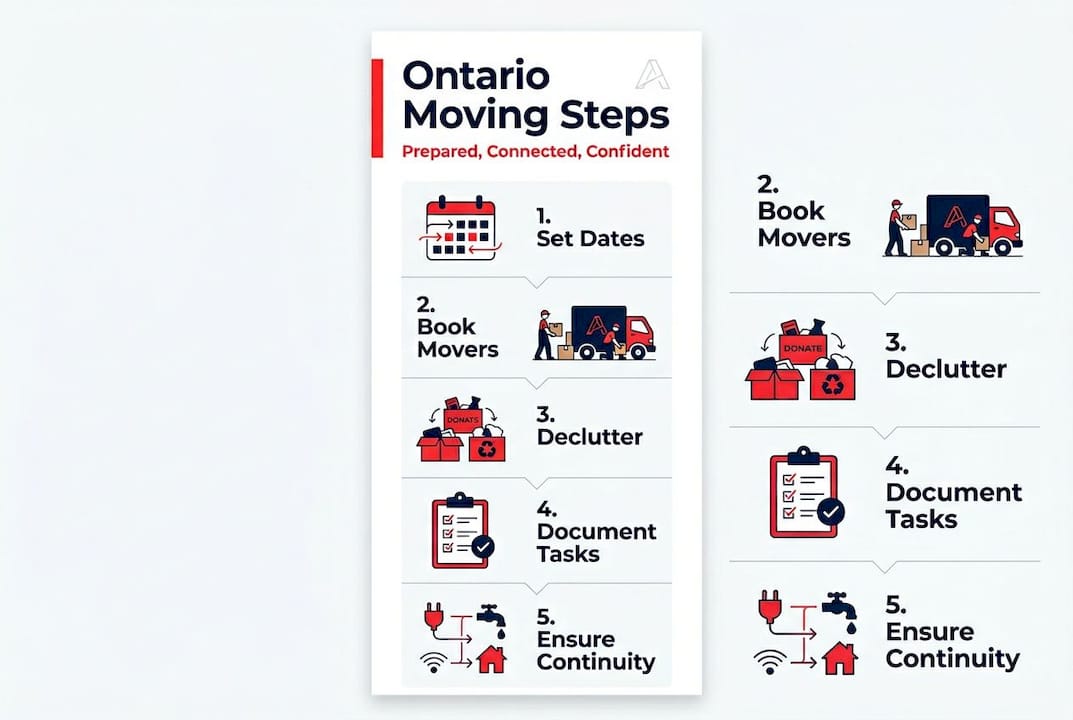
Families who treat relocation as purely a checklist exercise often find themselves unprepared for the decisions that were never written down. Who decides which items get donated versus sold? What happens if the new home is not ready on moving day? These are governance questions, and they need answers before the move begins.
Our honest advice after working with Ontario families through hundreds of moves: build your checklist, absolutely. But pair it with clear decision-making roles, sequenced milestones, and a genuine conversation about what matters most to your household. That combination is what separates a smooth move from a stressful one.
Make your Ontario move stress-free with expert support
Ready to put these planning principles into action? At Aleks Moving, we have spent over 18 years helping Ontario families and individuals move with confidence. Whether you are relocating across town or across the province, our team brings the structure, experience, and dependable service that makes the difference between a move that works and one that does not.

Explore our Ontario residential moving services to learn how we tailor our approach to your specific situation. If you want a clear picture of what the entire experience looks like from booking to final box, our overview of the moving process in Ontario walks you through it step by step. For practical guidance you can use right now, our collection of residential moving tips covers everything from packing strategies to settling-in routines. Contact us today for a free upfront quote with no hidden fees, and let our family help move yours.
Frequently asked questions
What are the first steps to plan a move in Ontario?
If you are renting, start by providing your landlord with 60 days written notice using the correct provincial form, then document everything in writing and build a detailed moving timeline from that date forward.
Why is a checklist alone not enough for successful relocation?
A checklist captures individual tasks, but successful moves also require managing dependencies between tasks and having a clear decision-maker available when priorities conflict or unexpected issues arise.
How can I help my family adjust emotionally after moving?
Re-establish familiar daily routines as quickly as possible in your new home, and support emotional adjustment for children especially by maintaining consistent meal times, bedtimes, and family activities in the first two weeks.
When should I hire professional movers?
Book professional movers as early as possible, ideally six or more weeks before your move date, particularly if you have fragile, oversized, or specialty items, since early booking reduces risk of scheduling conflicts and last-minute complications.
Recommended
- Emergency relocation workflow: your step-by-step Ontario guide
- Employee relocation explained: Smooth transitions for Ontario moves
- Commercial relocation: a practical guide for Ontario businesses
- How to prepare for a move: Ontario’s essential guide
- Strategic Office Relocation to Malta: A Guide – Offices in Malta To Let & For Sale