

TL;DR:
- Hidden moving fees in Ontario often arise from incomplete assessments, non-binding estimates, and extras like stairs or packing. To protect your budget, ask detailed questions about costs upfront, request a written, itemized quote, and budget a 10 to 25 percent buffer for unexpected expenses. Even well-organized movers can encounter cost changes, so choosing a transparent company ensures a smoother, stress-free move.
You receive a moving quote for $1,800 and breathe a sigh of relief. Then moving day arrives, and the final bill reads $2,700. This exact scenario plays out regularly across Ontario, catching homeowners and renters completely off guard. Moving costs in Ontario suggest budgeting a 10 to 25 per cent buffer on top of any quote, because extras inflate fast. This guide walks you through every category of hidden fee you could face, explains why they exist, and gives you the tools to protect your budget from the very first call.
Table of Contents
- Why hidden moving fees happen
- The most common hidden fees in Ontario moves
- Hidden rental and ownership transition costs
- How to avoid (or prepare for) hidden moving costs
- What most people miss about moving fees in Ontario
- Find a mover who believes in transparency
- Frequently asked questions
Key Takeaways
| Point | Details |
|---|---|
| Hidden fees are common | Most Ontario movers face surprise costs that can significantly inflate your bill. |
| Main culprits to watch for | Extra insurance, packing, and access fees are typical hidden charges. |
| Transition costs add up | Renters and homeowners should budget for deposits and taxes in addition to mover fees. |
| Budget goes beyond the quote | Add a 10-25 percent buffer to your moving budget to cover surprise costs. |
| Proactive questions help protect you | Planning and asking the right questions make hidden fees less likely to derail your move. |
Why hidden moving fees happen
Many people assume a moving quote is a fixed contract. It rarely is. Most standard quotes from Ontario moving companies are based on an estimate of time, crew size, and distance. They do not always account for every variable that surfaces on moving day.
Understanding how moving companies work helps clarify why fees get added later. Moving companies build quotes using base rates, which typically cover labour per hour and basic truck usage. Add-ons are separate line items that only apply when certain conditions are met, such as navigating a staircase, packing fragile goods, or storing items overnight.
Here are the most common reasons hidden fees appear:
- Incomplete initial assessments: Phone or online quotes often rely on the customer describing their own belongings. If you underestimate how many boxes or large pieces you have, the crew will take longer, and that costs more.
- Non-binding estimates: An estimate without a binding clause is simply a best guess. If conditions change, costs change.
- Omitted line items: Standard quotes sometimes omit fuel surcharges, environmental fees, or minimum time charges because they vary by job.
- Ontario-specific logistics: High-rise buildings in Toronto, Ottawa, or Hamilton often have elevator booking requirements and building access rules that add time and fees.
“A flat-rate quote is not always what it seems. Always ask whether your quote includes fuel, stairs, insurance, and packing materials before signing anything.”
Transparent moving estimates are your best safeguard here. Getting every cost in writing before moving day transforms a guess into an agreement. As unexpected moving costs continue to catch Ontario residents off guard, knowing how to read a quote correctly has never been more important.
The most common hidden fees in Ontario moves
With a grasp of the root causes, it is vital to pinpoint the actual fees that Ontario movers often overlook in quotes. Some of these will surprise you. Others are easy to anticipate once you know what to look for.
Insurance upgrades
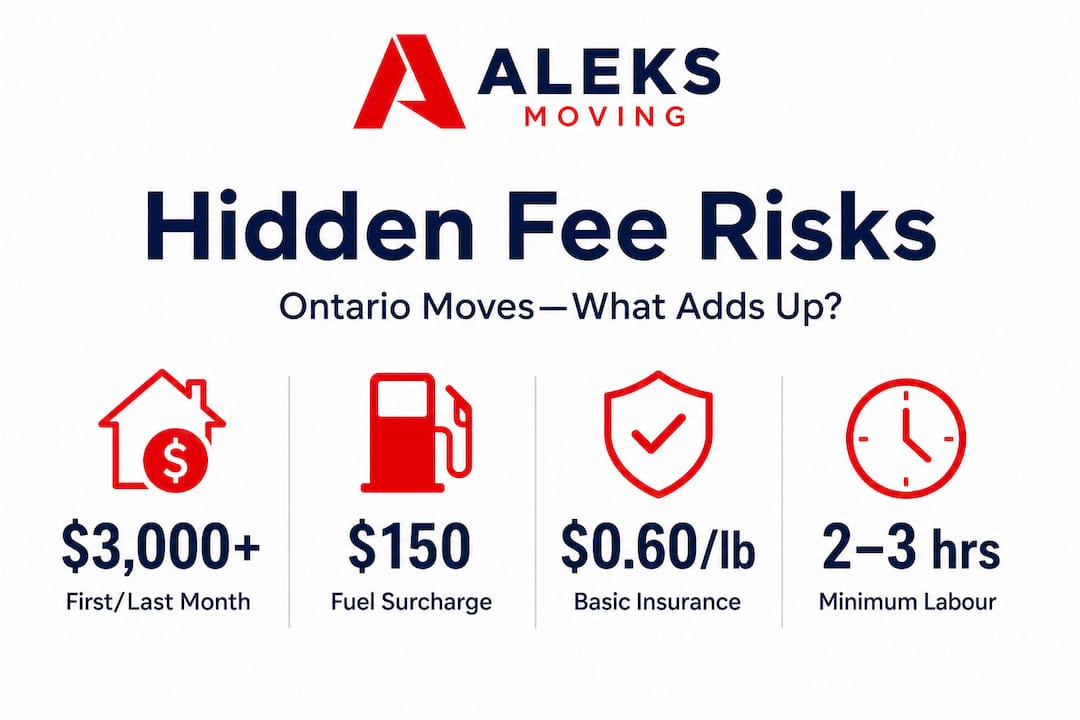
Basic liability coverage provided by most Ontario movers amounts to roughly $0.60 per pound per item. That means a 30-pound television worth $800 would be compensated at only $18 if damaged. Full-value protection, which actually covers the replacement or repair cost of your belongings, typically costs 1 to 2 per cent of goods value and is almost never included in the base quote. If you own electronics, antiques, or artwork, this upgrade is not optional — it is essential.
Stair, elevator, and long carry charges
Most movers charge extra when they have to carry items up or down more than one flight of stairs. Elevator fees apply when a crew must book and wait for building lift access, which is common in condo towers across the Greater Toronto Area. A long carry charge kicks in when the truck cannot park within a reasonable distance of your front door, typically around 75 feet. Each of these can add $50 to $200 or more to your final bill.

Packing and unpacking add-ons
A quote that covers moving your boxes does not automatically cover packing them. If you ask the crew to wrap furniture, box up your kitchen, or disassemble and reassemble beds, each of those tasks carries an additional cost. Understanding moving company packing charges before booking saves you from sticker shock on moving day.
Travel time and minimum hour charges
Many Ontario moving companies charge a travel fee that covers the time it takes the crew to drive from their depot to your home and back at the end of the day. This is sometimes called a “truck fee” or “portal-to-portal charge.” Additionally, most companies enforce a minimum booking of two to three hours, even if the job takes less time.
Fuel surcharges and environmental fees
These charges are sometimes listed separately from hourly labour and can range from $30 to $150 depending on distance and fuel prices. Ask specifically whether fuel is included in the quoted rate or whether it will be itemised at the end.
| Hidden fee type | Typical Ontario cost range | Included in standard quote? |
|---|---|---|
| Basic liability insurance | $0.60/lb only | Usually yes |
| Full-value protection | 1 to 2% of goods value | Rarely |
| Stair/elevator fee | $50 to $200 | No |
| Long carry charge | $50 to $150 | No |
| Packing materials and labour | $150 to $500+ | No |
| Travel/portal-to-portal fee | $50 to $150 | Sometimes |
| Fuel surcharge | $30 to $150 | Sometimes |
| Storage (delay-related) | $75 to $200/day | No |
The importance of moving quotes becomes obvious when you add these numbers together. A job initially quoted at $1,500 can quickly reach $2,200 once stairs, packing materials, insurance, and fuel are factored in.
Here is a practical numbered guide for reviewing your quote line by line:
- Confirm whether the hourly rate includes all crew members or just one.
- Ask whether the truck fee and fuel surcharge are included or added at the end.
- Clarify whether packing materials (boxes, tape, wrapping) are billed separately.
- Request a breakdown of how stairs, elevators, and long carries are charged.
- Confirm what type of insurance is included and what an upgrade would cost.
- Ask whether there is a minimum number of hours you will be billed for.
Pro Tip: Request a written, itemised quote rather than a verbal one. A written quote makes it much easier to hold the company to the agreed price and spot anything that was conveniently left out.
These factors vary depending on where in Ontario you are moving. Review Ontario moving cost factors relevant to your specific situation before finalising any booking.
Hidden rental and ownership transition costs
Besides the charges set by moving companies, those changing homes face additional transition expenses that are easy to overlook when you are focused on packing boxes and booking trucks.
For renters
If you are renting your next home, you will likely need to pay first and last month’s rent upfront before you even receive the keys. In Ontario, rental transition costs can add $3,000 or more in upfront expenses alongside your moving costs, which is a significant amount of money to have ready at once. You may also face application fees, utility connection deposits, and in some cases a separate deposit for a parking spot.
For homeowners
Buyers face a different set of transition costs. Ontario’s land transfer tax, legal fees, home inspection costs, and title insurance can add several thousand dollars to the purchase. In Toronto specifically, there is both a provincial and a municipal land transfer tax, which can amount to over $10,000 on a $700,000 property. These costs arrive at the same time as moving expenses, creating significant financial pressure.
For a detailed breakdown of Ontario taxes and legal fees for buyers, reviewing the full picture before your closing date will help you avoid scrambling at the last moment.
| Expense type | Renters | Homeowners |
|---|---|---|
| First and last month’s rent | Yes, typically $3,000+ | No |
| Utility deposits | Sometimes | Rarely |
| Land transfer tax | No | Yes, provincial + municipal |
| Legal/closing fees | No | Yes, $1,500 to $3,000+ |
| Moving company charges | Yes | Yes |
| Storage if delayed | Sometimes | Sometimes |
The overlap between transition costs and moving company charges is where budgets break down. Knowing the difference between local and long-distance costs also affects your overall spending, since long-distance moves often come with additional deposit and storage requirements.
Key rental transition costs to anticipate:
- First and last month’s rent deposit
- Damage deposit (where applicable)
- Application or administration fees
- Utility setup and connection fees
- Parking deposit or additional rental
How to avoid (or prepare for) hidden moving costs
Now that we have outlined where people lose money to hidden fees, here is how you can outsmart them and protect your budget before moving day arrives.
Ask the right questions before booking
The single most powerful tool you have is a direct conversation with your mover before signing anything. Do not assume anything is included. Ask everything.
- Is this a binding quote or a non-binding estimate?
- What happens if the job runs longer than expected?
- Are packing materials included, or will they be charged separately?
- How do you handle stair and elevator fees?
- Is full-value insurance available, and what does it cost?
- Are there any minimum hour requirements?
- Is fuel included in the quoted price?
Budget a buffer from the start
Adding 10 to 25 per cent over your quoted price is sound financial planning. If your quote is $2,000, plan to have $2,400 available. This buffer handles the unexpected, whether that is a parking ticket the crew gets while outside your building, extra wrapping materials for a fragile item, or an additional hour because the elevator was slow.
Pro Tip: Set your buffer money aside in a separate account or envelope before moving day. When you are stressed and time-pressed, it is easy to let costs slide. Having the buffer already set aside makes it easier to handle surprises calmly.
Read the contract carefully
Look for clauses that allow the company to add fees after the fact. Red flags include vague language like “additional charges may apply,” no mention of what insurance is provided, and no stated policy on overtime or delays. A reputable company will clearly list all potential charges upfront.
Choose the right insurance level
Review your moving insurance options in Ontario before your move date. Full-value protection gives you genuine peace of mind, especially for high-value items. Basic coverage, at $0.60 per pound, simply does not reflect the real cost of your belongings.
When estimating moving costs accurately, factor in the insurance upgrade, the potential for stair fees, and packing materials as standard budget items rather than surprises.
What most people miss about moving fees in Ontario
Here is a perspective that most moving guides never mention: being perfectly organised does not protect you from hidden fees on moving day.
You can have a colour-coded spreadsheet, a detailed inventory list, and every box labelled by room. But if you have never moved in Ontario before, you may not know to ask about elevator booking windows, building freight schedules, or the fact that some Toronto condo buildings charge the moving company a damage deposit that gets passed on to you. No checklist tells you that.
We have seen this play out many times over our 18 years in the industry. The customers who fare best are not always the most organised. They are the most flexible. They know that what a moving quote really means is a starting point, not a ceiling.
The uncomfortable truth is that even a great mover, with the best intentions, can run into conditions that change costs. Traffic, building restrictions, a customer who underestimated their belongings — all of these shift timelines and fees. What separates a good moving experience from a frustrating one is often how those changes are communicated and handled.
Our opinion: if a company hesitates to explain their fee structure, adds charges only after the truck is loaded, or discourages you from asking questions, walk away. Your best defence is not just preparation. It is the willingness to say “I need this in writing before we proceed.” A mover who values transparency will not flinch at that request.
Find a mover who believes in transparency
At Aleks Moving, we built our business around one straightforward principle: no surprises on your bill. After 18 years of relocating Ontario families and businesses, we know that trust is earned through honesty, not just hard work.

Our flat-rate pricing model means you know exactly what you are paying before the truck pulls up. We walk you through every potential charge during your free quote, so nothing catches you off guard on moving day. Whether you need full-service moving support or simply want to understand your moving insurance options before committing, our team is here to answer every question directly and honestly. Reach out today and see what a truly transparent moving experience looks like.
Frequently asked questions
What are the most common hidden moving fees in Ontario?
Common extras include insurance upgrades, packing services, stair and elevator fees, fuel surcharges, and storage during delays. Basic coverage is only approximately $0.60 per pound, so full-value protection is a frequent added cost.
How much extra should I budget for surprise moving costs?
Experts recommend a 10 to 25 per cent buffer on top of your moving quote to cover unexpected fees, meaning a $2,000 quote could realistically cost up to $2,500.
What hidden expenses should renters expect besides moving company costs?
Renters face significant upfront costs including first and last month’s rent and deposits, which can total $3,000 or more before factoring in the actual moving bill.
Is basic moving insurance enough to protect my stuff?
No. Basic coverage at $0.60/lb rarely reflects the real value of your belongings, and full-value protection at 1 to 2 per cent of goods value offers far more meaningful security.
Can I negotiate fees with a moving company?
Yes. Clarify all cost details upfront, ask about bundling services, and request a binding quote in writing. A reputable mover will be willing to discuss and document every line item before your move begins.