Skip to content


TL;DR:
- Ontario businesses are relocating mainly to achieve cost savings, operational efficiency, and better talent access.
- Site selection now involves multi-factor evaluation including infrastructure, incentives, and regulatory timelines, supported by Invest Ontario.
- Regulatory reforms, such as Bill 56, streamline approvals, reducing costs and lead times for relocation projects.
Ontario’s business landscape is shifting fast, and the numbers are hard to ignore. The provincial government’s cost-saving policies are reducing business expenses by $11.7 billion in 2025 through tax cuts, payroll reductions, and red tape removal. But here’s what many business owners miss: relocation is rarely just about moving desks and equipment from one building to another. It’s a strategic decision that touches your workforce, your supply chain, your cost base, and your long-term growth potential. This guide helps you cut through the noise and make a clear, informed decision about whether relocating within Ontario is the right move for your business.
Table of Contents
- Understanding the motivations for relocation in Ontario
- Evaluating site selection and expansion strategies
- Comparing urban costs and operational benefits
- Navigating regulatory changes and timelines
- The overlooked realities of business relocation in Ontario
- Connect with Ontario’s trusted moving experts
- Frequently asked questions
Key Takeaways
| Point | Details |
|---|---|
| Incentives drive relocation | Ontario’s government policies and incentives substantially reduce business costs and attract investment. |
| Smart site selection | Evaluating locations using labour, logistics, and market proximity ensures effective business expansion. |
| Cost and efficiency balance | Relocating to affordable areas improves competitiveness without sacrificing access to talent or infrastructure. |
| Regulations are evolving | Streamlined approvals and regulatory reforms lower lead times and increase planning certainty for moves. |
| Expert help matters | Partnering with moving professionals and leveraging guides saves time and avoids costly mistakes. |
Understanding the motivations for relocation in Ontario
Having set the context, let’s explore what actually drives relocation decisions for Ontario businesses.
Relocation is rarely a snap decision. Most business owners who move do so after months of watching costs climb, noticing talent gaps, or recognising that their current location no longer supports growth. In Ontario, several converging forces are making relocation a genuinely smart option for a growing number of firms.
Cost savings remain the primary driver. Ontario’s government has been aggressive about reducing the burden on businesses. Tax cuts, lower payroll costs, and streamlined regulatory processes are freeing up capital that can fund growth. When you factor in differences in commercial rent between urban centres and more affordable regions, the savings compound quickly. Understanding moving costs in Ontario is a practical first step before projecting your total relocation budget.
Operational efficiency is the second major motivator. Businesses operating with outdated infrastructure, congested logistics routes, or poorly located facilities lose time and money every single day. Moving to a location with better road access, modern industrial parks, or proximity to ports and rail lines can shorten delivery times, reduce fuel costs, and improve customer service. These gains are real and measurable.
Access to talent shapes many relocation decisions. Ontario’s workforce is highly diverse and well-educated, but talent is not evenly distributed across the province. Sectors like advanced manufacturing, life sciences, and technology tend to cluster around specific regions. Moving your business closer to where your ideal employees live and study is often more effective than trying to recruit people willing to commute long distances.
Key motivations Ontario businesses commonly cite include:
- Reducing commercial rent and overhead costs
- Improving access to highways, rail, or port infrastructure
- Recruiting skilled workers in specific sectors
- Gaining proximity to key customers or suppliers
- Qualifying for regional incentive programmes
- Reducing regulatory compliance burden
The results speak for themselves. Ontario attracted $45 billion in automotive investments and $5 billion in life sciences, generating 12,000 new jobs in 2023 from 137 global companies. Lower costs, a skilled workforce, and red tape reductions were the main draws. These investments signal a province that is actively working to retain and attract business activity, which benefits local businesses considering intra-provincial moves just as much as foreign investors.
The key takeaway is that relocation decisions driven by a combination of cost, talent, and logistics tend to produce better outcomes than those driven by any single factor alone.
Evaluating site selection and expansion strategies
After covering motivations, it’s essential to understand how site selection shapes smart moves.
Site selection sounds technical, but it comes down to a clear question: which location gives your business the best combination of cost, talent, infrastructure, and incentives? Getting this wrong is expensive. Getting it right sets your business up for years of stronger performance.
Modern site selection uses a multi-factor approach. You don’t evaluate locations based on rent alone. A disciplined process looks at several dimensions simultaneously:
- Labour availability and skill match: Does the local workforce include people with the skills your operation requires? Is there a college or university nearby producing graduates in your field?
- Logistics and infrastructure: How close is the site to major highways, airports, or distribution hubs? What are average freight costs from this location?
- Total occupancy cost: Compare rent, property taxes, utilities, and any local levies across shortlisted sites.
- Incentive landscape: Are there municipal or provincial grants, tax credits, or subsidised training programmes available at this location?
- Regulatory environment: How quickly can you get permits? Are zoning regulations flexible enough for your planned operations?
| Factor | Urban centre | Smaller city or town |
|---|---|---|
| Commercial rent | High | Significantly lower |
| Talent availability | Broad and diverse | Sector-specific clusters |
| Logistics access | Congested but connected | Often better highway access |
| Incentive programmes | Limited | Frequently available |
| Regulatory speed | Slower | Often faster |
Reverse benchmarking is a useful tactic here. Instead of starting with your current location as the baseline, you start with your ideal future state and work backwards to find locations that match it. This removes bias and forces you to evaluate objectively.
Invest Ontario plays a central role in this process. The agency attracts $4.3 billion in investments and creates 4,100 jobs by providing site selection tools, streamlined approvals, and sector-specific incentives. They work directly with businesses in advanced manufacturing, life sciences, and agri-food to match them with suitable locations and navigate government support programmes.
Pro Tip: Contact Invest Ontario early in your process. Their advisory services are free, and they have detailed data on available industrial and commercial properties across the province that isn’t always visible through standard real estate searches.
Expansion strategies for manufacturing and life sciences firms often involve moving employees as part of the transition. Planning employee relocation transitions carefully protects morale and keeps key staff from leaving during the move. If your new site is well outside your current location, you may also benefit from long-distance commercial moving services that handle equipment and office assets efficiently.
Comparing urban costs and operational benefits
Understanding selection strategies leads naturally to comparing costs and operational factors across Ontario.
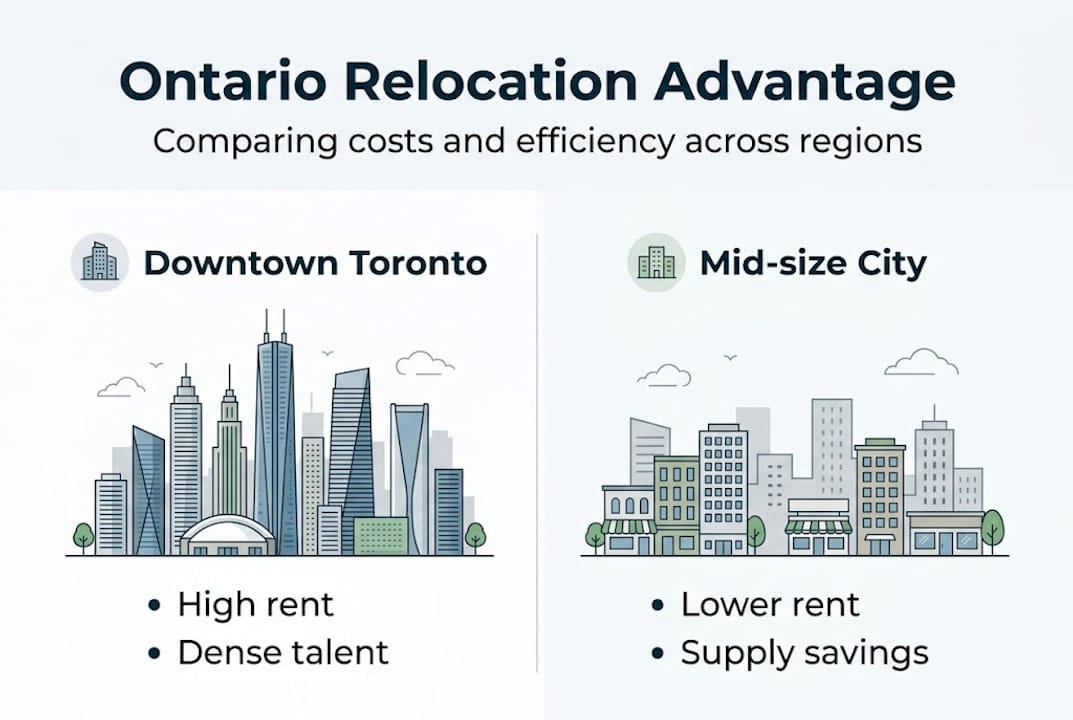
Ontario offers a wide spectrum of business environments. Toronto’s downtown core offers unmatched access to financial services, talent pools, and corporate networks. But the cost of that access has risen sharply over the past decade. Rising rents, parking costs, and congestion all add up. For businesses that don’t rely on a central urban address for their brand or client relationships, the case for moving to a more affordable location within Ontario is strong.
Relocation to affordable areas within Ontario directly enhances competitiveness, particularly as supply chain disruptions and tariff pressures increase operating costs. When margins are tight, rent savings of 30 to 50 percent compared to downtown Toronto can make a genuine difference to profitability.
Consider some illustrative cost comparisons across common expense categories:
| Expense category | Downtown Toronto | Mid-size Ontario city |
|---|---|---|
| Office rent (per sq ft/year) | $35 to $55+ | $15 to $25 |
| Industrial rent (per sq ft/year) | $20 to $30 | $8 to $14 |
| Average commercial property tax | High | Moderate to low |
| Employee commute time | Long, expensive | Shorter, more manageable |
The operational benefits of relocation go beyond cost reduction. Clustering and co-location are powerful forces that many business owners underestimate. When firms in related industries locate near each other, they share infrastructure, reduce logistics costs, and build informal knowledge networks.
Manufacturing clusters in Toronto and Montreal show that neighbourhood-level concentration captures 90 percent or more of sector employment, demonstrating just how much operational efficiency comes from being near your industry peers.
Moving your business to a region where your suppliers, logistics partners, and skilled workers are already concentrated can deliver efficiency gains that outperform even the most generous rent reduction.
For businesses weighing whether to stay local or move further afield, understanding the full picture of local vs long-distance moves helps you plan logistics and budget with accuracy. The right decision depends on your sector, your customers, and your workforce strategy. There is no universal answer, but the data consistently shows that businesses that align location with operational needs outperform those that prioritise cost alone.
Supply chain resilience is increasingly relevant too. Tariff pressures and global disruptions have pushed many Ontario businesses to bring their supply chains closer to home. Relocating to a site near key suppliers or within a well-connected logistics corridor can reduce dependence on long international routes and improve your ability to respond quickly to disruptions.
Navigating regulatory changes and timelines
Having compared costs and efficiency, let’s tackle the regulatory updates that are shaping Ontario relocations right now.
Regulation has historically been one of the biggest frustrations for businesses planning a move or expansion in Ontario. Long permit timelines, overlapping approval processes, and inconsistent requirements across municipalities added weeks or months to project timelines and increased costs significantly.
Recent reforms are changing that picture. Bill 56 streamlines approvals and reduces regulatory burdens across mining, manufacturing, and forestry, cutting lead times and costs while improving planning certainty and return on investment for expansion projects. This is a meaningful shift for any business planning a significant relocation or build-out.
Here is a practical timeline framework for planning a business relocation in Ontario under current regulatory conditions:
- Months 1 to 2: Define your site selection criteria, engage Invest Ontario, and begin shortlisting locations. Start your commercial real estate search.
- Months 2 to 3: Conduct site visits, review zoning and permit requirements, and obtain preliminary approval timelines from local municipalities.
- Months 3 to 5: Finalise your site selection, negotiate your lease or purchase, and begin permit applications. Under Bill 56 reforms, many approvals are now faster.
- Months 5 to 7: Plan your physical move. Engage your moving partner early to co-ordinate equipment, furniture, and inventory logistics.
- Months 7 to 9: Execute the move in phases if possible, keeping operations running throughout. Communicate proactively with staff, customers, and suppliers.
- Months 9 to 12: Complete the transition, close your old location, and begin measuring performance against your relocation objectives.
Pro Tip: Build a two-week buffer into every major milestone. Regulatory approvals, building fit-outs, and equipment installations almost always take longer than initial estimates, and a buffer protects your launch date without creating unnecessary pressure on your team.
Preparing for a move with a clear project plan dramatically reduces the risk of costly delays. If your timeline compresses unexpectedly due to a lease expiry or business opportunity, short notice relocation services exist specifically for situations where speed matters more than extended planning.
Planning certainty is one of the most underappreciated benefits of regulatory reform. When you know how long permits will take and what approvals you need, you can commit to timelines with your clients and staff. That certainty has real commercial value, especially for businesses in competitive sectors where delays translate directly to lost revenue.
The overlooked realities of business relocation in Ontario
Let’s now reflect on the real lessons from Ontario’s relocation trends, because the full picture is more nuanced than the headlines suggest.
Ontario’s incentive story is genuinely impressive. The automotive and life sciences investment numbers are real. But business owners who approach relocation purely as a cost-cutting exercise often find themselves disappointed a year or two after the move. Here is why.
Productivity lags are a persistent challenge in Canadian business, driven by weak firm dynamics and sector concentration. Moving to a lower-cost location does not automatically fix underlying inefficiencies in how your business operates. If your processes, technology, or management practices need improvement, relocation only delays the reckoning.
Sector concentration also cuts both ways. Clustering near industry peers creates efficiency, but highly concentrated markets can reduce competitive pressure and slow innovation. Some businesses that relocate into established clusters find it harder to differentiate themselves.
The data on cross-border relocation is also worth noting. Only 6 percent of Ontario businesses consider moving to the United States, even under significant tariff pressure. Most Ontario firms prefer to stay in the province. That tells us something important: intra-provincial moves to better-positioned regions within Ontario are almost always the more practical and lower-risk path.
We believe the best relocations are driven by growth strategy first and cost savings second. The role of professional movers in this context goes beyond carrying boxes. A well-coordinated move protects your equipment, keeps your team focused, and gets you operational faster, so the business benefits of your new location start flowing as soon as possible.
Connect with Ontario’s trusted moving experts
Once you’re equipped with practical knowledge, expert assistance is your next best step.
Relocating a business involves dozens of moving parts, and the physical move is where many well-planned transitions stumble. Delays, damaged equipment, and disorganised setup all cost time and money that your new location was supposed to save.
At Aleks Moving, we specialise in commercial relocations across Ontario, offering flat-rate pricing with no hidden fees so you can budget with confidence. Whether you’re moving a small office across town or coordinating a large-scale facility move across the province, our team brings over 18 years of experience to every job. Explore our trusted moving services, learn how we handle employee relocation transitions, and review our practical tips for relocating your business efficiently. Contact us today for a free upfront quote.
Frequently asked questions
What are the top incentives for relocating a business within Ontario?
Ontario’s government reduces business costs by $11.7 billion in 2025 through tax cuts, payroll relief, and red tape reduction, making provincial retention and relocation financially attractive for most firms.
How does site selection support growth for Ontario businesses?
Invest Ontario provides free site selection tools, streamlined approvals, and sector incentives, having helped attract $4.3 billion in investment and 4,100 new jobs across key growth sectors.
Are urban centres still viable for new business locations in Ontario?
Urban areas offer talent and infrastructure, but rising rent costs make affordable Ontario regions increasingly competitive, especially for businesses managing supply chain and tariff pressures.
What regulatory changes affect business expansion in Ontario?
Bill 56 reforms reduce approval burdens in mining, manufacturing, and forestry, cutting lead times and improving planning certainty so businesses can commit to expansion timelines with greater confidence.
Is relocating outside Canada a consideration for most Ontario businesses?
Only 6 percent of Ontario businesses consider US relocation, with most preferring intra-provincial moves that keep them close to Ontario’s incentive programmes, workforce, and market proximity.