Skip to content


TL;DR:
- Proper packing is essential for preventing damage and loss during a move.
- Special items like hazardous, perishable, or valuable belongings require tailored handling and separate planning.
- Using professional packing services ensures safety, efficiency, and peace of mind.
Most homeowners treat packing as an afterthought, something to tackle the week before moving day with whatever boxes they can find. That mindset is exactly what leads to broken dishes, damaged furniture, and missing valuables. How you pack is just as important as how you move, and restricted items like hazardous materials, perishables, and irreplaceables require separate handling that can reshape your entire loading strategy before a single box is sealed. This article breaks down exactly what goes into safe, effective packing for a smooth move across Ontario.
Table of Contents
- Why packing is the foundation of a safe move
- Choosing the right materials and methods
- Packing special and restricted items safely
- Packing efficiency: tips to cut time and stress
- The hidden risks of DIY packing: what most guides don’t tell you
- Let experts handle your packing for peace of mind
- Frequently asked questions
Key Takeaways
| Point | Details |
|---|---|
| Packing is move safety | The way you pack directly impacts whether your items arrive undamaged. |
| Plan for edge cases | Special and restricted items need tailored approaches to avoid major risks. |
| Right materials matter | Using strong boxes and correct padding reduces damage and stress. |
| Efficiency eases stress | Organised, room-by-room packing saves time and prevents costly mistakes. |
| Expert help available | Professional movers can protect your possessions and your peace of mind. |
Why packing is the foundation of a safe move
Now that we’ve set the stage, let’s look at why packing quality shapes your entire moving experience.
Most people focus almost entirely on finding a moving truck or booking a moving crew, leaving packing to the last minute. The problem is that packing decisions directly determine whether your belongings arrive at your new home in one piece. A dented bookcase corner or a shattered heirloom dish can’t be undone, and those losses happen far more often than most people realise.
Packing isn’t just about filling boxes. It’s a series of decisions about protection, weight distribution, and item safety that begin the moment you start planning your move.
Packing mistakes consistently rank among the leading causes of move-related damage and financial loss. Here’s what goes wrong most often:
- Underpacked boxes that collapse under weight during transport
- Overpacked boxes that split open or cause strain injuries when lifted
- Mixed-weight packing, where heavy items sit on top of fragile ones
- No padding between items, allowing glass, ceramics, and electronics to collide
- Improperly sealed boxes that open mid-move and spill contents
- Mislabelled boxes that get tossed, stacked, or placed incorrectly in the truck
There is also a category of items that add a different layer of risk entirely. Hazardous materials like cleaning solvents, propane canisters, and aerosol sprays cannot simply be tossed into a box. Perishable food items can leak and contaminate other belongings. Irreplaceable documents and valuables like jewellery often need to travel separately. When you follow stress-free packing tips early in your planning, you create a framework that handles all of these scenarios before moving day.
The biggest lesson here is simple. Packing is not an optional step you rush through. It is the foundation on which your entire move stands.
Choosing the right materials and methods
Understanding why packing matters is only the first step. Next, let’s break down the building blocks of safe packing.
Not all cardboard boxes are created equal. A sturdy, double-walled box from a moving supply store is vastly different from a flimsy box salvaged from a grocery store. Choosing the right materials from the start saves you from costly surprises on moving day.
Common packing materials and their best uses
| Material | Best for | Avoid using for |
|---|---|---|
| Double-walled cardboard boxes | Heavy books, tools, canned goods | Very fragile glassware (add padding) |
| Bubble wrap | Glassware, ceramics, electronics | Paintings (can trap moisture) |
| Packing peanuts | Filling void space in boxes | Heavy, sharp-edged items |
| Packing paper (unprinted) | Wrapping dishes, cushioning boxes | Alone with no outer box |
| Foam wrap sheets | Mirrors, picture frames, china | Liquids or wet items |
| Wardrobe boxes | Hanging clothes, curtains | Electronics or kitchen items |
Once you have the right materials, method matters just as much. Follow these steps to pack a standard box safely:
- Reinforce the bottom with two or three strips of strong packing tape before adding anything.
- Place the heaviest items first, flat along the bottom of the box.
- Add a layer of packing paper or foam between each layer of items.
- Fill all empty spaces with packing peanuts or crumpled paper so nothing shifts during transport.
- Keep the box weight under 20 kg as a general rule, especially for boxes with fragile contents.
- Seal the top securely with at least three strips of tape across the seam.
- Label the box clearly on two sides with the room it belongs to and a brief description of contents.
Pro Tip: Write “FRAGILE” and “THIS SIDE UP” on boxes with breakables, but also draw a large arrow pointing upward. Visual cues are processed faster than text when people are working quickly.
Good packing means packing like a pro by following tested methods rather than winging it box by box. Each room in your home has different packing requirements, and recognising that early helps you plan your supply list accurately.
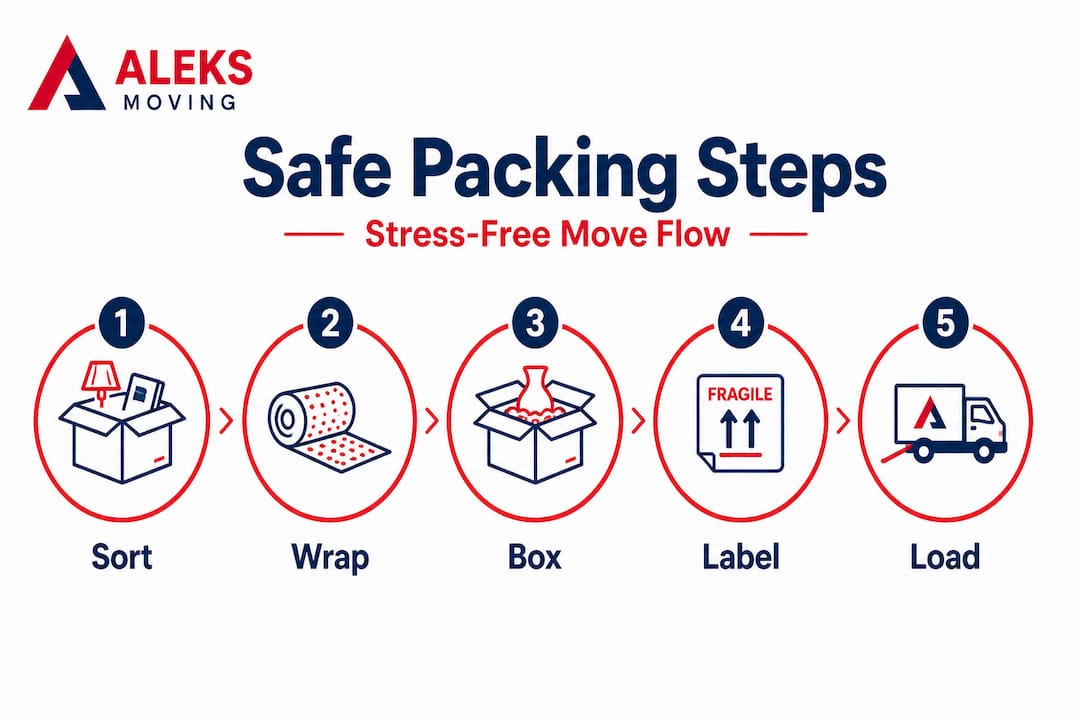
One area where most online guides fall short is the handling of restricted items. As industry advisories confirm, restricted and hazardous items can change your entire loading strategy before boxes are even sealed. Proper Ontario packing advice always includes a clear inventory of what cannot go in a standard box and why.
Packing special and restricted items safely
With the basics covered, it’s crucial to address the unique considerations that come with especially delicate or risky household items.
Some of the most costly moving mistakes involve items that homeowners assume are fine to pack normally. Fragile, hazardous, perishable, and irreplaceable belongings each need their own tailored approach, and skipping that step can result in damage, legal issues, or safety hazards.
Categories of special items and how to handle them
| Item category | Examples | Recommended approach |
|---|---|---|
| Hazardous materials | Paint, cleaning solvents, propane tanks, batteries | Dispose of or transport separately; check Ontario regulations |
| Perishables | Fresh food, plants, refrigerated items | Consume, donate, or discard before moving day |
| Irreplaceable documents | Passports, property deeds, birth certificates | Carry personally; use a waterproof folder or binder |
| High-value items | Jewellery, artwork, collectibles | Declare to your mover; consider separate transport or insurance |
| Fragile items | Glassware, ceramics, mirrors, electronics | Individual wrapping, dedicated boxes, plenty of padding |
| Medications | Prescription and over-the-counter drugs | Pack in a personal bag and carry with you |
Here are the key principles for packing these categories safely:
- Never assume an item is safe to pack without checking its category first.
- Hazardous materials that leak in transit can damage or destroy everything around them.
- Perishable food items left in boxes can attract pests and cause mould in your new home.
- Irreplaceable items should never be loaded into the moving truck if you can carry them yourself.
- Valuables like jewellery and small antiques travel best in your personal vehicle, not in a box.
Planning for packing fragile items requires individual wrapping for every single piece, not just a layer of padding on top. Each glass, plate, or ceramic figure should be wrapped separately in foam or packing paper, then nested in a box with cushioning on all sides.
Pro Tip: Take photos of high-value items before packing them. Those photos serve as documentation for insurance purposes if anything is damaged in transit.
Long-distance moves raise the stakes even higher. If you’re relocating across Ontario or beyond, knowing how to pack fragile items for a long-distance move is essential because boxes spend far more time in the truck, encountering more vibration, temperature changes, and handling points along the way.
Industry guidance consistently confirms that edge-case planning for restricted items is just as critical as the materials themselves, since these items require entirely separate handling and can disrupt your overall loading plan if not addressed in advance.
Packing efficiency: tips to cut time and stress
Beyond safety, efficiency can make or break the moving experience. Here’s how to pack smart, not just hard.
Even with the best materials and methods, packing becomes overwhelming when it lacks structure. Ontario homeowners who plan their packing process strategically save hours of time and avoid the frantic last-minute scramble that leads to sloppy, unsafe boxes.
Here is a practical framework to keep your packing organised from start to finish:
- Set up a central packing zone in one room, ideally with a large table or clear floor space. Keep all your supplies, boxes, tape, markers, and labels there so nothing gets lost.
- Work room by room, never mixing items from different spaces in the same box. This makes unpacking dramatically faster and reduces confusion.
- Pack non-essentials first, things you won’t need in the weeks before the move, like seasonal décor, extra linens, and books.
- Set daily packing targets, for example, two rooms per week, so you never face a mountain of unpacked items the night before moving day.
- Use a colour-coded label system: assign one colour per room and apply matching stickers to boxes. Movers can place boxes in the correct rooms instantly, saving significant time at your destination.
- Create a “first night” box for each family member containing essentials like toiletries, a change of clothes, phone chargers, and snacks. Keep this box accessible, not buried in the truck.
Pro Tip: Use your suitcases for clothes and linens instead of boxes. Suitcases are built for travel, already have handles, and save you money on extra cardboard boxes.
Efficiency in packing also means knowing what you’re packing for. The approach for efficient local packing in Ontario differs from what you’d do for a longer journey across the province. Local moves are generally faster, so your priority is organisation. For longer routes, durability of the pack matters more because boxes are in transit longer.
If you’re tackling a longer relocation, reviewing long-distance packing tips will help you adjust your strategy accordingly. Reinforce boxes more heavily, use stronger tape, and avoid overpacking to protect items from the extended road conditions.
Don’t forget to loop in your household. Assigning family members specific rooms or tasks and sharing a checklist keeps everyone on the same page and prevents duplicated or missed work. Even older children can pack their own clothes and books with a little guidance.
The most important rule of all is this: start early. A move that feels manageable four weeks out becomes genuinely stressful when compressed into three days.
The hidden risks of DIY packing: what most guides don’t tell you
After years of helping Ontario homeowners through their relocations, we’ve seen the same painful patterns repeat themselves. Most packing guides tell you what materials to buy and what sizes of boxes to use. What they rarely tell you is where the real losses happen.
The honest truth is that the costliest packing mistakes rarely come from using the wrong type of bubble wrap. They come from overlooking edge cases entirely. A homeowner who packs beautifully organised boxes but forgets to address the half-can of paint thinner in the garage, the jar of homemade preserves on the shelf, or the irreplaceable family documents tucked in a desk drawer, is still at serious risk.
Industry safety advisories are clear that restricted and perishable items require entirely separate handling and can affect your entire loading strategy if they’re not identified before packing begins. Most homeowners don’t discover this until a mover points it out on moving day, which leaves no time to properly address it.
We’ve also seen the consequences of last-minute improvising. A homeowner who runs out of padding and uses old newspapers (which can leave ink stains on white dishware and delicate items) or who stacks boxes without weight consideration ends up with damaged goods and real financial loss.
Expert packing is not about using more boxes. It’s about making better decisions early, especially for high-value, fragile, and edge-case items. Our advice for stress-free residential moving always starts with this: spend the first hour of your packing preparation identifying your problem items, not pulling out boxes.
This mindset shift changes everything. Once you know what needs special handling, you can plan your materials, your timeline, and your conversations with your moving company accordingly.
Let experts handle your packing for peace of mind
If you’d rather not leave packing safety to chance, there’s a straightforward solution that saves time and protects your belongings.
At Aleks Moving, we’ve supported Ontario homeowners through thousands of successful relocations over 18 years. We bring the right materials, tested techniques, and real-world experience to every job, so nothing gets left to guesswork. Whether you need full packing assistance or just help with your fragile and special items, our team is ready to step in.
Explore our full-service moving options or find out exactly how our professional packing service works. A quick inquiry is all it takes to get a free, flat-rate quote with no hidden fees. Let our family move yours, safely, efficiently, and with complete peace of mind from start to finish.
Frequently asked questions
What are the most commonly forgotten packing steps that lead to damage?
Skipping the identification of edge-case items and failing to properly tape and reinforce box bottoms are the two most frequent causes of damage. Planning for restricted and special items before you start packing prevents the most serious losses.
How do I know if an item is restricted or needs special handling when moving?
Hazardous, perishable, and high-value items almost always require distinct packing or separate transport arrangements. Always check with your moving company before you begin packing, as these categories can affect your entire loading plan.
How can I speed up the packing process without sacrificing safety?
Use a room-by-room packing system, enforce a 20 kg weight limit on boxes, and label each box on two sides as you go. This approach keeps packing both efficient and safe without cutting corners.
Is professional packing always safer than DIY?
Professional packing significantly reduces risk by using tested materials, weight protocols, and proper techniques, particularly for fragile, hazardous, or high-value items where mistakes are most costly.