Skip to content


TL;DR:
- Proper planning and phased packing minimize disruption and reduce move-related errors.
- Labeling, inventory management, and open-first boxes ensure a smooth transition and quick setup.
- Involving professionals helps protect assets and guarantees a more efficient, stress-free move.
A disorganised office move can cost your business far more than just time. Lost documents, damaged computers, confused staff, and days of downtime are all real consequences when packing is rushed or poorly planned. Whether you are relocating a five-person team or a multi-floor operation, the way you pack your office directly determines how quickly you get back to full productivity. This guide gives you a professional-grade, step-by-step process to pack your Ontario office efficiently, protect your assets, and arrive at your new space ready to work from day one.
Table of Contents
- What you need before packing your office
- Packing in phases: The proven sequence
- Packing delicate equipment and confidential files safely
- Common office packing mistakes and how to avoid them
- How to check your office is move-ready
- Why most office packing plans fail: A professional’s perspective
- Get expert help for your office move
- Frequently asked questions
Key Takeaways
| Point | Details |
|---|---|
| Start with non-essentials | Begin packing storage and archived materials several weeks before your move. |
| Pack in clear phases | Organise packing by department and leave essentials for last to reduce confusion. |
| Label and track every box | Use comprehensive labelling and inventory to avoid misplaced items and delays. |
| Special care for sensitive items | Electronics and confidential files require extra precautions and documentation. |
| Finish with a final checklist | Verify all steps with a move-ready list to ensure a smooth office reopening. |
What you need before packing your office
Now that you understand the pitfalls of disorganised moves, let’s start with gathering the right materials.
Before a single box is taped shut, you need the right supplies and a clear plan. Walking into packing day unprepared is one of the most common reasons office moves go sideways. A missing roll of tape or an unlabelled box can create confusion that ripples all the way to move-in day.
Essential packing materials to gather:
- Sturdy double-walled boxes in multiple sizes
- Bubble wrap and antistatic bubble wrap for electronics
- Packing tape and a tape gun
- Permanent markers in multiple colours
- Colour-coded labels or sticker dots for each department
- Document bags and sealed file boxes for confidential records
- Moving carts and dollies for heavy items
- Foam padding and corner protectors for monitors and furniture
- Designated “open-first” boxes for each department
Beyond materials, your pre-move preparation sets the tone for everything that follows. Appoint a move coordinator, ideally someone organised and respected by the team, to oversee the entire process. This person communicates timelines, answers questions, and keeps packing on schedule. Confirm your moving date as early as possible and share it with all staff so no one is caught off guard.
Proper labelling moving boxes is not optional. Every box should show the department it belongs to, a brief description of its contents, and whether it needs special handling. Use colour-coded labels by department so movers can instantly place boxes in the right rooms at the new location.
| Supply | Purpose | Quantity guide |
|---|---|---|
| Double-walled boxes | General office items | 10 to 15 per workstation |
| Antistatic bubble wrap | Electronics protection | 2 to 3 rolls per tech station |
| Colour-coded labels | Department sorting | 1 colour per department |
| Document bags | File and record transport | 1 per file drawer |
| Open-first boxes | Immediate essentials | 1 per department |
As experts recommend, packing in phases starting with non-essentials and archives is the most effective approach. Getting your supplies and team organised before you begin packing is what makes that phased approach actually work.
Packing in phases: The proven sequence
With your supplies ready and team informed, here’s how to tackle the real work with minimal disruption.
Packing everything at once is a recipe for chaos. The phased approach keeps your office functional for as long as possible while still making steady progress toward move day. Think of it as peeling back layers rather than stripping everything at once.
The three-phase packing sequence:
- Phase one: Non-essentials and archives. Start three to four weeks out. Pack storage rooms, archived files, old equipment, rarely used supplies, and anything that staff do not need day-to-day. These items are the easiest to pack early without disrupting operations.
- Phase two: Department-by-department packing. Begin one to two weeks before the move. Work through each department systematically. Pack shared spaces like meeting rooms, reception areas, and break rooms before individual workstations. Give each department a clear packing deadline.
- Phase three: Last-day essentials. On the final day or evening before the move, pack the items staff need right up until the last moment. Computers, phones, daily files, and personal items go in last. These boxes are labelled clearly as priority items.
For each department, prepare a dedicated open-first box. This box contains everything the team needs to start working immediately at the new location: chargers, stationery, a printed contact list, login credentials, and any forms or documents needed for day-one operations. As the ultimate office packing checklist confirms, creating an essentials or open-first box for each department is one of the most impactful steps you can take.
“The difference between a move that costs two days of productivity and one that costs two hours often comes down to whether someone prepared an open-first box.” This is the kind of detail that separates a planned move from a reactive one.
Pro Tip: Assign one staff member per department to oversee their team’s packing. They become the point of contact for the move coordinator and are responsible for completing their open-first box before move day.
| Approach | Disruption level | Risk of errors | Recovery time |
|---|---|---|---|
| Phased packing | Low | Low | Minimal |
| All-at-once packing | High | Very high | Significant |
| No plan | Extreme | Near certain | Days to weeks |
For more practical business relocation tips specific to Ontario, and to learn how to plan a smooth office move from start to finish, these resources will help you build a complete picture before move day arrives.
Packing delicate equipment and confidential files safely
Once the packing sequence is underway, proper handling of electronics and documents requires special attention.
Electronics and sensitive files are the two categories most likely to cause serious problems if packed carelessly. A dropped monitor or a misplaced client file can have consequences that go well beyond the cost of replacement.
How to pack electronics safely:
- Photograph the back of every computer tower, monitor, and printer before disconnecting cables. This makes reassembly far faster at the new location.
- Label every cable with a tag or piece of masking tape showing which device it belongs to.
- Use antistatic bubble wrap for all electronics. Standard bubble wrap can generate static that damages components.
- Pack monitors vertically, never flat. Use original boxes where available, or double-box with foam padding.
- Create a device inventory list that includes serial numbers, assigned users, and destination desk numbers at the new office.
- Never stack heavy items on top of boxes containing electronics.
How to handle confidential files and documents:
- Use sealed, lockable file boxes for any documents containing personal information, financial records, or client data.
- Number each file box and record its contents in a master document log kept by the move coordinator.
- Transport sensitive files in a dedicated vehicle or with a designated staff member present throughout the move.
- Shred any documents that are no longer needed rather than moving them unnecessarily.
“Treat your confidential files the same way you would treat cash. Know exactly where they are at every stage of the move.”
Pro Tip: For IT assets specifically, consider having your IT team or a trusted technician oversee packing and unpacking. They can verify nothing is damaged and ensure systems are reconnected correctly, saving hours of troubleshooting later.
Understanding the role of office movers in handling specialised equipment is important. Professional movers experienced in commercial relocations know how to transport heavy tech safely. You can also find detailed guidance on packing office chairs and follow a thorough desk packing guide to protect your furniture during transit.
Common office packing mistakes and how to avoid them
Even with the best plans, mistakes can happen. Here’s how to sidestep the most common issues.
Most office move problems are predictable. They show up in the same forms again and again, and they are almost always avoidable with a bit of foresight.
The top five office packing mistakes and their fixes:
- Poor labelling. Boxes arrive at the new office with no indication of where they belong or what is inside. Fix: Use colour-coded labels by department and write a brief content description on every box. Never leave a box unlabelled, even temporarily.
- Skipping the inventory. Without a master inventory, you have no way to confirm everything arrived safely. Fix: Number every box and maintain a running spreadsheet. Assign this task to the move coordinator.
- Last-minute rushing. Teams that start packing too late end up throwing items into boxes without care or organisation. Fix: Begin packing non-essentials at least three to four weeks before the move. Use the phased sequence described above.
- Ignoring technology needs. Cables get tangled, devices go missing, and setup at the new office takes days. Fix: Photograph setups before dismantling, label every cable, and create a device inventory before packing begins.
- Staff confusion about roles. When no one knows who is responsible for what, things fall through the cracks. Fix: Appoint a move coordinator and department leads. Hold a brief team meeting to clarify expectations and timelines.
Pro Tip: Send a written summary of packing responsibilities to all staff at least two weeks before the move. A simple one-page document covering what to pack, when to pack it, and who to contact with questions eliminates most confusion before it starts.
Following a phased packing plan is the single most effective way to avoid these mistakes. When you have a structure to follow, there is far less room for error. Working with professionals who know how to avoid downtime with office movers can also make a significant difference in keeping your business running smoothly through the transition.
How to check your office is move-ready
Before move day, confirm everything is in order with this final check.
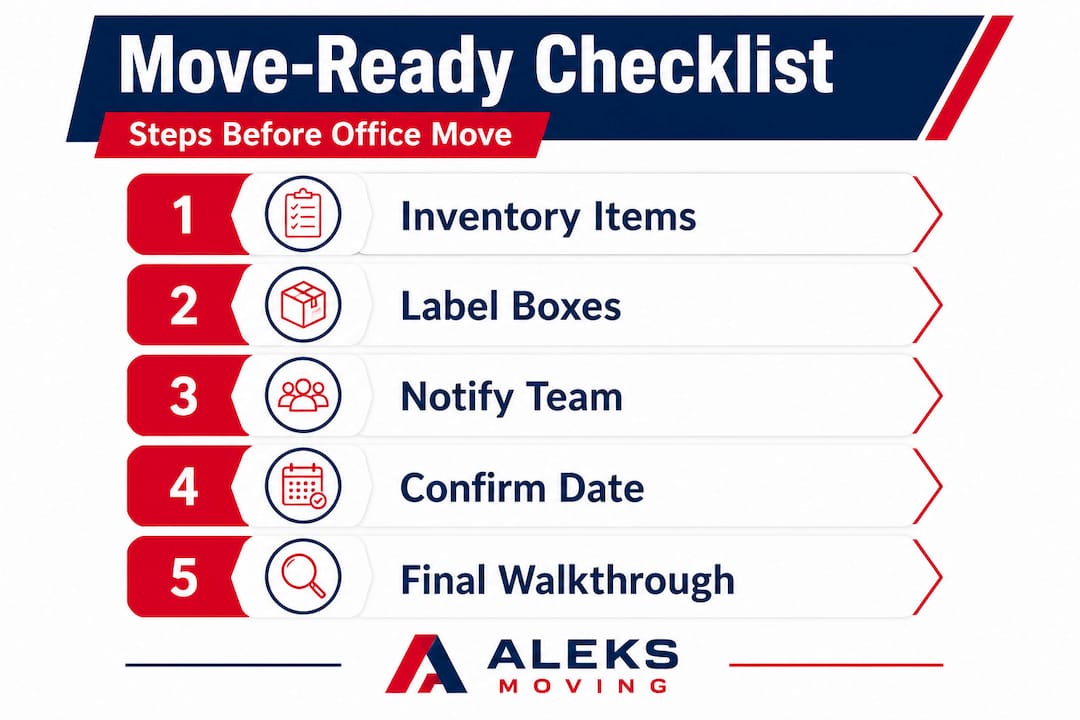
A final walkthrough is not just a formality. It is your last opportunity to catch anything that was overlooked and ensure the move proceeds without surprises. Treat it as a formal verification step, not a casual glance around the office.
Your move-ready checklist:
- Walk through every room, including storage areas, server rooms, and break rooms, to confirm all items are packed and labelled.
- Match your box inventory list against the physical boxes present. Every numbered box should be accounted for.
- Confirm that each department has its open-first box clearly labelled and set aside from the main load.
- Verify that all electronics are disconnected, inventoried, and packed with appropriate protective materials.
- Check that all confidential files are sealed, numbered, and documented in the master file log.
- Confirm that staff know their responsibilities for move day, including arrival times and who to report to.
- Notify building management at both the current and new locations about the move schedule, elevator bookings, and parking arrangements.
Pro Tip: Do your final walkthrough the evening before the move, not on the morning of. This gives you time to address any gaps without the pressure of movers waiting at the door.
Understanding what professional movers do on move day helps you prepare your team and your space accordingly. When your office is properly packed and organised, movers can work faster and with greater care, which directly reduces your total move time and cost.
Why most office packing plans fail: A professional’s perspective
With the checklist done, here’s what experienced movers know that most overlook.
After years of handling commercial relocations across Ontario, we have seen a clear pattern. The office moves that go smoothly are not always the ones with the biggest budgets or the most elaborate plans. They are the ones where someone took the time to involve the whole team early and committed to a simple, structured sequence.
Most managers underestimate the sheer volume of tasks involved in an office move. They assume that packing is straightforward and leave it too late, or they delegate it without providing clear direction. The result is a patchwork effort where some departments are well-prepared and others are scrambling on move morning.
Here is the contrarian view: over-planning can be just as harmful as under-planning. We have seen businesses spend so much time creating elaborate spreadsheets and colour-coded systems that they never actually start packing until it is too late. The solution is not a perfect plan. It is a good-enough plan executed consistently, with every staff member playing their part.
The finishing touches matter more than most people realise. An open-first box that is actually complete, an inventory list that has been checked twice, and a team that knows exactly what to do on move morning are what guarantee a productive first day at the new location. These are not glamorous tasks, but they are the ones that determine whether your business loses two hours or two days to the transition.
We also recommend learning from pro packing secrets that experienced movers use, because there are techniques developed through thousands of moves that simply do not appear in generic checklists. Small adjustments in how you wrap, stack, and label can make a meaningful difference in both protection and efficiency.
Get expert help for your office move
Ready to make your move truly seamless? Here’s how expert help can set you up for relocation success.
Planning and executing a professional office move is a significant undertaking, and you do not have to manage it alone. At Aleks Moving, we have been helping Ontario businesses relocate efficiently and confidently for over 18 years. From packing and logistics to storage solutions, our team handles the details so your staff can stay focused on running your business.

Our trusted moving services are tailored to the specific needs of commercial clients, with flat-rate pricing and no hidden fees so you always know what to expect. Whether you need full-service packing or just reliable transport, our professional packing solutions are designed to protect your equipment, your documents, and your timeline. Contact us today for a free upfront quotation and let our experienced team take the stress out of your next office move.
Frequently asked questions
What should you pack first when moving an office?
Start with non-essentials like archives or storage items, then move on to departmental items, packing essentials and daily-use items last to keep your office operational as long as possible.
How do you keep office equipment safe during a move?
Use padded antistatic materials for electronics, photograph all cable setups before disconnecting, and seal confidential documents securely in lockable file boxes with a numbered inventory log.
What is an essentials or open-first box?
An essentials or open-first box contains must-have items for immediate use at the new office, such as chargers, stationery, and key documents. It is packed last and opened first on arrival.
How early should you start packing for an office move?
Begin packing non-essentials at least three to four weeks before your move date, following a phased sequence to minimise disruption and give each department adequate time to prepare.