Skip to content


TL;DR:
- Hiring a licensed direct carrier with a flat-rate quote reduces small business relocation costs and downtime.
- Ensuring the carrier owns their trucks and crews improves accountability, scheduling, and liability management.
Hire a licensed direct carrier that provides a flat-rate, binding quote and after-hours availability. That single decision protects your budget, keeps your team accountable to a named crew, and gets your office operational again before Monday morning. Your immediate next step: request a written binding quote and schedule an on-site survey or virtual walkthrough before you sign anything.
Table of Contents
- Why small businesses benefit from professional office movers
- What makes direct carriers better than brokers for small-office moves?
- When should you schedule a small-business office move?
- What should a professional office mover include in its service?
- How does pricing work for small-office moves in Canada?
- How do you vet and choose the right office mover?
- Your moving-day checklist for a smooth small-office move
- Why Aleksmoving is a trusted choice for small-business office moves in Canada
- Key takeaways
- What actually matters most in a small-business office move
- Ready to get a binding quote from Aleksmoving?
- Useful sources and further reading
Why small businesses benefit from professional office movers
Lost billable hours are the real cost of a poorly managed office move. A professional commercial relocation keeps your client-facing operations running, protects specialised equipment, and hands you a predictable schedule rather than a guessing game.
The business case is straightforward:
- Minimise downtime. Professional movers work to a floor plan, so workstations are placed and connected faster than a DIY crew could manage.
- Protect your equipment. Servers, monitors, and ergonomic furniture require commercial-grade packing materials and trained handling.
- Preserve client continuity. A Friday-to-Monday move means your team walks into a fully set-up office on Monday, with no visible disruption to clients.
- Cost certainty. Fixed-price contracts where the quote is the invoice eliminate the surprise fees that hourly or non-binding estimates routinely produce.
Trust signals worth verifying before you book: binding written quotes, documented insurance limits, on-site survey confirmation, and named crew assignments in the contract. Change management matters too. Clear communication with employees about the new workspace layout, hot-desking policies, and hybrid arrangements is as critical to productivity as the physical move itself.
What makes direct carriers better than brokers for small-office moves?
Direct carriers own their trucks, hire their own crews, and provide binding quotes with full accountability. That is the short answer. For a small business, the distinction matters more than it does for a large corporation with a dedicated facilities team.
Brokers take your booking and resell it to a third-party mover. The risks:
- Hidden markups added between your quote and the actual invoice.
- No control over which crew shows up or what equipment they bring.
- Liability disputes that bounce between the broker and the carrier when something breaks.
A direct carrier eliminates those handoffs. The company writing your quote is the one supplying the truck and the crew, which simplifies liability, scheduling, and accountability on move day.
Pro Tip: Ask one question to identify a carrier versus a broker instantly: “Do you own your trucks?” A direct carrier answers yes without hesitation. A broker will hedge or redirect.
When should you schedule a small-business office move?
Schedule your move from Friday evening through to Sunday, so your team returns Monday to a working office. This approach, sometimes called the Friday-to-Monday method, allows businesses to be fully operational without losing a single productive weekday.
Planning milestones to lock in early:
- Book your movers 4–6 weeks out. Quality direct carriers fill weekend slots quickly, especially in spring and September.
- Order internet and network circuits immediately when your lease is signed. Commercial circuit provisioning commonly takes 60–90 days, and being offline at move-in is an avoidable disaster.
- Finalise your floor plan before the mover’s walkthrough. Labelled placement saves hours on move day.
- Get a lease decommissioning estimate early. Make-good clauses can require returning the space to bare walls and sometimes cost more than the physical move itself.
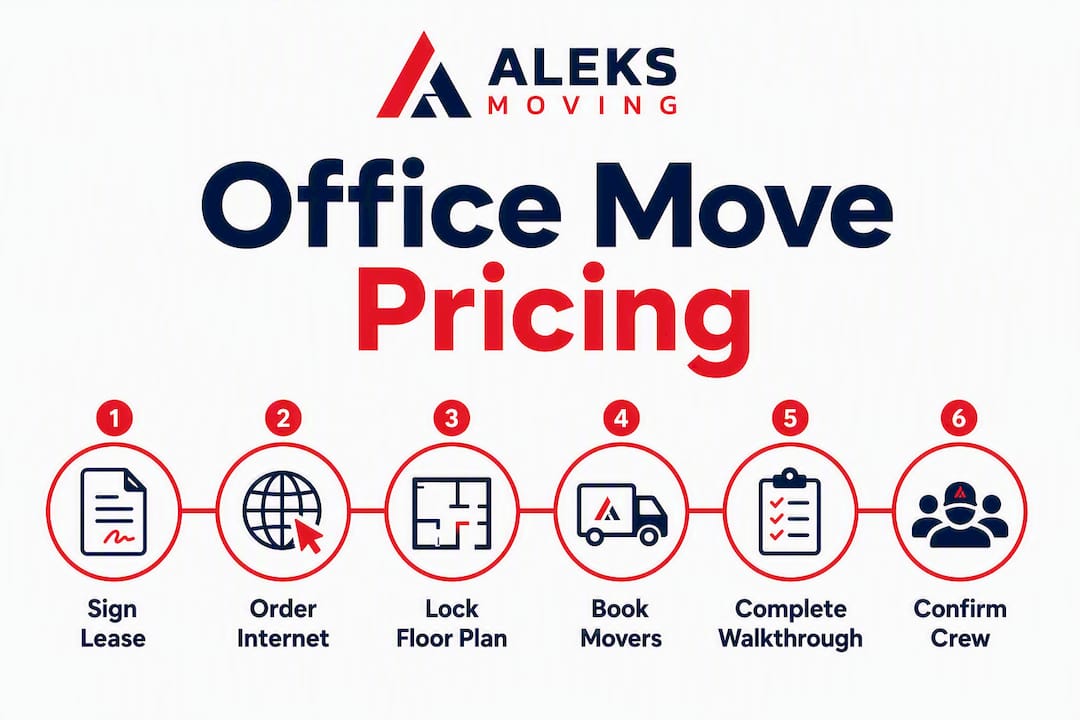
The sequential logic: sign lease → order internet → lock floor plan → book movers → complete walkthrough → confirm crew and timing. Skipping any step compresses the timeline in ways that cost money.
Pro Tip: Check your Ontario business relocation tips for local permit and building-access requirements that can affect weekend move scheduling.
What should a professional office mover include in its service?
A binding quote for a small-business office move should cover all of the following. If any item is missing, ask why before signing.
- On-site survey or virtual walkthrough before the quote is issued.
- Professional packing and unpacking with labelled boxes by workstation.
- IT disconnect and reconnect coordination.
- Furniture disassembly and reassembly.
- Labelled floor-plan placement at the destination.
- Commercial-grade insurance and a certificate of insurance (COI) available on request.
- Short-term or long-term storage options for items that cannot go directly to the new space.
- Specialty handling for art, antiques, or sensitive equipment.
Watch the contract language carefully. Flat-rate means the quote is the invoice. Any mention of “estimate subject to change,” overtime clauses, long-carry fees, or stair surcharges that are not capped in writing signals a non-binding quote. Professional business movers include dedicated project management and floor-plan placement as standard, not as add-ons.
How does pricing work for small-office moves in Canada?
Flat-rate binding quotes give you cost certainty. Hourly rates and non-binding estimates do not. That distinction is worth repeating, because a lowball estimate that inflates on move day is genuinely more expensive than a transparent flat rate.
| Cost factor | Typical impact | What to ask your estimator |
|---|---|---|
| Number of staff / rooms | Primary driver of crew size and truck count | How many movers and trucks are included? |
| Distance (local vs. long-distance) | Local moves: — | Is the quote flat-rate or hourly? |
| Packing and IT services | Adds additional charges depending on volume | Are packing materials and IT disconnect included? |
| Specialty items | Art, antiques, server racks priced separately | Is specialty handling itemised in the quote? |
| Stairs, long carries, elevator waits | Can add $100–$300 per occurrence if not capped | Are access surcharges capped in the contract? |
| Lease decommissioning | Potentially exceeds the physical move cost | Have you reviewed the make-good clause? |
| Building access permits | Varies by property management | Who arranges the freight elevator booking? |
One cost that many small-business owners miss entirely: lease decommissioning. Make-good obligations can require stripping the space back to bare walls, patching, and repainting. Get a landlord estimate before your move budget is finalised.
How do you vet and choose the right office mover?
Prioritise direct carriers offering flat-rate binding quotes and documented insurance limits. Here is a practical vetting checklist:
- Do you own your trucks and employ your own crews? (Confirms direct carrier.)
- What are your commercial insurance limits, and can you provide a COI?
- How many years of commercial relocation experience do you have?
- Will you conduct an on-site survey before issuing the quote?
- Who is the named on-site supervisor on move day?
- Do you handle IT disconnect and reconnect, or do we need a separate contractor?
- Can you provide references from comparable small-business moves?
- What packing materials do you use for monitors and server equipment?
Red flags to walk away from: vague answers about truck ownership, no on-site survey offered, a quote that arrives without seeing the space, lowball pricing with no itemisation, and no COI available. Verify references with a direct call, not just a link to a review page. Check that the written contract matches the verbal quote exactly.
Your moving-day checklist for a smooth small-office move
A tight moving-day checklist keeps the crew on schedule and prevents the small mistakes that cause big delays.
Pre-departure (morning of move):
- IT team on-site first to disconnect and label all equipment.
- Confirm labelled boxes match the floor plan at the destination.
- Move champion present and in direct contact with the mover’s lead.
- Walk through the origin space with the crew supervisor before loading begins.
During the move:
- Monitor specialty items (servers, art, antiques) during loading.
- Keep the signed floor plan accessible for the crew at the destination.
- Track elevator and freight access at both buildings.
Immediate post-move:
- Walk through the new space with the crew supervisor before signing off.
- Confirm IT reconnection and test network connectivity.
- Check all specialty items for condition.
- Photograph the vacated space for lease decommissioning records.
Pro Tip: Appoint a single internal move champion who coordinates HR, Finance, IT, and your moving vendor. One point of contact prevents miscommunication and keeps the timeline intact.
Why Aleksmoving is a trusted choice for small-business office moves in Canada
Aleksmoving meets the core criteria for a reliable small-business office mover: direct-carrier accountability, flat-rate binding quotes, after-hours and weekend scheduling, and over 18 years of commercial relocation experience across Ontario and Canada.
Key proof points:
- 18+ years of experience in residential and commercial relocations, with a track record in small and mid-size office moves.
- Flat-rate pricing with no hidden fees. The quote is the invoice.
- On-site surveys and written floor-plan placement included as standard.
- IT disconnect and reconnect coordination, specialty handling for art and antiques, and short-term storage options.
- Insurance coverage and COI availability for building management requirements.
- Multiple contact channels: phone, WhatsApp, and an online quote form for fast response.
Aleksmoving’s commercial relocation services are built around the Friday-to-Monday approach, so your team walks into a working office on Monday morning. After-hours moves, labelled workstation placement, and a named on-site supervisor are part of every commercial booking.
To request a binding quote or schedule an on-site survey, reach Aleksmoving by phone, WhatsApp, or the online quote form at aleksmoving.ca.
Key takeaways
Hiring a direct carrier with a flat-rate binding quote is the single most effective way for small businesses in Canada to control moving costs and minimise downtime.
| Point | Details |
|---|---|
| Choose a direct carrier | Direct carriers own trucks and crews, giving you binding quotes and clear accountability on move day. |
| Book 4–6 weeks out | Quality weekend slots fill quickly; early booking also allows time for IT circuit provisioning (60–90 days). |
| Flat-rate beats hourly | Fixed-price contracts absorb unforeseen costs; non-binding estimates routinely inflate on move day. |
| Budget for decommissioning | Lease make-good clauses can exceed the physical move cost; get a landlord estimate before finalising your budget. |
| Aleksmoving for Ontario moves | Aleksmoving offers flat-rate quotes, 18+ years of experience, after-hours scheduling, and COI availability across Canada. |
What actually matters most in a small-business office move
Most office-move guides focus on boxes and truck sizes. The real risk for a small business is not the physical move. It is the 72-hour window where your team is neither fully operational at the old space nor set up at the new one.
The businesses that come through a move without losing revenue are the ones that treated the IT circuit order as a day-one lease task, not a week-three task. They also had a single internal person who owned every vendor conversation, from the mover to the building manager to the internet provider. That move champion role sounds administrative, but it is the difference between a Monday morning where everything works and one where half the team is on hotspot data.
Flat-rate pricing matters for a different reason than most people think. It is not just about avoiding surprise fees, though that matters. It is about the signal it sends: a mover willing to give you a binding quote has already done the mental work of scoping your move accurately. A mover who hedges with hourly estimates is either inexperienced with commercial moves or is leaving room to charge more. Neither is the right partner for a business that cannot afford a lost week.
Ready to get a binding quote from Aleksmoving?
When you are ready to move your office without the guesswork, Aleksmoving delivers flat-rate pricing, direct-carrier accountability, and after-hours scheduling designed specifically for small businesses in Ontario and across Canada. With 18+ years of commercial relocation experience, we handle the logistics so you can focus on keeping your business running.
To get your written binding quote, have the following ready before you reach out:
- Your current and new office addresses and floor plans.
- Number of staff and workstations.
- Any specialty items (servers, art, antiques).
- Lease decommissioning notes or make-good obligations.
- Preferred move dates (include your first-choice weekend).
Request your quote, book an on-site survey, or ask about after-hours availability through our moving services page. You can also reach us by phone, WhatsApp, or the online quote form at aleksmoving.ca.
Useful sources and further reading
- Your office moving checklist | JLL — Change management and employee communication guidance for office relocations.
- The ultimate office move checklist | WeWork — Broad planning framework for businesses of all sizes.
- Aleksmoving commercial relocation guide for Ontario businesses — In-depth local guidance on commercial moves in Ontario, including permit and building-access considerations.