Skip to content


Most local moves in Oakville run between $600 and $1,700 for a two-person crew, according to HomeStars’ Canadian moving-cost guide, with hourly rates of about $120 to $200. The single biggest variable to check on any quote is crew size relative to your home’s size: a one-bedroom apartment moves quickly with two movers, while a three-bedroom house often needs three or four to avoid ballooning hours.
TL;DR:
- Crew size significantly impacts costs, with larger teams needed for bigger homes that often increase both hourly rates and total time.
- Local moves involving stairs, specialty items, or limited access can add surcharges that should be clearly itemized before the move begins.
- Accurate estimates require a visual survey; phone-only quotes are unreliable and may lead to unexpected charges.
- Booking on weekdays or off-peak times can reduce costs, and fully disassembling furniture beforehand speeds up the move.
- Verifying mover credentials and avoiding low-ball bids help prevent scams and hidden fees, especially when dealing with unverified operators or those demanding cash-only deposits.
Table of Contents
- Typical costs by home size and hourly rates for Oakville moves
- How movers calculate your bill: the factors that determine price
- Common surcharges and how to spot them on a quote
- Sample estimate scenarios for Oakville moves
- How to get reliable, comparable quotes in Oakville
- Ways to reduce your Oakville moving costs without adding risk
- Red flags, scams and how to vet movers in Oakville
- Insurance, valuation and liability options for Oakville moves
- Author perspective: how Aleks Moving estimates and protects clients
- Aleks Moving: how to request a quote and what we offer
- Sources
- FAQ
Typical costs by home size and hourly rates for Oakville moves
Home size drives almost everything about your final bill. A studio or one-bedroom apartment in Oakville typically takes a two-person crew about three to four hours to load, transport, and unload, landing near the lower end of the $600 to $1,700 range reported for local Canadian moves by HomeStars. Add a few boxes of books or a piano, and those hours climb fast.
A two or three-bedroom home usually needs a three-person crew and five to seven hours on the clock. At the HomeStars-reported hourly bands of $120 to $200, that stretches costs toward the upper half of the local range, sometimes past it once you add stairs, a long carry from the truck, or packing materials.
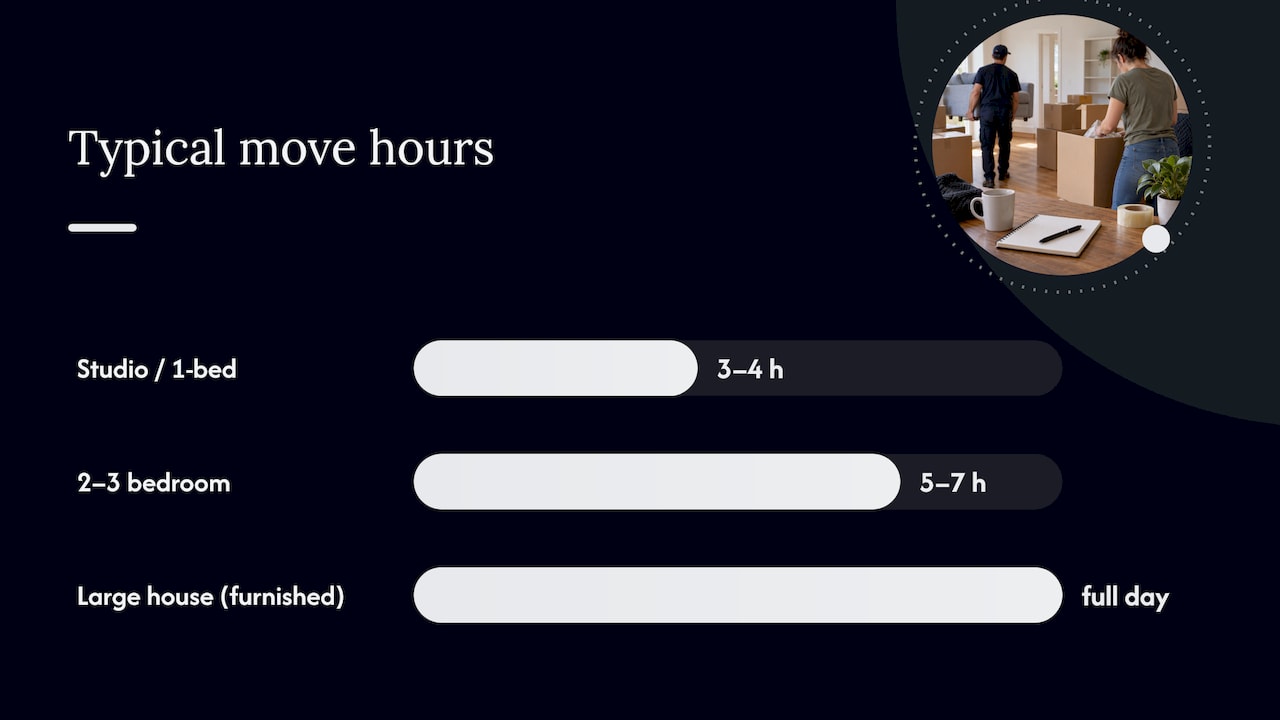
Large houses, four bedrooms or more, commonly have local Oakville quotes that can be quite a bit higher when the home is fully furnished and the crew needs a full day. Long-distance segments (a move to Ottawa or beyond, for example) are priced differently again, often by weight or volume rather than by the hour, so a local hourly quote won’t translate directly.
What typically shifts the total for any home size:
- Crew size: more movers finish faster but raise the hourly rate.
- Truck trips: a home that needs two truck loads doubles transportation time.
- Packing: full-service packing adds materials and labour on top of the move itself.
- Distance between homes: a short local hop costs less than a cross-city relocation with highway time.
Aleks Moving offers local moving services across Oakville with flat-rate pricing, which removes some of the guesswork tied to hourly billing, since the total is agreed before moving day rather than tallied afterward.
How movers calculate your bill: the factors that determine price
Most Ontario movers bill local jobs by the hour, using a rate tied to crew size and truck size. Long-distance moves usually switch to a rate based on weight or cubic footage, since travel time alone doesn’t reflect what’s actually being moved.
Three things interact on every estimate: how many movers show up, what size truck they bring, and how many hours the job is expected to take. A bigger crew costs more per hour but can finish a large house in half the time a two-person team would need, so the hourly rate alone tells you very little without an hours estimate attached to it.
Several factors push the final number higher:
- Access issues: narrow stairwells, no elevator, or a long walk from the truck to the door.
- Specialty items: pianos, safes, antiques, or artwork that need extra care and equipment.
- Timing premiums: weekends, month-end dates, and summer months tend to cost more.
- Packing materials: boxes, tape, and wrapping supplies billed separately from labour.
An accurate estimate depends on a mover actually seeing what you own. The Office of Consumer Affairs notes that reputable movers typically carry out a visual, room-by-room survey, in person or by video, before quoting a firm price. A phone-only quote with no survey is one of the clearest signs an estimate won’t hold up on moving day.
Pro Tip: Walk the mover through every room, including the basement and garage, during your in-home or video survey so nothing gets missed on the estimate.
Common surcharges and how to spot them on a quote
Surcharges aren’t automatically a problem. They become a problem when they’re vague, unitemized, or sprung on you after the truck is loaded.
Common ones you’ll see on a legitimate Oakville quote:
- Fuel surcharge: a flat fee or percentage tied to distance.
- Stair or elevator fee: charged when there’s no ground-level access.
- Long carry fee: applied when the truck can’t park close to the door.
- Oversized item fee: for pianos, pool tables, or large appliances.
- Packing materials: boxes, tape, and blankets billed separately from labour.
A trustworthy mover itemizes each of these on the written estimate before the move, not on an invoice afterward. Fuel and stair fees are usually fixed; oversized-item fees are sometimes negotiable if you can help clear a path or disassemble furniture yourself.
Ontario law gives you a concrete backstop here. Under Ontario’s guidance on hiring a mover, a mover cannot charge more than 10% above a written estimate unless you agree to extra services or supplies partway through the job.
Sample estimate scenarios for Oakville moves
These three scenarios use assumed hours and the hourly bands HomeStars reports for local Canadian moves, so treat them as a starting point for comparison, not a quote.
- One-bedroom apartment, local move: two movers, three hours, no stairs. At roughly $120 to $200 an hour, this lands near $360 to $600 before materials, close to the lower end of the typical local range.
- Two to three-bedroom house, local move: three movers, six hours, second-floor bedrooms with stairs. Expect a total closer to the upper half of the $600 to $1,700 local range, with a stair fee added.
- Four-bedroom-plus house with specialty items: four movers, a full day, plus a piano or antique furniture requiring extra equipment. Local totals here commonly exceed $2,500 and can approach $5,000 depending on volume and access.
Adjust each sample up if you’re on a top floor with no elevator, if the truck needs a long carry from street parking, or if you’re moving during a peak summer weekend, when demand and rates both rise. Use these numbers as a sanity check: if a written quote lands wildly below scenario 1 or 2 for a comparable home, ask why before you sign anything.
How to get reliable, comparable quotes in Oakville
The single best defence against a surprise bill is refusing a quote that skips the survey. The Office of Consumer Affairs recommends getting at least three written estimates and checking each mover’s membership with the Canadian Association of Movers before booking.
A complete, comparable quote should include:
- Mover’s legal name, address, and contact information, not just a phone number.
- Crew size and vehicle size assigned to your specific move.
- An itemized inventory or hours estimate based on an actual survey of your home.
- Valuation and insurance details, spelled out in writing.
- Deposit amount and cancellation terms, including what happens if your date changes.
Ontario’s hiring-a-mover guidance requires a written, itemized contract before the job starts, and restates that 10% cap on any increase above the original estimate. It also warns about move brokers, companies that sell your job to a third-party crew rather than operating their own trucks, since that arrangement can leave you with little recourse if something goes wrong.
Pro Tip: Ask directly whether the company owns its own trucks and employs its own crew, or whether your move might be brokered out to someone else.
Checking Canadian Association of Movers membership and a company’s Better Business Bureau standing takes a few minutes and rules out a large share of problem operators before you ever pick up the phone for a quote.
Ways to reduce your Oakville moving costs without adding risk
Cutting costs doesn’t have to mean cutting corners. The most reliable savings come from reducing labour hours, since that’s what most local quotes are built on.
- Pack your own boxes: leaves the crew to focus on loading and transport, not wrapping dishes.
- Declutter before the survey: fewer items mean a smaller truck and fewer hours quoted.
- Book off-peak: weekday and mid-month dates are typically cheaper than weekends and month-end.
- Disassemble furniture in advance: beds, shelving units, and tables load faster when they’re already apart.
Container or truck rental can be a reasonable budget option for a small, simple move, but it shifts the risk of damage and heavy lifting onto you. The Competition Bureau notes that DIY rental is typically the cheapest route, container moves sit in the middle, and full-service moving costs the most while offering professional handling and liability coverage.
If a mover offers a flat rate, confirm in writing exactly what’s included, hours, crew size, and which surcharges (if any) still apply, before you agree to a number.

Red flags, scams and how to vet movers in Oakville
Most Oakville movers are legitimate, but rogue operators follow a recognizable pattern. The Competition Bureau warns that scams typically start with an unusually low phone quote, then escalate into unexpected fees or, in the worst cases, belongings held until a much larger cash payment is made.
Watch for:
- Cash-only deposits with no receipt or written contract.
- Phone-only quotes with no survey and no fixed business address.
- Suspiciously low bids that undercut every other estimate you’ve received.
- Vague or missing insurance details on the written quote.
Before booking, verify Canadian Association of Movers membership and Better Business Bureau standing directly rather than trusting a badge displayed on the mover’s own website, and always collect three written estimates as recommended by the Office of Consumer Affairs.
Pro Tip: If a crew demands extra cash before unloading your belongings, document everything with photos, refuse payment beyond your written contract, and contact local police and the Competition Bureau immediately.
Insurance, valuation and liability options for Oakville moves
Standard carrier liability, the coverage included by default, settles claims based on a declared value you set before the move, not full replacement cost. That means underdeclaring your goods’ value to save money can backfire badly if something breaks.
Replacement cost protection is worth the extra premium for higher-value households, since it covers repair or replacement rather than a capped settlement. A federal pre-move resource notes that claims are commonly settled based on repair or replacement cost limited by the value you declared, which is why documentation matters so much.
Before movers arrive:
- Photograph high-value items and existing damage on furniture and electronics.
- Keep receipts for anything you’d want fully replaced, not just repaired.
- Ask what valuation option is included by default versus what costs extra.
- File claims promptly, since most movers set short reporting windows after delivery.
Author perspective: how Aleks Moving estimates and protects clients
Some moving companies in Ontario emphasize a pricing model where a quote is presented as a promise, not a starting point for negotiation. Such companies may offer flat-rate pricing with no hidden fees, meaning the number given after a survey is the number paid, rather than increasing after loading the truck.
That number comes from an in-home or virtual survey, the same kind of walkthrough consumer advocates recommend, where a coordinator reviews furniture, boxes, access points, and any specialty items like antiques or artwork before quoting. Customers preparing for a quote should have a rough inventory ready and flag anything unusual, a piano, a wall safe, a narrow stairwell, so the estimate accounts for it upfront rather than as a surprise surcharge later.
That’s the difference between a quote you can budget around and one you have to hope holds up.
— Ali
Aleks Moving: how to request a quote and what we offer
Moving companies may handle local and long-distance residential moves, packing, storage, and specialty items like antiques and art across regions such as Oakville and wider Ontario, often offering flat-rate pricing with no hidden fees.

Requesting a free quote takes a few minutes: reach out through our site or by phone, and have your rough inventory, move date, and any access details (stairs, elevator, long carry) ready so we can give you an accurate number from the start. Whether you’re moving a one-bedroom apartment or a full house with delicate pieces to protect, start with our local moving services page or explore residential moving and specialty items to see what’s included before you book.
Sources
For readers who want to dig further into their rights and options before booking a mover:
- Hiring a mover — Ontario government
- Moving advice – Office of Consumer Affairs
- The next time you move, dodge the ‘rogue movers’ – Competition Bureau of Canada
- Moving Costs in Canada (2026 Guide) — HomeStars
FAQ
Is $100 each a good tip for movers?
Tipping isn’t mandatory in Canada, and typical practice for a standard local move varies based on job difficulty. Many Canadian households tip based on effort and care, often using a per-hour or flat amount per mover rather than a fixed large sum regardless of job size.
What is the average cost of hiring movers in Ontario?
Local moves in Ontario typically fall between $600 and $1,700 for a two-person crew, based on hourly rates of about $120 to $200 reported by HomeStars. Larger homes with more furniture or specialty items usually land toward the higher end or above it.
What is the cheapest day to hire movers?
Weekdays and mid-month dates are generally cheaper than weekends and month-end, since demand for movers peaks around those times. Booking outside peak summer months can also help keep hourly rates and availability more favourable.
What are red flags with movers?
Cash-only deposit demands, phone-only quotes with no home survey, and bids far lower than every other estimate are all warning signs. The Competition Bureau also warns that rogue movers often escalate fees unexpectedly once your belongings are already on the truck.