
Get your antiques appraised before packing day, not after. A written appraisal gives you a documented value to declare to your mover, and it is the only number an insurer or mover will take seriously if something breaks. Once a piece is wrapped and sealed in a box, nobody can inspect it, and the chance to document it properly is gone.
This guide explains who can appraise antiques in Ontario, what a written appraisal is, how to prepare, and how to pass the result to your moving company. We move antiques and art across Ontario every week, so we also share what we see on the moving side.
TL;DR
- Book the appraisal before packing begins. Packed items cannot be inspected, and experts stress finalizing the appraisal before packing day.
- Ask for a formal written appraisal for insurance. A verbal estimate is useful guidance, but it carries little weight in an insurance dispute.
- Tell your mover about every high-value piece in writing. Without a declared value, liability is often limited to about $0.60 per pound ($1.32 per kg) per item.
- Museums will not do this for you. Look for an appraiser who belongs to a recognized professional association.
Table of Contents
- Why the appraisal comes before the move
- What counts as an antique worth appraising
- Verbal estimate or written appraisal
- What the number actually means
- Who to ask in Ontario
- How to prepare before the appraiser arrives
- Passing the value to your mover
- Our perspective: what we see on moving day
- Packing and moving appraised antiques
- Moving antiques with Aleks Moving
- A timeline that works
- FAQ
- Sources
Why the appraisal comes before the move
Most people think of an appraisal as something for estates or insurance, not for moving. But a move is the moment your antiques are most exposed. They leave a stable home, travel in a truck, and are handled by several people.
Three things depend on the timing.
1. You cannot declare a value you do not know. Movers ask what your items are worth. If you guess, you may guess low, and the coverage will follow your guess.
2. Condition needs a record. An appraiser inspects condition, materials and marks. That record shows what the piece looked like before it travelled. If a corner is chipped on arrival, you have proof of its prior state.
3. Packed items are invisible. An appraiser cannot assess a piece they cannot see. Doing it after packing means unpacking, rewrapping and often paying twice.
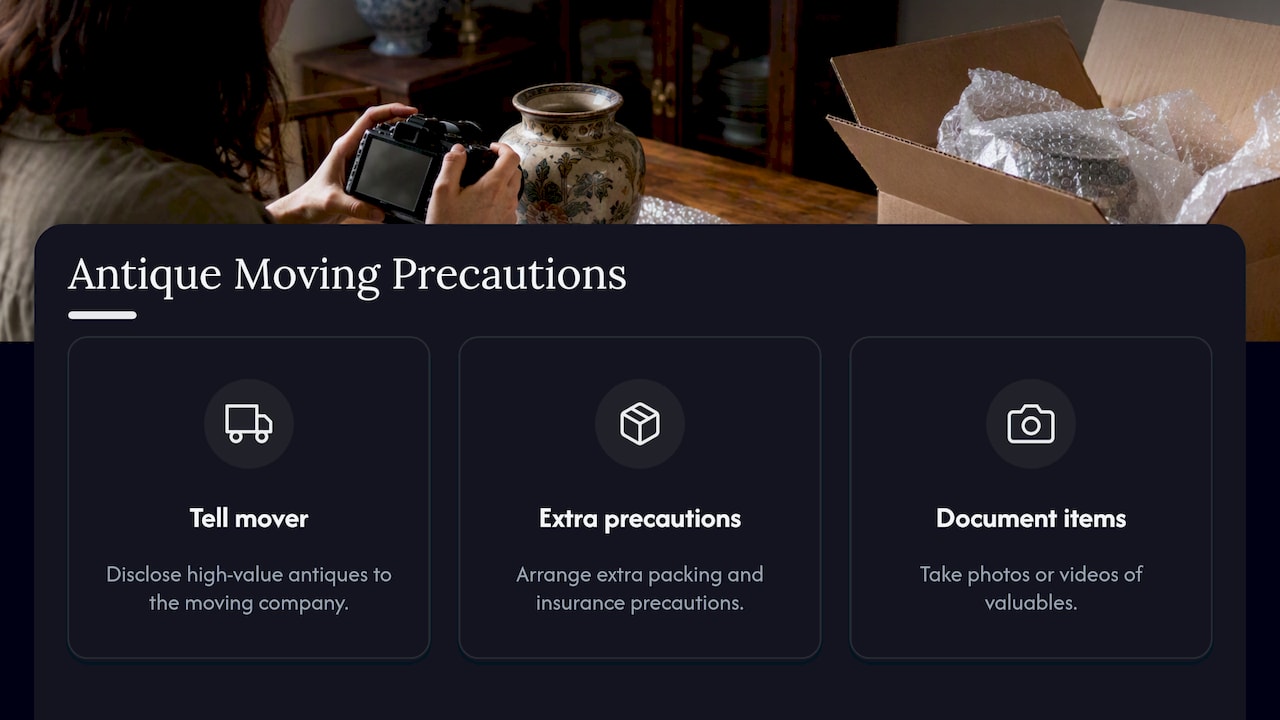
The Canadian Association of Movers advises telling the moving company about high-value items such as fine art, valuable instruments, furs or antiques, so they can apply extra precautions in packing and insuring each one. It also suggests taking photos or videos of valuables.
What counts as an antique worth appraising
Not everything old is valuable, and not everything valuable is old. Age alone does not set the price. What a buyer will actually pay does.
Pieces worth a professional look before a move include:
- Solid wood furniture with original finish, hardware or maker’s marks
- Clocks, mirrors and lighting with fragile or period parts
- Porcelain, glassware and ceramics, especially sets
- Paintings, prints and framed works
- Rugs, silver, brass and bronze
- Inherited items that came with a story but no paperwork
If you are not sure which pieces are worth the cost, take clear photographs and ask an appraiser for a preliminary opinion. Many professionals can give a preliminary assessment from clear, high-resolution photos. A formal appraisal for insurance or legal purposes almost always requires an in-person inspection.
Verbal estimate or written appraisal
This difference trips up many people.
| Verbal estimate | Written appraisal | |
|---|---|---|
| Best for | Deciding what is worth pursuing | Insurance, probate, tax reporting |
| Format | Conversation or quick message | Formal report with item descriptions |
| Research | Light | Condition, rarity, provenance and comparable sales |
| Weight in a dispute | Generally none | Accepted as documentation |
A written appraisal is a formal document involving research into condition, rarity, provenance and recent comparable sales. A verbal estimate generally holds no weight in formal insurance disputes. If you want your mover to record an extraordinary value, a written report gives that number a basis.
What the number actually means
Appraisers in Canada often work with Fair Market Value. The Canadian Cultural Property Export Review Board guide for monetary appraisals says it should rest on actual market data and comparable sales, not on emotional attachment or arbitrary formulas. The International Society of Appraisers explains FMV in the context of Canadian personal property appraisals for charitable donations, estates and cultural property applications.
Two practical lessons follow.
- Asking prices are not sale prices. A similar chair listed online for a high price tells you what a seller hopes for. Professional appraisers filter for verified sold-item data.
- Insurance value and market value can differ. Some appraisals state a replacement value for insurance and others state fair market value. Tell the appraiser the purpose of the report when you book, so the document fits the job.
Who to ask in Ontario
Look for appraisers who belong to a recognized professional body and follow a code of ethics. Three places to start:
- The Canadian chapter of the International Society of Appraisers, where you can find personal property appraisers by specialty, including antiques, furniture, ceramics and Canadiana
- The Canadian Personal Property Appraisers Organization, a national network of accredited appraisers
- The Canadian Association of Personal Property Appraisers, whose site lets you search for a member by location and offers verbal or formal written appraisals
The Canadian Antique Dealers Association lists Toronto-area dealers as well. Some dealers also provide personal property appraisals. Ask whether they will appraise without a purchase offer, because an appraiser who also wants to buy your piece has a different interest than you do.
Why not the museum?
It is a common assumption that the local museum will tell you what your heirloom is worth. It will not. The Royal Ontario Museum states that offering financial appraisals to the general public is contrary to its practice. Go to a professional appraiser instead.
Questions to ask before you hire
- Which association do you belong to, and what is your specialty?
- Will the report be formal and written, and is it suitable for insurance?
- How do you charge: hourly, per item or flat? Is there a travel fee?
- Do you need to see items in person, or can you start from photos?
- How long until I receive the report? (This matters when your moving date is fixed.)
We do not publish appraiser fees here because they vary widely by appraiser, item count and report type. Ask for a written quote.
How to prepare before the appraiser arrives
A prepared home makes the visit shorter and the report stronger.
- Make items accessible. Clear the path to the cabinet, move boxes off the sideboard, and take pieces down from high shelves where safe.
- Gather provenance. That means ownership history: receipts, old appraisals, family letters, auction records, photographs of the piece in the home years ago. Documented origin matters in establishing value.
- Photograph everything yourself. Take wide shots and close-ups of marks, labels, signatures, joints and any damage. Date the files.
- Measure each piece. Height, width and depth help both the appraiser and your mover plan the truck load.
- Do not clean or repair first. Heavy polishing or restoration can change value. Ask the appraiser before you touch anything.
- Make a list. Note which items are going with you, which are going to storage and which you may sell.
A few details stay with the appraiser, but this list is your part of the work.
Passing the value to your mover
The appraisal is only half the job. The other half is making sure the moving company knows about it, in writing.
The Canadian Association of Movers notes that movers are generally limited to a default rate, typically $0.60 per pound ($1.32 per kg) per item, when value is not declared. For a 30-pound antique clock worth thousands, that default is far below its worth. Replacement Value Protection may be required to cover full market value, and your mover can explain how to list these items separately on your Bill of Lading.
Here is a simple order of operations:
- Get the appraisal or, at minimum, a written valuation for each high-value piece.
- Share the list with your mover when you request a quote, not on moving day.
- Ask how the mover will list the items on the Bill of Lading and what coverage options apply.
- Ask what extra packing the mover will use for each piece.
- Keep your photos and a copy of the report in a place that is not in the truck.
The federal government’s moving advice from the Office of Consumer Affairs also recommends getting estimates from several movers and choosing one with reliable evidence of good customer service. For a clearer picture of how valuation and liability work in Ontario, see our guide to moving valuation explained.
Our perspective: what we see on moving day
We have been moving Ontario families for over 18 years, and antiques are the items people worry about most. The worry is fair. A piece with a story attached is one you cannot replace.
Here is what we have learned.
The homeowners who have the smoothest moves are not the ones with the most expensive pieces. They are the ones who arrive with a list. When a customer tells us up front which items are fragile or valuable, we can plan crew size, wrapping materials and truck loading around them. When we hear about a family heirloom for the first time on moving day, we are making those decisions in a hurry. That helps nobody.
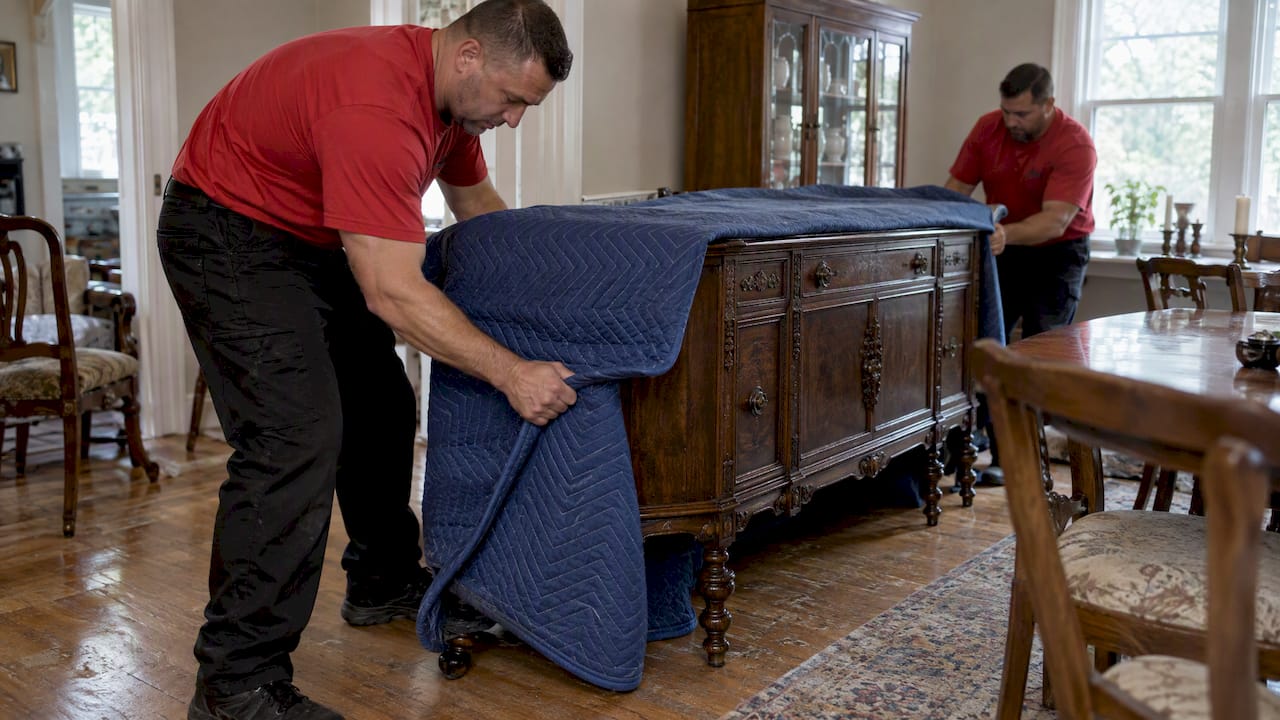
We also encourage people to separate the two questions: what is it worth, and how should it be moved. An appraiser answers the first. We answer the second. Our flat-rate quotes come with no hidden fees, so we like to see the list of special items early. It lets us give you a firm number that already accounts for the extra care.
If you are not sure whether a piece needs appraising, ask us. We will tell you honestly whether it needs special handling, and we will not tell you what it is worth, because that is an appraiser’s job.
— Ali
Packing and moving appraised antiques
Once the paperwork is done, the physical side starts. Appraised pieces should be packed with the same care as the report describes them.
- Keep the appraisal’s item description or photo with each piece so everyone knows what it is.
- Disassemble only what the maker intended to come apart. Bag and label hardware.
- Use proper wrapping and padding and avoid newspaper ink on finished surfaces.
- Load fragile pieces so they cannot shift, and keep them upright where the design requires it.
For step-by-step methods, read our guides on how to pack antiques safely and how to pack antiques for a long-distance move. Our broader guide to moving antiques in Canada covers planning, and if you want a sense of budget, see our page on antique moving cost.
Moving antiques with Aleks Moving
We offer antiques and art moving as part of our residential moving services. If you would rather not pack delicate pieces yourself, our packing service handles it. We can also store items between homes through our moving and storage service. Tell us about your appraised pieces when you ask for your free upfront quote, and we will build a flat-rate plan around them. You can reach us through our website, by phone or on WhatsApp.
A timeline that works
| When | What to do |
|---|---|
| 8 to 6 weeks before | List your antiques, take photos, contact appraisers |
| 6 to 4 weeks before | Appraisal visit; collect provenance documents |
| 4 to 3 weeks before | Receive written report; request moving quotes with your list |
| 2 weeks before | Confirm declared values and coverage in writing |
| Moving week | Pack or have professionals pack; keep reports and photos separate |
| Delivery day | Inspect each piece against your photos before signing off |
If your move is closer than that, do not skip the step. Ask an appraiser whether a photo-based preliminary opinion is possible, and tell your mover which items are still awaiting formal valuation.
FAQ
Do I really need an appraisal if I am only moving across town?
Not always, but a short move does not remove the risk. If a piece would be hard to replace or is worth a significant amount, a written valuation helps you declare it properly. For lower-value items, photos and a clear list may be enough. Ask your mover what documentation they need.
Is a 70-year-old piece of furniture an antique?
There is no single rule that settles it, and age alone does not set value. Definitions vary among dealers, collectors and insurers. What matters for your move is whether the piece has real market value and whether you would be able to replace it.
Can I get an appraisal from photos only?
For a preliminary opinion, often yes. Many professionals can give a first assessment from clear photos. For a formal written appraisal for insurance or legal use, expect an in-person inspection.
What should I not say to an appraiser?
Do not inflate the story or guess at details you are unsure of. Tell them what you know and what you do not. Also share the purpose of the report, because that changes the type of value they write.
Will my mover’s standard coverage pay full value for an antique?
Not unless you declare it and arrange suitable protection. The default liability is often a small amount per pound, as the Canadian Association of Movers explains. Ask your mover about Replacement Value Protection before moving day.
Sources
- Liability, Canadian Association of Movers
- Antique and Estate Appraisals in Ontario, Visbids
- CCPERB Guide for Monetary Appraisals
- Understanding and Determining Fair Market Value in Canadian Appraisals, ISA
- International Society of Appraisers, Canadian Chapter
- Canadian Personal Property Appraisers Organization
- Canadian Association of Personal Property Appraisers
- CADA Toronto Dealers
- Does the Museum appraise or authenticate objects? Royal Ontario Museum
- Moving advice, Office of Consumer Affairs