

A studio move in Toronto typically runs in the lower hundreds of dollars, a one‑bedroom move costs several hundred to just over a thousand, and a two‑bedroom move can cost upwards of a thousand dollars, all before HST. The spread comes down to hours worked, crew size, truck fees, and extras like stairs or long carries. Your best move: get three written, itemized estimates before you book anyone.
TL;DR:
- The average cost for a studio move in Toronto ranges from a few hundred dollars up to about $1,000 before tax, depending on building access and obstacles.
- Complex jobs, like long-distance transitions or moves involving stairs and no elevator, can push the price toward $4,000, especially with full packing or multiple flights.
- Hourly rates typically run from $110 to $150 for two movers or $150 to $200 for three, plus a truck fee of $150 to $220, with extras for stairs, long carries, and after-hours moves.
- Obtaining three detailed, itemized estimates helps avoid hidden fees and ensures the final invoice aligns with the original quote, especially for flat-rate contracts.
- Booking mid-week, off-peak seasons, and early elevator reservations can significantly reduce move costs and logistical complications.
Table of Contents
- How much does an apartment move cost in Toronto by size?
- What do movers charge per hour in Toronto?
- Which extra fees catch renters off guard?
- What do packing, supplies, and storage cost?
- What should you check about insurance, deposits, and tax on your quote?
- What do two real Toronto moving quotes look like line by line?
- How do you build your own moving estimate before calling anyone?
- What do Ontario rules and CRA guidance mean for your budget?
- Why transparent pricing matters more than the lowest quote
- Ready to book a move without the surprise invoice?
- Where to verify these numbers yourself
- Sources
- FAQ
How much does an apartment move cost in Toronto by size?
The price you pay depends less on square footage and more on how many hours a crew needs and how many obstacles they hit along the way. A studio with a straightforward elevator building costs far less than a one‑bedroom on a third floor walk‑up with no parking out front.
Here’s how the ranges typically break down for local moves within the city:
- Studio apartment: typically costs less with fewer hours and a small crew
- One‑bedroom apartment: usually requires more hours and possibly an extra crew member, increasing the cost
- Two‑bedroom apartment: involves even more hours and crew, leading to higher costs
Some industry mover guides report broader Toronto ranges stretching from $300 up to $4,000 for local moves. That top end almost always reflects complex jobs: long‑distance apartment‑to‑house transitions, full packing service, or moves involving multiple flights of stairs with no elevator access.
Building access changes the math more than most renters expect. A high‑rise with a loading dock and service elevator can shave a full hour off a job compared to a walk‑up on a narrow residential street where the truck has to park half a block away. Movers in older Toronto neighbourhoods like Parkdale or the Annex, where laneway parking and tight staircases are common, often quote flat rates instead of hourly ones specifically because the variability is too high to estimate cleanly.
Timing matters too. Weekend moves, month‑end moves, and anything scheduled between May and September tend to carry premium pricing because demand spikes. Booking a Tuesday in February will almost always cost less than a Saturday on July 1.
What do movers charge per hour in Toronto?
Hourly rates are the backbone of most local moving quotes, and understanding them lets you sanity check any estimate you receive. A two‑person crew typically charges somewhere between $110 and $150 per hour before tax, while a three‑person crew runs higher, often $150 to $200 per hour, because the extra set of hands speeds up loading but adds to the labour bill.
On top of the hourly rate, most Toronto movers charge a one‑time truck or dispatch fee, generally $150 to $220 depending on truck size and how far the crew has to travel to reach your building. That fee typically covers:
- Fuel and vehicle wear for the trip to and from your address
- Basic furniture disassembly and reassembly (beds, tables, shelving units)
- Furniture blankets, dollies, and basic protective wrapping
What usually costs extra: specialty crating for artwork or antiques, appliance disconnection requiring a licensed technician, and any packing service beyond what you’ve boxed yourself. Ask upfront whether the quoted hourly rate includes drive time between stops, since some companies bill portal to portal and others only bill from arrival.
Which extra fees catch renters off guard?
A handful of predictable surcharges account for most of the gap between an initial phone quote and the final invoice. Knowing them in advance means you can either budget for them or negotiate them away.
- Stairs and long carry fees. Expect a per‑flight charge if there’s no elevator, plus a long carry surcharge if the truck can’t park within roughly 50 metres of your door.
- Elevator reservation and building fees. Many condo buildings require advance booking of the service elevator and may charge a refundable deposit or admin fee separately from your mover’s bill.
- Large or awkward item handling. Pianos, safes, treadmills, and oversized sectionals often trigger a flat surcharge because they need extra hands or special equipment.
- After‑hours or holiday premiums. Evening moves or anything scheduled on a statutory holiday typically carries a rate bump of 15% to 25%.
Reserving the elevator early, pre‑measuring doorways and hallways, and disassembling small furniture yourself before the crew arrives are the fastest ways to keep these line items off your final bill.
What do packing, supplies, and storage cost?
Packing your own boxes is the cheapest route, with basic supplies (boxes, tape, paper) running roughly $50 to $150 for a one‑bedroom apartment. Hiring full packing service instead typically adds $200 to $600 depending on how much needs wrapping, since it bills as additional crew hours plus material costs.
Bin rentals sit in the middle. Renting 20, 50, or 100 reusable bins instead of buying cardboard is popular with renters doing multiple moves or downsizing, since bins stack cleanly in a truck and don’t collapse under weight. Delivery and pick‑up for bin rentals runs $150 as a flat, one‑off fee on top of the rental itself.
Short‑term storage becomes worth the cost mainly when your move‑out and move‑in dates don’t line up, or when a new unit isn’t move‑in ready and you need somewhere to park your belongings for a week or two.
What should you check about insurance, deposits, and tax on your quote?
Every mover carries basic liability coverage, but it’s usually minimal, often calculated by weight rather than item value. If you own anything genuinely valuable, ask about declared value coverage or a third‑party insurance policy before moving day, not after something breaks.
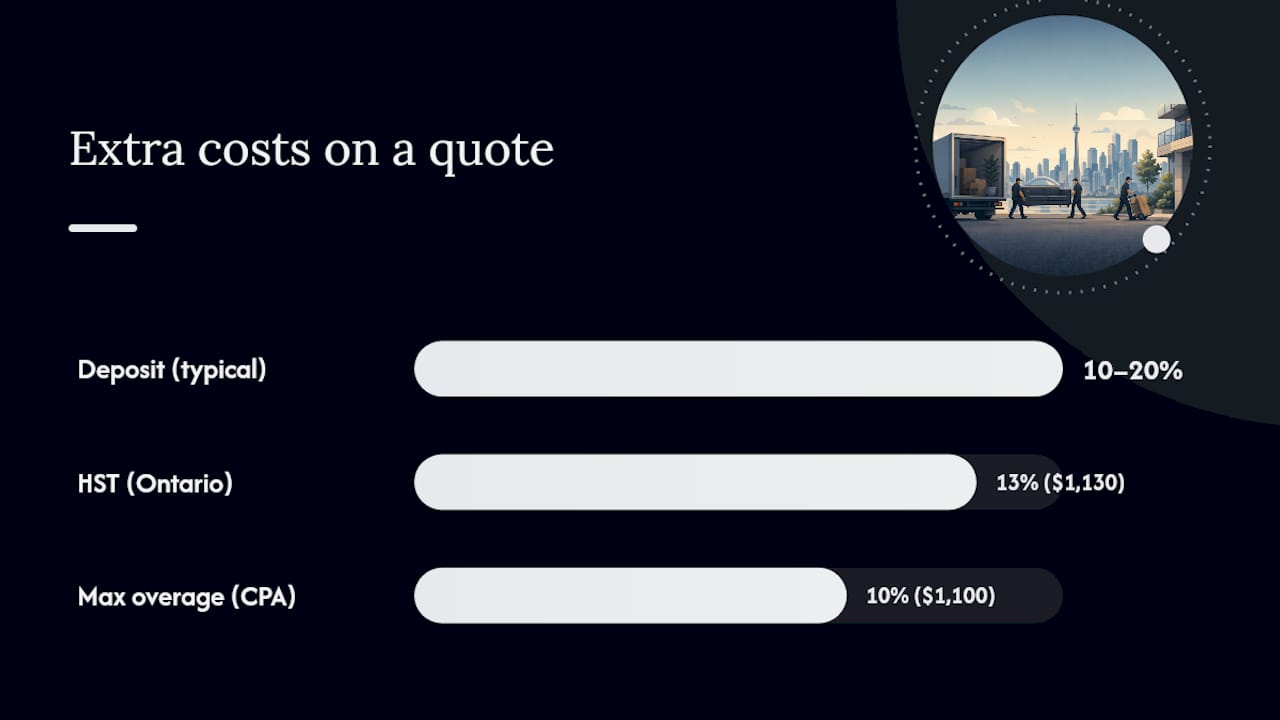
Deposits are common but should be modest, typically 10% to 20% of the estimated total, and should always appear as a line item on a written contract rather than a cash handshake.
Statistic Callout: HST at 13% applies to moving labour and most related services in Ontario, so a $1,000 quote actually costs $1,130 once tax lands. Ontario’s Consumer Protection Act framework generally supports a maximum 10% overage above a written estimate, meaning a $1,000 quote shouldn’t legally become $1,300 on move day.
What do two real Toronto moving quotes look like line by line?
Numbers make more sense once you see them stacked. Here are two worked examples using typical Toronto rates.
Sample A: One‑bedroom apartment, elevator building, minimal stairs
- 2 movers × 4 hours × $120/hour = $960
- Truck and dispatch fee = $180
- Subtotal = $1,140
- HST at 13% = $148.20
- Estimated total = $1,288.20
Sample B: Two‑bedroom apartment, third‑floor walk‑up, partial packing
- 3 movers × 6 hours × $150/hour = $2,700
- Truck and dispatch fee = $200
- Stair surcharge (three flights) = $120
- Partial packing service = $250
- Subtotal = $3,270
- HST at 13% = $425.10
- Estimated total = $3,695.10
On a $3,270 quote, that caps a legitimate overage around $327, not several hundred dollars more.
How do you build your own moving estimate before calling anyone?
Walking through your apartment with a phone camera before you request quotes puts you in control of the conversation instead of reacting to whatever number a mover gives you.
- Photograph every room and note anything unusually heavy, oversized, or fragile (pianos, glass tables, wall units).
- Count items by category, not just boxes: furniture pieces, appliances, and anything requiring disassembly.
- Measure doorways, hallways, and stairwells at both locations, since a couch that won’t fit around a corner adds real time.
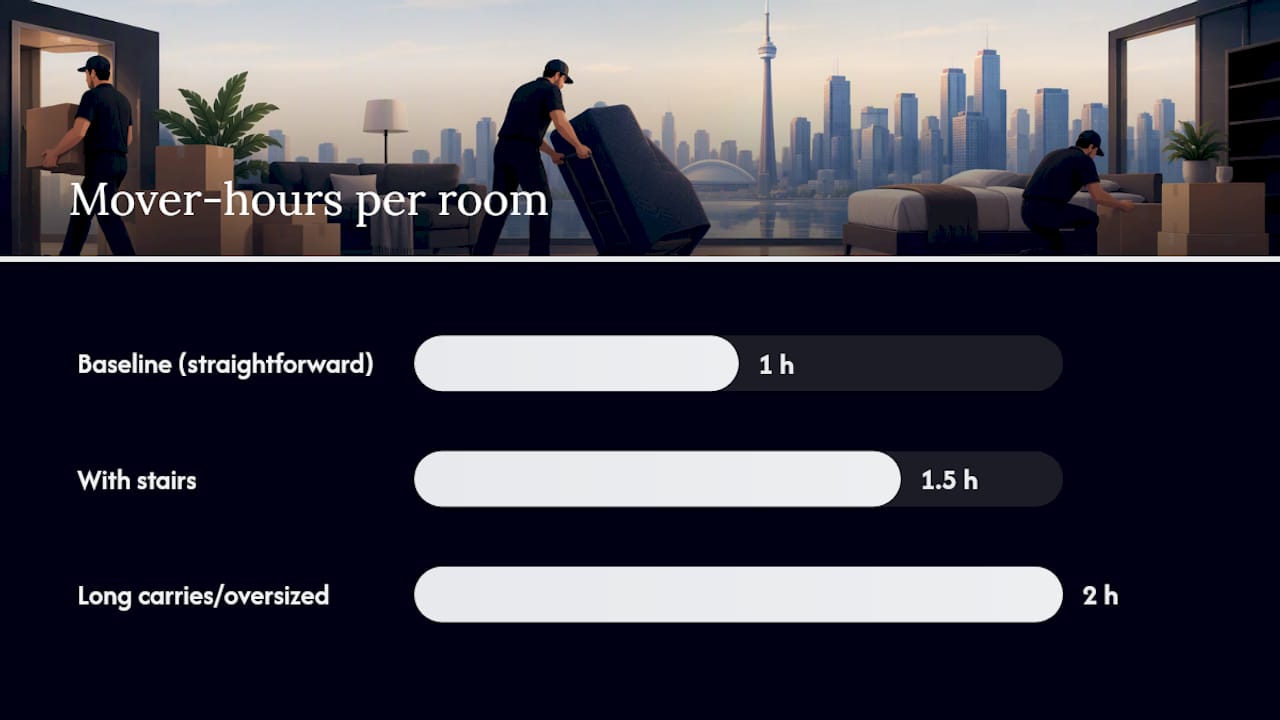
- Estimate mover‑hours using a rule of thumb: roughly one hour per room for a 2‑person crew in a straightforward building, adding 30 to 60 minutes for stairs or long carries.
- Request written, itemized quotes from at least three companies, and ask each one directly about truck fees, stair charges, and whether HST is included in the number they’ve given you — a key step emphasized by Moving Company SEO Services for verifying company websites and estimates.
Pro Tip: Send the same room‑by‑room inventory list to every mover you contact. Identical input makes the three quotes genuinely comparable instead of apples to oranges.
A detailed moving checklist can help you sequence these steps against your actual move date so nothing gets missed in the final week.
What do Ontario rules and CRA guidance mean for your budget?
Ontario doesn’t license moving companies provincially, which is exactly why written documentation matters so much. The province’s own guidance on hiring a mover recommends collecting at least three written estimates and confirming an itemized contract that spells out crew size, truck size, and estimated hours before you sign anything.
A few protections worth knowing:
- Movers cannot lawfully hold your belongings hostage to force additional payment beyond your contract.
- Ontario’s consumer protection framework generally limits unilateral price increases, with a 10% variance from the original estimate commonly cited in disputes.
- If your move is tied to a new job or business location at least 40 kilometres closer, the CRA allows eligible moving expenses to be claimed using Form T1‑M, so keep every receipt.
- Renters facing genuine financial hardship may qualify for flat moving amounts through Toronto’s Housing Stabilization Fund, currently $350 for singles or couples moving within Ontario.
Why transparent pricing matters more than the lowest quote
The renters who end up happiest with their move aren’t the ones who found the cheapest hourly rate. They’re the ones who got an itemized quote that actually matched their final invoice. A flat‑rate or clearly itemized contract removes the guesswork and the awkward negotiation on move‑out day. Some moving companies build their quotes this way, with flat‑rate pricing and no hidden fees across residential moves, packing, and bin rental, because a number you can trust in advance beats a number that changes on you at 4 p.m. on moving day.
— Ali
Ready to book a move without the surprise invoice?
Most Toronto movers quote by the hour and let surcharges pile up as the day goes. Some moving companies take a different approach: flat‑rate pricing agreed to upfront, with no hidden fees added once the truck shows up. That means the number you see in your written estimate is the number you pay, whether the job hits traffic, extra stairs, or a tight parking spot.

Whether you’re moving out of a studio downtown or coordinating a two‑bedroom move with a tight elevator window, Aleksmoving’s local moving service covers the full job, from loading to unloading. If packing is eating your weekend, professional packing service can take that off your plate entirely, and bin rental is worth a look if you’d rather skip cardboard altogether. Get a free written estimate for your residential move and lock in a flat rate before your move date arrives.
Where to verify these numbers yourself
For the rules governing estimates and contracts, Ontario’s own hiring a mover guidance is the primary source. Tax questions belong with the CRA’s moving expenses page, and renters facing financial hardship should check the City of Toronto’s Housing Stabilization Fund for eligibility. Before booking any company, a quick check on BBB or HomeStars adds useful context on complaint history.
Sources
- Canada
- Housing Stabilization Fund – City of Toronto
- Amended Pricing by Moving Company: Unilateral Change from Originally Provided Estimate | Forseti Legal Services
FAQ
Who are the cheapest movers in Toronto?
There’s no single cheapest company, since rates shift with season, crew size, and building access. The most reliable way to find an affordable option is comparing three written, itemized estimates for your specific apartment size and move date, as Ontario’s guidance on hiring a mover recommends.
What is the cheapest day to hire movers?
Weekdays, particularly mid‑week and mid‑month, are typically cheaper than weekends and month‑end dates because demand drops. Booking outside the May to September peak season also tends to lower hourly rates and truck fees.
How do you calculate how much it will cost to move?
Multiply your expected mover‑hours by the hourly crew rate, then add the one‑time truck fee and any known surcharges like stairs or elevator reservations.
What is the most expensive part of moving?
Labour hours are usually the largest line item, followed by stair or long carry surcharges on buildings without elevator access. Full packing service adds meaningfully to the total too, often $200 to $600 depending on how much needs wrapping.