
Movers typically refuse hazardous materials and household chemicals, fuels and propane tanks, explosives and fireworks, firearms and ammunition, perishable foods, live animals and houseplants, and high-value valuables or heirlooms. Policies vary by company and by contract, so confirm restrictions when you book. The good news: every one of these items has a practical, legal alternative, and we’ll walk through the full checklist below.
TL;DR:
- Movers typically refuse hazardous chemicals, fuels, explosives, firearms, perishables, live animals, valuables, and unboxed fragile items, mainly due to safety and insurance restrictions.
- Proper alternatives include personal carrying of valuables, using municipal hazardous waste depots, draining fuel from equipment, and hiring licensed specialists for high-value or fragile items.
- Before moving, photograph valuables, disconnect gas and batteries, label boxes clearly, and ask the mover about specific restrictions and coverage limits for high-value items.
- Recalled products and certain antiques require special handling, documentation, or professional crating, with outright refusal often linked to safety hazards and insurance exclusions.
- International moves impose additional restrictions based on destination country rules, especially for foods, plants, firearms, and pets, requiring careful planning and documentation.
Table of Contents
- Items movers won’t move: the complete category breakdown
- What to do with items your mover won’t take
- Your pre-move checklist: questions to ask and prep to do
- Why movers draw the line where they do
- What about items with a recall or safety notice?
- Antiques and fragile pieces need a different kind of care
- How insurance policies shape what a mover will carry
- Crossing the border: extra rules for international moves
- A note on transparency from Aleks Moving
- How Aleks Moving handles the items that need extra care
- Where to go for disposal, donation, and mover research
- Sources
Items movers won’t move: the complete category breakdown
Every professional mover works from a list of restricted goods, and while the exact wording differs between companies, the categories are remarkably consistent across the industry. Insurance policies, provincial transport regulations, and basic fire safety drive almost every rule on that list. Here’s what typically won’t make it onto the truck, and why.
Hazardous household chemicals and cleaning supplies. Paint thinners, solvents, bleach, pool chemicals, pesticides, and most aerosol cans fall into this category. These products can react with each other in a hot, jostling truck, and some are flammable enough to pose a real fire risk during transport. Mayflower’s guidance on prohibited items confirms that household hazardous materials sit near the top of nearly every mover’s exclusion list, largely because insurers won’t cover damage or injury caused by a chemical spill or fire in transit.
Fuels and gas-containing items. Gasoline, propane cylinders, barbecue tanks, and any fuel left sitting in a lawn mower or chainsaw are almost universally refused. A full propane tank in an enclosed truck is a fire and explosion hazard, and federal transport rules restrict how flammable liquids move between provinces. Movers will often accept the equipment itself once you’ve drained the tank, but not the fuel.
Explosives and fireworks. Fireworks, flares, and any explosive-grade chemical are barred outright. The reason comes down to basic chemistry: gunpowder and other pyrotechnic mixtures rely on an oxidizer paired with a fuel source, which makes them sensitive to heat, friction, and impact. A moving truck bouncing over highway potholes is precisely the wrong environment for that kind of chemistry.
Firearms and ammunition. Most movers won’t transport guns or ammunition under their standard contract, partly because of legal chain-of-custody requirements and partly because insurers exclude them from coverage. If you own firearms, expect to transport them yourself under your province’s transport and storage rules, or use a licensed specialty carrier.
Perishable foods and refrigerated goods. Anything in your fridge or freezer, along with fresh produce, is typically off the list. Spoilage during a multi-hour or multi-day move creates contamination risk and, frankly, a mess nobody wants to deal with at the other end. Moving lists perishables as one of the most consistently refused categories across the industry. Canned goods, dry pasta, and other shelf-stable items are usually fine to pack.
Live animals and houseplants. Pets and plants both come with welfare and liability concerns that most movers simply won’t take on. NerdWallet’s review of what movers exclude notes that some local movers make exceptions for plants on short trips, but it’s the exception rather than the rule, and cross-border moves add quarantine and inspection issues on top.
Valuables, heirlooms, and important documents. Jewellery, cash, passports, wills, and family heirlooms carry sentimental or financial value that standard mover insurance won’t fully cover. Coverage limits and liability exclusions mean a lost or damaged heirloom rarely gets reimbursed at its true worth, which is why industry guidance consistently recommends personal transport for anything irreplaceable.
Unboxed electronics and fragile items. A flat-screen TV without its original box, or china without proper crating, often gets refused on the spot. Moving Help’s list of restricted items points to breakage risk and liability as the main drivers here; movers can’t take responsibility for damage to something that was never properly protected in the first place.
Oversized specialty items. Pianos, gun safes, and heavy marble furniture often need riggers, extra crew, or special equipment that falls outside a standard moving contract. It’s less a flat refusal and more a case of “not without the right add-on service.”
What to do with items your mover won’t take
Every restricted category has a workable alternative, and most of them take less effort than you’d expect.
- Personal transport for valuables and documents. Keep jewellery, passports, wills, and cash in a bag that travels with you in the car, never in the truck. If you own legally registered firearms, check your province’s transport rules and consider a locked case in your own vehicle.
- Municipal hazardous-waste depots for chemicals. Most cities run drop-off depots for paint, solvents, pesticides, and batteries. A quick search for your municipality’s hazardous-waste program will usually turn up hours and accepted items.
- Drain fuel before moving day. Run lawn mowers and trimmers until the tank is empty, or siphon out gasoline safely, and most movers will then accept the equipment. Our guide to packing yard tools walks through the safe order of operations.
- Specialist carriers for pianos, firearms, and fine art. Ask for licensed, insured movers who specialize in these categories, and request written confirmation of their coverage limits before you book.
- Donate non-perishable food instead of packing it. Programs like Move For Hunger partner with moving companies across North America to collect canned goods and pantry staples, keeping usable food out of the landfill.
- Stage your move with storage. If a chemical, seasonal item, or oversized piece doesn’t fit neatly into either “take it yourself” or “toss it,” temporary storage lets you deal with it separately instead of holding up the whole truck.
Pro Tip: Photograph the contents of your fridge and pantry a few days before your move, then plan meals specifically to use them up. It’s the easiest way to avoid a last-minute scramble to find a home for perishables.
Your pre-move checklist: questions to ask and prep to do
Before you sign a contract, ask your mover three things: what their written list of restricted items covers, whether their insurance has separate limits for high-value goods, and what fees apply for special handling like pianos or safes. Getting these answers in writing avoids disputes later, and it’s worth reviewing how to choose a reputable moving company before you commit to anyone.
On your end, prepare like this:
- Photograph valuables and heirlooms, and keep receipts or appraisals handy.
- Drain gas from lawn equipment and disconnect batteries, especially lithium-ion battery packs, which carry their own fire risk if damaged in transit.
- Pack perishables into a cooler for personal transport or plan to use them up beforehand.
- Label every box clearly and keep a written inventory as items go on the truck.
On moving day, walk the home with your crew before loading starts. According to NerdWallet’s research, mover exclusions cluster around three drivers: safety risk, insurance limitations, and handling logistics like weight or access. A quick walkthrough catches any item that falls into one of those buckets before it becomes a problem on the truck.
Why movers draw the line where they do
Insurers set most of these rules, not the movers themselves. A crew that loads a leaking propane tank or an unboxed chemical bottle exposes the company to liability its policy won’t cover, so refusing the item is the only responsible option.
That said, exceptions exist under the right conditions. We’ve accepted drained lawn equipment, pianos moved with a hired rigger, and high-value pieces transported under a separate written agreement with specific coverage terms. The pattern is consistent: whenever an item needs special handling, expect a conversation about documentation, extra fees, or a standalone contract rather than a flat “no.”
What about items with a recall or safety notice?
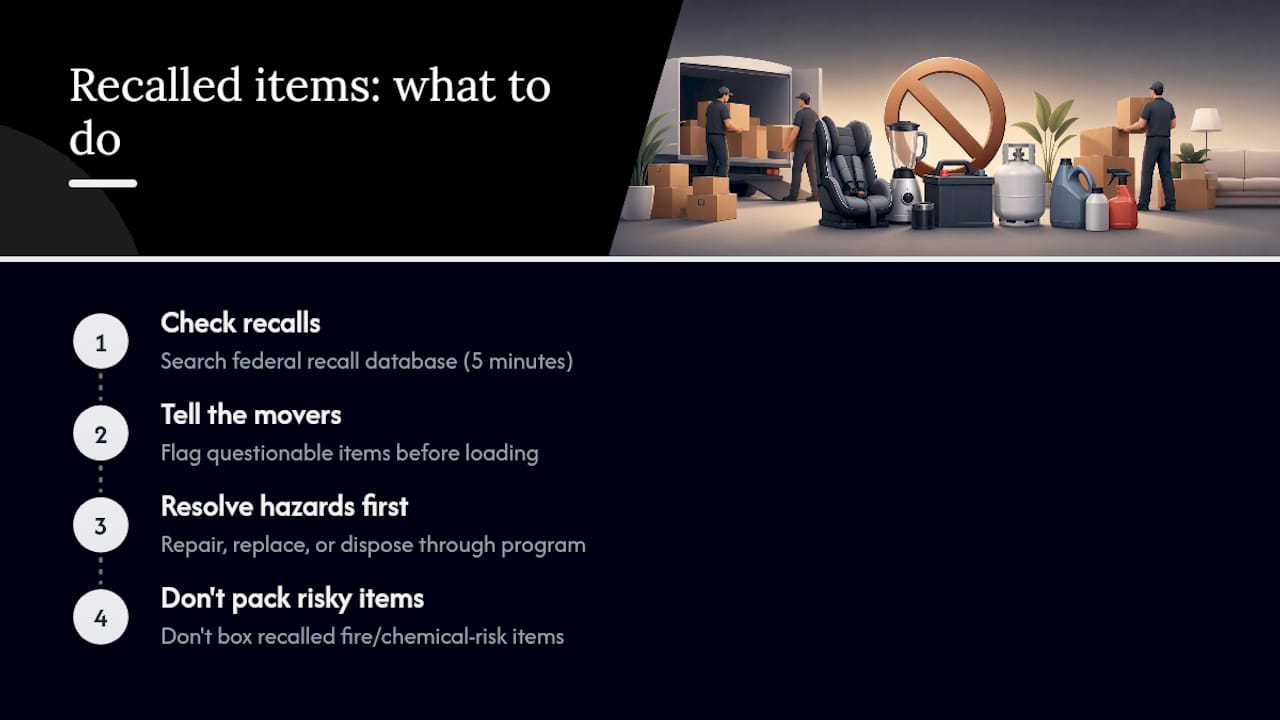
Products under an active Health Canada or Transport Canada safety recall present a grey area many movers won’t touch, particularly if the recall involves fire or chemical risk (certain space heaters, lithium battery packs, or specific appliance models, for example). Even when a mover is willing to load a recalled item, you’re taking on the liability yourself if it causes damage in transit.
Before your move, it’s worth checking any major appliance, car seat, or electronic device against the federal recall database, especially if you bought it secondhand or it’s been sitting in storage for years. If an item is under recall for a fire or safety hazard, the safest move is to deal with it before packing day, either through the manufacturer’s repair or replacement program or by disposing of it through the appropriate channel. Don’t just tuck a recalled space heater into a box and hope it makes the trip. Most recalls exist because something failed under stress, and a bumpy truck ride qualifies.
If you’re unsure whether an item falls under an active notice, a five-minute search beats finding out the hard way. Movers appreciate transparency here too. Flagging a questionable appliance ahead of time lets everyone plan around it instead of discovering the problem mid load.
Antiques and fragile pieces need a different kind of care
Standard moving contracts assume standard furniture. Antiques, fine china, and fragile art often fall outside what a general crew and standard packing materials are built to protect. That doesn’t always mean an outright refusal, but it usually means special terms.
A century-old dresser with veneer that’s already lifting, a marble-topped table, or a set of hand-blown glassware needs custom crating, extra padding, and sometimes a slower, more deliberate loading process than a typical dresser or sofa. Movers who handle antiques regularly will often ask to inspect the piece beforehand, note any existing damage in writing, and quote separately for the materials and time involved.
If your mover’s standard service doesn’t include this kind of specialty handling, ask directly whether they offer it as an add-on or can refer you to someone who does. Our packing services page covers the materials and techniques used for fragile and high-value pieces, which is worth a look if you’re moving anything irreplaceable. The goal isn’t just getting the item on the truck. It’s making sure the crew handling a 100-year-old heirloom understands why it deserves more time than a flat-pack bookshelf.
How insurance policies shape what a mover will carry
A mover’s insurance policy is the quiet force behind most of these restrictions. Basic liability coverage, sometimes called released value protection, caps what a company owes per pound of damaged goods, and that cap is often far below the real value of jewellery, art, or family heirlooms. Movers restrict these items partly to protect you from being underinsured and partly to protect themselves from disputes over items they can’t reasonably appraise.
Full-value protection plans exist and usually cost more, but even those plans typically exclude cash, securities, and certain collectibles outright. That’s a policy limitation, not a loophole a bigger premium can fix. If you’re moving something genuinely valuable, ask your mover for the exact wording of their coverage exclusions before moving day, not after something goes wrong.
This is also where separate written agreements come in. When a mover agrees to transport a high-value item, they’ll often ask you to sign a supplementary contract acknowledging the item’s declared value and the specific coverage terms that apply to it. It’s a bit of extra paperwork, but it protects both sides if a dispute ever comes up.
Crossing the border: extra rules for international moves
International moves add a second layer of restrictions on top of a mover’s standard policy. Customs regulations in your destination country can prohibit items that a domestic move would happily accept, including certain foods, plants, wood products, and firearms.
Alcohol, tobacco, and some medications also face strict quantity limits or outright bans depending on where you’re headed. Wood furniture and certain plant-based items can trigger agricultural inspection holds if they’re not properly declared, and pets crossing international borders need specific vaccination and quarantine documentation well in advance of the move date.
If your move crosses a border, check both Canada’s export rules and your destination country’s import restrictions separately. They rarely match exactly, and assuming they do is one of the more common mistakes movers see. A specialist in international relocations can flag these issues early, well before your goods reach a customs checkpoint and get held up.
A note on transparency from Aleks Moving
Over 18 years of moving households and offices across Ontario, we’ve learned that most restricted-item surprises come from a lack of upfront conversation, not bad intentions. We flag unusual items during the in-home estimate, quote specialty handling honestly, and refer customers to trusted partners for pianos, fine art, or firearms when a job calls for it.
If your move involves anything on this list, or anything you’re simply unsure about, ask us before booking. We’d rather sort it out at the quote stage than on moving day.
— Ali
How Aleks Moving handles the items that need extra care
A moving company can be the practical alternative to sorting out restricted items on your own. Professional movers can handle packing, crating, and specialty logistics to keep antiques, electronics, and high-value pieces safe, and may connect you with trusted partners for anything that falls outside a standard move.
Some moving companies offer services such as professional packing with proper crating materials for fragile and antique pieces, short and long-term storage for items that require separate handling, and referrals to licensed specialists for pianos, firearms, and fine art moves. Quotes may be provided with flat rates and no hidden fees, so customers can understand the cost of specialty handling before moving day.
If your upcoming move includes items you’re unsure about, whether it’s a chemical cabinet, a family heirloom, or a piano that needs a rigger, request a free quote and we’ll walk through your inventory together and flag anything that needs special handling before the truck ever shows up.
Where to go for disposal, donation, and mover research
For household chemicals and hazardous waste, search your municipality’s hazardous-waste depot program before moving day. For non-perishable food, Move For Hunger connects movers with local food-rescue organizations across North America. Before booking any moving company, check its complaint history and accreditation through the Better Business Bureau to confirm it’s in good standing.
Sources
- Here’s What Your Movers Won’t Move
- What Will Movers Not Move? What Items Are Not Worth Moving – NerdWallet
- Move For Hunger