

Yes, you can move on a holiday in Canada, but it takes earlier booking and a realistic budget for holiday pay. Do three things now: book your movers well ahead, get a written quote with deposit and cancellation terms, and confirm utility transfers, elevator bookings and any parking permits before the date arrives.
TL;DR:
- Compare two written estimates for crew size, truck size, and holiday surcharges; cancellations with less than 24 hours’ notice can cost $150 to $330.
- Ask movers to itemize holiday rates and state whether they cover the whole job or only holiday hours; compare the quote with a nearby weekday.
- Some utility providers require up to 30 days’ notice, while elevator bookings, parking permits, and holiday enforcement rules vary by municipality.
- Renters should check provincial notice rules, document the unit with dated photos, and arrange key handover in writing; a short rent overlap can ease delays.
- For Montréal moves on July 1, book months ahead: many Québec leases end June 30, creating a concentrated rush for crews, elevators, and parking.
Table of Contents
- When should you book movers for a holiday move?
- How do holiday pay and demand affect moving costs?
- How do you arrange utilities, elevators, parking and permits?
- What belongs on your final week and move-day checklist?
- What should renters do differently on a holiday move?
- Why does Montréal’s July 1 moving day matter?
- How do you choose a mover for a holiday move?
- How can you keep holiday moving stress under control?
- How do you handle holiday traffic and weather on moving day?
- How do you fit a move around holiday events and celebrations?
- Who should you tell about a holiday move, and when?
- A practical view from our crews
- How can we help with your holiday move?
- FAQ
- Sources
When should you book movers for a holiday move?
Busy holiday dates can book out weeks to months ahead, so treat your moving date like a flight on a long weekend: reserve early, then fine-tune. If you are not sure how early is early enough, our guide on how far in advance to plan a move walks through the usual milestones.
Here is a timeline that works for most households:
- Well ahead of the move: Request at least two written estimates and compare exactly what each one includes: crew size, truck size, hourly or flat rate, and any holiday surcharge.
- Once you have compared estimates: Choose your mover, sign the contract and pay the deposit. Note the cancellation deadline in your calendar.
- Early in your planning: Contact your utility providers, since some need long notice to close or transfer an account.
- Well ahead of the move: Book the building elevator, loading dock or concierge time in writing, and apply for any parking permit.
- Before moving day: Reconfirm the arrival window with your mover by email.
Pay attention to the deposit terms. The Office of Consumer Affairs advises getting written quotes and notes that short-notice cancellations can be costly, with examples running from $150 to $330 for less than 24 hours’ notice. Reputable movers often ask for a firm deposit or signed contract, which protects your date as much as theirs.
How do holiday pay and demand affect moving costs?
Moving on a statutory holiday costs more for two plain reasons: labour and demand. Provincial holiday-pay rules mean that working on a statutory holiday costs an employer more than a regular business day, and CFIB’s paid holidays guidance explains how those rules raise the cost of work on those days. That higher base cost shows up in your quote.
Holiday pay rules effectively raise the minimum cost of working a statutory holiday compared with a standard business day, according to CFIB. In practice, that means a holiday rate is a normal part of the price, not a sign of a dishonest mover.
Demand adds pressure on top. When many households want the same long weekend, crews are scarce and prices tend to rise, while availability shrinks.
To keep your budget under control:
- Ask for the holiday rate as its own line item on the written quote.
- Ask whether the holiday rate applies to the whole job or only to the hours worked on the holiday itself.
- Compare a holiday move with the same move on a nearby weekday, and weigh the savings against the time off work you would need.
- Confirm in writing whether travel time, fuel and packing materials are included.
If a quote arrives as a single number with no breakdown, ask for the details before you pay anything.
How do you arrange utilities, elevators, parking and permits?
Holiday moves fail more often on logistics than on lifting. Offices at utility companies and city halls run on holiday schedules too, so anything you leave late may simply not happen on time.
Work through these steps in order:
- Call your utility providers early. Some providers may need up to 30 days’ notice to close or transfer an account, so start this step first.
- Book building access in writing. Reserve the elevator, loading dock or freight lift with your superintendent, property manager or concierge well in advance, and keep the confirmation email.
- Ask about move-in rules. Many buildings limit moves to certain hours, require a deposit or insist on elevator padding. Learn the rules before the day.
- Request street-parking permits or temporary signage. Where the truck cannot sit in a driveway or loading zone, ask your municipality what is required.
- Check holiday enforcement windows. Holiday hours and by-laws vary by province and municipality, and the Retail Council of Canada’s holiday hours overview shows how widely they differ.
Pro Tip: Send your building manager and your mover the same written summary of the move window, so everyone is working from one set of times.
What belongs on your final week and move-day checklist?
A holiday move rewards people who finish most of the work before the crew arrives. For a fuller walkthrough, our step-by-step moving checklist and our guide on how to prepare your house for movers go into more detail.
Follow this order in the last stretch:
- Before moving day: Reconfirm every booking, pack everything you will not need, label each box by room and start an inventory list.
- Before moving day: Pack a separate essentials box with medications, chargers, toiletries, basic tools, pet supplies and a change of clothes for each person.
- Before moving day: Confirm the mover’s arrival window, parking and elevator access. Defrost the freezer, and unplug and label appliances and electronics.
- The night before: Set aside keys, documents and valuables to carry yourself, and clear pathways so crews can work quickly.
- Move morning: Walk both locations with the crew lead, sign the inventory and keep your insurance paperwork where you can reach it.
Keep these on a single page by the door:
- Mover’s contact number and arrival window
- Signed contract and certificate of insurance
- Building manager’s phone number
- Inventory sheet
- Keys and access cards for both homes
CMHC suggests numbering your boxes and keeping an inventory, which makes it much easier to spot anything missing at the end. If you want the hour-by-hour view of the day itself, see our moving day plan for homeowners hiring movers.
What should renters do differently on a holiday move?
Renters have one extra layer: a landlord, a lease and a deadline that does not move just because the calendar says holiday.
- Give written notice on time. Notice periods differ by province, so check your lease and local rules, and review the Canada on rights and responsibilities.
- Document the unit. Take dated photos or video of every room, and complete any inspection checklist your landlord provides. CMHC also recommends documenting the condition of your rental with photos.
- Confirm utilities. Ask what the landlord covers and what you must open in your own name.
- Consider a short overlap. CMHC notes that an overlap period can ease time pressure. Paying two rents for a few days may cost less than a rushed move when keys or utilities are not ready on the holiday itself.
- Agree on key handover in writing. A holiday is a poor time to chase a landlord for a missing key.
Why does Montréal’s July 1 moving day matter?
In Québec, many leases end on June 30, so a huge share of tenants move on the same day. Square One reports that July 1 is often fully booked months in advance and can be the hardest and most expensive day of the year to hire movers in Montréal. Radio-Canada’s coverage of the peak points the same way: tight availability and sharply higher hourly rates.
If your move falls on July 1, book months ahead, confirm elevator and parking permissions early, and do not count on finding a crew at short notice.
How do you choose a mover for a holiday move?
A holiday move raises the stakes on who you hire, because rushed or opportunistic operators appear when demand is high. Insist on these before you pay a deposit:
- A written estimate with a clear breakdown of the holiday rate
- The mover’s certificate of insurance
- Crew size, truck size and arrival window confirmed in writing
- An inventory and a signed load and unload checklist
- Deposit and cancellation terms in writing, including the deadline after which fees apply
- A clear answer on whether the crew who arrives is the mover’s own staff or a subcontractor
Avoid any arrangement where responsibility is unclear. If something is damaged, you want one company on the contract that is accountable for it.
Pro Tip: Ask the mover to email the certificate of insurance rather than showing it on a phone at the door, so you have a copy on file.
How can you keep holiday moving stress under control?
Stress on a holiday move comes from too many open questions on one day. Close them early, and the day gets calmer on its own.
Start by deciding what “done” means for move day. For most households, that is beds assembled, the kitchen usable and the essentials box unpacked. Everything else can wait until the following weekend. Giving yourself permission to leave the rest in boxes removes a lot of pressure.
Next, protect the basics. Eat a proper breakfast, keep water and snacks within reach, and charge your phone the night before. People who forget to eat are the ones who make poor decisions around noon.
Then, split the roles. One adult supervises the crew and signs the paperwork, while another handles children, pets or the second location. If you are on your own, ask a friend to be at the new home, since a second set of eyes on both ends prevents mix-ups.
Build in a buffer, too. If the crew is booked for an early start, assume the job will run longer than the estimate, and avoid scheduling anything important that evening. Having a clear stopping point, such as a hotel night, a stay with family or a pre-booked meal, keeps one delay from spoiling the whole day.
Finally, lighten the load before it starts. Bins staged over several days make packing less frantic, and our packing workflow for relocation shows how to break the job into manageable pieces. If you want to rent bins instead of hunting for boxes, we offer bin rental so you can pack ahead without the last-minute scramble.

How do you handle holiday traffic and weather on moving day?
Holiday traffic is lopsided. Roads out of the city fill on the day before a long weekend and the evening it ends, while the holiday morning itself is often quiet. That quiet can work in your favour for a local move, because crews can load and drive without stop-and-go delays.
Ask your mover which hours they expect to be easiest, and plan your start time around them. If you are moving between cities, avoid the typical getaway and return windows on the road, and add buffer time for your arrival.
Weather needs a plan before the forecast turns. In winter, clear and salt the driveway, walkway and building entrance so crews can carry furniture safely, and keep a mat or runner at each door to protect floors. In summer, schedule heavy lifting for the cooler part of the morning where you can, and keep cold water on hand for the crew and for you. Rain and snow call for plastic wrap on upholstered furniture, extra floor protection and a covered spot for boxes that cannot get wet.
Check the forecast in advance, then again the night before, and message your mover if conditions look rough. A good crew would rather adjust the start time than work in unsafe conditions. Make sure the truck has a legal spot to park, since a holiday does not always relax parking enforcement, and confirm the plan in your permit or building message.
If your vehicle needs are bigger than expected, such as ferrying family or extra belongings, a short-term van rental can help, and a partner’s overview of van rental pricing and logistics shows how mileage and vehicle size affect cost. That page reflects the partner’s own market, so confirm local availability and pricing before you rely on it.
How do you fit a move around holiday events and celebrations?
A holiday is rarely a blank day. Relatives visit, meals are planned, and traditions do not pause for a truck in the driveway. The best approach is to decide what matters most and protect it.
Choose the one event you refuse to miss, whether a family dinner, a service or a parade, and schedule the move around it. An early start may help leave the evening open, but confirm the timing with your mover. Tell your mover about the event when you book, so they can set realistic arrival windows.
If you are hosting, think about moving first and celebrating later. A holiday meal in a half-packed home is stressful for everyone. Some families hold the gathering at a relative’s home, or move the celebration to the following weekend once the new space is ready.
Use the people around you. Relatives who are already in town can watch children, hold the elevator, take pets for a walk or unpack the essentials box at the new home. Give each person a specific job, since “can you help?” gets less done than “can you set up the kids’ beds?”
Plan the food in advance, too. Restaurants and stores run on reduced holiday hours, and the Retail Council of Canada notes that hours vary by province and municipality. Stock the new kitchen with simple meals, drinks and paper plates before move day, so no one has to hunt for an open shop at dinnertime.
Last, keep decorations and gifts separate. If you are moving near a gift-giving holiday, pack presents in clearly marked boxes you carry yourself, not on the truck.
Who should you tell about a holiday move, and when?
Good communication prevents most holiday surprises. Start with the people who control access, then work outward.
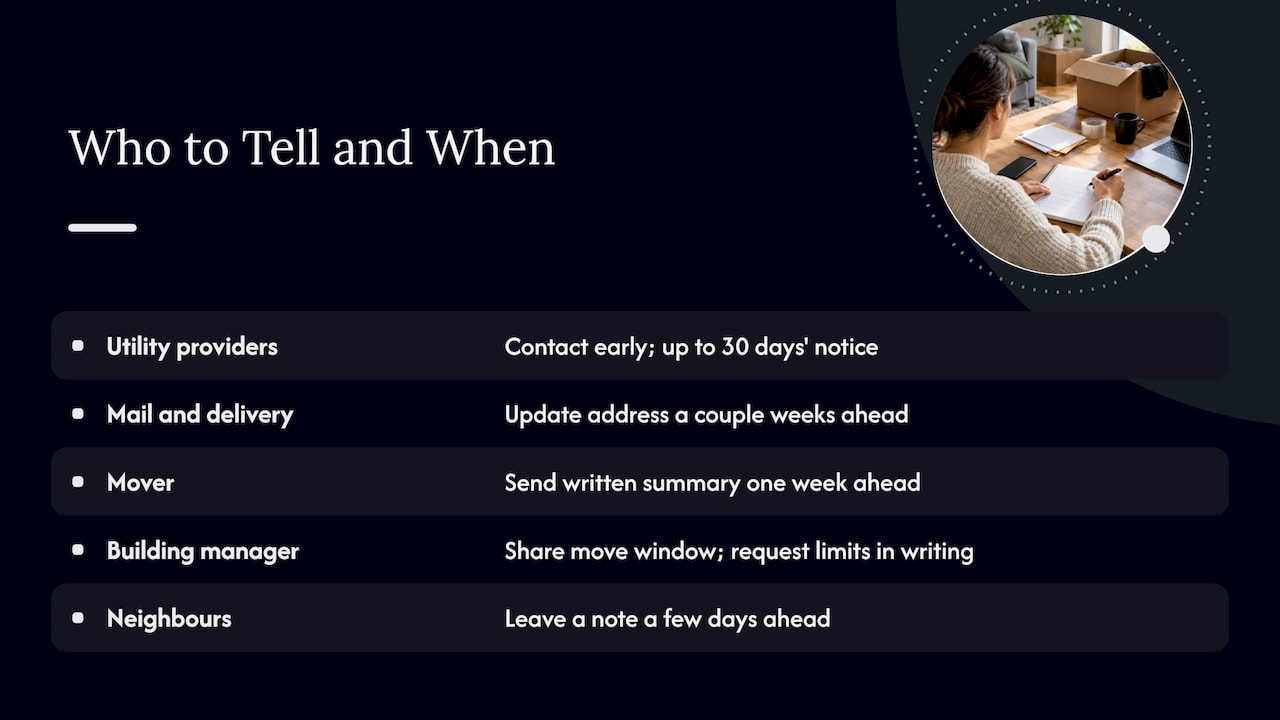
Your mover comes first. Send a written summary a week ahead covering the address at both ends, the arrival window, access details, parking and anything unusual such as a piano, a narrow staircase or a long carry from the truck. Ask them to confirm by reply. A written confirmation beats a phone call when there is a mix-up.
Your building manager or property manager comes next. Share the move window, the mover’s name and their certificate of insurance if the building asks for it. Ask about any holiday limits on elevator use, noise or loading areas, and request the answers in writing.
Utility and service providers need lead time. Because some can ask for up to 30 days’ notice, contact your electricity, gas, water and internet providers early, and confirm that service at your new address will be active on the holiday itself. Provincial move-in and move-out guides, such as this Alberta guide to utilities, remind movers that account responsibilities and billing cycles differ by retailer and region.
Do not forget your neighbours. A short, friendly note a few days ahead, covering the date, the approximate hours and where the truck will park, goes a long way. If your move blocks a shared driveway or a loading area, offer a phone number so someone can reach you quickly. Neighbours who feel informed are far more patient on a holiday, when many of them are at home.
Finally, tell people who send you mail and deliveries: your employer, bank, insurer, health providers and subscription services. Update your address a couple of weeks ahead, since holiday schedules slow postal and administrative processing.
A practical view from our crews
We believe the biggest mistake on a holiday move is trusting a verbal promise. In our experience, the moves that go smoothly are the ones where the quote, the insurance proof and the inventory are all on paper before the truck arrives. That is why we put those three things at the centre of how we work, and why we encourage you to ask every mover for them, including us. If the date is close, call early: we also handle last-minute moves, and a short phone conversation often finds a workable option. Reduce the unknowns, and the holiday takes care of itself.
— Ali
How can we help with your holiday move?
If you would rather hand the heavy lifting to a professional crew, we are ready to help you plan a holiday move. Our services for holiday moves include:
- Residential moving for homes and apartments, with careful handling of antiques and art
- Packing service so your boxes are ready before the crew arrives
- Bin rental for staged packing in the weeks beforehand
- Moving and storage when the keys, the elevator or the utilities at your new place are not ready on the day

Our quotes come at a flat rate with no hidden fees. Request your free written quote today and confirm the deposit and cancellation terms in writing.
FAQ
Can you hire movers on a statutory holiday in Canada?
Yes, many movers work on statutory holidays, though availability is tighter and a holiday rate often applies. Book early, ask for the holiday rate as a line item on your written quote, and confirm your crew’s arrival window in writing.
How far ahead should you book movers for a holiday?
Book as early as you can, since busy holiday dates can sell out weeks to months ahead. Request at least two written estimates and sign the contract and deposit as soon as you choose a mover.
What happens if you cancel a holiday move at the last minute?
You may owe a cancellation fee, and the Office of Consumer Affairs notes that short-notice cancellations can cost from $150 to $330 for less than 24 hours’ notice. Read the cancellation terms and note the deadline before you pay a deposit.
Why is moving on July 1 in Montréal so hard?
Many Québec leases end June 30, so a large share of tenants move on the same day. Square One reports that July 1 is often fully booked months ahead, so reserve your crew well in advance.
Do utilities need notice before a holiday move?
Yes, and some providers may need up to 30 days’ notice to close or transfer an account. Contact your electricity, gas, water and internet providers early so service is active at your new home on moving day.