Skip to content


Technology has fundamentally changed what a move looks like in Canada. From the moment you request a quote to the second your last box is unloaded, digital tools and AI-powered systems now handle tasks that once caused the most stress: hidden fees, missed updates, damaged items, and wasted time. The role of technology in moving is no longer a future promise. It is the standard that separates dependable movers from those still running on clipboards and phone callbacks.
Here is what that transformation looks like across every stage of a Canadian residential or commercial relocation in 2026:
- AI and machine learning generate accurate quotes, optimise routes, and predict scheduling conflicts before they happen
- Digital inventory tools catalogue every item before the truck arrives, eliminating moving-day price surprises
- GPS and IoT sensors provide live tracking and condition monitoring for fragile or high-value belongings
- Virtual consultations replace in-home estimator visits, cutting quote time from days to minutes
- Mobile apps and automated notifications keep you informed at every milestone without a single phone call
- Eco-friendly routing and EV fleets reduce fuel consumption and carbon emissions on every job
- Aleksmoving brings over 18 years of trusted expertise to these tools, combining technology with genuine care for your belongings
How technology shapes modern moving logistics and route planning
Route planning used to mean a driver’s best guess and a paper map. Today, AI-driven logistics platforms pull in live traffic data, municipal permit schedules, building access windows, and historical delivery patterns to compute dynamic routes in real time. The result is fewer idle hours, tighter delivery windows, and lower fuel costs on every job.
The environmental gains are real. AI-driven route optimisation reduces total transportation distance and carbon emissions significantly, according to recent industrial logistics evaluations. For a company running multiple trucks across a city simultaneously, those efficiency gains compound quickly.
Predictive modelling takes this further by forecasting congestion before it forms, drawing on patterns tied to weather, local events, and school schedules. Moving companies using these systems are not reacting to the city. They are anticipating it. For office relocations in particular, where downtime costs money, that kind of precision matters.
- Live traffic and permit data feed dynamic routing decisions
- Predictive congestion modelling reduces delays on complex urban routes
- Fuel savings from optimised paths lower operational costs and customer pricing
- Tighter delivery windows build trust with clients who have tight schedules
How digital inventory tools protect you from surprise fees
The single biggest source of moving-day frustration is a bill that looks nothing like the original quote. Digital inventory technology eliminates that problem by accurately pre-measuring and categorising every item before the truck rolls, improving customer trust and transparency across the board.
AI-powered video scanning tools can walk through a home room by room, automatically cataloguing furniture and estimating weight. Once the system knows exactly what needs to move, calculating the cost becomes straightforward. Platforms like Agoyu, for example, use this approach to flag items that typically trigger last-minute charges, such as glass tabletops or oversized sofas, so both the customer and the mover acknowledge them before moving day. That real-time inventory also doubles as evidence if a damage claim arises later.
- AI video scanning catalogues items automatically, room by room
- Weight and volume estimates are calculated digitally before the move begins
- Fragile and bulky items are flagged in advance, preventing surprise fees
- Itemised digital records support insurance claims and damage verification
Pro Tip: Ask your mover whether their inventory is generated digitally with photos and condition notes. A paper checklist offers you no protection if something goes wrong.
Why virtual consultations and online quotes change everything
Scheduling an in-home estimator visit used to add days to the planning process. Virtual survey technology has replaced that entirely. You walk through your home on a video call or a self-guided app, the system scans the rooms, identifies items, and builds a detailed inventory automatically. Surveys that once required a physical appointment now close in under fifteen minutes.
The business case for instant online quoting is equally clear. Moving companies that deploy instant online quotes report a significant increase in inbound quote volume, because customers want a price now, not a callback tomorrow. A customer who gets an instant price is already invested in that company’s number. One who submits a lead form is still comparison-shopping. Getting accurate moving quotes upfront protects your budget and sets clear expectations on both sides.
- Video walkthroughs replace in-person estimator visits entirely
- AI analysis generates volume and specialty item estimates from footage
- Instant online quotes reduce friction and increase booking conversion
- Transparent pricing builds confidence before a single box is packed
How communication technology keeps your move on track
The days of calling a dispatcher to find out where your crew is are over. Mobile apps now push real-time status updates at every job milestone, from crew dispatch through to unloading complete. You know what is happening without picking up the phone.
AI-assisted communication tools reduce response times and improve lead conversion by enabling instant quotes and automated translations for clients whose first language is not English or French. Integrated messaging platforms also coordinate moving teams internally, so special handling instructions for a piano or a piece of art reach the crew before they arrive at your door. Customer self-service portals handle the majority of pre-move questions automatically, which means fewer inbound calls and faster answers for you.
- Mobile apps deliver milestone notifications without requiring you to call
- Automated SMS and push alerts keep clients informed at each job stage
- Integrated team messaging reduces miscommunication on complex moves
- Self-service portals answer common questions around the clock
GPS tracking and IoT sensors: how your belongings stay safe in transit
Live GPS tracking gives you exact vehicle coordinates and an accurate estimated time of arrival, updated continuously. You are not waiting by the window guessing. You know.
Real-time GPS combined with IoT sensors allows continuous monitoring of cargo condition and vehicle status throughout a move. Multi-sensor gateways embedded inside moving containers transmit data every few milliseconds, detecting vibration and shock from potholes, temperature changes that could damage fine wood or artwork, and tilt alerts if a refrigerator tips inside the truck. Geofencing sends an automatic notification the moment the truck enters your destination zone, so you are ready to receive the delivery.
- Live GPS provides exact location and ETA updates in real time
- Vibration and shock sensors detect impacts that could damage fragile items
- Temperature monitoring protects climate-sensitive belongings like artwork
- Geofencing alerts notify you the moment the truck reaches your address
Eco-friendly technology that makes moving greener
Sustainability has moved from a talking point to an operational priority for Canadian moving companies. AI-powered smart climate control in storage facilities adjusts temperature and humidity based on what is being stored, reducing energy consumption while protecting sensitive items. That aligns directly with growing urban sustainability policies across Ontario and British Columbia.
Route optimisation, as noted earlier, cuts fuel consumption on every job. Electric vehicle fleets are entering the mix, and predictive maintenance systems flag mechanical issues before they cause breakdowns, reducing both unplanned downtime and unnecessary emissions. Paperless operations, including digital contracts, e-signatures, and cloud-stored documentation, have replaced the mountains of paperwork that used to accompany every move.
- Smart climate control in storage reduces energy use and protects sensitive items
- EV fleets lower the ecological footprint of long-distance and urban moves
- Predictive maintenance reduces breakdowns and unnecessary fuel burn
- Digital contracts and e-signatures eliminate paper waste entirely
What industry data tells us about Canadian moving in 2026
Technology is driving a shift from manual to predictive, data-informed moving models across Canada, contributing to measurable cost savings and higher customer satisfaction. The adoption gap between tech-enabled movers and those still on spreadsheets is widening fast.
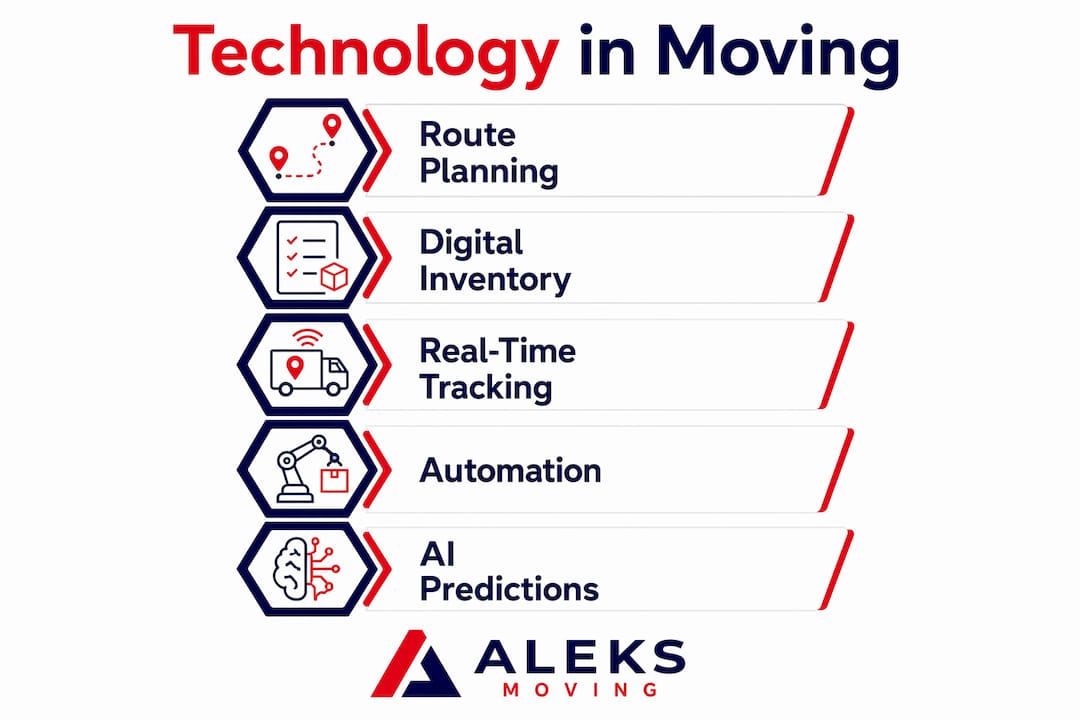
Companies that automate administrative tasks enable their moving teams to focus on handling fragile and specialty items with the care they deserve. Among companies doing more than $1M in annual revenue, purpose-built moving software adoption sits at approximately 85% in 2026. The gap between those operators and everyone else shows up in conversion rates, customer reviews, and operating margins.
Aleksmoving’s approach reflects exactly this philosophy: over 18 years of hands-on experience, combined with digital tools that handle the logistics so the team can focus on what matters most to you.
How IoT devices create real-time visibility across your entire move
IoT devices have turned asset tracking from a luxury into a standard feature. Smart tags and scanners attached to boxes and individual pieces of furniture allow both movers and clients to track every item throughout the journey. If something is left behind or misplaced, the system flags it immediately rather than waiting for a post-move inventory check.
At the fleet level, telematics platforms monitor vehicle diagnostics, driver behaviour, and fuel efficiency simultaneously. Hard braking events, engine idle time, and tyre pressure anomalies surface through dashboards that operations managers can access from anywhere. Every completed move generates structured data that feeds back into the system, making each subsequent job better informed than the last.
How AI and machine learning make moving more predictable
AI and machine learning bring predictive power to a process that has always felt unpredictable. Algorithms trained on thousands of past moves can estimate costs, assign crews, plan routes, and adjust schedules in real time based on traffic, weather, or last-minute changes. The more moves the system processes, the more accurate its predictions become.
Predictive analytics also identify high-risk moves before they begin, flagging potential challenges such as difficult building access, oversized items, or tight timelines, so the team can prepare rather than react. AI in relocation management can anticipate exceptional circumstances, adjust milestones, and provide destination information that helps clients plan with far greater confidence.
How automation is changing packing and loading
Automation in packing and loading is still emerging, but its early applications are already reducing errors and physical strain. AI-enabled mobile applications log item size, weight category, and fragility automatically when movers scan packages, guaranteeing correct volume estimates before the truck arrives. This prevents vehicle mismatches and hidden costs that come from underestimating a load.
Robotic assistance for lifting and loading heavy items is in early deployment at some large logistics operations. Wearable exoskeletons that reduce physical strain on crew members are also entering the field. Full adoption across the Canadian moving industry is still a few years out, but the direction is clear: automation will increasingly support the physical work, reducing injuries and improving consistency.
How mobile apps put you in control of your move
A good moving app functions as a command centre for your entire relocation. From generating packing checklists and storing digital contracts to communicating with your crew and tracking the truck in real time, everything lives in one place. Many platforms now integrate with utility providers so you can set up electricity, internet, and water service without leaving the app.
For moving companies, crew-facing mobile portals give teams instant access to job details, inventory lists, address information, and e-signature collection. Moving crews equipped with mobile portals report notably lower turnover and fewer errors on inventory documentation compared to companies using paper-based field operations. That stability translates directly into a more consistent experience for you on moving day.
Data privacy and technology challenges in moving services
Digital tools collect a lot of personal data: home addresses, inventory details, payment information, and move schedules. Canadian privacy legislation, including PIPEDA and provincial equivalents, requires moving companies to handle that data responsibly, with clear consent and secure storage. Not every operator meets that standard.
The adoption gap in the industry also creates inconsistency. Top companies use specialised tools for inventory and dispatch, yielding real operational advantages. Operators still relying on generic tools or paper systems cannot match the speed, accuracy, or transparency that technology-enabled movers deliver. When choosing a mover, asking about their data practices and software infrastructure is as reasonable as asking about their insurance coverage.
What robotics and autonomous vehicles mean for the future of moving
Self-driving trucks are being tested for long-distance relocations, and moving robots capable of lifting and carrying furniture are already in early deployment at some large logistics firms. These technologies promise safer loading, reduced physical injury risk for crews, and more consistent handling of heavy items.
Blockchain is also beginning to appear in moving contracts, offering tamper-proof service logs and automatic payment releases upon delivery confirmation. As platforms accumulate more data, personalisation will improve further: recommending the right truck size, predicting the best moving day based on traffic and weather, and tailoring the entire experience to your specific situation. The future of Canadian logistics points toward predictive, automated, and deeply transparent moving services.
Ready to experience technology-backed moving with Aleksmoving?
Aleksmoving combines over 18 years of trusted moving expertise with the digital tools that make your relocation transparent, accurate, and stress-free. Flat-rate pricing with no hidden fees, real-time communication, and a team that genuinely cares about your belongings. Whether you are moving locally across Ontario or planning a long-distance relocation, we are ready to help.
Get your free quote today and see what dependable, technology-backed moving looks like in practice.
Key takeaways
Technology in moving is most valuable when it eliminates uncertainty: accurate digital inventories, real-time tracking, and instant quotes together remove the three biggest sources of moving-day stress.
| Point | Details |
|---|---|
| Digital inventories prevent surprise fees | AI scanning catalogues every item before the move, so the final bill matches the quote. |
| Instant online quotes drive more bookings | Moving companies with online quoting see a significant increase in inbound quote volume. |
| GPS and IoT protect your belongings | Live tracking and sensor data monitor cargo condition and vehicle location throughout the move. |
| Route optimisation cuts costs and emissions | AI-driven route optimisation reduces total transportation distance and carbon emissions significantly |
| Automation frees crews for what matters | When admin tasks run digitally, moving teams focus on careful handling of fragile and specialty items. |
Recommended
- Top 5 Two Men and a Truck Alternatives in 2026 for Homeowners and Renters in Ontario Seeking Affordable Moving Services
- What Is Last-Minute Moving – Solutions for Urgent Relocations
- Moving Service in Canada: Ultimate Guide to a Stress-Free Move
- Moving Across Canada? Best Long Distance Movers in Toronto