Skip to content


Start planning a senior move at least 4 to 8 weeks ahead, not the week before. Keep medications, original documents, and valuables with family, never on the moving truck. Build a one-page timeline with clear deadlines, assign roles to specific people, and pack a first-week essentials box before move day arrives. Skipping this order is where most preventable problems start.
TL;DR:
- Starting the senior moving process 6 to 12 weeks ahead allows adequate time for downsizing, legal documentation, and careful planning, especially with medical needs involved.
- Original documents like IDs, health insurance, and medical lists should be kept safe with family, not packed on the moving truck, and scanned copies are highly recommended.
- Downsizing should be guided by clear categories like keep, donate, sell, or toss, with specific heuristics avoiding sentimental stalls and addressing safety risks.
- Proper labeling of boxes with resident name, room, and priority tags reduces chaos, and packing essentials last ensures a smooth transition on move-in day.
- Assigning clear roles, confirming mover credentials, and setting up the first night’s bed and bathroom are critical to a stress-free move, with a focus on safety and familiarity during the first week.
Table of Contents
- Senior moving checklist: what to do 6 to 12 weeks out
- What paperwork do you need before an assisted living move?
- How do you decide what to keep when downsizing a parent’s home?
- What’s the best way to label boxes for a senior move?
- Who should do what on move day?
- What matters most in the first week after moving?
- Printable checklist and carry-kit essentials
- Aleksmoving’s take on what actually derails senior moves
- Get a senior move quote from Aleksmoving
- Checklists and guides worth bookmarking
- Sources
Senior moving checklist: what to do 6 to 12 weeks out
A solid senior moving checklist works backward from move day, not forward from “someday.” Multiple senior move guides recommend starting the process 6 to 12 weeks in advance, with 90 days as the safer window when dementia or complex medical needs are involved.
Here’s how the weeks typically break down:
- 6 to 12 weeks before: Assess care needs honestly, tour and confirm the facility type, start downsizing early, and begin collecting legal and medical documents.
- 4 to 6 weeks before: Measure the new room, request the facility’s furniture and item policies in writing, and start sorting belongings into keep, donate, sell, or toss piles.
- 2 to 3 weeks before: Book movers or a senior move manager, refill prescriptions so there’s no gap in coverage, and assemble a move binder alongside the first week essentials box.
- 1 week before: Label every box by priority, reconfirm the movers’ arrival window and loading access, and run a final walkthrough of what’s staying versus going.
- Move day: Hand out role assignments, keep medications and documents in a family member’s custody at all times, and set up the bed and bathroom before anything else.
- First 7 days: Surround your parent or loved one with familiar objects, re-check medication administration with staff, and start introductions with the care team.
This isn’t a rigid script. A move triggered by a hospital discharge might compress six weeks into six days. But even a compressed timeline benefits from following this order rather than skipping steps under pressure.
What paperwork do you need before an assisted living move?
Every assisted living moving checklist lives or dies on paperwork, and the mistake families make most often is bringing originals when copies would do. Facilities need documentation for admission, but originals belong somewhere safer than a moving box.
Gather these before move week:
- Government ID and health insurance cards
- Power of attorney and advance health care directive
- A current medication list with dosages and prescribing physicians
- The signed admission agreement and any facility intake forms
- Proof of income or benefits documentation, if the facility requires it for billing
Keep originals with a trusted family member or a lawyer, and bring photocopies for the facility’s files. Guides for moving elderly parents consistently recommend this split, since originals lost in an admissions office are far harder to replace than a copy.
Pro Tip: Scan every document to a shared family cloud folder before move day. If a form goes missing at the facility, you can print a replacement in minutes instead of driving home to search for it.
Change of address matters here too, and it’s easy to forget in the emotional scramble of a move. Update the post office, banks, pension or benefits providers, subscriptions, and every healthcare provider on file. Confirm the facility’s medication policy in advance, since some require prescriptions transferred through their own pharmacy partner rather than the one your parent has used for years.
How do you decide what to keep when downsizing a parent’s home?
Downsizing works best with four simple categories: keep, donate, sell, toss. Vague sorting sessions stall out in sentiment. A defined framework moves things along, and senior move professionals rely on a four zone sorting system for exactly this reason.
A few heuristics speed up the decisions that usually cause the most friction:
- If it hasn’t been used in the past year, it goes to donate or sell, not keep.
- If it’s a duplicate, only the better-condition item survives.
- If it’s a safety risk, such as a loose rug or an unstable step stool, it doesn’t come along.
- Limit sentimental items to one representative piece per category, like one box of letters instead of five.
The memory box approach helps families who feel guilty tossing anything with history attached. Instead of keeping every card, photo, or knick-knack, consolidate the most meaningful items into one labelled box that travels with your parent. It preserves identity without turning a studio-sized room into a storage unit.
Whatever doesn’t come or go immediately needs a home. Donation centres, consignment shops, and short-term storage all work, but set a deadline for each so items don’t linger in a garage for months. Before committing to any large furniture piece, measure the new room and confirm what the facility actually allows. Assisted living move-in checklists flag furniture and fire-safety restrictions as one of the most common move-day surprises, since some facilities cap furniture size or prohibit certain electrical items outright. For a broader decluttering framework beyond the keep/donate/sell/toss basics, this decluttering method and checklist walks through pacing the process over several weeks.
What’s the best way to label boxes for a senior move?
Labelling isn’t cosmetic. It’s the difference between a calm first afternoon and a frantic search through a dozen identical boxes. Pack non-essentials first, and hold back anything needed daily until the very end.
Use a consistent label format on every box: resident name, destination room, and priority tag. Priority tags should read Open First, Week 1, or Storage, so movers and staff know instantly what needs to land where.
- Write a short inventory list on the side of each box, not just “kitchen” or “misc.”
- Flag fragile items clearly, and add handling notes staff can act on, like “handle with gloves” for glassware.
- Keep a separate list of electronics and medical devices, including model numbers, in case anything needs troubleshooting later.
- Pack chargers, hearing aid batteries, and device cables in the carry kit, not in a box headed for the truck.
Move-in checklists that use explicit “Open First” and “Week 1” labels report far less scrambling on arrival day, mainly because nobody has to open ten boxes to find one pair of glasses. It also helps to label every item entering a communal living environment, even clothing, since unlabelled belongings routinely go missing in shared laundry and common areas. For more on packing order generally, Aleksmoving’s guide on moving tips for seniors covers move-day sequencing in more depth.
Who should do what on move day?
Move day runs smoothly when roles are assigned before the truck arrives, not decided on the spot. Four roles cover most senior moves:
- Decision-maker handles any on-the-fly calls, like what stays if a couch doesn’t fit through a doorway.
- Documentation lead keeps every paper, medication list, and insurance card physically on their person.
- Runner manages last supply trips, deals with movers directly, and answers the phone.
- Companion stays with the senior the entire day, focused on comfort rather than logistics.
Before movers arrive, confirm their licence and insurance coverage, their arrival window, and a backup plan for weather delays or building access issues. If the destination is a facility, coordinate loading dock access, reserve the elevator if one exists, and get the permitted-items list in writing so nothing gets turned away at the door.
Safety comes before speed. Clear walkways of cords and loose rugs, keep essential medications and documents with a family member at all times, and photograph valuables before they’re packed for insurance purposes. Once the truck is unloaded, set up the bed and bathroom first, since those two rooms determine how comfortable that first night feels.
Pro Tip: Give the companion a small notepad to jot down anything the senior mentions wanting during the day, like a specific blanket or a framed photo. Small requests get lost in the noise of a move otherwise.
For last-minute complications, Aleksmoving’s tips for last-minute senior moves cover contingency planning when a move gets compressed onto a tighter schedule.
What matters most in the first week after moving?
The first seven days shape how a senior adjusts to a new environment, and small, familiar cues do more work than a fully unpacked apartment. Set up a favourite chair, a familiar blanket, and a few framed photos before touching anything else. That kind of familiarity anchoring cues comfort faster than an organized closet does.
- Confirm with nursing staff exactly how medication administration will work, and follow up within the first two days.
- Attend any initial medical or care-plan appointments scheduled for the first week.
- Build a basic daily routine, and schedule short, predictable visits rather than long, draining ones.
- Watch sleep, appetite, and mood closely, and note any concerns along with the staff contact responsible for follow-up.
Frequent short visits paired with early medication confirmation genuinely reduce relocation stress during this window. It’s a simple habit, but it’s the one families skip most often once the moving truck pulls away.
Printable checklist and carry-kit essentials
Keep a one page sheet with three columns: task, responsible person, and deadline. Tick boxes as each item closes out, and store a digital copy so it’s accessible from any phone.
Pack the carry kit separately from everything else:
- Current medications and a written medication list
- Glasses and hearing aids, with spare batteries
- Phone and charger
- ID, insurance card, and a small amount of cash
Aleksmoving’s take on what actually derails senior moves
Families rarely fail at logistics. They fail at sequencing, tackling emotional decisions and physical packing at the same time instead of one after the other. Companies with extensive experience handling relocations, including senior moves that require specialty handling for fragile antiques or family heirlooms, find that moves that separate “decide” from “pack” go far more smoothly than moves that try to do both in one weekend. Flat rate pricing removes one more variable from an already stressful week, since nobody’s calculating hidden fees while also trying to comfort a parent who’s leaving a long-time home.
— Ali
Get a senior move quote from Aleksmoving
A senior move deserves more care than a standard residential move, and this level of care is reflected in how some moving companies price and plan it. A senior move quote typically includes flat rate pricing with no hidden fees, optional full packing and unpacking service, and specialty handling for fragile or sentimental items like china, artwork, or antique furniture requiring careful wrapping.

To get an accurate quote, have three things ready: room measurements from the new facility, a rough inventory of what’s coming versus going, and a preferred move date. That’s it. Aleksmoving’s team uses that information to build a firm price with no surprises on move day, which matters even more when the move involves a parent who’s already anxious about the change. Request a free quote through Aleksmoving’s residential moving services page, or call to speak directly with someone about a senior move consultation before committing to a date.
Checklists and guides worth bookmarking
A few outside resources round out this checklist nicely. The assisted living move-in checklist covers facility-specific rules in more depth, while A Place for Mom’s moving guide walks through what to keep versus release room by room.
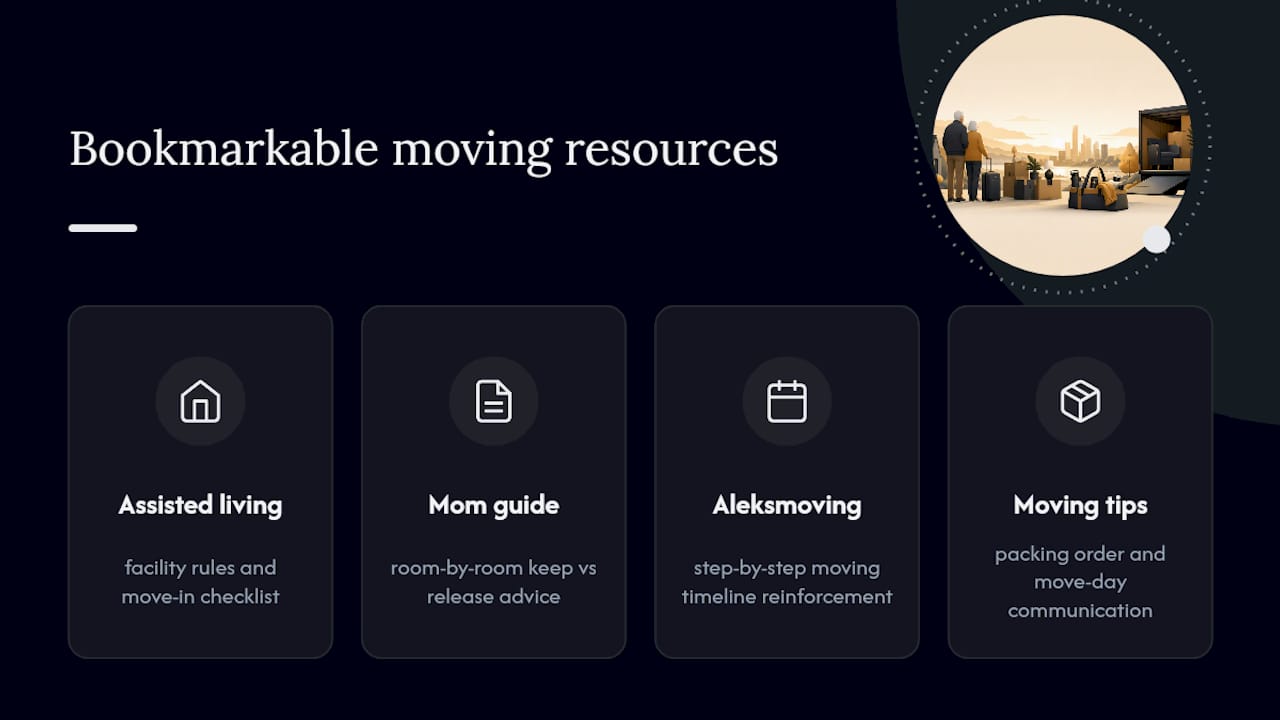
On Aleksmoving’s own site, the residential moving step-by-step guide reinforces the timeline covered above, and the senior moving tips page adds more detail on packing order and move-day communication.
Sources
- Checklist for Moving Elderly Parents, A Complete Guide
- Assisted Living Move-In Checklist: Before and After
- Moving to Assisted Living Checklist: Where to Start, What to Keep, and Everything in Between
- Moving to Assisted Living Checklist