

The easiest student move is the one planned early, packed by priority, and handled with Canada-specific admin in the first week. Start with a timeline four to eight weeks out, pack a three-tier essentials list instead of everything you own, and lock in mail forwarding, renter’s insurance, and banking before you arrive. These three moves cut most of the stress out of moving day.
TL;DR:
- Start sorting four to eight weeks ahead, pack day one bedding, toiletries, medication, and a laptop separately, and leave aspirational gear until you know your routine.
- Reserve the building elevator or loading window before move day, and confirm whether movers need a certificate of insurance to access the property.
- Arrange Canada Post forwarding before moving because activation can take three to five days, and buy renter’s insurance before move in day.
- Students who move at least 40 kilometres closer to school may claim eligible transportation, storage, and temporary living costs against taxable scholarship or employment income.
- Set aside roughly $200 to $400 for toiletries, cleaning supplies, and organizers, and buy bulky items locally after seeing your room rather than transporting them.
Table of Contents
- Your moving checklist from weeks before to move-in week
- How to pack smart using the three-tier method
- What to do on move day to avoid delays and damage
- Setting up mail, insurance, banking, and your CRA paperwork
- Settling in fast without roommate friction
- Real ways to cut moving costs as a student
- How Aleks Moving supports student relocations
- Tips for downsizing belongings effectively before the move
- How to organize and label boxes for easy unpacking
- Safety tips for moving valuable or fragile items
- Renting student-friendly storage between moves
- Checklist for notifying your school and updating records
- Transportation options for moving without a car
- What I’ve learned from watching student moves go sideways
- Get a flat-rate student move with Aleks Moving
- FAQ
- Sources
Your moving checklist from weeks before to move-in week
A clear timeline keeps you from scrambling the night before your move. Break it into four stages and work through each one in order.
- Four to eight weeks out: Confirm your housing details, decide whether you’re driving, flying, or hiring help, and start sorting belongings into keep, donate, and discard piles.
- Two to three weeks out: Book your mail forwarding through Canada Post, set up a bank account and a SIM or eSIM if you’re relocating from another province or country, and buy any essentials you can’t source near school.
- The week before: Coordinate with your roommate on who’s bringing shared appliances, confirm move-in windows with your building, and pack your essentials bag separately from everything else.
- Move day and the week after: Keep documents and chargers within reach, line up a contact at your new address, and once you’ve seen the room, update your addresses and buy bulkier items locally rather than hauling them from home.
Each stage builds on the last, so skipping the early sorting step usually means paying for it later in extra boxes or a rushed packing night.
How to pack smart using the three-tier method
Most overpacking comes from bringing things for the student you imagine becoming rather than the one who’s actually unpacking boxes in a 10 by 12 foot room. A three-tier packing system solves that by sorting belongings into essentials, comforts, and aspirational extras, then packing each tier differently.
Tier 1 covers what you need on day one: bedding, toiletries, a few study supplies, your meds, and your laptop. Pack this tier completely and keep it accessible. Tier 2 is comfort items, a favourite mug, a couple of books, a small speaker, and you pack these selectively since space is often tighter than expected. Tier 3 is the aspirational stuff, like gym equipment you might use, and the same guidance suggests packing little to none of it until you know your routine.
A room-by-room pass helps too:
- Bedding: check your bed size first, many residence beds use Twin XL and standard sheets won’t fit.
- Bath: a shower caddy and shower shoes matter most in shared bathrooms, according to dorm packing guidance.
- Study: a few pens, a notebook, and a desk lamp cover most needs until classes clarify what else you’ll want.
- Kitchen: bring a mug and basic cutlery, but check your building’s rules before packing a hotplate, since many dorms don’t allow them.
- Documents and meds: keep these in a carry-on style bag, never in the moving truck.
Pro Tip: Keep the original boxes for your laptop, monitor, or game console. They’re the safest way to ship or re-pack electronics later, and they take up far less space than a generic box with padding.
What to do on move day to avoid delays and damage
Move day goes smoothly when the logistics are locked in before the truck arrives, not after.
- Reserve your building’s elevator or loading dock window in advance, and check whether the building requires a certificate of insurance for movers or helpers.
- Pack an essentials bag with ID, your lease or offer letter, chargers, any medication, and one change of clothes, separate from the rest of your belongings.
- Choose your transport based on volume: a few car trips work for a light move, but a rented van or a short-notice crew saves time when you have furniture, multiple boxes, or a tight access window.
- Line up a helper or two and agree on a start time, since shared elevators and narrow stairwells slow things down fast without a plan.
- Unpack your Tier 1 items first so you can sleep, shower, and find your charger without digging through ten boxes on night one.
Setting up mail, insurance, banking, and your CRA paperwork
Canada-specific admin is easy to forget in the chaos of moving, but it saves real money and hassle once you’re settled.
- Set up Canada Post mail forwarding before you move, since online orders can take three to five days to activate and some require ID verification in person.
- Buy renter’s insurance before move-in day rather than after, especially if you’re bringing a laptop or other valuables.
- Set up a bank account and a SIM or eSIM early if you’re arriving from out of province or from abroad, since some providers need a Canadian address first.
- Know the rules around claiming moving costs on your taxes.
Students who move at least 40 kilometres closer to their post-secondary institution may be able to claim eligible moving expenses, including transportation, storage, and some temporary living costs, using Form T1-M. This can offset part of your moving spend against taxable scholarship or employment income, so keep your receipts from day one.
Settling in fast without roommate friction
The first week sets the tone for the rest of the year, so a few quick conversations go a long way.
- Confirm before you arrive who’s bringing the kettle, the vacuum, and other shared items so you don’t end up with three toasters and no can opener.
- Hold off on big purchases until you’ve seen the space, then buy locally from campus shops or nearby retailers for anything bulky.
- Bring one or two comfort items from home, like a photo or a favourite blanket, without packing for a room twice the size of the one you’re getting.
- Locate the nearest transit stop, campus security number, and a pharmacy in your first few days so you’re not searching for them in an emergency.
Real ways to cut moving costs as a student
Moving on a student budget usually comes down to timing and knowing when paying for help actually saves money.
- Move outside peak weekends when possible, since demand and pricing tend to ease midweek and mid-month.
- Rent bins instead of buying boxes you’ll toss after one use, and check campus or community freecycle groups for free supplies.
- Hire professional help when you’ve got heavy furniture, a building with strict access rules, or simply no time to manage it all yourself.
- Set aside roughly $200 to $400 for the inevitable post-move purchases, toiletries, cleaning supplies, and small organizers you didn’t realize you needed until you saw the room.
How Aleks Moving supports student relocations
We quote student moves at a flat rate with no hidden fees, so give us your item count and building access details for an accurate number. Our crews handle protective wrapping, furniture handling, and advance coordination with building management, and we can accommodate last-minute bookings when schedules get tight.
Tips for downsizing belongings effectively before the move
Downsizing works best when you sort by how often you actually use something, not how much you like the idea of it. Start three to four weeks out with a simple three-pile system: keep, donate, and discard, and be honest about clothes you haven’t worn in a year or gadgets you bought and barely touched.
Go room by room instead of tackling the whole place at once. Clothes and books are usually the easiest categories to cut first, since most students over-pack both. If you’re on the fence about an item, put it in a maybe box and revisit it a week later, most of the time you’ll donate it without a second thought.
Selling or donating early rather than the night before matters too. Campus marketplace groups, local buy-and-sell pages, and thrift donation bins all move faster when you’re not racing a deadline. For bigger furniture pieces you won’t need at school, ask family to store them rather than paying to ship something you’ll replace locally anyway.
A good rule of thumb: if replacing an item near campus would cost less than shipping or hauling it, leave it behind. This applies to most kitchen basics, floor lamps, and bulky storage bins, all of which are usually cheaper to buy new close to campus than to move across the country.
Downsizing isn’t just about fitting into a smaller space. It also means less to unpack, less to insure, and less to track if you move again next year, which most students do.
How to organize and label boxes for easy unpacking
Labelling boxes properly turns a chaotic move-in day into a manageable one. Label each box by room and by priority tier rather than just writing “miscellaneous” on the side, that one word guarantees you’ll open it last and regret it.
A simple colour-coding system helps too: use one colour of tape or sticker for bedroom boxes, another for kitchen items, and a third for study supplies. Write a short contents list on two sides of each box, not just the top, since boxes often get stacked with the top facing a wall.
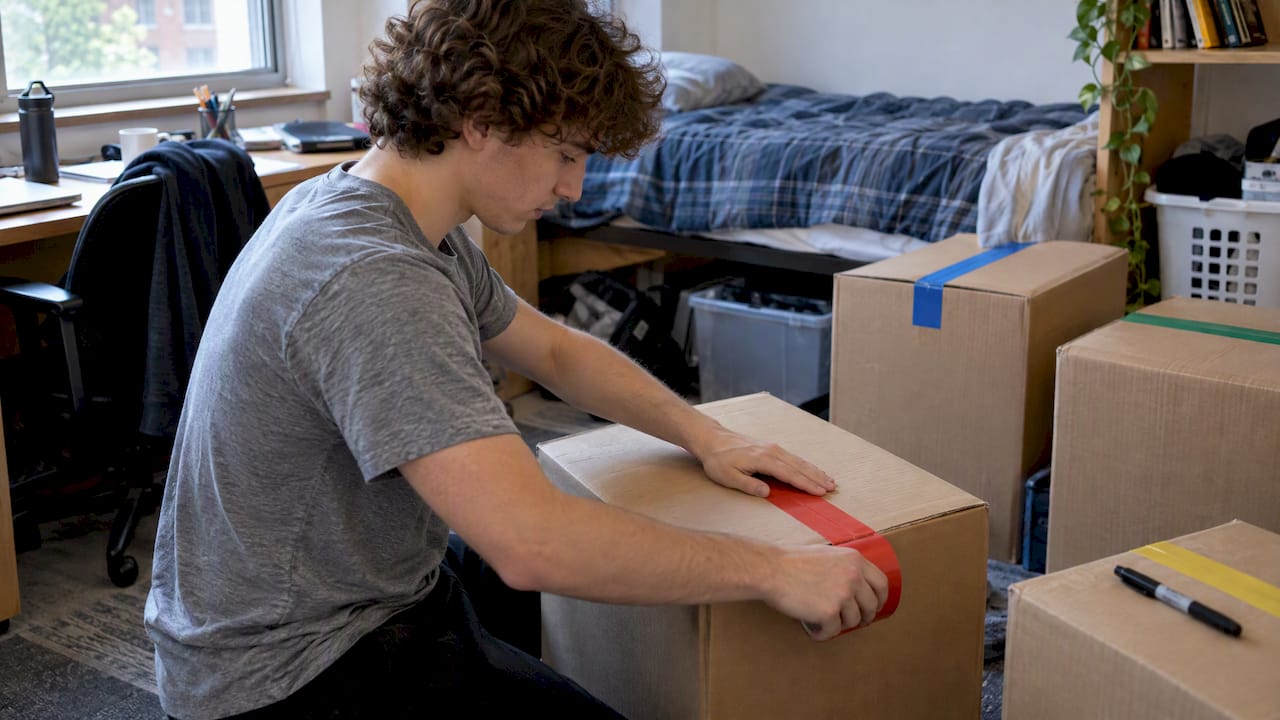
Pack heavier items in smaller boxes and lighter items in larger ones, which keeps every box manageable to carry and reduces the chance of a bottom giving out mid-move. Number your boxes and keep a simple master list, on your phone or on paper, so you know at a glance how many boxes should arrive and what’s inside each one.
Keep your essentials box separate from the labelling system entirely. Mark it clearly as “open first” so it never gets buried under heavier, lower-priority boxes during loading or unloading.
Safety tips for moving valuable or fragile items
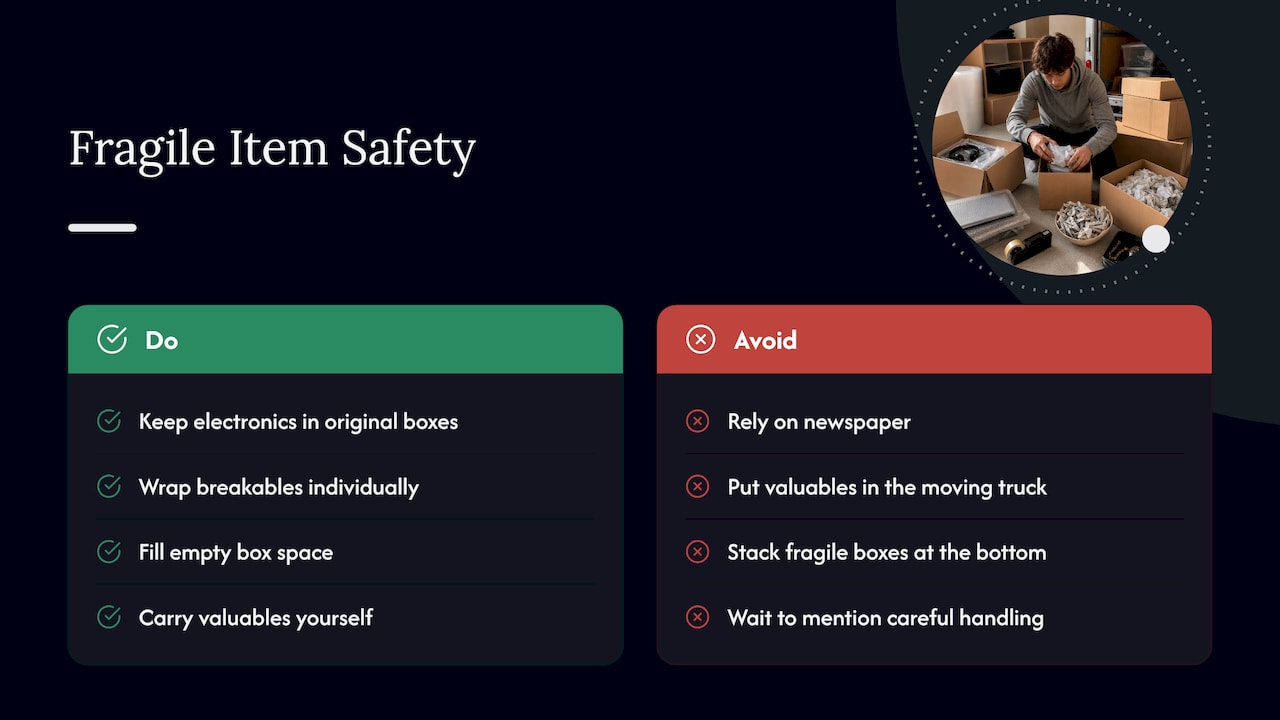
Fragile and valuable items need their own plan, separate from the rest of your packing. Keep laptops, tablets, and other electronics in their original boxes when you still have them, since manufacturer packaging is built around the exact shape and weight of the device.
Wrap breakables individually in packing paper or clothing rather than relying on newspaper, which can transfer ink and doesn’t cushion corners well. Fill empty space in boxes holding fragile items so nothing shifts during transport, a half-empty box is more likely to arrive with something broken than a fully packed one.
Carry your most valuable or irreplaceable items yourself rather than putting them in the moving truck or van. This includes documents, jewellery, meds, and any device you can’t easily replace before classes start.
Label boxes with fragile contents clearly, and keep them off the bottom of any stack. If you’re hiring help for a larger load, mention which boxes need careful handling before loading begins rather than after, since that’s when protective wrapping and careful placement actually get applied.
Renting student-friendly storage between moves
Storage solves a real problem for students: you often need somewhere to keep belongings between semesters, during a summer sublet, or while you’re waiting for a new lease to start. Short-term storage units sized for a few boxes and a couch are usually enough for a typical student load, and most providers offer month-to-month terms rather than long leases.
Our moving and storage service gives students a flexible option when you need somewhere secure to keep belongings for a month or two without committing to a full-year contract. This tends to work out better than asking a friend to store your things in a garage, especially for anything fragile or valuable.
Before booking any storage option, check the unit’s climate control if you’re storing electronics or anything sensitive to temperature swings over the summer. Measure your larger items, like a mini fridge or a desk, against the unit size listed, since underestimating space is the most common storage mistake.
If you’re storing just a handful of boxes, bin rental through our bin rental service is worth considering too, since it pairs sturdy, stackable containers with delivery and pick-up rather than requiring you to buy and dispose of cardboard boxes every term.
Checklist for notifying your school and updating records
Updating your student records matters just as much as updating your mailing address, and it’s easy to let slip in the rush of moving.
- Update your mailing address in your school’s student portal as soon as you know your new one.
- Notify your registrar’s office if your move affects your program status, residency, or OSAP and provincial aid eligibility.
- Update your emergency contact information with your school, especially if you’ve moved to a new city or province.
- Confirm your health insurance or student health plan reflects your new address, particularly if you’re moving between provinces with different coverage rules.
- Update your address with your library, parking or transit pass provider, and any campus clubs or associations that mail materials.
Doing this in the same week you move keeps your student records, financial aid, and insurance all pointing to the right address instead of your old one.
Transportation options for moving without a car
Not every student move needs a rented van. Public transit works for a lighter move, especially if you’re bringing mostly bags and boxes rather than furniture, and many Canadian cities have off-peak transit hours when buses and trains are less crowded for hauling bags.
Campus and city shuttle services sometimes run dedicated move-in routes during September and January, worth checking with your school’s housing office before you assume you need a car. Ride-share services work for a one-time trip with a few boxes, though most standard vehicles can’t fit a mattress or large furniture.
For anything bulkier, a short-term van rental or a professional crew makes more sense than multiple transit trips carrying awkward items through stairwells and train doors. If you’re moving a full apartment’s worth of belongings without a car, hiring help usually costs less in time and stress than piecing together several transit trips.
What I’ve learned from watching student moves go sideways
The moves that go smoothly are almost never the ones with the least stuff, they’re the ones with a plan. Pack your essentials bag the night before, and snap a photo of your new room layout before you start unpacking.
— Ali
Get a flat-rate student move with Aleks Moving
Moving across town or across the province for school shouldn’t mean guessing what your move will cost. We quote every student move at a flat rate with no hidden fees, so the number we give you upfront is the number you pay.
Here’s what tends to fit student budgets and timelines best:
- Local moving for a straightforward move within the same city or region.
- Packing service when exams or work leave you no time to pack boxes yourself.
- Bin rental for a staged move or when parents are shipping boxes ahead of you.
- Moving and storage for the gap between move-out and move-in, or storage over the summer.
If your building has strict access rules, you’re hauling furniture up several flights, or your moving window is tight, a professional crew usually costs less in stress than piecing it together alone. Reach out for a free quote and tell us your item count and building access details, and we’ll get you a number that holds.
FAQ
What are the key things I should know before moving to Canada?
Confirm your housing and move timeline early, and plan for Canada-specific steps like setting up mail forwarding through Canada Post and buying renter’s insurance before move-in. You’ll also want a Canadian bank account and SIM set up as soon as you have a confirmed address.
Is Canada still accepting foreign students?
Canada continues to admit international students through its post-secondary institutions, though specific study permit rules and processing details are set by federal immigration authorities and can change. Check the current requirements directly with Immigration, Refugees and Citizenship Canada or your institution’s international student office before finalizing travel plans.
Which job is best for students in Canada?
The best job depends on your schedule, skills, and study permit conditions, common options include on-campus roles, retail, and food service work that fits around class hours. Check your study permit’s work eligibility rules and your school’s career centre for openings suited to students.
What benefits can I get as a student in Canada?
Students may be eligible for provincial or federal financial aid, tax credits, and in some cases a deduction for moving expenses if they moved at least 40 kilometres closer to their school. Eligibility and amounts vary, so check with your institution’s financial aid office and the Canada Revenue Agency for your specific situation.
Sources
- Canada
- Forward mail when you move or relocate | Personal | Canada Post
- What to Pack for College | CollegeHelpGuide
- College Dorm Packing Checklist for 2026: The Complete Move-In List | Fastweb