

A studio move in Toronto typically falls within a range of costs all in, including Ontario HST, depending on how far you’re going, how many movers you book, and how your building handles elevators and loading. The safest way to land on a firm number is to get three written estimates from movers, or request a quote directly from Aleks Moving, so you’re comparing real numbers instead of guesses.
TL;DR:
- Most Toronto studio moves cost between $300 and $1,000 after HST, depending on furniture weight, building logistics, and distance traveled.
- Elevator booking windows, building insurance requirements, and re-trips due to delays significantly increase labor hours and final costs.
- Getting three written estimates and confirming inclusions for travel time, fees, and elevator or insurance policies ensures transparent pricing.
- Booking mid-week, off-season, and preparing furniture yourself can lower overall expenses and streamline the move process.
- Flat-rate quotes from experienced movers like Aleks Moving include building permits and elevator bookings to avoid unexpected delays and charges.
Table of Contents
- Typical price ranges and what’s behind them
- Worked examples: simple move versus a complex condo move
- What drives your final bill beyond the hourly rate
- How to get accurate quotes and know your rights in Ontario
- Insurance, protection options and condo logistics to confirm early
- Practical ways to lower your studio moving cost
- Aleks Moving: what 18 years of Toronto moves has taught us
- Ready to book? Here’s what a fast Aleks Moving quote looks like
- Sources
- FAQ
Typical price ranges and what’s behind them
Most Toronto movers price a studio move by the hour, and the crew size you book changes the math more than almost anything else. A two-mover crew with a truck commonly runs $120 to $200 per hour in 2026, and nearly every company applies a three-hour minimum, so even a small studio move rarely costs less than that minimum block of time.
For a studio apartment, here’s how the ranges tend to break down:
- Low band ($300 to $500): a small studio, minimal furniture, ground-floor or elevator building with easy loading, short drive.
- Typical band ($500 to $800): an average studio with a bed, couch, dresser and boxes, one flight of stairs or a standard elevator wait, moderate drive across town.
- High band ($800 to $1,000+): heavier furniture, a condo with a strict elevator booking window, long carry distances, or a move that spans opposite ends of the city.
On top of the hourly rate, many companies add a one-time truck or dispatch fee to cover fuel and vehicle prep. When you see an hourly quote that looks unusually low compared to others, ask whether that fee, or the travel time to and from the shop, is added separately. Our breakdown of hourly mover costs in Toronto walks through how these pieces usually stack.
Worked examples: simple move versus a complex condo move
Numbers are easier to trust when you can see the arithmetic. Here are two sample calculations built on 2026 market rates, both using a mid-range hourly figure.
- Example A, a straightforward studio move: two movers at $150 an hour, three hours on-site plus one travel hour, comes to four billable hours. That’s $600 before tax, and with Ontario’s 13% HST added, the total lands around $678.
- Example B, a condo move with a tight elevator window: the same two-mover crew, but the building only offers a two-hour elevator booking and the crew misses part of it waiting for the freight elevator. The job stretches to six billable hours instead of four, pushing the pre-tax subtotal to $900 and the final bill with HST to roughly $1,017.
The difference between these two examples isn’t the crew or the truck. It’s the extra carry time and the wasted wait for elevator access, which show up on your invoice as additional labour hours rather than a separate line item. That’s why confirming your building’s elevator rules before moving day matters as much as picking a mover.
What drives your final bill beyond the hourly rate
A handful of logistics issues can quietly add hours to a move that looked simple on paper. Condo buildings are the most common culprit: most require a Certificate of Insurance (COI) and a booked elevator window, and missing that window can force a re-trip or a rescheduled slot, which effectively doubles the labour time for that leg of the move.
What typically shows up on your invoice:
- Travel time, usually billed from the mover’s shop to your old address and again to the new one.
- Minimum-hour charges, often three hours regardless of how quickly the job finishes.
- Overtime, billed in 15 or 30-minute increments once you pass the estimated window.
- Add-on fees for pianos, appliance disconnects, or wardrobe boxes if you need them supplied.
Two movers plus a truck typically runs $120 to $200 per hour in the Toronto market for 2026, and that range sits at the higher end compared to smaller Ontario cities because of downtown logistics and demand.
Ontario’s HST, at 13%, applies to the full invoice, labour, truck fee and any add-ons alike, so build that into your budget from the start rather than treating it as an afterthought.
How to get accurate quotes and know your rights in Ontario
The single best thing you can do before booking is collect written estimates and read them side by side.
- Get at least three written estimates and confirm each one states whether travel time, fuel surcharges, and stair or elevator fees are included in the quoted rate.
- Check what the contract includes. Ontario’s guidance on hiring a mover lists what a proper estimate and contract should spell out, including services, dates and total charges.
- Ask about insurance and valuation coverage, specifically whether your self-packed boxes are covered the same way as boxes the mover packs.
- Watch for red flags, like a mover who won’t put anything in writing or one who demands extra cash before unloading your belongings at the new address.
Under Ontario’s Consumer Protection Act, a mover cannot charge more than 10% above a written estimate without your agreement, so a written number is real leverage if a final bill comes in high.
Pro Tip: Ask each mover the exact same three questions (hourly rate, minimum hours, and what triggers overtime) so you’re comparing apples to apples across quotes.
Insurance, protection options and condo logistics to confirm early
Most movers offer released-value protection by default, which caps what they owe you per pound of damaged goods rather than covering full replacement cost. Full-value replacement coverage costs more but pays out closer to what your items are actually worth, so it’s worth asking about explicitly rather than assuming you have it.
- Confirm the mover’s insurer name and policy number in writing before moving day, not after.
- Ask whether self-packed boxes are covered, since many policies limit liability for boxes you packed yourself.
- Book your elevator window with the building and confirm whether a COI is required, since this is the most common cause of delay on condo moves.
- Check street parking rules near both addresses, since moving vans can load and unload but Toronto doesn’t issue special parking permits for moving days.
Practical ways to lower your studio moving cost
A few small decisions can shave real money off the final bill.
- Move mid-month or in the off-season. Demand and pricing both tend to ease outside the end-of-month rush.
- Book weekdays instead of weekends when your schedule allows it, since weekend slots often carry a premium.
- Pack ahead of time and disassemble bulky furniture yourself, since every hour the crew spends packing or unbuilding is billable time.
- Confirm your elevator booking and clear hallways in advance so the crew isn’t waiting or re-routing on moving day.
Pro Tip: A modest cash tip, often in the range of $20 to $40 per mover for a studio-sized job, is a common and appreciated gesture, but it’s never required.
Aleks Moving: what 18 years of Toronto moves has taught us
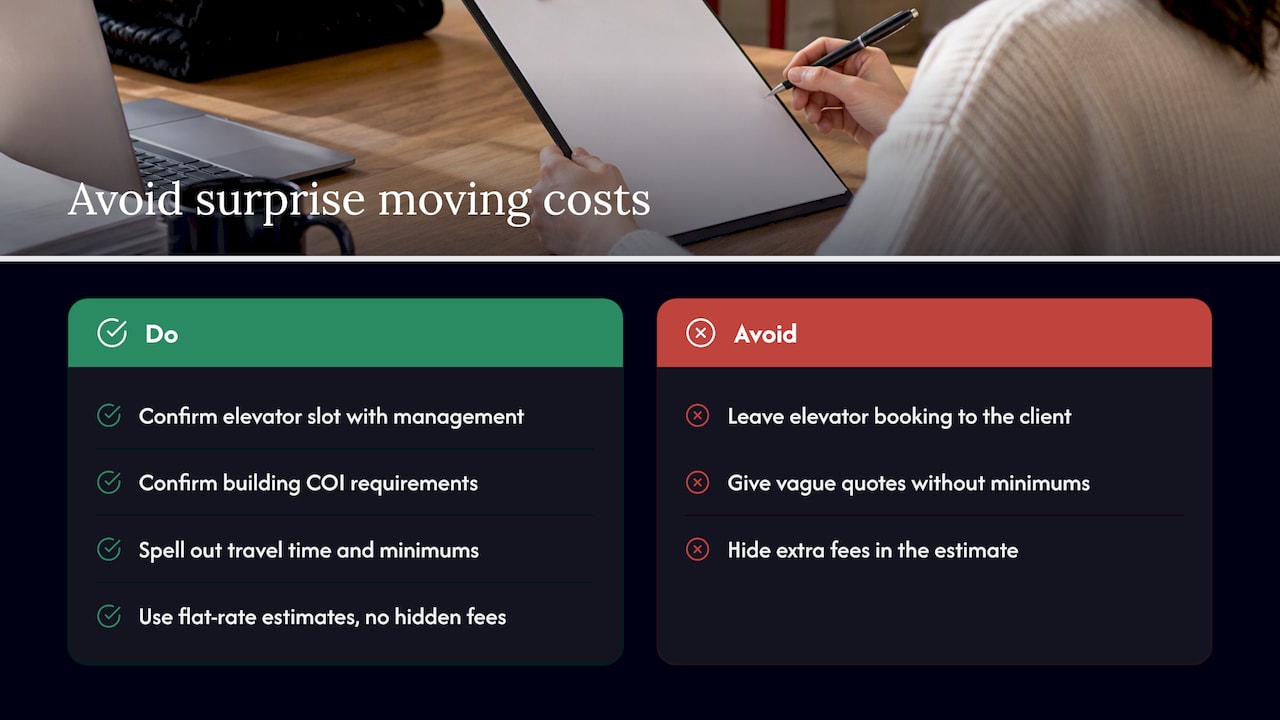
We’ve spent over 18 years moving studios, condos and family homes across Ontario, and the surprise costs almost always trace back to the same two things: an elevator window nobody confirmed, and a quote that didn’t spell out travel time or minimums up front. That’s why we build our estimates around flat-rate pricing with no hidden fees, so what you’re quoted is what you pay.
Before moving day, our team typically confirms the building’s COI requirements and books the elevator slot directly with management, rather than leaving it for the client to sort out at the last minute. It’s a small step that avoids the single most common cause of a longer, more expensive move.
— Ali
Ready to book? Here’s what a fast Aleks Moving quote looks like
A studio move doesn’t need to involve guesswork on price. When you request a quote from a professional moving company, flat-rate pricing can mean the number you receive accounts for crew size, truck, and building logistics up front, with no hidden fees added after the fact.

To get a fast, accurate quote, have this ready when you reach out:
- Your move date and any flexibility around weekdays or weekends.
- Both addresses, including floor number and whether either building requires an elevator booking or a COI.
- Parking notes, such as whether the movers can pull up curbside or need a loading dock.
- A quick list of large or unusual items, like a piano, treadmill, or antique furniture.
From there, we’ll walk you through what’s included, whether you want our packing service added on, and what a written estimate looks like before you commit. Start with our residential moving services page to request your quote.
Sources
- Ontario
- Parking regulations – City of Toronto
- Ontario
- Moving cost calculator Canada 2026 (CAD rates) | CalcCorp
FAQ
How much do movers charge in Toronto?
Most Toronto movers charge by the hour for a crew and truck, with two movers running $120 to $200 per hour and a three-hour minimum common across the industry. A studio move typically totals $300 to $1,000 once HST and any truck fees are included.
Is $100 each a good tip for movers?
There’s no fixed rule for tipping movers in Toronto, and it’s never required. A more common range for a studio-sized job is $20 to $40 per mover, with larger tips reserved for particularly heavy or difficult moves.
Who are the cheapest movers in Toronto?
Rates vary enough between companies that the cheapest option depends on your specific move date, crew size, and building access. The Ontario government recommends getting at least three written estimates so you can compare real quotes rather than advertised rates.
What is the cheapest day to hire movers?
Weekday moves are generally less expensive than weekend moves, since weekend demand tends to push rates higher. Moving mid-month, outside the common end-of-month lease turnover rush, also tends to open up better pricing and availability.