

TL;DR:
- White glove moving is a premium service where professionals handle every stage of a move, including packing, unpacking, and home setup. It is ideal for clients with fragile, high-value items, long-distance moves, or busy schedules seeking a fully organized home upon arrival. Verification of services and careful selection of providers ensure the full benefits of this comprehensive relocation option.
White glove moving is defined as a premium, concierge-level relocation service where professionals manage every detail of your move, from packing and custom crating through to full unpacking and home setup. Unlike standard or even full-service moving, white glove service delivers a fully functional, organised home the moment you walk through the door. The industry term you will also hear is “premium relocation management,” and both phrases describe the same thing: a move where you do not lift a finger. This guide explains exactly what is included, who benefits most, and how to choose the right provider.
What is white glove moving and how does it differ from other services?
White glove moving is a complete, end-to-end service that covers packing, custom crating, transport, unpacking, furniture reassembly, and debris removal. The name comes from the literal practice of movers wearing specialist gloves made of non-transfer materials to protect polished and sensitive surfaces throughout every stage of the move. Standard movers focus on transportation and manual labour. They load your boxes, drive to the destination, and unload. The responsibility for packing and unpacking stays with you.
Full-service movers go further by packing your belongings before transport. The critical gap is what happens at the other end. Full-service moves often leave boxes stacked in rooms, and unpacking is your problem. White glove moving closes that gap entirely. Movers unpack every box, arrange items in cupboards and closets, reassemble furniture, and remove all packing materials before they leave.
| Service level | Packing | Transport | Unpacking | Home setup | Debris removal |
|---|---|---|---|---|---|
| Standard | No | Yes | No | No | No |
| Full-service | Yes | Yes | No | No | No |
| White glove | Yes | Yes | Yes | Yes | Yes |
Pro Tip: Ask any provider to confirm in writing that unpacking and home setup are included. The term “white glove” is sometimes used for marketing purposes without those services actually being part of the contract.
Who should consider white glove moving services?
White glove moving best fits clients who have no time to manage a move, own complex or high-value items, or are relocating long distances where they cannot oversee logistics. Professionals often find the premium cost justified because taking time off work to pack and unpack costs more in lost income than the service price. The service also makes sense for anyone who simply wants to walk into a ready-to-live-in home without spending weeks sorting boxes.
The following situations are where white glove moving delivers the most value:
- Fragile or high-value belongings. Art, antiques, pianos, and collector items require specialist handling for fragile items and custom crating that standard movers do not provide.
- Long-distance or cross-provincial moves. When you cannot be present to supervise every stage, a fully project-managed service protects your interests.
- Busy professionals. Time is the scarcest resource. White glove moving converts weeks of packing and unpacking into a single managed event.
- Corporate relocations. Employees moving for work need to be productive quickly. A corporate relocation handled at the white glove level gets them settled faster.
- Clients with access challenges. Narrow staircases, elevator restrictions, and heritage buildings require pre-move route planning that white glove providers build into their process.
Clients with easily replaceable furniture and small, straightforward moves generally do not need white glove service. Standard moving is adequate when belongings are not fragile and you have the time and energy to unpack yourself.
Pro Tip: Calculate the real cost of your time before dismissing white glove moving as too expensive. If unpacking takes you two full weekends, factor in what those weekends are worth to you personally and professionally.
How does the white glove moving process work?
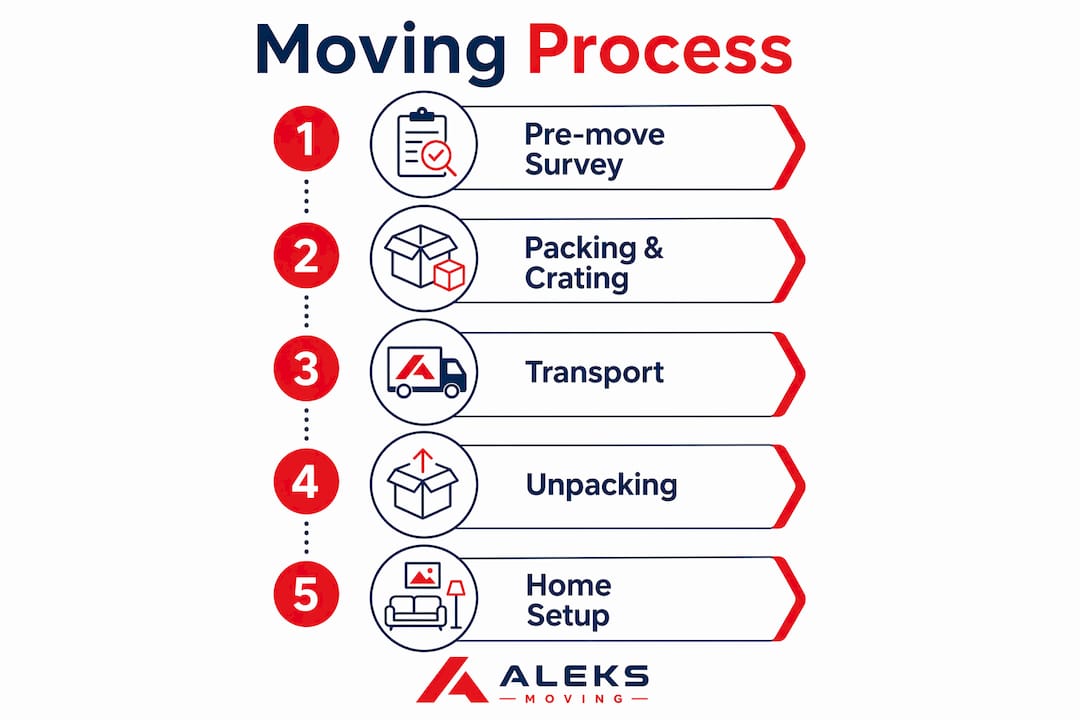
White glove moves are project-managed relocations built around risk mitigation through extensive pre-move planning. Every phase is coordinated, documented, and executed to a defined standard. Here is what the process looks like from start to finish.
- Pre-move survey. A specialist visits your home to assess access routes, stairwells, doorway widths, and elevator availability. This prevents surprises on moving day.
- Inventory and planning. Every item is catalogued. Fragile and high-value pieces are flagged for custom treatment, and a detailed move plan is produced.
- Premium packing. Archival-grade packing materials such as acid-free tissue, foam padding, and custom crates protect items beyond what standard packing supplies can offer.
- Custom crating. Art, antiques, and irreplaceable items receive custom wooden crates built to the exact dimensions of each piece.
- Furniture disassembly and labelling. Every disassembled component is labelled, and hardware is stored in labelled bags with a full inventory so reassembly at the destination is exact.
- Protected transport. Vehicles are padded and loaded using handling protocols that prevent shifting during transit.
- Unpacking and placement. At the destination, movers unpack every item and place it according to your instructions, including arranging contents in cupboards and closets.
- Furniture reassembly. All furniture is reassembled and positioned in the rooms you specify.
- Debris removal. Every box, wrap, and packing material is removed from your home before the team leaves.
| Phase | Key action | Purpose |
|---|---|---|
| Pre-move survey | Route and access analysis | Prevent damage and delays |
| Packing | Archival-grade and custom materials | Protect fragile and valuable items |
| Transport | Padded vehicles and handling protocols | Prevent shifting and impact damage |
| Setup | Unpacking, placement, reassembly | Deliver a livable home immediately |
| Completion | Debris removal | Leave the home clean and ready |
The use of specialist gloves made from non-transfer materials runs through every physical handling stage. This detail reflects the level of care applied to every surface, finish, and item throughout the entire move.
What are the benefits and potential drawbacks of white glove moving?
White glove moving is an investment in stress reduction and time management, not just a physical service. Experts note it is more cost-effective to pay for premium handling than to risk damage or exhaustion from managing a complex move yourself. The benefits are concrete and significant for the right client.
Benefits:
- You save weeks of physical and mental effort on packing and unpacking.
- Expert handling and pre-move planning reduce the risk of damage to fragile or costly items.
- Custom crating protects art, antiques, and other irreplaceable belongings that standard packing cannot safeguard. You can read more about packing fragile items safely to understand the difference in material standards.
- You walk into a fully organised home, not a house full of boxes.
- All packing debris is removed, so your new home is clean from day one.
Potential drawbacks:
- The cost is significantly higher than standard or full-service moving.
- For small moves with replaceable furniture, the premium is rarely justified.
- Not every company that uses the term “white glove” delivers the full service. Verifying inclusions is non-negotiable.
“The term ‘white glove’ is often confused with ‘full-service.’ Clients must confirm that unpacking and home setup are included, as these define true white glove service. Some companies use the term for marketing despite offering only standard service tiers.”
The growing popularity of white glove moving stems from busier lifestyles and increased demand for protecting delicate, valuable belongings. That trend makes the terminology confusion more common, not less.
How to choose the right white glove moving provider
Choosing a white glove provider requires more scrutiny than booking a standard mover. The service is only as good as what is written in the contract and confirmed by the provider’s track record. Use these criteria to evaluate any company you consider.
- Confirm unpacking and home setup in writing. A provider that cannot commit to these in the contract is not offering true white glove service.
- Verify expertise with your specific items. If you own fine art, ask directly about fine art moving experience and custom crating capability.
- Ask about access challenge experience. Narrow staircases, heritage buildings, and high-rise elevators require specific planning skills.
- Understand insurance and damage policies. Full replacement value coverage is the standard to look for, not depreciated value.
- Request a detailed inventory process. Providers who track every item with labelled bags and written inventories demonstrate the level of care that defines this service tier.
- Check client reviews for specifics. Look for reviews that mention unpacking, home setup, and handling of fragile items, not just punctuality and price.
- Clarify debris removal. Confirm that all packing materials are removed before the team leaves.
The logistics of complex relocations require providers who understand route planning, access management, and coordinated team execution. Ask any candidate how they handle unexpected access issues on moving day. Their answer tells you a great deal about their planning depth.
Pro Tip: Request a written move plan before signing any contract. A reputable white glove provider will produce a documented plan covering inventory, packing methods, transport protocols, and setup instructions. If they cannot provide one, look elsewhere.
Key takeaways
White glove moving is the only service tier that delivers a fully organised, livable home on arrival, making it the right choice for clients with fragile items, complex moves, or no time to manage the process themselves.
| Point | Details |
|---|---|
| Definition | White glove moving covers packing, transport, unpacking, home setup, and debris removal as a single managed service. |
| Key differentiator | Unpacking and home setup are what separate white glove from full-service moving. |
| Best fit | Clients with fragile or high-value items, long-distance moves, or demanding schedules benefit most. |
| Terminology risk | Always confirm inclusions in writing, as “white glove” is sometimes used as a marketing term without full service. |
| Selection criteria | Verify custom crating, insurance coverage, inventory tracking, and debris removal before signing. |
My honest assessment of white glove moving
I have seen a lot of moves over the years, and the single biggest misconception I encounter is that white glove moving is just “fancy packing.” It is not. The packing is almost a footnote. What clients are actually paying for is project management: the pre-move survey, the custom crating, the labelled inventory, the coordinated transport, and the fully set-up home at the end. That is where the real value lives.
The second misconception is that white glove moving is only for the wealthy. I disagree. If you own a grand piano, a collection of original art, or antique furniture that cannot be replaced, the cost of white glove service is trivial compared to the cost of damage from a standard move. The maths are straightforward.
What I find genuinely interesting is how the demand for this service has grown alongside busier lifestyles. People are not just protecting possessions. They are protecting their time and their mental energy. Walking into a fully organised home after a long-distance move is not a luxury. For many clients, it is the only way to stay functional through a major life transition.
My advice: do not decide based on cost alone. Decide based on what you own, how far you are moving, and how much your time is worth. For the right client, white glove moving is not an extravagance. It is the most practical choice available.
— Ali
Aleksmoving: trusted white glove moving in Ontario
Aleksmoving has over 18 years of experience handling residential relocations across Ontario and Canada, including moves that require the careful, detail-oriented approach that defines premium service.

Whether you are moving fine art, antiques, or simply want a fully set-up home without the chaos of unpacking, Aleksmoving’s residential moving services are built to handle every detail with care. Our team uses quality packing materials, thorough planning, and attentive handling to protect your belongings from the first box to the last piece of furniture placed in your new home. Flat-rate pricing means no hidden fees and no surprises. Contact Aleksmoving today for a free, no-obligation quote and find out how we can make your next move straightforward and stress-free.
FAQ
What is white glove moving in simple terms?
White glove moving is a premium relocation service where professionals handle every step, including packing, transport, unpacking, furniture setup, and debris removal, so you arrive at a fully organised home.
How does white glove moving differ from full-service moving?
Full-service moving includes packing and transport but typically leaves boxes in rooms at the destination. White glove moving goes further by unpacking, arranging belongings, reassembling furniture, and removing all packing materials.
Is white glove moving worth the cost?
White glove moving is worth the cost for clients with fragile or high-value items, long-distance moves, or limited time. For small moves with replaceable furniture, standard service is usually adequate.
What questions should I ask a white glove moving provider?
Ask whether unpacking and home setup are included in writing, what insurance coverage applies, how they handle fragile items, and whether debris removal is part of the service.
Does white glove moving include custom crating?
True white glove service includes custom wooden crates built to the dimensions of fragile or irreplaceable items such as art, antiques, and pianos, along with archival-grade packing materials throughout.