Skip to content


Sorting out moving costs can feel confusing for Ontario homeowners and small business owners trying to plan a smooth, affordable relocation. Understanding exactly what a moving quote in Canada covers matters because hidden fees and unclear terms often create stressful surprises. This guide breaks down how moving quotes work, what to look for in a trustworthy estimate, and the steps to ensure cost transparency before signing any agreement.
Table of Contents
- Defining A Moving Quote In Canada
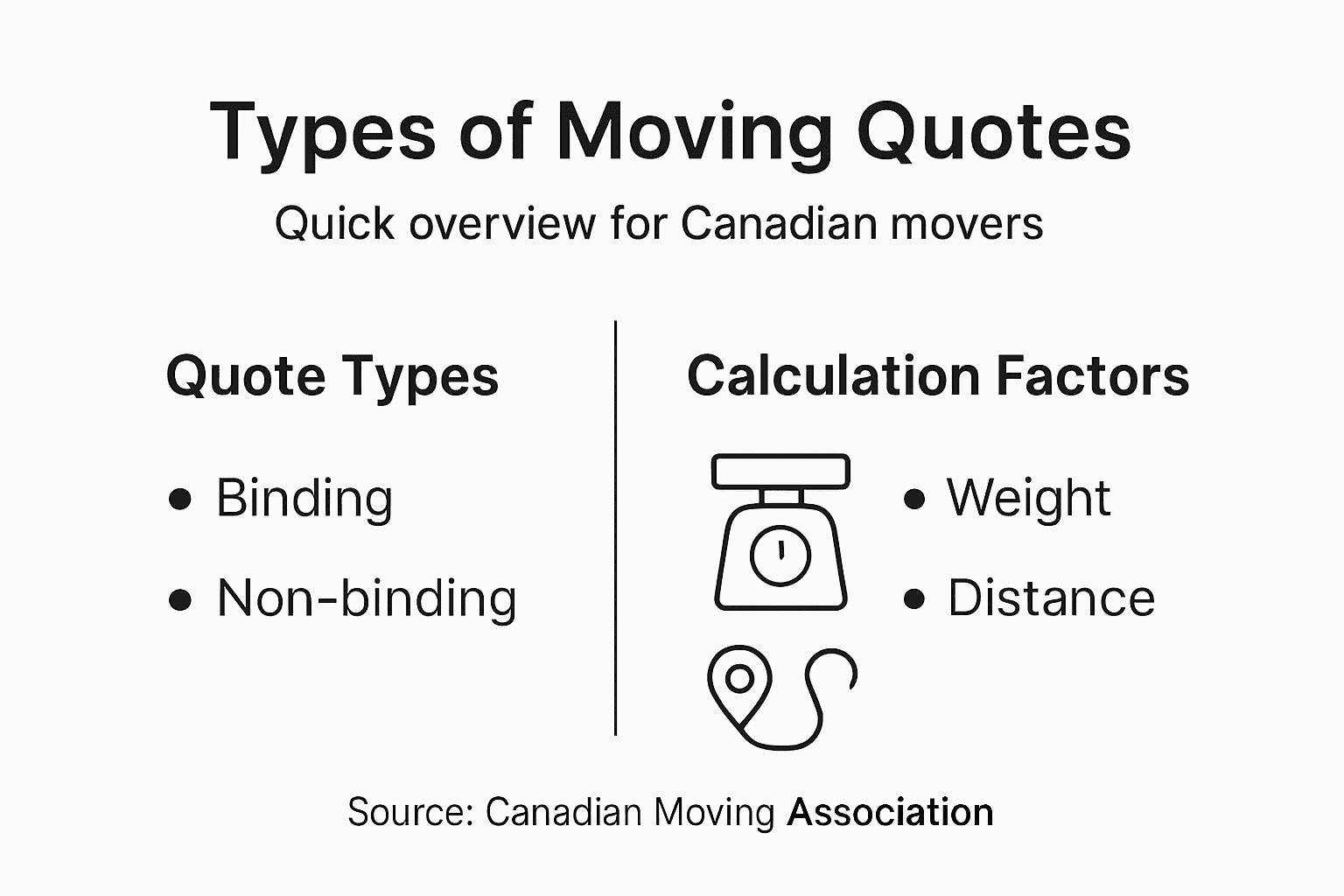
- Types Of Moving Quotes And Differences
- How Moving Quotes Are Calculated
- Flat Rate Versus Hourly Estimates
- Hidden Fees And Budgeting Risks
Key Takeaways
| Point | Details |
|---|---|
| Understanding Moving Quotes | A moving quote is a legally binding estimate outlining costs and logistics for relocation in Canada, providing transparency to consumers. |
| Types of Moving Quotes | There are three main types of quotes: Binding, Non-Binding, and Binding Not-to-Exceed, each offering different levels of price certainty and financial risk. |
| Calculating Moving Costs | Quotes are based on various factors including weight, distance, and complexity, necessitating thorough assessments by moving companies. |
| Avoiding Hidden Fees | Consumers should carefully review moving contracts, request detailed estimates, and be cautious of vague terms to mitigate unexpected expenses. |
Defining a Moving Quote in Canada
A moving quote is an official estimate that outlines the anticipated cost and logistics of relocating your belongings from one location to another within Canada. Unlike informal price discussions, a professional moving quote represents a detailed, legally binding document that provides transparency about potential relocation expenses.
In the Canadian moving industry, a comprehensive quote typically encompasses several critical components:
- Total estimated transportation costs
- Itemized breakdown of services
- Potential additional charges or fees
- Estimated timeframe for the move
- Inventory of items being transported
Moving quotes are not merely price tags but strategic documents that protect consumer rights under Canadian regulatory frameworks. These estimates help customers understand exact financial commitments and prevent unexpected expenses during relocation.
Professional moving companies in Canada are required to provide transparent, detailed quotes that include all potential charges. This approach ensures customers can make informed decisions about their move, comparing services and understanding the full scope of their relocation investment.
Key Considerations for Moving Quotes:
- Always request written documentation
- Verify all included and potential additional services
- Ask about insurance and liability coverage
- Understand cancellation and rescheduling policies
- Compare quotes from multiple providers
Pro tip: Request an in-home or virtual survey to receive the most accurate moving quote possible.
Types of Moving Quotes and Differences
In the Canadian moving industry, there are three primary types of moving quotes that provide different levels of pricing certainty and protection for consumers. Understanding these quote variations is crucial for making informed relocation decisions.
Types of Moving Quotes:
- Binding Quote: A fixed price guarantee that locks in the total moving cost
- Non-Binding Estimate: An approximate price subject to change based on actual services
- Binding Not-to-Exceed Quote: A maximum price commitment with potential for lower final costs
Binding quotes offer the most financial predictability for customers. These quotes represent a legally binding contract where the moving company cannot charge more than the originally quoted amount, regardless of additional time or unexpected challenges during the move. This type of quote provides significant peace of mind for those seeking complete cost transparency.
Non-binding estimates, conversely, are more flexible but potentially riskier. These quotes provide an initial price projection that can fluctuate based on actual moving conditions, such as additional labour, unexpected packing requirements, or changes in transportation logistics. Customers should carefully review these estimates and understand they might encounter additional charges.
Here’s a concise comparison of the three most common moving quote types in Canada:
| Quote Type | Pricing Certainty | Financial Risk | Best For |
|---|---|---|---|
| Binding | Fixed price, no change | Low risk | Budget-focused consumers |
| Binding Not-to-Exceed | Price capped, may decrease | Moderate risk | Complex moves with flexibility |
| Non-Binding Estimate | Estimate can change | Higher risk | Unpredictable or small moves |
Key Differences Between Quote Types:
- Price Certainty: Binding > Binding Not-to-Exceed > Non-Binding
- Risk Level: Non-Binding (Higher Risk) vs Binding (Lower Risk)
- Flexibility: Non-Binding allows adjustments, Binding maintains fixed pricing
Professional moving companies in Canada are required to provide clear, transparent documentation explaining the specific terms of each quote type.
Choosing the Right Quote Type:
- Consider your budget flexibility
- Evaluate the complexity of your move
- Ask detailed questions about potential additional charges
- Request written explanations of quote terms
- Compare quotes from multiple providers
Pro tip: Always request a written breakdown of services and potential additional fees to avoid unexpected moving day surprises.
How Moving Quotes Are Calculated
Moving quotes are meticulously calculated through a comprehensive assessment of multiple factors that influence the overall cost and complexity of a relocation project. Moving companies estimate costs by evaluating several critical components that directly impact the final price.
Primary Factors Influencing Moving Quote Calculations:
- Total volume and weight of belongings
- Distance between origin and destination
- Complexity of the move (stairs, elevators, long carries)
- Number of movers required
- Specialized equipment or handling needs
- Packing and unpacking services
- Time of year and moving season demand
The weight and volume of items represent the most significant determinants in quote calculations. Professional movers typically conduct either an in-home visual survey or a detailed virtual assessment to precisely measure the quantity and type of items being transported. This allows them to estimate the labour, truck space, and resources necessary for a successful move.
Geographic distance plays a crucial role in quote determination. Local moves within the same city are typically charged by the hour, while long-distance relocations are calculated based on total distance traveled and the weight of transported items. Additional factors like fuel costs, potential overnight stays for long-distance moves, and regional transportation complexities further influence the final quote.
Breakdown of Quote Calculation Components:
- Base moving rate
- Additional labour costs
- Transportation expenses
- Packing material fees
- Special handling charges
- Insurance and valuation coverage
Transparent moving companies provide itemized quotes that clearly explain each cost component, ensuring customers understand exactly what they’re paying for.
Additional Quote Considerations:
The following table highlights major factors that influence Canadian moving quote calculations:
| Factor | Typical Impact on Costs | Example Context |
|---|---|---|
| Weight & Volume | Increases with quantity | Larger homes, heavy furniture |
| Distance | Longer trips cost more | Interprovincial or rural relocations |
| Move Complexity | Raises labour & charges | Narrow halls, stairs, elevators |
| Seasonal Demand | Peak periods cost more | Summer weekends, holiday moves |
- Seasonal pricing variations
- Peak moving periods (summer months)
- Potential additional service fees
- Potential storage requirements
- Last-minute changes or complications
Pro tip: Request a detailed, written breakdown of all potential charges to avoid unexpected expenses during your move.
Flat Rate Versus Hourly Estimates
Moving cost structures in Canada typically fall into two primary pricing models: flat rate and hourly estimates. Flat-rate moving options offer distinct advantages for Ontario homeowners seeking predictable relocation expenses.
Flat Rate Pricing Model:
- Fixed total cost for the entire move
- Predetermined price based on initial assessment
- Provides complete cost transparency
- Eliminates unexpected financial surprises
- Ideal for long-distance or complex moves
Hourly estimates function differently, charging customers based on the actual time spent during the moving process. For local moves within the same city, hourly rates can be more flexible but potentially less predictable. Hourly pricing typically includes the number of movers, truck size, and total hours worked, which means the final cost can fluctuate depending on unexpected challenges or complications during the move.
Comparison of Pricing Models:
- Cost Predictability: Flat Rate (High) vs Hourly (Low)
- Complexity Handling: Flat Rate (Better) vs Hourly (More Variable)
- Financial Risk: Flat Rate (Lower) vs Hourly (Higher)
The choice between flat rate and hourly estimates depends on several factors, including move distance, complexity, and personal risk tolerance. Local moves under 50 kilometres might benefit from hourly rates, while long-distance or multi-location moves typically warrant a flat-rate approach to ensure budget certainty.
Professional moving companies recommend carefully reviewing the specific terms and conditions of each pricing model before making a final decision.
Factors Influencing Pricing Model Selection:
- Distance of the move
- Total volume of belongings
- Complexity of pickup and delivery locations
- Number of items requiring special handling
- Potential logistical challenges
Pro tip: Request a detailed written breakdown of all potential charges, regardless of the pricing model you choose, to avoid unexpected expenses.
Hidden Fees and Budgeting Risks
Moving expenses can quickly spiral out of control when consumers fail to understand the potential hidden costs in moving quotes. Unscrupulous moving companies often employ subtle tactics that can dramatically increase the final bill beyond the initial estimate.
Common Hidden Fee Categories:
- Stair carry charges
- Long carry fees
- Fuel surcharges
- Packing material expenses
- Equipment rental costs
- Storage fees
- Insurance and valuation coverage
- Overtime labour rates
Professional moving companies sometimes include additional charges that are not immediately apparent during the initial quote process. These fees can encompass everything from extra labour for complex moves to specialized handling of fragile or oversized items. Customers should carefully review all potential supplementary expenses before signing any moving contract.
Red Flags for Potential Hidden Fees:
- Significantly lower initial quote compared to competitors
- Vague language in the moving contract
- Lack of itemized cost breakdown
- Reluctance to provide detailed written estimates
- Pressure to make quick decisions
Transparent moving companies will always provide a comprehensive, written estimate that clearly outlines all potential charges and fees.
Strategies to Mitigate Budgeting Risks:
- Request detailed, written estimates from multiple providers
- Ask explicit questions about potential additional charges
- Verify the moving company’s credentials and reputation
- Understand the difference between binding and non-binding quotes
- Negotiate clear terms before signing any agreement
Pro tip: Always allocate a 10-15% buffer in your moving budget to accommodate unexpected expenses and potential additional fees.
Secure Your Move with Accurate, Transparent Quotes from Aleks Moving
Understanding the true cost of your move is essential to avoid hidden fees and unexpected expenses highlighted in the article “What Is a Moving Quote and Why It Matters.” If you feel overwhelmed by confusing estimates or worried about fluctuating prices, Aleks Moving offers clear, flat-rate pricing that ensures you know exactly what to expect. Our expertise in providing detailed, binding moving quotes tackles the common challenges of budgeting and planning your relocation.

Take control of your moving experience today by requesting a free, no-obligation quote from Aleks Moving. With over 18 years of professional service across Ontario and Canada, we prioritise transparency and customer satisfaction. Visit Aleks Moving to get started, explore our comprehensive local and long-distance moving services, and discover how we remove surprises from your moving day. Don’t wait until the last minute — secure your stress-free move now with trusted professionals who value honesty and clarity.
Frequently Asked Questions
What is a moving quote?
A moving quote is an official estimate outlining the anticipated cost and logistics of relocating your belongings. It details transportation costs, itemized services, potential charges, and the estimated timeframe for the move.
Why is a moving quote important?
A moving quote is essential because it provides transparency about costs, protects consumer rights, and helps prevent unexpected expenses during relocation. It ensures customers understand their financial commitments beforehand.
What types of moving quotes are there?
There are three types of moving quotes: binding quotes (fixed price), non-binding estimates (approximate price that can change), and binding not-to-exceed quotes (maximum price that may decrease). Each offers different levels of pricing certainty and risk.
How are moving quotes calculated?
Moving quotes are calculated based on several factors including the total volume and weight of belongings, distance between locations, move complexity, and any additional services required, such as packing and unpacking.