Skip to content


TL;DR:
- Furniture storage offers a practical solution during moves, renovations, or business transitions in Ontario.
- Choosing the right storage type depends on your timeline, budget, access needs, and item fragility.
- Properly preparing and protecting your furniture ensures safe storage and easy retrieval.
Many people assume furniture storage is only for those with too much stuff or nowhere to go for months at a time. That’s a common misconception. In reality, furniture storage is one of the most practical tools available during any residential or commercial move in Ontario, whether you’re bridging a gap between leases, renovating a space, or managing a business transition. Knowing your options, understanding what to look for, and preparing your belongings correctly can make the difference between a stressful move and a smooth one. This guide walks you through everything you need to know.
Table of Contents
- Understanding furniture storage: What it is and why it matters
- Types of furniture storage solutions available in Ontario
- Key factors to consider when choosing furniture storage
- How to prepare and store furniture safely
- A fresh perspective: Why furniture storage is more than a fallback
- Discover Ontario’s trusted furniture storage and moving options
- Frequently asked questions
Key Takeaways
| Point | Details |
|---|---|
| Furniture storage defined | Furniture storage involves safely keeping household or business items off-site, often during moves or renovations. |
| Choosing the best option | Select a storage service based on your timeline, security needs, and budget for the smoothest relocation. |
| Proper preparation matters | Disassemble, clean, and protect furniture to ensure it survives storage undamaged. |
| Ontario-specific solutions | Ontario movers offer services for residents and businesses requiring flexible, secure storage during transitions. |
Understanding furniture storage: What it is and why it matters
Furniture storage, at its simplest, means keeping your household or office furniture in a secure, off-site facility for a set period of time. That period could be a few weeks or several months, depending on your situation. The facility could be run by a moving company, a dedicated storage provider, or a combination of both.
Who actually uses furniture storage? More people than you might expect:
- Homeowners between moves who close on a new home before their current one sells
- Renters navigating overlapping lease dates or waiting for a unit to become available
- Businesses in transition that are renovating, downsizing, or relocating offices
- Families decluttering before listing a home on the market
- Anyone receiving large furniture before a new space is ready to receive it
The benefits go beyond simply having somewhere to put your things. Furniture storage protects your belongings from damage during a chaotic move. It gives you flexibility to move at your own pace rather than rushing to fit everything into one frantic day. It also reduces the physical and logistical pressure of coordinating a move when timing doesn’t line up perfectly.
Storage when moving can ease moving stress for both families and businesses, giving you breathing room when the timeline gets tight.
One of the most practical advantages is that many moving companies now offer integrated storage solutions. That means your movers can pick up your furniture, transport it to a secure facility, and deliver it again when you’re ready. You don’t have to coordinate multiple vendors or rent a truck yourself.
Pro Tip: If you’re working with a moving company that offers storage, ask whether the same team handles both the move and the storage. Continuity reduces the risk of damage and miscommunication.
Exploring your furniture storage options early in the planning process gives you more time to compare providers, ask the right questions, and make a confident decision. With the basics in place, let’s explore the different storage options in more detail.
Types of furniture storage solutions available in Ontario
Not all storage solutions are built the same. In Ontario, you’ll generally encounter three main types, and each one suits a different kind of move or budget.
The types of storage services available differ in cost, convenience, and the level of control you have over your belongings. Here’s a quick breakdown:
| Storage type | Who manages access | Best for | Typical cost range |
|---|---|---|---|
| Full-service | Moving company | Busy families, businesses | Higher, all-inclusive |
| Self-storage | You | Budget-conscious movers | Lower, DIY effort |
| Mobile/pod storage | Shared (you and provider) | Flexible timelines | Mid-range |
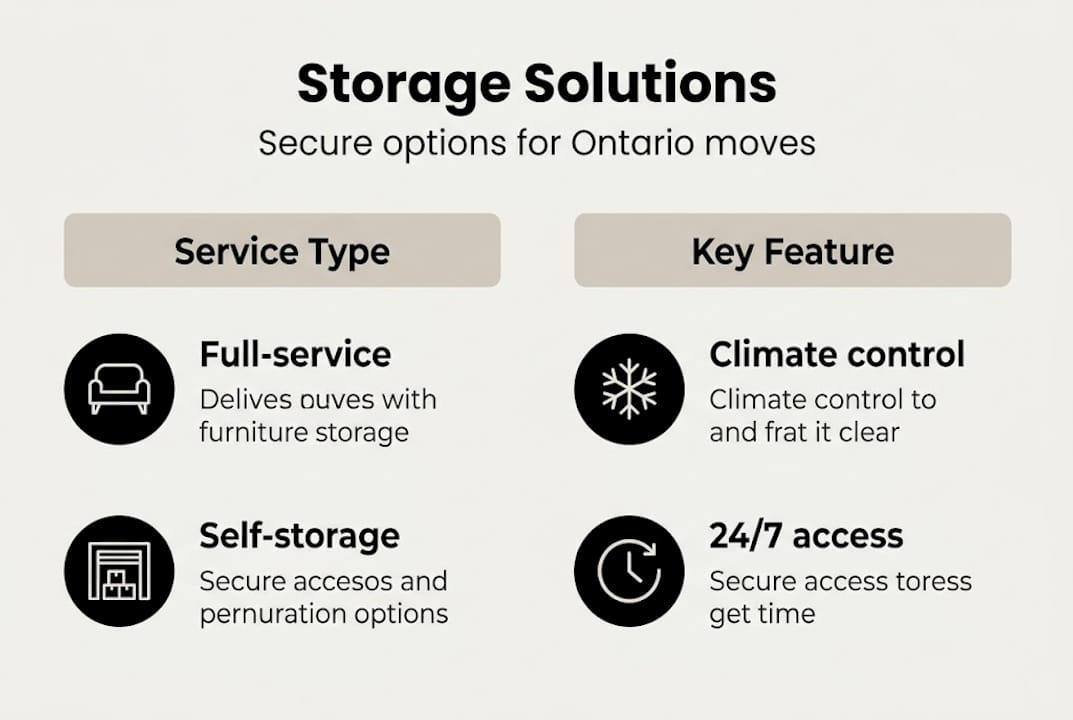
Full-service storage is the most hands-off option. Your moving company picks up your furniture, stores it in their facility, and returns it when you’re ready. You never need to visit the unit.
Self-storage puts you in control. You rent a unit, load it yourself, and access it on your schedule. It’s more affordable but requires more effort and planning.
Mobile or pod storage sits somewhere in between. A container is delivered to your home, you fill it at your own pace, and the provider picks it up and stores it until you need delivery.
How do you choose? Follow these steps:
- Define your timeline. Short-term needs under three months often suit full-service or pod storage. Longer stays may be more economical with self-storage.
- Assess your items. Fragile, valuable, or large furniture may need the added care of a full-service provider.
- Set your budget. Get quotes from multiple providers and compare what’s included.
- Consider access needs. If you’ll need to retrieve items frequently, self-storage gives you the most flexibility.
- Check for integration. If you’re already hiring movers, ask whether renting a storage unit through them saves time and money.
Now that you understand the kinds of storage available, it’s useful to consider what really matters when making your decision.
Key factors to consider when choosing furniture storage
Choosing a storage facility isn’t just about price. Several factors directly affect whether your furniture arrives back in the same condition it left.
Here’s what to evaluate before signing any agreement:
- Security features: Look for 24/7 surveillance cameras, gated access, and individual unit alarms. Ask whether staff are on-site during business hours.
- Climate control: Wood furniture can warp, leather can crack, and electronics can fail in extreme temperatures. Climate-controlled units maintain stable temperature and humidity levels.
- Access hours: Some facilities offer 24-hour access; others have restricted hours. Know what you need before committing.
- Contract terms: Watch for minimum stay requirements and penalties for early exit. Month-to-month contracts offer more flexibility.
- Insurance coverage: Confirm whether your belongings are covered under the facility’s policy or whether you need separate insurance.
The storage cost breakdown matters too. Storage duration, insurance, and facility features significantly impact what you’ll pay and how satisfied you’ll be with the experience.
Here’s a general sense of what Ontario storage can cost in 2026:
| Unit size | Estimated monthly cost | Climate controlled |
|---|---|---|
| Small (5×5 ft) | $60 to $100 | Optional |
| Medium (10×10 ft) | $120 to $200 | Recommended |
| Large (10×20 ft) | $200 to $350 | Strongly recommended |
These figures vary by location, provider, and season. Urban areas in Ontario tend to cost more than rural ones.
A key insight: many people focus entirely on monthly price and overlook insurance. If something goes wrong and your items aren’t covered, the savings won’t feel worth it. Always ask for written confirmation of what’s covered and what’s not. Choosing trusted storage services with clear terms protects you from unpleasant surprises.
Understanding your needs and the features that matter, let’s get practical about preparing your furniture for storage.
How to prepare and store furniture safely
Even the best storage facility can’t protect furniture that hasn’t been prepared properly. The way you pack and organise your items before they go into storage directly affects how they come out.
Follow these steps to protect your belongings:
- Clean everything first. Dirt, moisture, and food residue can cause mould, staining, and odours during storage. Wipe down all surfaces and let items dry completely.
- Disassemble large pieces. Beds, shelving units, and desks take up less space and are less likely to be damaged when broken down. Disassembling furniture for storage also makes loading and unloading much safer.
- Wrap and protect surfaces. Use moving blankets for large items, bubble wrap for fragile parts, and plastic covers for upholstered furniture. Avoid wrapping wood in plastic directly, as it can trap moisture.
- Label everything clearly. Mark boxes and wrapped items with their contents and destination room. This saves enormous time during unpacking.
- Organise strategically. Place items you might need to access first near the front of the unit. Stack lighter boxes on top of heavier ones.
For specialty items like antiques, artwork, or office equipment, consider custom crating or additional padding. These items are more sensitive to temperature changes and physical impact. If you’re planning a longer move, reviewing how to prep for long-distance moving can give you additional guidance on protecting items over extended periods.
Common mistakes to avoid include wrapping items before they’re fully dry, stacking heavy furniture directly on top of softer pieces, and forgetting to remove batteries from electronics before storage.
Pro Tip: Before anything goes into storage, take photos of each item from multiple angles. This creates a visual inventory and provides documentation if you ever need to make an insurance claim.
Armed with these insights, let’s explore a unique angle on making storage work for you.
A fresh perspective: Why furniture storage is more than a fallback
Most people think of storage as a last resort. Something you turn to when things don’t go according to plan. We’d push back on that.
In our experience, the clients who benefit most from storage are the ones who plan for it from the start. A family staging a home for sale uses storage to remove excess furniture and make rooms feel larger, which can directly increase the sale price. A business relocating its office uses storage to phase the move across weekends without disrupting daily operations. A landlord renovating between tenants uses storage to protect fixtures and fittings without cramming them into another room.
Storage isn’t a sign that something went wrong. It’s a sign that someone thought ahead. When you treat it as a strategic tool rather than an emergency measure, it gives you control over your timeline, your space, and your stress levels.
For businesses especially, the value of efficient business relocation is directly tied to minimising downtime. Storage makes that possible. Think of it less as a holding area and more as a flexible extension of your moving plan.
Discover Ontario’s trusted furniture storage and moving options
If you’re planning a move in Ontario and wondering how storage fits into your plan, we’re here to help. At Aleks Moving, we’ve been supporting families and businesses across Ontario for over 18 years, and we understand that every move has its own timing challenges.
Our secure furniture storage solutions are designed to work alongside your move, not complicate it. Whether you need short-term storage between homes or a longer arrangement during a business transition, we offer transparent pricing with no hidden fees. Explore our full range of moving and storage services or reach out today to get a free quote tailored to your situation. Let us help you move forward with confidence.
Frequently asked questions
What does furniture storage mean?
Furniture storage refers to keeping household or office furniture in a secure facility outside your home or workplace, usually during moves or renovations. It eases moving stress for both families and businesses by creating flexibility in the timeline.
How do I choose the right storage option for my needs?
Consider security, climate control, access hours, cost, and contract flexibility when evaluating providers. The differences between storage types such as full-service, self-storage, and mobile storage can significantly affect your experience.
How should I prepare my furniture for storage?
Clean, disassemble, and wrap your items with appropriate protective materials to prevent damage. Labelling boxes and preparing furniture properly also makes retrieval much easier when the time comes.
What does it cost to store furniture in Ontario?
Monthly prices depend on storage type, unit size, and features like climate control. Always request a clear storage cost breakdown so you know exactly what you’re paying for before signing.
Is furniture storage safe for valuable or fragile items?
Yes, provided you choose a facility with strong security, climate control, and proper preparation of your items. Key features like monitoring and climate protection are essential for keeping valuable pieces in top condition.