

TL;DR:
- Accurate estimates and detailed documentation help prevent unexpected moving costs and disputes.
- Moving costs vary based on home size, distance, timing, access, and special items in Ontario.
- Choosing a transparent, written, not-to-exceed or binding estimate offers the best financial protection.
Moving costs in Ontario can spiral quickly, and the final bill often looks nothing like what you expected. One moment you have a rough number in mind, and the next you’re staring at charges for elevator time, fuel surcharges, and packing materials you never anticipated. Getting an accurate moving estimate from the start is the single best way to protect your budget and your peace of mind. This guide walks you through every stage of the estimation process, from understanding what drives costs to verifying your final quote, so you can plan your move with confidence.
Table of Contents
- What impacts your moving costs?
- Choosing the right estimate: Types and how to get them
- Accounting for extras and special circumstances
- Verifying and finalising your moving cost estimate
- Our hard-won lesson: Why transparency is your best ally in estimating moving costs
- Take the guesswork out of your next Ontario move
- Frequently asked questions
Key Takeaways
| Point | Details |
|---|---|
| Understand main cost drivers | Knowing the size, distance, and timing of your move is key to accurate cost estimates. |
| Request multiple written quotes | Always get at least three detailed quotes with inventory surveys to compare accurately. |
| Beware extras and seasonal surcharges | Include hidden costs like storage, peak rates, and GTA elevator fees in your estimate. |
| Add a safety buffer | Increase your budget by 10–20% to cover surprise costs that can arise during the move. |
What impacts your moving costs?
After laying the groundwork for why moving cost estimates are essential, we dig deeper into the main factors that drive these costs. Knowing what influences the price helps you ask better questions and make smarter decisions before moving day.
The key cost drivers
The moving cost factors that affect your bill fall into a few clear categories. Home size is the biggest one. A one-bedroom apartment takes far fewer hours and less truck space than a four-bedroom house. Distance matters enormously too. A local move within the same city is priced differently from a long-distance relocation across Ontario.
Here are the main factors that influence what you’ll pay:
- Home size: More rooms mean more furniture, more boxes, and more labour hours.
- Distance: Local moves are typically charged by the hour, while long-distance moves are quoted by weight or flat rate.
- Time of year: Peak season runs from May through September. Moving during this window almost always costs more.
- Access challenges: Stairs, narrow hallways, long carries from the truck, and elevator waits all add time and cost.
- Specialty items: Pianos, antiques, oversized artwork, and safes require special handling and equipment.
- Packing services: If you want the movers to pack and unpack your belongings, that adds to both time and materials costs.
Ontario cost benchmarks for 2026
Understanding real numbers helps you plan. Based on current moving costs in Ontario, here is what you can expect to pay for a local move:
| Home size | Local move (Ontario) | Long-distance (intra-provincial) |
|---|---|---|
| One bedroom | $500 to $1,000 | $2,000 to $4,500 |
| Two bedrooms | $900 to $2,000 | $3,000 to $7,000 |
| Three bedrooms | $1,500 to $3,000 | $4,500 to $10,500 |
These figures give you a solid baseline, but they are just starting points. Storage, professional cleaning at your old home, and utility connection fees can add several hundred dollars on top of the moving cost itself. Storage alone typically runs $150 to $300 per month depending on unit size and location.
It is also worth knowing what Toronto moving costs look like specifically, since urban moves tend to carry additional fees for parking permits, condo building access, and peak-hour delays.
Pro Tip: Always add a 10 to 20 percent buffer to whatever estimate you receive. Unexpected costs are common, and having that cushion means you will not be caught short on moving day.
Choosing the right estimate: Types and how to get them
Understanding costs is one thing, but getting a trustworthy estimate is another. There are three main types of moving estimates, and each one carries different risks and protections for you as the customer. Knowing the difference before you sign anything is critical.
The three types of moving estimates
Non-binding estimate: This is the most common type, but also the riskiest for the customer. The mover provides a rough price based on a visual or virtual inspection of your belongings. The final bill can legally exceed the estimate by up to 10 percent over the quoted amount. In practice, some less reputable movers use low non-binding estimates to win the job and then charge significantly more upon delivery.
Binding estimate: The mover commits to a fixed price regardless of how long the move takes or how much your items weigh. This gives you certainty. If the move ends up taking more time or effort than expected, the mover absorbs that cost, not you. The trade-off is that binding estimates are sometimes higher upfront because the mover is taking on the risk.
Not-to-exceed estimate (also called a guaranteed maximum): This is widely considered the most customer-friendly option. The mover sets a maximum price. If your actual move costs less, you pay the lower amount. If it costs more, you still pay only the quoted maximum. It protects you from overpaying while keeping the mover accountable.
| Estimate type | Price certainty | Risk to you | Best for |
|---|---|---|---|
| Non-binding | Low | High | Short, simple local moves |
| Binding | High | Low | Long-distance or complex moves |
| Not-to-exceed | High | Very low | Anyone wanting maximum protection |
How to get reliable pro moving estimates
Getting a trustworthy estimate requires a bit of preparation on your part. Follow these steps:
- Create a full inventory of your belongings. Walk through every room and list major furniture pieces, appliances, and the approximate number of boxes. The more detail you provide, the more accurate the estimate will be.
- Request a survey. Ask the mover to conduct either a virtual walkthrough via video call or an in-home inspection. Estimates given over the phone without a survey are often inaccurate.
- Get at least three written quotes. Comparing multiple offers helps you identify outliers. An unusually low quote can signal hidden fees later.
- Ask for itemised breakdowns. Each quote should list labour, truck fees, fuel surcharges, packing materials, and any applicable taxes separately.
- Confirm the estimate type in writing. Know exactly whether you are receiving a non-binding, binding, or not-to-exceed quote before you commit.
- Check for accreditation. Verify that each company is registered and carries appropriate insurance.
Taking these steps turns a vague phone quote into a reliable written commitment you can plan around.
Accounting for extras and special circumstances
Once you know the base estimate, it is time to factor in all the little extras and circumstances that can change the final cost. These are the charges that catch most people off guard, and they add up fast.
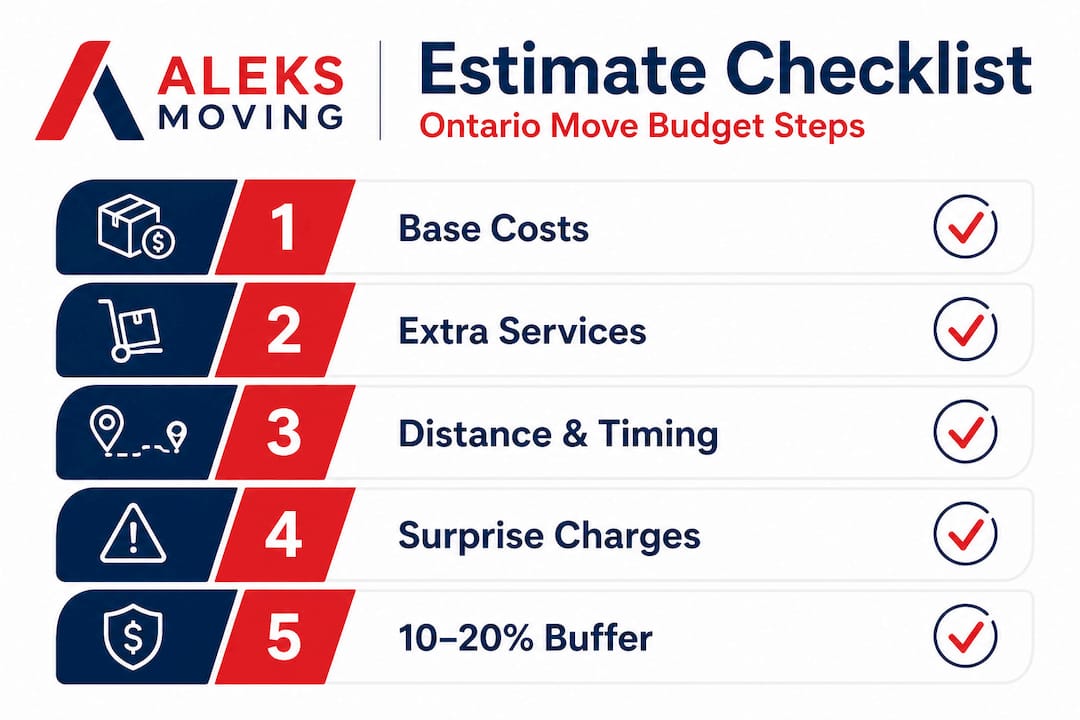
The extras that inflate your bill
Many homeowners underestimate how much the circumstances of their specific move can push the price upward. Here are the most common additions:
- Elevator fees: In GTA condos and urban apartment buildings, movers must often reserve a service elevator and pay a deposit. GTA condo moves can add 25 to 40 percent to your base cost, with elevator charges running $150 to $300 per hour and building deposits reaching $1,000.
- Peak season surcharges: Moving between May and September, on weekends, or at the beginning or end of a month can add 20 percent or more to your quote.
- Last-minute booking: If you book within a week or two of your move date, especially during peak season, expect to pay a premium.
- Long carries: If the truck cannot park close to your home, movers charge for the extra distance they carry your belongings.
- Bulky or specialty items: Pianos, hot tubs, large safes, and fragile antiques require extra equipment and expertise.
- Additional insurance: Basic moving insurance often covers items only at minimal replacement value. Full-value protection costs more but offers real peace of mind.
Pro Tip: If you are moving from or into a condo in the GTA, contact your building management office well in advance to book the service elevator and understand any deposits or restrictions. Missing this step can delay your move and cost you extra.
Storage, cleaning, and other common extras
Beyond the move itself, many Ontario residents also need temporary storage when there is a gap between their move-out and move-in dates. Storage fees typically run $150 to $300 per month, and some moving companies charge extra to load and unload a storage unit as a separate service. Professional cleaning at your previous home, particularly if you are a renter needing your damage deposit back, can cost $200 to $500 depending on the size of the space.
DIY truck rentals: Lower cost, higher risk
Renting a truck yourself can seem like a budget-friendly alternative. A local truck rental runs approximately $250 to $500, but this figure does not include fuel, insurance, dollies, moving blankets, or the physical and logistical effort involved. Damage to your belongings during a self-managed move is your responsibility entirely. For families with significant furniture or fragile items, the real cost of a DIY move often closes the gap with professional services quickly. Read our long-distance moving tips if you are weighing this decision for an interprovincial relocation.
“The cheapest quote is rarely the best value. What matters is the total, transparent cost, including every possible charge, compared against the protection and service quality you receive.”
Verifying and finalising your moving cost estimate
With all the pieces in place, here is how to make sure your estimate is accurate and your move stays on budget. Verification is not about distrust. It is about making sure everyone is on the same page before moving day arrives.
Your estimate review checklist
Before you sign any agreement, go through this checklist carefully:
- Confirm all charges are listed. Labour, truck, fuel, packing materials, elevator fees, and taxes should all appear as separate line items.
- Clarify the estimate type. Is it non-binding, binding, or not-to-exceed? Make sure this is stated explicitly in the written agreement.
- Check the cancellation and change policy. What happens if your move date shifts or you need to add items? Understand any fees for changes.
- Verify insurance coverage. Confirm what is covered, the coverage limit per item, and whether you need to purchase additional protection.
- Ask about payment terms. Reputable movers do not demand full payment upfront. Understand when and how payment is collected.
- Review the delivery window for long-distance moves. Confirm the expected arrival date range and what compensation applies if the movers miss it.
Getting three or more written quotes with a full inventory survey is the most reliable way to ensure you are comparing apples to apples. When quotes vary widely, ask each company to explain the differences line by line.
How to compare final offers and select the best value
Price alone should not make the decision for you. Consider the company’s reputation, years of experience, customer reviews, and what is included in each quote. A company offering a slightly higher price but including packing materials, full-value insurance, and a binding estimate may deliver far better overall value than a cheaper quote with several exclusions.
Check out service pricing tips for a detailed breakdown of how to evaluate competing offers side by side.
Once you have selected a mover, keep copies of every document: your written estimate, the signed agreement, and any receipts. If a dispute arises later, this paper trail is your strongest protection.
Remember: always add that 10 to 20 percent buffer. Even with the most thorough estimate, moving day can produce small surprises. Having that cushion built into your budget turns a stressful situation into a manageable one.
Our hard-won lesson: Why transparency is your best ally in estimating moving costs
After more than 18 years helping Ontario families relocate, we have seen one pattern repeat itself more than any other. Clients who arrive with a vague, verbal estimate almost always encounter a surprise on moving day. The problem is rarely the mover acting in bad faith. More often, it is simply a failure of communication and documentation.
When clients ask detailed questions, request itemised written quotes, and insist on clarity around every charge, their moves go smoothly. When they accept a rough number without asking follow-up questions, they leave room for misunderstandings to grow into disputes.
The moving strategies that work best are the ones built on clear written agreements, not assumptions. Our advice is simple: if a mover hesitates to put something in writing, treat that as a red flag. Every legitimate charge can be documented. Every legitimate mover will document it.
Transparency is not just good for customers. It makes moves run better for everyone involved.
Take the guesswork out of your next Ontario move
Planning a move across Ontario should feel manageable, not overwhelming. When you have a precise, written estimate in hand, backed by a thorough inventory survey and a clear agreement, you can focus on the exciting parts of starting fresh in a new home.

At Aleks Moving, we have spent over 18 years providing flat-rate, transparent quotes with no hidden fees to homeowners and renters across Ontario. Whether you are moving a one-bedroom apartment across town or relocating a full household to another city, our team is ready to give you a detailed written estimate you can rely on. Explore our trusted moving services or learn about our Ontario storage solutions if you need a safe place to keep your belongings during the transition. Contact us today for your free upfront quotation.
Frequently asked questions
How much does it cost to move a three-bedroom home locally in Ontario?
In 2026, expect to pay $1,500 to $3,000 for a local three-bedroom move in Ontario, depending on access, timing, and any additional services required.
How can I avoid hidden fees in my moving estimate?
Always request a detailed, itemised written quote and ask specifically about extras like stairs, elevator fees, fuel surcharges, and last-minute changes. A written inventory survey before the quote is issued gives you the most accurate result.
What is the not-to-exceed moving estimate and why is it safe?
A not-to-exceed estimate means you will pay no more than the quoted amount, even if the move takes longer or your shipment is heavier than expected. According to estimate type guidelines, this option offers the strongest financial protection for the customer.
Should I add a buffer to my moving budget?
Yes. Adding 10 to 20 percent on top of your estimate covers unexpected expenses like short-term storage, additional packing materials, or last-minute scheduling changes.