Skip to content


Yes, moving the same day your closing completes is doable, but it works best when you plan around Ontario’s typical afternoon key release instead of fighting it. Our advice: book a professional mover who offers last-minute or same-day service, and confirm your contract and insurance details in writing before closing day arrives. We offer flat-rate, last-minute moving services across Ontario for situations like this.
TL;DR:
- Ontario closings commonly release keys between 1 p.m. and 5 p.m., so use a flexible arrival window and confirm timing with your lawyer.
- Require a written contract listing itemized prices, total cost, services, dates, and delivery timing; Ontario gives you 10 days to cancel if signed at home.
- Agree in writing on delay fees and standby options, including partial loading, documented waiting, or temporary storage if registration or key release runs late.
- Get at least three estimates, verify certification, and ask whether the company is the carrier or a broker before booking.
- Request the mover’s insurance certificate, confirm liability limits and replacement value, and photograph belongings and both properties before and after the move.
Table of Contents
- Your pre-closing checklist for a same-day move
- Why Ontario closing times push most moves into the afternoon
- What your mover’s contract needs to say in writing
- A sample hour-by-hour playbook for closing day
- Why professional movers make the most sense on a tight closing schedule
- How Aleks Moving supports your same-day closing move
- FAQ
- Sources
Your pre-closing checklist for a same-day move
A smooth same-day move starts well before the closing date. The more you lock down in advance, the less room there is for delays or surprise charges once the keys finally change hands.
- Book your mover early and get a written estimate and contract listing services, start and end dates, and the total price.
- Reserve building access and parking for the move, especially in condos or shared driveways.
- Measure doorways, stairwells, and elevators for large furniture, and flag any long carries or tight entrances to your mover.
- Pack and label boxes by room, keep valuables and essential documents with you, and set aside an essentials box with toiletries, chargers, and a change of clothes.
- Request the mover’s Certificate of Insurance and confirm liability limits and any replacement-value options before move day.
- Share your closing time and contact details with your mover, lawyer, realtor, and building manager so everyone is working from the same schedule.
Getting accurate moving quotes in writing, with no vague line items, is one of the simplest ways to avoid a stressful surprise on the day itself.
Pro Tip: Call your mover the morning before closing to reconfirm the crew size, truck size, and arrival window, especially if your lawyer has given you a tentative completion time.
Why Ontario closing times push most moves into the afternoon
Most Ontario residential closings wrap up in the afternoon, typically during mid to late day hours, because mortgage funds, wire transfers, and land registration all have to happen that same day before keys can be released, according to a moving day playbook built around this timing pattern. That sequence, lender to lawyer to registry, means your lawyer’s office is often the last link in the chain, not your moving company.
Planning a morning arrival without your lawyer’s confirmation is the riskiest version of this schedule. A better approach:
- Set a flexible arrival window with your mover rather than a fixed early-morning time.
- Ask your crew about staggered loading, so they can begin packing the truck with non-essential items while you wait on final paperwork.
- Discuss late-completion contingencies in your contract before move day, not after you’re standing in an empty driveway.
- Agree in writing on what happens if keys are delayed, whether that means temporary storage, a partial load, or waiting fees.
The moving day playbook notes that building your schedule around the afternoon window, rather than hoping for an early release, avoids needless wait time and avoidable costs.
What your mover’s contract needs to say in writing
Before you sign anything, check that your contract covers the basics Ontario requires and protects you if something goes sideways.
- A written contract must list the mover’s contact details, a description of services, itemized prices, the total amount, and start and end dates, and if you signed it in your home you have a 10-day cooling-off period under Ontario’s hiring-a-mover rules.
- Ask whether your estimate is binding or non-binding, and clarify in writing what triggers extra charges beyond the quoted price.
- Confirm whether you’re dealing with a broker or the carrier doing the actual move, since brokers can create accountability gaps if something goes wrong, per guidance from the Office of Consumer Affairs.
- Check that delivery timing is specifically endorsed in your contract, since under O. Reg. 643/05 a carrier isn’t bound to a specific delivery time unless that time appears in the contract of carriage.
One more thing worth knowing: the Office of Consumer Affairs recommends getting at least three estimates and checking certification, such as Canadian Association of Movers membership, before you book. Photographing the condition of your belongings and your property before and after the move also strengthens any claim if items are damaged or lost along the way. Comparing moving insurance types ahead of time helps you understand what’s actually covered.
A sample hour-by-hour playbook for closing day
Every closing runs on its own clock, but having a rough hour-by-hour structure gives you something to adjust rather than a blank page to panic over.
- Morning (8 a.m. to 11 a.m.): Confirm final walkthrough details with your realtor, do a last check of packed boxes, and have your essentials box in the car.
- Late morning to early afternoon: Your lawyer’s office finalizes mortgage funding and registration; stay reachable by phone, and keep your mover updated on any changes to the estimated completion time.
- Key release (typically 1 p.m. to 5 p.m.): Once your lawyer confirms registration is complete, keys are released and your mover can begin loading at the old address or moving into the new one, depending on your situation.
- Load and transit window: Crews load, transport, and begin unloading according to the access and parking arrangements you confirmed in advance.
- Final walkthrough: Do an inventory check with your crew, take photos of both properties, note any meter readings, and get sign-off before the crew leaves.
If keys are delayed past your expected window, ask your mover about standby options such as a partial load, a short wait with documented hold time, or temporary storage until access is confirmed. Keep a written log of any delays and who caused them, since that record matters if a dispute comes up later.
Pro Tip: Save your lawyer’s direct line and your mover’s dispatch number in one spot on move day; a single phone call at each milestone keeps everyone moving instead of guessing.
Why professional movers make the most sense on a tight closing schedule
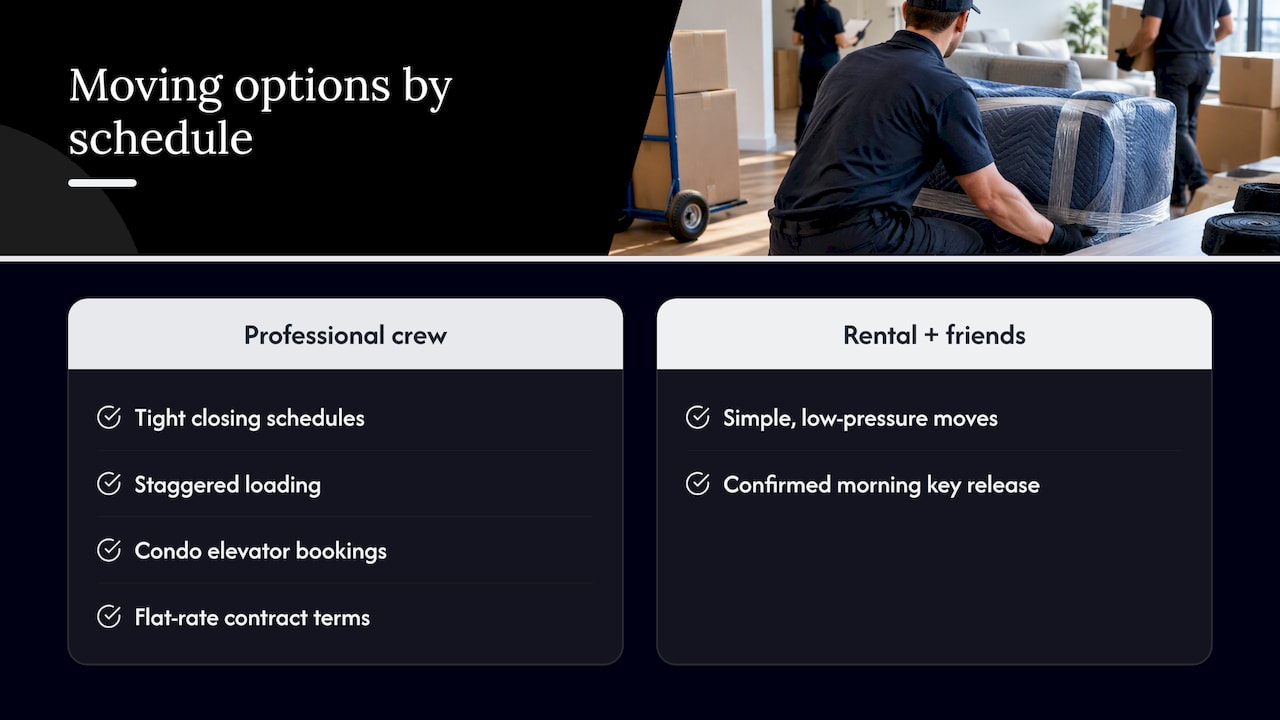
Same-day closings leave little margin for error, and that’s exactly where experienced crews earn their keep. A professional team that has handled dozens of tight Ontario closings knows how to stage a truck for a staggered load, manage condo elevator bookings, and keep a move on track when the key release slides later than expected.
A rental truck and a weekend of help from friends can work for a simple, low-pressure move with a confirmed morning key release. Once the schedule gets tight, or the building has elevator and loading-dock rules to navigate, a professional crew with flat-rate pricing and clear contract terms removes a layer of risk that’s hard to manage on your own.
— Ali
How Aleks Moving supports your same-day closing move

We’ve built our last-minute and same-day moving process around the reality that Ontario closings often run late into the afternoon, and we structure our crews and trucks to work with that timing rather than against it. Whether you’re moving a condo, a house, or an office, flat-rate pricing means you know your total before the truck ever shows up.
Here’s what helps us move fast once you call:
- Your expected or confirmed closing and key-release time.
- Any building access constraints, such as elevator bookings, loading docks, or parking permits.
- A quick list of oversized or fragile items, including antiques or art that need special handling.
- Which services you need: local moving, packing, or short-term storage if your new place isn’t quite ready.
We offer residential moving services across Ontario, along with local moves, full packing support, bin rentals for a more organized pack-and-unpack, and moving and storage for gaps between closing and move-in. Request a fast quote from our team, and we’ll confirm your contract terms and insurance details in writing before move day so there are no surprises when the keys finally land in your hand.
FAQ
Is it realistic to move the same day a closing happens?
Yes, it’s realistic, but Ontario closings commonly complete in the afternoon rather than the morning, so a same-day move needs a flexible arrival window built into your mover’s schedule, per the moving day playbook. Confirming your lawyer’s expected completion time before booking a morning crew helps you avoid paying for wait time.
What should be in a mover’s contract before a same-day move?
Your contract should list the mover’s contact information, a description of services, itemized prices, the total amount, and start and end dates, as required under Ontario’s hiring-a-mover rules. If you signed the contract in your home, you also have a 10-day cooling-off period to cancel.
How do I handle utilities and address changes around a same-day move?
Schedule utility disconnections at your old address and connections at your new one for your closing date, since same-day moves leave no buffer for a missed appointment. Update your address with Canada Post, your bank, and other key accounts in the days around your move rather than waiting until afterward.
What happens if the keys are delayed past the expected time?
Ask your mover in advance about standby options such as a partial load, a documented wait period, or short-term storage if registration and key release run later than planned. Keeping a written log of the delay, along with photos and timestamps, protects you if a dispute comes up about extra charges.
Should I use a broker or a direct moving company?
A direct moving company carries clear responsibility for your move from quote to delivery, while a broker arranges the job through another carrier, which can create gaps in accountability if something goes wrong, according to the Office of Consumer Affairs. Asking directly whether a company is a broker or the carrier doing the physical move is a simple way to clarify this before booking.
Sources
- Ontario
- Moving advice – Office of Consumer Affairs
- Moving Day Playbook: An hour-by-hour schedule that works