
Yes, you can move most treadmills safely, but only with the right prep. Unplug the machine, remove the safety key, and measure your route before anyone touches the frame. Then get at least two helpers and the correct equipment on hand.
- Never lay a treadmill flat or move it alone.
- Use a dolly at a controlled 45° tilt, or roll it on its built-in transport wheels if it has them.
- Protect your floors, baseboards, and any exposed wiring before the first lift.
Most moving guides recommend a minimum crew of two for a standard treadmill, with professional help called in for stairs, tight landings, or unusually heavy models. That single guideline prevents more injuries and dented drywall than any amount of muscle ever will.
Key Takeaways
Moving a treadmill safely comes down to measuring the full route first, using a controlled dolly angle, and knowing exactly when to call in professional help.
| Point | Details |
|---|---|
| Measure before you lift | Check folded and unfolded dimensions against every doorway, hallway, and stair section on the route. |
| Use a controlled tilt | Tip the machine to roughly 45 degrees to slide a dolly under the motor end, then strap it down. |
| Staff the crew properly | Assign a front, rear, and spotter role, with extra crew added for any stairs. |
| Protect against dust and moisture | Wrap the console separately and avoid leaving the machine uncovered outdoors or in a truck overnight. |
| Call professionals for high-risk moves | Aleks Moving offers flat-rate pricing and specialty equipment handling for stairs, heavy models, and tight turns. |
Table of Contents
- Preparing for moving a treadmill: measurements and crew roles
- What equipment do you need to move a treadmill?
- How do you actually move a treadmill step by step?
- How do you move a treadmill on stairs safely?
- Reassembling and testing your treadmill after the move
- When should you hire professional movers for a treadmill?
- Protecting treadmill components from dust, moisture, and damage in transit
- What actually matters more than strength when moving a treadmill
- Get a flat-rate quote for your treadmill move
- Sources
Preparing for moving a treadmill: measurements and crew roles
Almost every treadmill moving disaster traces back to one thing: nobody measured anything first. A machine that clears your bedroom doorway can still get stuck dead in a stairwell turn or a truck ramp with an awkward lip.
Start with the tape measure, not the dolly.
- Measure the treadmill in both its folded and unfolded states, noting overall length, width, and height in each position.
- Measure every chokepoint on the route — doorways, hallway width, stair width, landing depth, and the truck or elevator opening. Moving guidance consistently recommends comparing the machine’s folded and unfolded dimensions against each of these before committing to a path.
- Check the owner’s manual for folding latches and any manufacturer-approved disassembly points. Some consoles detach with four bolts; others are riveted and best left alone.
- Photograph the console wiring and connection points before removing anything, so reassembly later doesn’t turn into guesswork.
- Clear the route of rugs, low-hanging fixtures, and anything that narrows your working space, and lay down floor protection where the dolly will roll.
Once the path is confirmed, assign roles. Put your strongest mover at the front, since the motor and control end carries most of the weight, a second person at the rear, and a spotter watching turns and thresholds. Agree on simple verbal commands, lift, pivot, stop, before anyone bends their knees.
Pro Tip: Walk the entire route empty-handed first, phone in hand, and note every spot where you’d need to angle the machine. It takes two minutes and saves you from discovering a problem while holding 250 pounds of steel.
What equipment do you need to move a treadmill?
A treadmill’s weight is concentrated and awkward, not evenly balanced, so generic moving gear only gets you partway there. Match the tool to the terrain.
- Flat furniture dolly: fine for short, level moves across one room.
- Appliance dolly with a strap: better for heavier consoles and uneven weight distribution.
- Stair-climbing dolly: worth renting for any move involving more than a couple of steps, though these are less common at general rental counters than flat and appliance dollies.
- Moving blankets and corner protectors: wrap the console and frame edges to prevent scuffs and cracked plastic.
- Ratchet straps: secure the load to the dolly and again inside the truck.
- Furniture sliders: useful for the final few feet across hardwood or tile.
- Heavy-duty gloves and a loading ramp: for grip and for getting the machine into the truck without a dead lift.
Most hardware stores and local truck rental counters carry the basics. For blankets and padding, a supplier page like Bridges Bros. packing materials is a reasonable option if you’re stocking up locally. Label every removed bolt in its own bag; you’ll thank yourself in an hour.
How do you actually move a treadmill step by step?
Moving day goes smoothly when you follow the same order every time, in the same sequence a moving crew would use.
Before you lift anything:
- Unplug the treadmill and remove the safety key.
- Photograph the wiring layout and console connections.
- Fold and lock the deck if your model allows it, following the manual’s latch instructions.
- Remove or tape down any loose parts, water bottle holders, tablet mounts, cords, and bag all hardware.
The lift and transfer:
- Tip the machine to a controlled angle, roughly 45 degrees, so the motor end lifts just enough for the dolly to slide underneath. This is the technique most experienced movers rely on because it keeps the load centred rather than swinging.
- Centre the treadmill on the dolly plate before strapping it down. An off-centre load is the most common cause of a mid-hallway tip.
- Roll slowly, especially over thresholds and floor transitions. Rushing a dolly across a metal transition strip is how wheels catch and machines lurch.
Loading into the truck:
- Use a ramp rather than lifting the machine up into the truck bed directly.
- Keep the treadmill low and tilted through the ramp, with one person steadying each side and a third guiding from inside the truck if you have the crew for it.
- Strap the treadmill to the truck wall or a tie-down rail once it’s positioned, and pad any contact points with a blanket.
Reassembly and first test:
- Reconnect wiring using your photos as a reference, then check every fastener against your labelled bags.
- Level the deck on the new floor before powering on.
- Run the belt at low speed and watch for drifting, and listen for grinding or clicking that wasn’t there before.
Pro Tip: If the belt drifts to one side after the move, it’s almost always a levelling issue rather than a mechanical fault. Adjust the rear roller bolts slightly before assuming something broke in transit.
For general local move planning and crew communication, Aleks Moving’s guide to low-stress local moves covers timing and logistics that apply well beyond treadmills.
How do you move a treadmill on stairs safely?
Stairs change the math completely. What’s a simple two-person carry on flat ground becomes a genuine injury risk the moment gravity gets a vote, and uncontrolled downhill momentum is the single most cited cause of stair-move injuries.
- Keep the heavy motor end uphill at all times, whether you’re going up or down.
- Add at least one extra crew member beyond your flat-ground minimum, ideally two.
- Stop and reset your grip on every landing rather than pushing through in one continuous carry.
- Use a stair-climbing dolly where one is available. It controls descent speed far better than four hands and a lot of hope.
- Treat ratchet straps as a secondary restraint, not decoration. A strapped load that slips still has a backup holding it.
- Never let the machine roll or slide unchecked, even for a second. That’s the moment most injuries happen.
If the stairwell is narrow enough to require removing a door or handrail, or if you don’t have the crew to keep the heavy end controlled the entire way, that’s the signal to call in professional movers rather than forcing it. Adding just one flight of stairs is often enough to shift a job from manageable DIY into professional territory.
Reassembling and testing your treadmill after the move
Reassembly rewards the patient. Put structural pieces back first, the main frame and deck, before reattaching rails, uprights, or the console.
- Work from your photos and labelled hardware bags in the same order you removed each piece.
- Check every wiring connector is fully seated before closing any housing panels.
- Stabilize the feet and confirm the deck sits level with no wobble under light pressure.
- Power on and run the belt at low speed, watching for tracking drift and listening for new sounds.
- If the belt drifts, adjust the rear roller before assuming a bigger problem exists.
- Re-check all bolts after your first two or three runs, since transit vibration can loosen fasteners that felt tight on move day.
When should you hire professional movers for a treadmill?
Some moves are DIY-friendly. Others aren’t, and pretending otherwise usually ends with a scratched staircase wall or a strained back.
Call in professionals when your move involves stairs, tight turns, a non-folding or unusually heavy machine, delicate flooring you can’t risk scuffing, or simply not enough hands. If you’re short two helpers or the right dolly, that alone is a legitimate reason to hire out rather than improvise.
When you’re vetting a moving company, ask specifically about:
- Experience handling fitness or gym equipment, not just general furniture.
- Insurance coverage for damage during transit.
- Crew size for the job, and whether stair fees are itemized separately.
- Whether packing, unpacking, and reassembly are included or billed extra.
Aleks Moving brings 18+ years of specialty equipment handling and flat-rate pricing with no hidden line items. For an accurate quote, tell the estimator your treadmill’s brand, whether it folds, and how many stairs or turns are involved. A detailed briefing gets you a written estimate that actually matches moving day, rather than a surprise invoice at the end of it.
Pro Tip: Send a quick photo of your treadmill’s model plate along with your quote request. Estimators can flag non-folding or unusually heavy units immediately instead of discovering them curbside.
Protecting treadmill components from dust, moisture, and damage in transit
Electronics and moisture do not mix, and a treadmill console has more exposed wiring than most people realize once the housing panels come off. Wrap the console separately in a moving blanket or plastic sleeve before it goes anywhere near a truck, and keep it upright rather than stacked under other items.
Dust is the quieter enemy. Motors and belt mechanisms left uncovered during a move pick up grit that works its way into bearings and rollers over the following weeks, not immediately, which is why the damage often gets blamed on age rather than the move itself. A simple fitted cover or even a large garbage bag secured with tape over the motor housing solves most of this.
For humid climates or a move that involves any outdoor staging time, treat moisture as seriously as impact damage. Avoid setting the treadmill directly on damp pavement or grass, and never leave it uncovered in a truck overnight if rain is even a possibility. Silica packets tucked near the console during storage or transit are a cheap insurance policy against condensation.
Truck floors themselves need protection too, both to shield the treadmill’s feet and frame from vibration damage and to keep the truck bed from scratching plastic housings. A folded moving blanket under the base, combined with the ratchet straps already holding the load steady, covers both concerns at once without adding real cost to the move.
What actually matters more than strength when moving a treadmill
The biggest myth in treadmill moving is that it’s a strength problem. It isn’t. Most DIY moves that go wrong fail at the planning stage, not the lifting stage, a mismeasured doorway or a hallway causes more damage than a weak grip ever does.
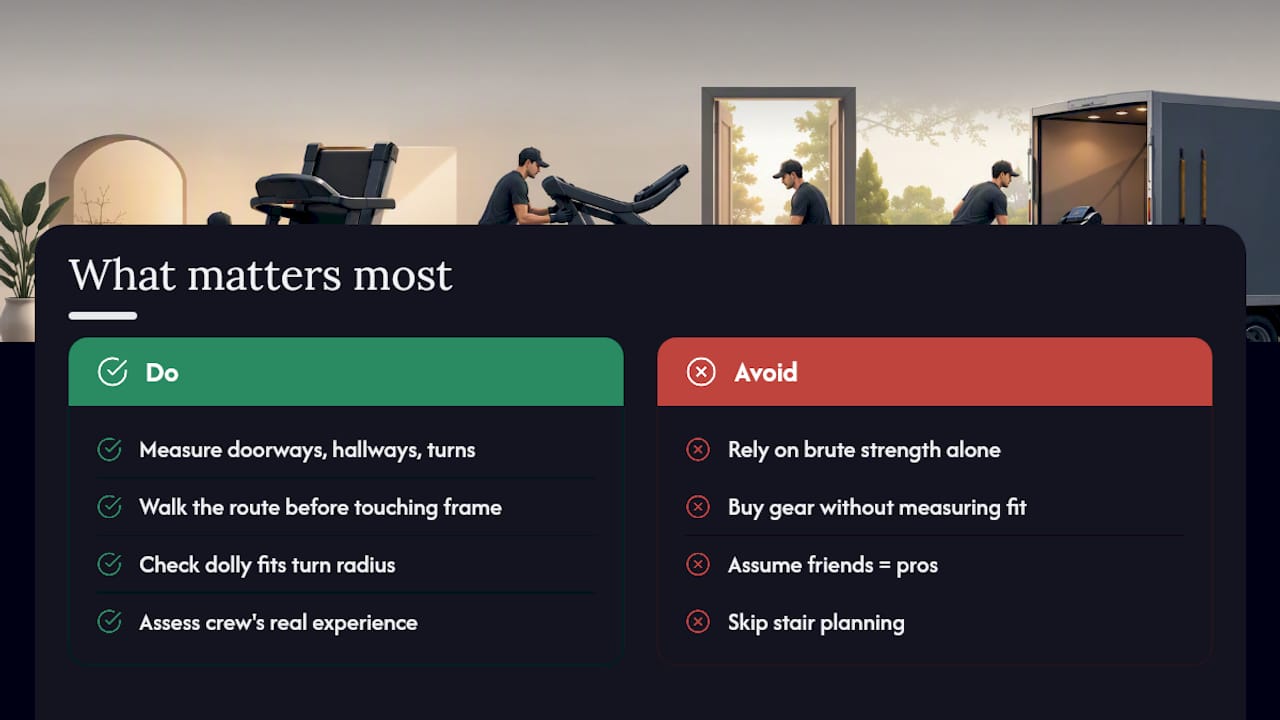
Conventional advice tends to overweight equipment recommendations and underweight the five minutes of measuring that would have prevented the problem in the first place. Buying a stair-climbing dolly doesn’t help if you never checked whether it actually fits your landing’s turn radius.
What I’d prioritize differently: treat the tape measure as your first tool, not your dolly. Walk the route before you touch the frame. And be honest about your crew’s real capacity, two willing friends who’ve never moved equipment together are not the same as two experienced movers who communicate under load. Stairs are where that gap shows up fastest, and it’s exactly where the conventional wisdom of “just get a friend to help” breaks down hardest.
— Ali
Get a flat-rate quote for your treadmill move
Renting a dolly, buying blankets, and coordinating two helpers on a Saturday morning works fine until your treadmill hits a stairwell turn nobody measured properly. Aleks Moving handles that exact scenario as part of standard local moving services, with a flat-rate quote that already accounts for stairs, specialty equipment, and reassembly, so there’s no surprise line item waiting at the end.

We’ve spent 18+ years moving gym equipment, appliances, and everything else that doesn’t fit neatly through a standard doorway, and our crews know the difference between a machine that folds and one that doesn’t before they show up. If your move involves stairs, a narrow landing, or a treadmill you simply can’t lift alone, request a free quote through our moving company page and tell us your model and route details upfront. You’ll get a written estimate that matches what actually happens on moving day.
Sources
- How to Move a Treadmill: A Step-by-Step Safety Guide
- How to Move a Treadmill in 4 Simple Steps
- How to Move a Treadmill Without Injury