
Plan early, book a vet visit, update your pet’s ID and microchip, and never place a pet inside the moving truck. Keep them with you or arrange safe boarding for the loading window instead. Schedule your vet appointment 2 to 4 weeks before moving day to sort vaccinations, paperwork, and any cross-border requirements through the CFIA. A professional moving company handles your boxes and furniture. You handle your pet’s safety.
TL;DR:
- Scheduling a vet visit 2 to 4 weeks before moving helps address travel anxiety, obtain certifications, and plan any necessary medication prescriptions.
- Updating microchip registration and collar tags with current contact information is crucial, along with starting crate training weeks prior to the move.
- Boarding or securing a safe room during moving day is safest; clearly label carriers and keep pets away from open doors and foot traffic.
- Driving is generally safer than flying for most moves, with regular stops every 2 to 3 hours and avoiding sedatives unless prescribed by a vet.
- Proper pet-proofing and enrichment in the new home, along with a prepared essentials bag, can significantly reduce stress during the transition.
Table of Contents
- Your top checklist for moving with pets
- Prepare your pet ahead of moving day: vet, ID, crate training, paperwork
- Moving day: the plan that prevents escapes and reduces stress
- Car vs plane: choosing the safest travel option
- The first days and weeks: applying the 3-3-3 rule
- Pet-proofing and enrichment for a faster settle-in
- Pet essentials bag for moving day and the first 48 hours
- Handling multiple pets during the moving process
- Special considerations for cats, dogs, and exotic pets
- Emergency preparedness during travel with pets
- Finding pet-friendly stops and temporary housing
- Practical notes from movers
- How Aleksmoving can help you move with pets
- Sources
Your top checklist for moving with pets
Every successful pet move breaks down into three phases. Miss a step in any one of them and moving day gets harder than it needs to be.
Pre-move (2 to 6 weeks out):
- Book a vet appointment and request health records and any required certificates, scheduling the visit several weeks before moving day.
- Update microchip registration details and swap in a fresh ID collar tag
- Start crate or carrier training with short practice sessions
Moving day:
- Board your pet or ask a trusted friend to watch them during loading and unloading
- Label carriers and keep them away from open doors and foot traffic
- Tell the crew lead exactly where your pet is staying, and ask them to avoid that space
Arrival:
- Set up a quiet safe room with food, water, and familiar bedding before anything else gets unpacked
- Stick to the old feeding and walk schedule as closely as possible
- Watch for appetite changes or toileting accidents, both early signs of stress
Prepare your pet ahead of moving day: vet, ID, crate training, paperwork
The weeks before a move matter more than moving day itself. Get these four tasks locked in early and the rest of the process runs a lot smoother.
- Book the vet visit 2 to 4 weeks out. This is the window vets recommend for discussing travel anxiety, car sickness, and any paperwork your move requires. It also leaves time to fill a prescription if your vet recommends one for a long drive.
- Update microchip records and collar tags. Your pet’s chip is only useful if the registry has your new address and phone number. Take a few current photos too, in case you ever need to describe or identify your pet quickly.
- Start crate acclimatisation 4 to 6 weeks ahead. Short practice drives, paired with treats and familiar toys inside the carrier, turn the crate into a safe space instead of a punishment box.
- Check border and airline rules early if your move crosses into Canada or involves a flight. The CFIA publishes official import and travel requirements for pets, and airline pet policies vary enough that a phone call beats guessing.
Pro Tip: Feed your pet their normal meal in the crate for two weeks before the move. By moving day, the crate smells like dinner, not danger.
Moving day: the plan that prevents escapes and reduces stress
Moving day is loud, chaotic, and full of open doors. That combination is exactly how pets go missing, so the goal is to remove your pet from the chaos entirely, not manage them through it.
The safest option is boarding your pet, or leaving them with a friend, for the hours movers spend loading and unloading. Boarding during that window is often the least stressful and most cost-effective choice compared with the risk of a bolted gate or a startled cat squeezing past a mover’s feet.
If boarding isn’t possible, set up a locked safe room instead:
- Choose a room far from the front door, ideally one movers won’t need to enter
- Post a sign on the door so nobody opens it by mistake
- Stock it with water, a litter box or pee pads, and a familiar blanket
- Double check every door and window latch before the crew arrives
Label carriers clearly, keep medications and paperwork in your pet’s essentials bag, and tell the crew lead where your pet is staying. Most professional movers, Aleksmoving included, don’t transport live animals in the truck, so build your own plan for getting your pet from the old home to the new one.
Car vs plane: choosing the safest travel option
Driving is the better choice for most moves when the distance allows it. You control the temperature, the stops, and the stress level, none of which is true once a pet is in cargo. For long drives, secure the crate on the back seat with a seatbelt strap or use a crash-tested harness; an unrestrained pet is both a safety risk and a driver distraction.
Flying adds real variables. In-cabin space is limited and books up fast, cargo carries higher risk for brachycephalic breeds and older animals, and every airline sets its own size and paperwork rules. Book your pet’s spot as early as you book your own seat, then confirm details directly with the airline and your vet.
- Stop every 2 to 3 hours on road trips for water, a bathroom break, and a stretch
- Never leave a pet alone in a parked car, even briefly, even with cracked windows
- Size the crate so your pet can stand, turn, and lie down comfortably
- Skip sedatives for air travel unless your vet prescribes them specifically for that purpose
Veterinary guidance generally advises against sedating pets for flights, since sedation can interfere with temperature regulation and breathing at altitude.
The first days and weeks: applying the 3-3-3 rule
Your pet doesn’t understand that the move is over once the truck pulls away. Veterinary behaviourists use the 3-3-3 rule to set realistic expectations for how long adjustment actually takes.
- First 3 days: expect your pet to feel overwhelmed, possibly hiding, refusing food, or sleeping more than usual. Keep the safe room stocked and don’t force interaction.
- First 3 weeks: routines start to click. Keep feeding times, walks, and play sessions on the same schedule they had before the move, since predictable routines signal stability to an unsettled animal.
- First 3 months: your pet finally feels at home. Confidence builds, exploration increases, and the new house starts to feel like theirs, not a strange box full of unfamiliar smells.
Pro Tip: Open the safe room door a crack after day three and let your pet decide when to explore. Forcing the pace usually backfires.
Watch for red flags at any stage: persistent appetite loss, litter box avoidance, house-soiling that wasn’t a problem before, or aggression that seems out of character. Any of those, especially lasting more than a few days, is worth a call to your vet or a certified behaviourist.
Pet-proofing and enrichment for a faster settle-in
Before you unpack a single box, walk the new place with your pet’s eyes. Secure loose cords, move houseplants out of reach, check balcony railings and screen doors, and confirm nothing toxic is sitting in an easy-to-reach cabinet.
For cats, vertical space and hiding spots do more for confidence than any toy. A cat tree near a window, a few empty boxes to duck into, and a scratching post placed somewhere visible all help. Pheromone diffusers and general enrichment measurably reduce stress-related behaviours in cats during a relocation, so plugging one in a few days before arrival is worth the small cost.
A simple scent trick works for both species: rub a cloth on your pet’s face or neck, then wipe it on a shelf, doorway, or piece of furniture at the new place. Introducing their own scent into the environment tends to shorten hiding time and speed up exploration.
For dogs, keep leash introductions short and controlled at first, offer safe chew toys to burn nervous energy, and scatter a few treats around the room for a scent-based game that turns exploring into something fun instead of frightening.
Pet essentials bag for moving day and the first 48 hours
Pack this bag the night before and keep it with you, never in the moving truck.
- Food and water for at least two days, plus bowls
- Any medications, with dosing notes written out clearly
- Medical records, microchip information, and recent photos of your pet
- Leash, carrier, familiar bedding, and one favourite toy
Keep border or airline paperwork in a labelled folder inside the same bag. If your pet takes medication on a schedule, a sticky note with times and doses saves you from guessing during an exhausting first day.
Handling multiple pets during the moving process
Moving one anxious animal is manageable. Moving three that all react differently is a coordination problem, and it helps to treat each pet as its own project rather than a single group task.
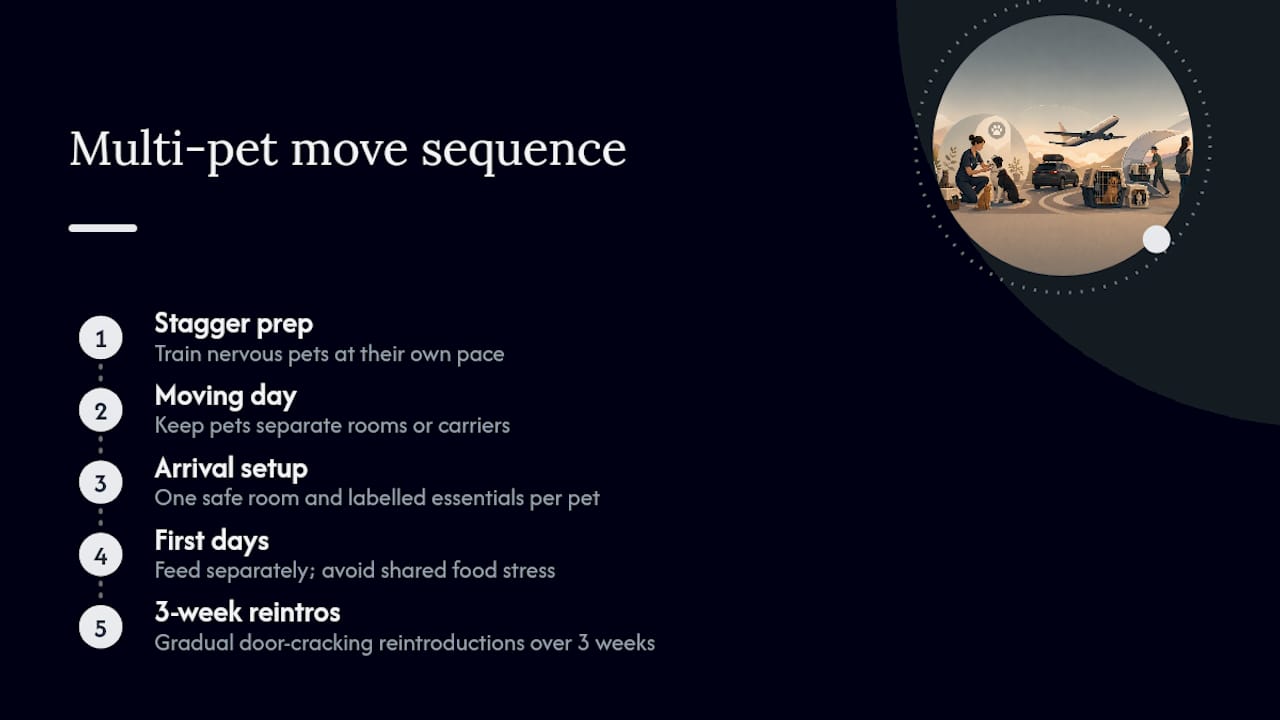
Stagger your prep so the more nervous animal in the household gets extra attention. If one cat hides at the sound of tape guns and another barely notices, plan crate training around the sensitive one’s pace, not the confident one’s.
On moving day, separate pets into different rooms or carriers rather than grouping them together. Two stressed animals in one crate often escalate each other’s anxiety instead of offering comfort. If boarding is your plan, most facilities can house multiple pets from the same household in adjoining kennels, which keeps them close without forcing shared space during the loudest hours.
At the new home, set up one safe room per pet if space allows, especially for cats that don’t get along or a dog and cat meeting a new layout for the first time. Reintroduce them to shared spaces gradually over the first 3-week window, using the same door-cracking approach recommended for single-pet households. Feed pets separately during the first few days too. A stressed animal guarding food near another stressed animal is a common, avoidable flashpoint.
Keep each pet’s paperwork, medication, and essentials bag clearly separated and labelled with their name. Sorting through one pile of mixed documents while a dog whines and a cat yowls in the car is a problem you can solve now, before it happens.
Special considerations for cats, dogs, and exotic pets
Cats and dogs handle moves differently, and exotic pets follow different rules entirely.
Cats bond with territory more than people, which is why sudden environment changes hit them harder. Keep cats confined to one room for longer than you would a dog, and resist the urge to let them roam the whole house on day one. Litter box placement matters too. Put it somewhere quiet and consistent, since a cat that can’t find a stress-free bathroom spot may stop using it altogether.
Dogs bond with routine and people, so a familiar walk schedule and consistent handler presence often matter more than the physical space itself. Leash walks around the new neighbourhood, done calmly and on a fixed schedule, help dogs map their new territory faster than free-roaming ever will.
Exotic pets, reptiles, birds, small mammals, need far more attention to environmental stability. Temperature and humidity swings during transport can be dangerous for reptiles, and birds are sensitive to drafts, temperature drops, and unfamiliar noise. Transport terrariums and cages with portable heat sources where needed, and never leave a reptile or bird in a car during a temperature extreme, even for a short errand. If you’re relocating an exotic pet across any distance, call an exotic-specialty vet ahead of time. General small-animal advice doesn’t always apply.
Emergency preparedness during travel with pets
Plan for the trip going wrong, not just the trip going right. A flat tire on a rural highway or a sudden bout of car sickness is manageable if you’ve already thought it through.
Keep your vet’s contact information and an emergency vet locator saved on your phone before you leave, not after something happens. If you’re driving through unfamiliar territory, look up 24-hour animal hospitals along your route the night before departure.
Pack a basic pet first aid kit: gauze, adhesive tape, a digital thermometer, tweezers for splinters or ticks, and any medication your pet takes regularly. Include a printed copy of vaccination records in case a border crossing or emergency clinic needs proof on the spot, since a dead phone battery shouldn’t be the reason you can’t prove your pet is up to date on rabies.
If your pet has a chronic condition, ask your vet for a short written summary of their history before you leave. It saves precious time if an unfamiliar clinic needs context fast.
Watch for heatstroke signs on warm-weather moves: heavy panting, drooling, or wobbliness are early warnings. Pull over, get your pet into shade or air conditioning, and offer water immediately if you notice any of these.
Finding pet-friendly stops and temporary housing
Long-distance moves often mean at least one overnight stop, and not every hotel that says it’s pet-friendly actually is once you call and ask the details.
Book pet-friendly rooms as early as you book the rest of your trip. Many hotel chains cap the number of pet rooms per location, and those fill up fast during peak moving season in late spring and summer. Call ahead rather than trusting a website filter alone. Confirm weight limits, breed restrictions, and any pet fees before you arrive with a tired animal and no backup plan.
If your move includes a stretch of temporary housing, corporate rentals and extended-stay properties are often more flexible with pets than standard short-term rentals, though policies vary enough that a phone call still beats an assumption. Ask specifically whether there’s a weight or breed restriction, since some properties advertise as pet-friendly but exclude larger dogs.
Whatever the stop, bring your pet’s own bedding and a familiar toy into every temporary space. New smells everywhere is disorienting on its own. One familiar-smelling blanket cuts through a lot of that disorientation, even in a room your pet has never seen before.
Practical notes from movers
Professional crews don’t put live animals on the truck. It’s not a policy that exists to be difficult. Live cargo isn’t something a moving company is equipped or insured to manage, and pets are safer with you, a boarder, or a registered pet transporter than riding in a cargo hold surrounded by furniture.
Coordination is simple once you name it out loud. Tell the crew lead which room is off-limits, post a sign on that door, and ask the team to schedule unloading with a short buffer so your pet has time to settle before boxes start moving past them. We’ve seen moves go smoothly and moves go sideways, and the difference is almost always whether the owner communicated the plan before the truck arrived, not during.
How Aleksmoving can help you move with pets
Professional movers handle the part of your move that has nothing to do with your pet’s safety, such as boxes, furniture, the truck, and provide flat-rate quotes with no hidden fees, so you can put your full attention on your pet’s comfort instead of splitting it between a couch and a crate.

Our team won’t transport your pet, but we will work around them. Tell us about your safe room setup when you book, and we’ll build the loading and unloading schedule to give your pet’s recovery space some breathing room. If your move needs a short storage window between homes, ask about our storage options so you’re not juggling boxes and a stressed animal on the same day. Ready to lock in your date? Request a flat-rate quote and let us handle the household side of the move while you handle the one who can’t pack their own bag.
Sources
- Moving with your pets | American Humane
- Bringing animals to Canada: Importing and travelling with pets | CFIA
- How to Move Into a New Home With Your Cat | Cat Fanciers’ Association