Skip to content


Most Canadian offices pay $200 to $500 for a small disassembly job under 10 desks, $500 to $1,500 for a mid-size office of 10 to 30 workstations, and $2,000 or more for large cleanouts or full-floor modular teardowns, according to CRS Moving’s breakdown. The exact number for your office depends on volume, access, and disposal choices, so the smartest next step is a site walkthrough or itemized quote from a professional mover before you commit to a number.
TL;DR:
- Disassembly costs vary significantly by office size, with small jobs under 10 desks costing $200 to $500 and large projects exceeding $2,000, depending on volume and complexity.
- Building access issues, including elevator scheduling and floor height, can greatly increase costs and should be clarified with the building manager upfront.
- Prices differ based on furniture type, with cubicle removal often costing more per station than simple desks, especially in high-volume projects.
- A detailed, itemized quote should include labour, transport, disposal, and surcharges, and confirm delivery timelines and scope adjustments beforehand.
- Resale credits, donation, recycling, and bundling with moves can significantly offset the gross disassembly expense.
Table of Contents
- Typical Canadian cost ranges and what each band includes
- Main cost drivers that change a quote
- How professionals price disassembly and how to evaluate quotes
- Sample scenarios and ballpark budgets for Canadian offices
- How to lower the net cost: resale, donation, recycling and bundling
- Aleks Moving’s approach and proof points
- My practical checklist for hiring disassembly services in Canada
- Aleks Moving: what we offer for office furniture disassembly and how to request a quote
- FAQ
- Sources
Typical Canadian cost ranges and what each band includes
Cost bands are a starting point, not a quote, but they help you sanity-check whatever number a vendor hands you.
A small job, generally under 10 desks or workstations, tends to run $200 to $500 in Canada. That band usually covers a two-person crew, a few hours of labour, and minimal transport to a nearby donation centre or disposal site, per CRS Moving’s figures. A mid-size office, roughly 10 to 30 workstations, lands between $500 and $1,500. At this size, you’re usually paying for a larger crew, a full truck or two, proper disposal fees, and sometimes elevator booking fees if your building requires a scheduled freight slot.
Large projects, meaning 50-plus desks or a full floor of modular cubicles, often exceed $2,000 before any resale or donation credits are applied. Costs scale here because modular cubicle systems take longer to break down per station, and the volume alone requires more trucks, more labour hours, and more disposal tonnage.
If you want to budget per item rather than per project, a few benchmarks help:
- Per-piece disassembly labour for standard furniture commonly runs $50 to $150, averaging around $150 per piece depending on complexity.
- Modular cubicle removal services sometimes advertise starting prices as low as $145 per station, though final cost depends on workstation count and panel configuration.
- A mixed office with filing systems, task chairs, and standard desks will usually fall between the per-piece average and the full-project band, since labour time compounds across different furniture types.
Treat these as planning numbers. The real price depends on what’s actually in your office and how hard it is to get it out the door.
Main cost drivers that change a quote
Two offices with the same desk count can get very different quotes. Vendors price on a handful of variables, and knowing them lets you scope your job accurately before you call anyone.
- Volume and asset mix. Cubicles take longer to disassemble than freestanding desks, and premium task chairs, dense filing systems, and IT equipment each add handling time.
- Building access. Floors above ground level, freight elevator reservations, and stair carries all add labour hours, and some buildings require a certificate of insurance before a crew can even enter.
- Labour complexity. Specialist disassembly for engineered modular systems, careful handling of data-bearing IT equipment, and heavy items like safes or boardroom tables all push hours up.
- Transport, disposal, and surcharges. Truck fees, dump or recycling tipping fees, e-waste surcharges, and insurance coverage are often priced separately from labour.
High-rise buildings add a real cost layer that’s easy to underestimate. Commercial cleanout pricing in Canada frequently applies labour premiums for higher floors and prices modular cubicle stations separately from flat furniture, since cubicle teardown simply takes longer per unit. Freight elevator scheduling and building insurance requirements are two of the most common sources of unexpected fees, so it’s worth asking your building manager about COI and elevator booking rules before you request quotes.
E-waste is its own category. Monitors, servers, and networking equipment often need certified recycling rather than standard disposal, which can mean a modest surcharge but also protects you from liability around data-bearing hardware.
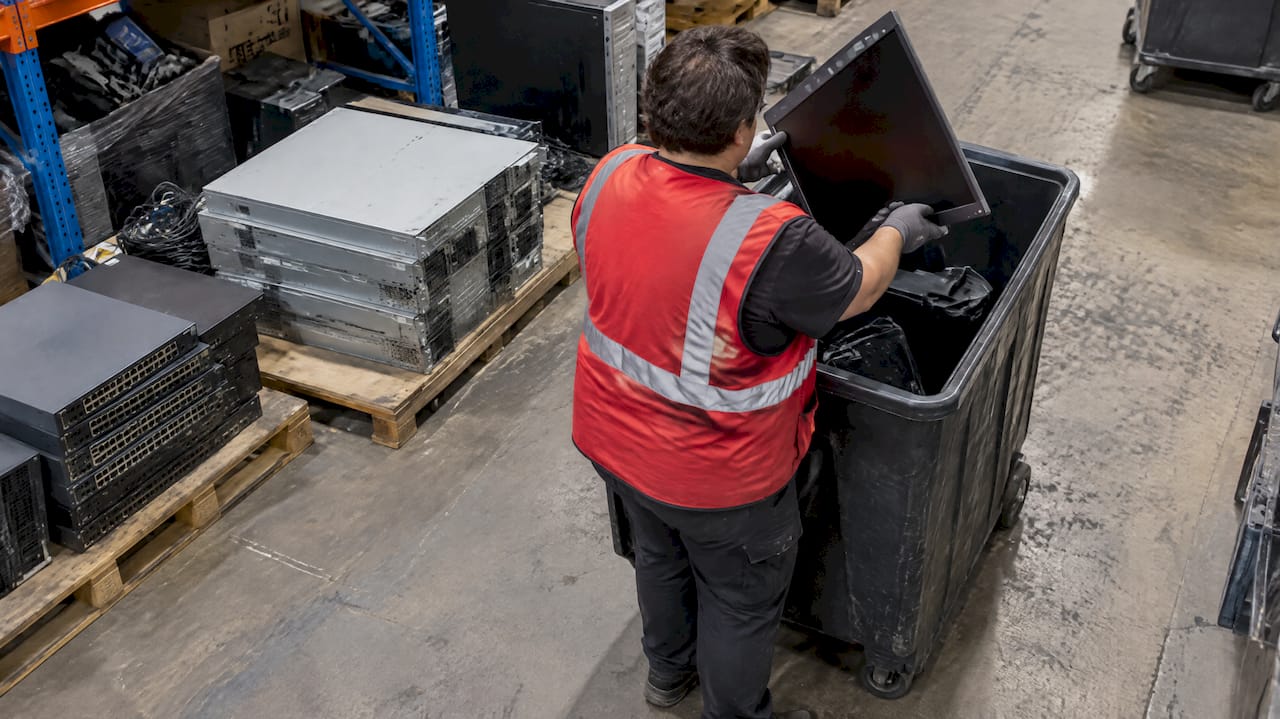
Pro Tip: Ask every vendor for building access details upfront, floors, elevator type, stair-only entries, since that single variable swings quotes more than almost anything else.
How professionals price disassembly and how to evaluate quotes
Vendors generally use one of three pricing models, and each comes with trade-offs worth understanding before you sign anything.
Flat-rate pricing locks your total cost before the job starts, which protects you from surprise add-ons but requires the vendor to do a proper walkthrough first. Per-piece pricing is transparent and easy to compare across quotes, but it can understate true cost if your furniture mix includes complex modular systems. Per-hour pricing is common for small, unpredictable jobs, but it puts the schedule risk on you if the crew runs into access delays.
Whichever model you choose, a solid quote should break out its line items clearly:
- Labour, usually priced per crew-hour or per piece depending on the model.
- Travel or truck fees, covering the vehicle and mileage to your disposal or donation destination.
- Disposal or tipping fees, which vary by material and local landfill or recycling rates.
- Surcharges, for e-waste handling, stair carries, or after-hours scheduling.
Before booking, ask for an itemized quote in writing, a certificate of insurance if your building requires one, and, if e-waste is involved, documentation from the recycler showing proper handling. Dumpster and container rental pricing is a useful comparison point here, since full container rental in Canada sometimes runs $294 to $500 per week, which can be cheaper for large volumes but shifts all the labour to your own team.
Finally, confirm the vendor’s timeline, cancellation policy, and what happens if the scope changes mid-job, for example if a crew discovers extra items on-site that weren’t in the original walkthrough.
Sample scenarios and ballpark budgets for Canadian offices
Seeing a few worked examples makes the cost bands easier to apply to your own office. These are illustrative scenarios, not quotes, built from the Canadian cost ranges above.
Say a small office with 5 desks and standard task chairs needs to clear out before a lease ends. At $50 to $150 per piece for disassembly labour, five desks and five chairs might land near the low end of the $200 to $500 small-job band, especially with minimal transport distance to a donation centre.
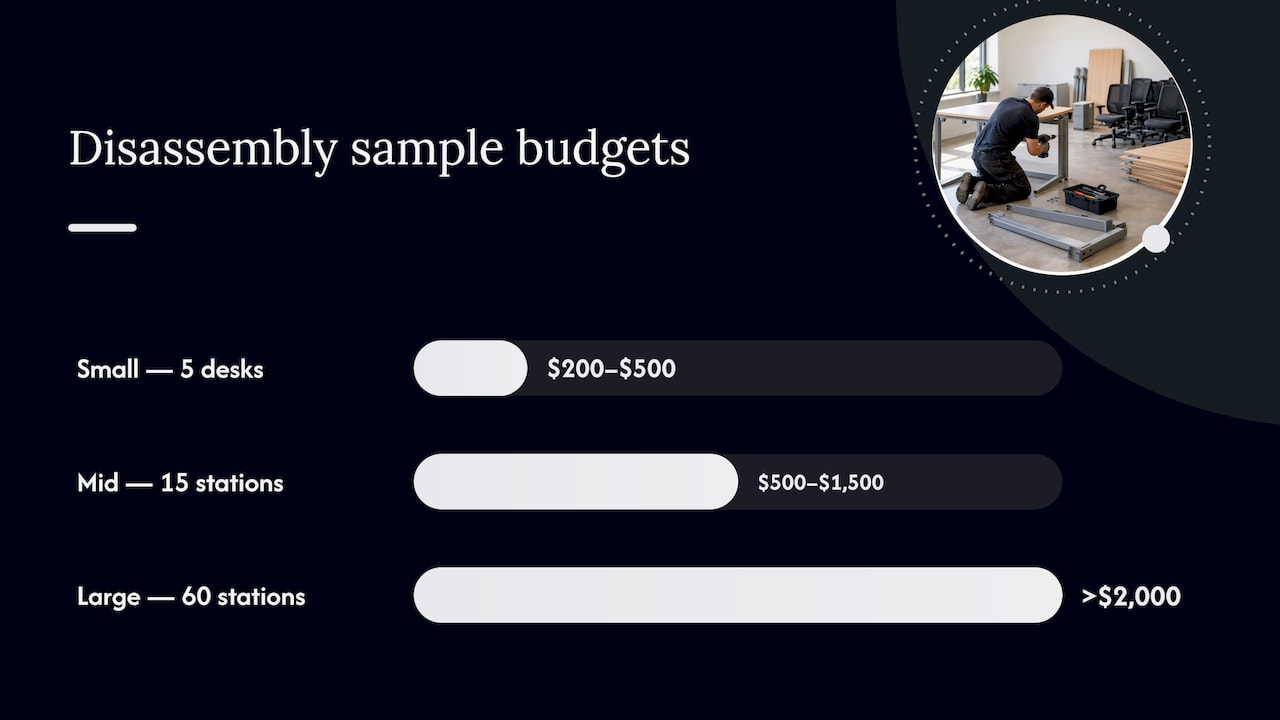
A mid-size office with 15 workstations, including a mix of modular cubicles and freestanding desks, sits closer to the middle of the $500 to $1,500 band. If the building requires a scheduled freight elevator slot, add a modest surcharge on top, since elevator coordination usually adds crew wait time that gets billed as labour.
A large modular cubicle teardown, say 60 stations across a full floor, pushes past $2,000 once you account for the slower per-station disassembly time that cubicle systems require compared to flat furniture. Here’s roughly how costs might break down:
- Labour: the largest line item, scaling directly with station count and cubicle complexity.
- Transport: multiple truck runs for high-volume projects.
- Disposal: tipping fees that scale with tonnage, higher for large teardowns.
- Offsets: resale or donation credits that can meaningfully reduce the net total.
That last point matters more than most office managers expect. Net cost after resale and donation is often meaningfully lower than the gross quote, particularly when premium-brand task chairs and desks are in good condition. For a closer look at how these line items show up in real projects, our breakdown of business moving costs in Ontario walks through similar examples.
How to lower the net cost: resale, donation, recycling and bundling
The gross quote isn’t your final cost. A few channels can offset it meaningfully, sometimes by a significant margin.
Office furniture commonly retains 30% to 40% of its original value after five years, and liquidators or resellers may pay 10% to 30% of original retail for modular systems in good condition. That resale credit can offset a sizable chunk of a mid or large job’s gross cost.
A few practical levers to pull:
- Resale: get a walkthrough quote from a liquidator before disassembly starts, since condition and brand drive the offer.
- Donation: many Canadian charities accept gently used office furniture and can issue a tax receipt for the donated value.
- Recycling: certified e-waste recycling adds a small surcharge but is often required for monitors and electronics.
- Bundling: pairing disassembly with your move or packing service usually cuts transport costs, since one crew and one truck handle both jobs instead of two separate vendors.
Bundling tends to be the easiest saving to capture, since it doesn’t require sourcing a separate buyer or charity.
Aleks Moving’s approach and proof points
We handle office relocations including furniture disassembly as part of commercial moves, rather than treating it as a separate, mysterious line item.
Our process starts with an assessment followed by an itemized quote with flat-rate pricing before you book. Once the quote is confirmed, we schedule the crew around your timeline, including last-minute moves.
Getting a fast, accurate quote is simple: have a rough item list ready, note any building access details like floors or elevator booking rules, and tell us your preferred dates. You can reach us by phone, through our contact form, or by messaging.
My practical checklist for hiring disassembly services in Canada
When I look at a disassembly quote, six things tell me whether it’s solid: building access noted upfront, every fee itemized rather than bundled into one number, a certificate of insurance offered without me asking, a realistic timeline, clear language on e-waste or recycling handling, and straightforward payment terms with no surprise deposit rules.
Speed, cost, and resale recovery pull against each other. A fast teardown rarely leaves time to arrange resale, while chasing maximum resale value can stretch your timeline by days. My rule: hire a full-service mover when furniture has resale or donation value worth protecting, and go with a junk-removal vendor only when everything is headed straight to disposal anyway.
— Ali
Aleks Moving: what we offer for office furniture disassembly and how to request a quote
We quote office furniture disassembly with flat-rate, itemized pricing locked in before you book. Our commercial moving service includes disassembly, transport, and reassembly at your new space to cover the full job.

To get an accurate number fast, prepare three things before you call: a rough inventory of what needs disassembling, notes on building access at both your current and new location, and your preferred move dates. From there, we can usually turn around a firm quote quickly. If you also need short-term storage for furniture you’re keeping, our moving and storage service can run alongside the disassembly job.
Ready to see what your office move would actually cost? Visit our commercial moving services page to request your free, itemized quote.
FAQ
What is the cheapest way to move furniture across Canada?
Bundling disassembly, transport, and reassembly into one moving service is usually cheaper than hiring separate vendors for each step, since one crew and one truck handle the whole job. Dumpster or container rental can work out cheaper for large-volume disposal, but it shifts labour to your own team.
Is it better to disassemble furniture before moving?
Yes, disassembling bulky items like desks, cubicles, and shelving before a move generally reduces transport time and lowers the risk of damage during transit. Professional crews also disassemble and reassemble as part of a standard commercial move, so it adds minimal extra coordination.
What is the average cost of office furniture disassembly?
Small jobs under 10 desks typically run $200 to $500, mid-size offices of 10 to 30 workstations run $500 to $1,500, and large cleanouts often exceed $2,000 before resale or donation offsets. Per-piece labour averages around $150 per item depending on complexity.
How do I disassemble furniture for a move?
Start by removing drawers, shelves, and any loose hardware, then photograph each assembly step so reassembly goes faster later. For modular cubicles or complex systems, hiring a crew familiar with the specific panel configuration avoids damage and saves significant time compared to a DIY teardown.
Sources
- How Much Does Commercial Liquidation Cost in Canada? A 2026 Pricing Breakdown
- Cubicle removal & disposal | LoadUp
- How Much Does It Cost to Dispose of Office Furniture?
- What does furniture assembly cost? HomeAdvisor