
Most self-storage facilities set access hours somewhere between 6:00 a.m. and 10:00 p.m., though the exact window depends on the property. Some locations offer 24/7 access as an optional add-on, not a standard feature, so you’ll need to check before assuming you can drop by at midnight. The real hours for your unit live in two places: your lease agreement and the facility’s own location page.
TL;DR:
- Only some storage facilities offer 24/7 access, often requiring a specific enrollment process and sometimes charging an extra fee.
- Access hours typically range from 6:00 a.m. to 10:00 p.m., but may be shorter depending on property type, layout, local bylaws, and staffing.
- Clarify and verify the actual access hours on the facility’s website, signage, and lease agreement before signing or loading, as discrepancies are common.
- Temporary changes to access hours can occur during major holidays, system outages, or when arranging after-hours move-ins, requiring prior coordination.
- Extended or 24/7 access is mostly beneficial for shift workers, contractors, or businesses with off-hours needs, while standard daytime access suffices for most users.
Table of Contents
- Storage access hours: typical windows and what shapes them
- How 24/7 storage access actually works
- Access hours vs. office hours: the distinction that trips people up
- Holiday closures, security lockouts, and after-hours move-ins
- Your pre-lease checklist for confirming access hours
- A mover’s perspective on scheduling around access hours
- Who actually needs extended or 24/7 storage access
- Let Aleksmoving handle the scheduling around your storage hours
- Where to check facility access policies yourself
- Sources
Storage access hours: typical windows and what shapes them
Ask five different facilities about their gate hours and you’ll likely get five slightly different answers. That’s normal. Common access windows run from around 6:00 a.m. to 10:00 p.m., but some properties trim that to 7:00 a.m. to 7:00 p.m., especially in residential neighbourhoods where late-night vehicle traffic draws complaints. A smaller share of locations advertise around-the-clock entry, usually at business-heavy or industrial sites.
What actually determines your hours comes down to a few practical factors:
- Unit type: drive-up units often follow the outer gate schedule, while indoor climate-controlled units may close earlier if the building itself locks down for the night.
- Property layout: a facility built inside a shared commercial plaza may have to match the hours of neighbouring businesses or the plaza’s own security gate.
- Local bylaws: municipalities sometimes restrict late-night lighting or vehicle movement in mixed residential zones, which pushes closing times earlier.
- Staffing model: fully unmanned facilities with app-based entry tend to offer longer windows than those relying on a live manager for gate control.
Never assume hours based on a facility you’ve used before, even one from the same company. Check the property’s own location page, read the posted signage at the gate, and confirm the wording in your lease. Those three sources should always agree. If they don’t, ask the manager to clarify before you sign anything.
How 24/7 storage access actually works
Round-the-clock access isn’t something every renter gets by default. It’s typically an enrolment process, and it’s offered at select locations rather than as a blanket amenity. Here’s the general sequence:
- You request extended access, usually at move-in or afterward through the manager.
- The facility may require manager approval, which can involve confirming your unit size, insurance coverage, or payment standing.
- You get issued a fob, gate code, or mobile app credential tied specifically to the extended hours.
- Some properties charge a small monthly premium for the privilege, since it usually means added security monitoring on their end.
Businesses that need off-hour pickups, contractors hauling equipment before sunrise, and shift workers coming off a late shift are the classic candidates for this kind of access. Facilities can also suspend or revoke 24/7 privileges if a unit falls behind on payment, if there’s a security concern tied to that access code, or if the property changes its policy during a lease term.
Pro Tip: Ask whether 24/7 access transfers automatically if you switch units within the same facility. Some operators treat it as tied to the original agreement, not the renter, which means you might have to reapply.
Access hours vs. office hours: the distinction that trips people up
This is where most confusion happens, and it’s worth getting straight before you ever need a unit at 9:00 p.m. on a Tuesday. Office hours cover the staffed side of the business. Access hours, sometimes called gate hours, cover the independent side where you use a code or app to get in on your own.
- During office hours, you can sign a lease, buy boxes or locks, ask a manager about billing, or resolve an access problem in person.
- During access hours but outside office hours, you can enter your unit independently using your assigned code or app, but no staff member is on-site to help.
- Outside both windows, you generally can’t get in unless you’ve enrolled in 24/7 access specifically.
Most operators also run customer care lines that stay reachable around the clock for things like a forgotten code or a technical outage. That support is real, but it’s remote. A phone agent can help you troubleshoot a keypad error. They usually can’t unlock a gate from a call centre three provinces away.
Holiday closures, security lockouts, and after-hours move-ins
Access hours aren’t fixed forever. A handful of situations will change them temporarily, and it helps to know which ones before they catch you off guard.
- Holiday closures: many facilities scale back access or close the office entirely on major statutory holidays, even if the gate itself stays on schedule.
- Security lockouts: a break-in attempt, a system glitch, or scheduled maintenance can trigger a temporary suspension of access, usually with signage or an email notice.
- After-hours move-ins: if your moving day lands outside standard hours, many locations can arrange a temporary allowance if you coordinate with the manager in advance.
Pro Tip: If you’re moving in after dark, treat it like any other unfamiliar parking lot at night. Bring a light source, park under a camera if one’s visible, and text someone your arrival and expected finish time. It costs nothing and it’s the kind of habit movers build early.
Your pre-lease checklist for confirming access hours
Get this sorted before you sign, not after you’ve already loaded a truck.
- Compare the hours listed on the facility’s website against the signage at the actual gate. Discrepancies happen more often than you’d think.
- Read the lease’s access clause word for word. This is the legally binding version, not the marketing page.
- Ask directly: Is 24/7 access available? What does it cost? What happens if the gate system goes down overnight?
- Get any special approval, like an extended-hours upgrade, confirmed in writing, and save the after-hours contact number somewhere you’ll actually find it.
Pro Tip: Take a photo of the posted gate hours on move-in day. It’s a small habit, but it gives you a timestamped record if hours ever change without notice.
A mover’s perspective on scheduling around access hours
Coordinating a move around someone else’s gate schedule is a familiar puzzle for professional movers. Paperwork, arrival windows, and gate codes all need to line up before a truck ever backs into a loading zone, and that only works with a plan set the day before, not the morning of.
Flexible or extended access earns its cost on multi-trip moves or staged unloads, where a crew needs the unit open outside a single tight window. For a straightforward one-time drop-off, standard hours are usually plenty. Our scheduling habit: confirm the gate code again the night before, book manager time during office hours for any lease questions, and build in a buffer in case the first slot runs long.
Who actually needs extended or 24/7 storage access
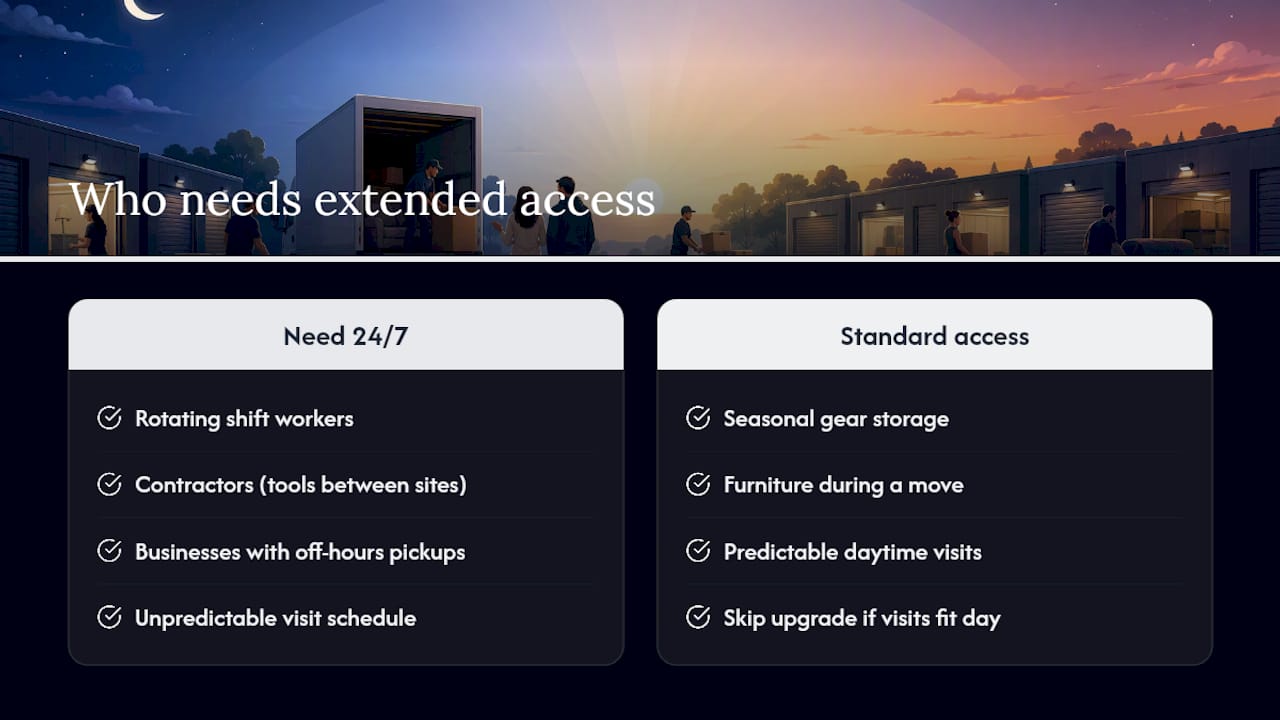
Round-the-clock access earns its cost for a specific type of renter: someone on rotating shifts, a contractor storing tools between job sites, or a business that needs inventory pickups outside a nine-to-five schedule. For everyone else storing seasonal gear or furniture during a move, standard daytime access covers the job without the extra fee.
My rule of thumb: if you can predict your visits will fall within a normal daytime window, skip the upgrade. If your schedule is unpredictable by nature, ask about 24/7 access before you sign, not after your first missed visit.
— Ali
Let Aleksmoving handle the scheduling around your storage hours
Storage access hours are only half the puzzle. The other half is getting your belongings there during the window that actually works. Aleksmoving coordinates move timing directly with facility schedules, handles the paperwork that needs to happen during office hours, and arranges staging when a property allows it, so you’re not stuck guessing whether your movers and the gate schedule will actually line up.
We work on flat-rate pricing with no hidden fees, so the quote you get is the quote you pay, whether it’s a straightforward drop-off or a multi-stage move that needs extra coordination. You can reach us by phone, contact form, or WhatsApp for a free quote. If storage is part of your move, take a look at our storage services page and request a quote built around your actual timeline, gate hours included.
Where to check facility access policies yourself
- StorageMart’s access and office hours FAQ breaks down typical gate windows and the office-versus-access distinction.
- Public Storage’s 24-hour access explainer covers who benefits most from round-the-clock entry.
- Your own facility’s location page and lease agreement remain the final word on your specific hours.
Sources
- Access and office hours | StorageMart
- Access and Office Hours — StorageMart (assets)
- 24 Hour Self Storage Near You | Public Storage®