Skip to content


Most people assume fragile items get damaged because movers are careless. The reality is quite different. The role of movers in fragile item transport goes far beyond simply carrying boxes from one place to another. Research shows that most breakage comes from internal shifting inside poorly packed boxes, not from dropping or rough handling. That means the packing decisions made before the truck even starts moving are what determine whether your grandmother’s china arrives in one piece. This article walks you through what professional movers actually do to protect your valuables, and how you can work with them more effectively.
Table of Contents
- Key takeaways
- What counts as a fragile item
- How professional movers protect fragile items
- Specialist partnerships for high-risk items
- Choosing movers and packing fragile items safely
- Common mistakes and how movers prevent them
- My honest take after years in this industry
- Moving fragile items with confidence? Aleksmoving can help
- FAQ
Key takeaways
| Point | Details |
|---|---|
| Internal shifting causes most damage | Voids inside boxes allow items to collide during transit, even when external packaging looks fine. |
| Professional packing methods matter | Snug boxes, proper cushioning, and double-layered tape can reduce breakage rates from 30% to under 3%. |
| Labelling on all sides is non-negotiable | Fragile labels on only the top are often buried in stacks and ignored by handlers. |
| Specialists exist for high-risk items | Grand pianos, antiques, and oversized valuables benefit from movers who partner with niche specialists. |
| Communication with your mover prevents surprises | Telling your mover exactly what is fragile before move day changes how the entire load is planned. |
What counts as a fragile item
Understanding what is fragile item moving starts with knowing which belongings actually need special care. The category is broader than most people think.
Common examples of fragile items to move include:
- Glassware, crystal, and ceramics
- Mirrors and framed artwork
- Antique furniture and collectibles
- Electronics such as televisions, monitors, and audio equipment
- Musical instruments, particularly stringed and keyboard instruments
- Sculptures and decorative objects
- Bottles, wine collections, and laboratory equipment
What makes these items particularly vulnerable is their sensitivity to three forces: vibration, compression, and internal impact. A ceramic vase sitting loosely inside a half-filled box does not need to fall off a shelf to crack. It just needs to shift repeatedly against another object over a two-hour drive. Properly filling every gap in a box with cushioning is what prevents that kind of invisible damage.
Standard moving procedures are designed for durability and speed. They work well for sofas, bed frames, and kitchen appliances. But fragile item handling requires a different mindset entirely. What is fragile item handling? It is a deliberate, methodical approach to packing, loading, and positioning items so that no single vibration or bump can cause them to move against each other.
How professional movers protect fragile items
The importance of movers for fragile goods becomes clear when you see exactly what a trained mover does that an untrained person simply would not think to do.
Packing from the inside out
Professional movers start with the box itself. The box must be snug for the item, not roomy. A box that is too large creates space for movement, which creates opportunity for damage. They use double-layered tape on all seams, not just the bottom flap, because pressure during loading can push through a single layer.
Each fragile item is wrapped individually before anything goes into the box. Bubble wrap is preferred for hard surfaces, while foam padding works better for irregular shapes. After placing the item, movers fill all remaining voids with crumpled packing paper or foam peanuts. Filling all voids with padding is what keeps items from colliding when the truck hits a pothole.
The shake test and tactile assessment
Once a box is sealed, experienced movers use what is called the shake test. They gently shake the box and listen. Any rattling means something is loose inside and the box needs to be repacked. Well-packed boxes feel solid, balanced, and completely silent. This is a simple but highly effective quality check that takes about three seconds per box.
Beyond sound, movers also assess boxes by feel. A box that flexes or feels unbalanced side to side tells them the weight distribution is off. This matters during stacking, because an unbalanced box under load is far more likely to shift or collapse.
Labelling that actually works
One of the most overlooked aspects of fragile item protocols is labelling. Writing “Fragile” on the top of a box is nearly useless once that box is placed in a stack of fifteen others. Labels on all four sides, printed in red with arrows indicating “This Side Up,” give movers a visible cue no matter which way the box is oriented on the truck.
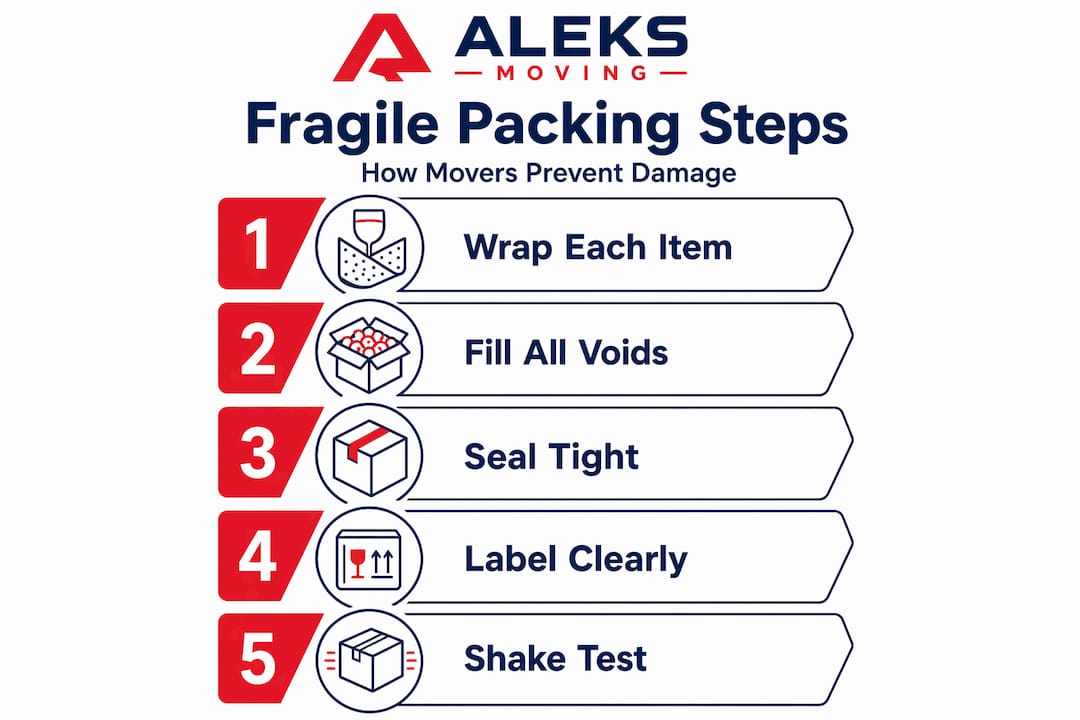
Pro Tip: Use a red marker and write “FRAGILE” and “THIS SIDE UP” on all four vertical sides and the top of every box containing breakables. Red is harder to miss than black under warehouse or truck lighting.
Specialist partnerships for high-risk items
Some items fall outside what general movers should handle alone. Grand pianos, irreplaceable antiques, large sculptures, and commercial-grade equipment require tools, vehicles, and knowledge that go beyond a standard moving kit.
The professional approach here is not to attempt everything in-house. General movers subcontract to regional specialists for exactly these situations, and doing so is considered a mark of professionalism rather than a limitation. Specialists use custom crating, air-ride suspension vehicles, and heavy load-rated lift equipment to move items that would otherwise be at serious risk of damage.
Here is how to evaluate a specialist moving partner:
- Verify their experience with your specific item type. A company that specialises in piano moving has different credentials than one focused on fine art or antique furniture.
- Confirm their licensing and insurance coverage. Specialist transport requires appropriate cargo insurance, and you should ask for documentation before any agreement is signed.
- Request references from recent comparable jobs. A credible specialist can point to clients who moved similar items without incident.
- Ask about their equipment directly. Air-ride suspension is the gold standard for vibration-sensitive items. If they cannot explain what they use, that tells you something.
| Item type | Why general movers may fall short | What specialists bring |
|---|---|---|
| Grand piano | Weight distribution and tuning sensitivity | Custom dollies, air-ride vehicles, experienced crews |
| Fine art and paintings | Surface and frame fragility | Climate-controlled transport, custom crating |
| Antique furniture | Aged joints and irreplaceable finishes | White-glove handling, padded wrapping systems |
| Wine collections | Temperature sensitivity and vibration | Climate-controlled vehicles, padded bottle carriers |
You can read more about handling specialty items in Ontario to understand how damage rates drop significantly when the right expertise is applied.
Choosing movers and packing fragile items safely
Whether you are moving your home or relocating a business, moving fragile items safely comes down to the choices you make before move day. Here is what to prioritise:
Asking the right questions
Before hiring any mover, ask these directly:
- Do you provide professional packing services for fragile items, or do clients pack themselves?
- What packing materials do you supply, and at what cost?
- How do you handle claims if a fragile item is damaged during the move?
- Are your movers trained specifically in fragile item handling?
- Do you partner with specialists for items like pianos or antiques?
A mover who cannot answer these questions confidently is a mover who has not thought through the details.
When to use professional packing services
If you have a significant number of fragile items, high-value collectibles, or simply no confidence in your own packing ability, professional packing is worth the cost. Proper professional packing standards can reduce breakage rates from 30% to under 3%. That is a dramatic difference for a relatively modest investment.
DIY packing tips that actually work
If you are packing fragile items yourself, keep these in mind:
- Never pack fragile items in oversized boxes. Match the box to the item.
- Wrap each piece individually. Never let two unwrapped items touch inside a box.
- Plates pack better standing upright, not flat. Flat stacking concentrates weight on the bottom piece.
- Use at least 5 cm of padding on all six sides of the box interior before placing the item.
- Always do the shake test before sealing. If you hear anything move, repack.
For longer relocations, it is worth reviewing guidance on packing for long-distance moves, since road vibration over hours compounds the risk of internal shifting.
Pro Tip: Tell your mover which boxes contain fragile items before loading begins, not after. This changes how the truck is loaded and where your boxes end up in the stack.
Common mistakes and how movers prevent them
Even well-intentioned packers make errors that lead to preventable damage. Professional fragile item moving services exist partly to catch these mistakes before they become expensive.
| Common mistake | Why it causes damage | How movers address it |
|---|---|---|
| Half-filled boxes | Items shift and collide during transit | Movers fill all voids before sealing |
| Single-side labelling | Labels go unseen in stacked loads | Labels applied to all four sides plus top |
| Mixing heavy and light items | Heavy items crush fragile ones | Items are sorted and packed by weight class |
| Skipping the shake test | Loose items go undetected | Shake test is standard before each box is sealed |
Load order is another area where professional movers’ protocols make a measurable difference. Fragile items are loaded last onto the truck and unloaded first. This minimises the number of times they are handled and ensures they never end up at the bottom of a pile. It also means they are the least exposed to road vibration during the longest part of the journey, since they sit near the cab end of the truck where movement is reduced.
“The box that rattles on the truck is the box you will regret packing.”
My honest take after years in this industry
I have worked alongside moving crews long enough to tell you something that most articles leave out. Technique beats luck every single time.
When I see a fragile item arrive damaged, the cause is almost never a mover who dropped something. It is a box that was half-full, a plate that was flat-stacked, or a wine glass that was wrapped in a single sheet of paper with no padding around it. The physical act of carrying is rarely where things go wrong.
What I have come to believe is that the real value of professional packing services is not the labour. It is the trained eye. An experienced mover can look at a packed box and know within seconds whether it will survive the trip. That knowledge takes time to build, and it is not something you can replace with a YouTube tutorial.
I have also seen clients transform their moving experience simply by communicating better with their mover. Telling the team on move day which items matter most to you changes the entire dynamic. Movers are professionals, and professionals respond to clear information.
— Ali
Moving fragile items with confidence? Aleksmoving can help
Aleksmoving has over 18 years of experience handling residential and commercial relocations across Ontario and beyond, including moves that involve delicate, high-value, and specialty items. Whether you need expert packing support, careful transport for antiques, or a full-service move with flat-rate pricing and no hidden fees, we are ready to help.
Our team is trained in fragile item protocols from packing to load order, and we partner with specialists when your items call for it. You can explore our full range of moving services or get in touch for a free upfront quotation. If you are planning a local move in Ontario, our local moving services are built for exactly this kind of careful, personalised work. Contact us today and let our family move yours.
FAQ
What is the role of movers in fragile item transport?
Professional movers protect fragile items through specialised packing, load order planning, and trained handling techniques. Their role goes beyond carrying boxes to actively preventing damage through protocols like the shake test, void-filling, and proper labelling.
What are examples of fragile items to move?
Common fragile items include glassware, ceramics, mirrors, framed artwork, electronics, musical instruments, antiques, and wine collections. Each requires individual wrapping and secure packing to survive transit without damage.
How do professional movers assess if a box is safely packed?
Movers use the shake test to detect internal movement and assess boxes by feel for firmness and balance. A properly packed box is solid, silent, and evenly weighted.
When should I hire a specialist mover for fragile items?
You should consider specialist fragile item moving services for grand pianos, irreplaceable antiques, fine art, or any item that requires custom crating or climate-controlled transport. General movers often partner with niche specialists for these situations.
How can I pack fragile items safely on my own?
Use snug-fitting boxes, wrap each item individually, fill all voids with padding, and do the shake test before sealing. Label all four sides and the top with “Fragile” and “This Side Up” in red to ensure careful handling throughout the move.