Skip to content


Business move planning is the strategic programme that coordinates every workstream of a commercial relocation — governance, budget, IT cutover, vendor contracts, communications, and post-move verification — so your operations stay protected from the moment you decide to move until the day your team is fully productive in the new space. Done well, it minimises downtime, controls cost, and keeps your people and clients confident throughout the transition. Aleksmoving has supported commercial relocations across Ontario for over 18 years, and the single clearest lesson from that experience is this: the businesses that plan early win.
Your quick operational checklist:
- Form a governance team (executive sponsor, relocation committee, move coordinator)
- Build a realistic budget including direct and indirect costs
- Map your IT and telecom cutover windows early
- Book commercial vendors and confirm building access
- Draft internal and external communications
- Execute a move-day runbook with assigned roles
- Run post-move verification before declaring operations restored
When to start: medium and large moves need a 6–12 month runway; small office moves need at least 3 months. Starting later compresses every decision and drives up cost.
Table of Contents
- What does business move planning actually cover?
- How to plan your move: the 6–12 month phased roadmap
- Who owns what: project governance and vendor selection
- What moves, what stays, and how to design the new space
- IT and telecom migration: how to sequence the cutover
- Logistics: vendors, building access, permits, and move-day operations
- Budget planning: what to include and how much contingency to hold
- Communications and change management: keeping everyone informed
- Move-day execution and post-move verification
- Why strategic relocation pays: research-backed outcomes
- Ready-to-use templates: timelines and checklists
- Canadian regulatory and compliance considerations during a business move
- How to manage risk and plan for unexpected delays
- Environmental and sustainability practices for Canadian office relocations
- Key takeaways
- What we have learned from 18 years of commercial relocations
- Aleksmoving’s commercial moving services: what to expect
- Useful Canadian resources for your relocation
What does business move planning actually cover?
The scope of a commercial relocation varies significantly depending on the type of move. A full headquarters relocation is a fundamentally different project from consolidating two branch offices or fitting out a new floor while keeping the existing lease. Knowing your move type early shapes the timeline, governance model, and budget you need.
Common move types and their scope:
- Full headquarters relocation: all staff, servers, records, and operations move to a new address; highest complexity, longest lead time
- Branch or regional office move: one location relocates while others stay live; lower risk but still requires IT and HR coordination
- Consolidation: two or more offices merge into one; adds a decommissioning workstream and often triggers lease termination costs
- Downsizing or right-sizing: moving to a smaller footprint; requires purge decisions and storage planning
- Fit-out only: staying in the same building or moving within a complex; shorter timeline but still needs IT and facilities coordination
The business functions that almost always require special planning are IT and telecom, legal and compliance, HR (particularly for staff who may not follow the move), facilities and fit-out, and supply chain or client-facing operations. A business relocation strategy that accounts for all of these functions from the start delivers competitive advantages that a reactive, logistics-only approach simply cannot.
Three questions to determine your move’s complexity:
- Are you changing province, municipality, or just building?
- Does the move affect client-facing services, regulated data, or licensed premises?
- How many staff are relocating, and does the move require any workforce changes?
Your answers determine whether you need a 3-month or 12-month plan, and whether you need legal, HR, and compliance workstreams running in parallel with logistics.
How to plan your move: the 6–12 month phased roadmap
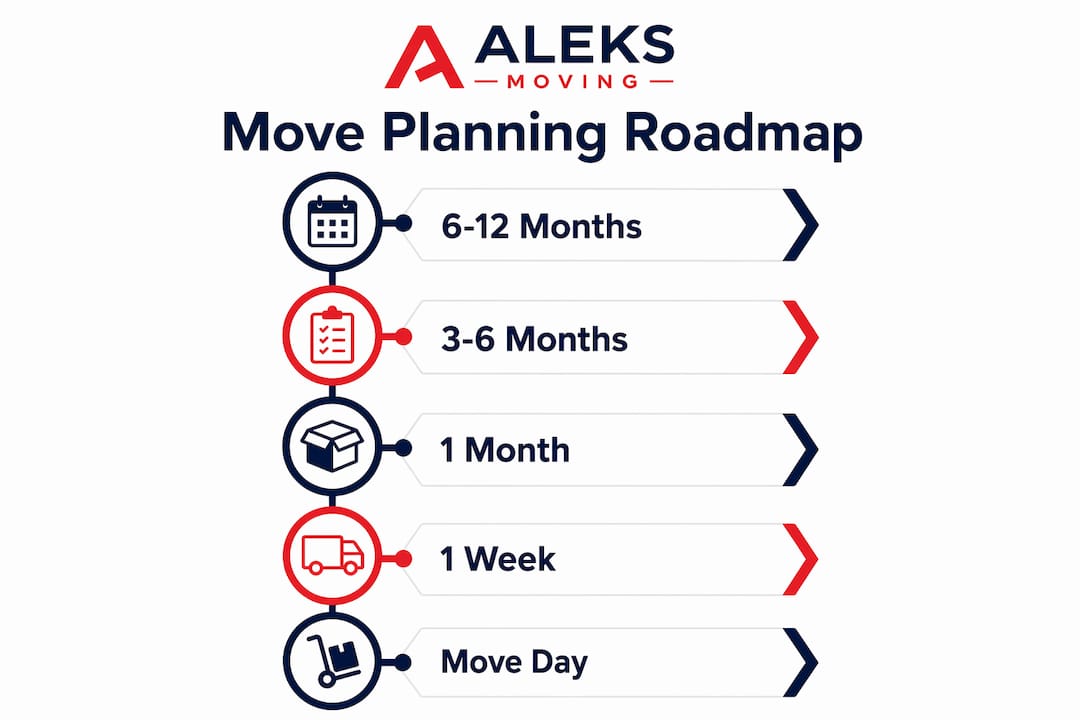
A 6–12 month master schedule with a named relocation committee and move coordinator is the single most reliable way to reduce transition risk. Here is what to lock in at each stage.
6–12 months out: strategy and site selection
- Define the business case: growth, cost reduction, talent access, or lease expiry
- Set measurable success metrics (e.g., zero client-facing downtime, move-in by a specific date)
- Form the relocation committee: IT, HR, operations, finance, and facilities leads
- Appoint a single move coordinator who owns the master schedule
- Build a high-level budget model covering all direct and indirect cost categories
- Shortlist sites and begin lease or purchase negotiations
- Engage a real estate consultant to evaluate labour markets, incentives, and fit-out potential
Industry guidance is clear that early phases favour awareness over speed. Rushing site selection to save a few weeks almost always costs more in lease terms or fit-out surprises.
3–6 months out: design and vendor engagement
- Finalise site selection and sign heads of agreement or lease
- Commission space planning and fit-out design
- Issue RFPs to commercial movers, IT contractors, and fit-out teams
- Build a full furniture and equipment inventory
- Decide what moves, what gets replaced, and what gets disposed of
- Lock in IT and telecom circuit orders (these have the longest lead times)
- Draft the communications plan for staff, clients, and suppliers
1 month out: execution preparation
- Confirm all vendor contracts in writing, including access windows and insurance
- Distribute move packets to staff with role assignments and emergency contacts
- Finalise IT cutover sequence and validation checklist
- Notify clients, suppliers, and Canada Post of address change
- Confirm building access: loading docks, elevator bookings, HVAC windows
1 week out: final checks
- Walk both sites with the move coordinator and lead vendor
- Confirm IT disconnect and reconnect timing with telecom providers
- Verify insurance coverage is active for move day
- Distribute the move-day runbook to all team leads
- Pack non-essential items; leave workstations active as long as possible
Who owns what: project governance and vendor selection
Clear ownership before you engage a single contractor is what separates a controlled relocation from a costly one. The governance model does not need to be complicated, but every workstream needs a named owner and a defined escalation path.
Recommended governance structure:
- Executive sponsor: approves budget, resolves cross-functional conflicts, signs off on go/no-go decisions
- Relocation committee: one representative from IT, HR, operations, finance, and facilities; meets weekly from 6 months out, daily in the final 2 weeks
- Move coordinator: owns the master schedule, holds vendors accountable, and is the single point of contact on move day
RACI summary by workstream:
| Workstream | Responsible | Accountable | Consulted | Informed |
|---|---|---|---|---|
| Budget and finance | Finance lead | Executive sponsor | All committee | Board/investors |
| IT and telecom | IT lead | Move coordinator | Telecom vendors | All staff |
| HR and communications | HR lead | Executive sponsor | Legal | All staff |
| Facilities and fit-out | Facilities lead | Move coordinator | Landlord, contractors | IT, operations |
| Logistics and vendors | Move coordinator | Executive sponsor | Commercial mover | All committee |
Vendor selection criteria for commercial movers:
- Demonstrated commercial relocation experience (not just residential)
- Proof of liability insurance and cargo coverage appropriate for your asset values
- References from comparable office moves in your region
- Clear contract terms covering access windows, damage liability, and contingency procedures
- Transparent, itemised pricing with no hidden fees
Practitioners recommend making irreversible contractual decisions — leases, vendor bookings, IT circuit orders — before starting reversible tasks like packing. This sequencing keeps your options open and your costs predictable.
What moves, what stays, and how to design the new space
A full inventory is the foundation of both your budget and your moving-day logistics. Without it, you will pay to move equipment you should have replaced, and you will design a space around furniture that does not fit.
What to record in your inventory:
- Asset tag or serial number
- Department and current location
- Condition rating (move, replace, dispose, store)
- Special handling requirements (server equipment, artwork, regulated documents)
- Destination zone in the new space
Decision criteria for each item:
- Is it under warranty or lease? Check contract terms before disposing.
- Does it meet safety or accessibility codes in the new jurisdiction?
- Is it cheaper to replace than to move and reinstall (e.g., older server hardware)?
- Does it need to be retained for regulatory or audit purposes?
Layout principles that reduce disruption focus on keeping teams that collaborate frequently in adjacent zones, placing meeting rooms and shared resources centrally, and designing IT infrastructure around workflow rather than aesthetics. Interim storage is a practical option when fit-out timelines slip or when you are downsizing and need time to make disposal decisions without pressure.
Pro Tip: Lock in your lease, vendor contracts, and IT circuit orders before you pack a single box. Packing is reversible; a signed lease is not. Sequencing irreversible decisions first keeps your plan flexible and your costs under control.
IT and telecom migration: how to sequence the cutover
IT and telecom migrations require significantly longer lead times than physical furniture moves and are the most common bottleneck in commercial relocations. A misaligned cutover window — where your lease starts but your internet circuit is not live — can cost days of productivity. Here is a sequencing runbook non-technical managers can use to coordinate the process.
- Inventory all IT assets at least 5 months out: servers, workstations, phones, network hardware, cloud subscriptions, and licensed software.
- Order new circuits and infrastructure immediately after signing the lease. Telecom providers in Canada often need 60–90 days to provision business-grade connections.
- Back up all critical data to a verified off-site or cloud location before any hardware is moved.
- Define the cutover window: a specific date and time range, ideally a weekend, when systems go offline at the old site and come online at the new one.
- Run parallel systems where possible during the cutover window: keep VPN access to old systems live until the new environment is validated.
- Execute the reconnection sequence: network infrastructure first, then servers, then workstations, then phones and peripherals.
- Validate before going live: test internet, VoIP, email, CRM, and any client-facing systems before staff arrive on the first working day.
- Document and encrypt all data transfers; control physical access to servers during transit.
Data security and continuity checks must run in parallel with logistics, not as an afterthought. Assign one named person — your IT lead — as the data security owner for the move window, with authority to delay go-live if validation fails.
For guidance on scheduling and IT cutover sequencing, the Aleksmoving resource on minimising downtime during an office move covers practical tactics specific to Ontario office environments.
Logistics: vendors, building access, permits, and move-day operations
The logistics workstream is where plans meet reality. A well-scoped vendor contract and a confirmed building access plan are what keep move day from becoming a costly delay.
- Scope your commercial mover carefully. Ask for references from comparable office moves, confirm their liability insurance covers your asset values, and get a written contract that specifies access windows, loading dock assignments, and damage resolution procedures.
- Book building access early. In most Canadian commercial buildings, elevator reservations, loading dock bookings, and after-hours HVAC must be arranged with building management weeks in advance. Some buildings in Toronto and other major centres require written approval from property management for any commercial move.
- Check municipal permit requirements. Depending on your municipality, you may need a temporary no-parking permit for moving vehicles, a sidewalk occupancy permit, or notification to the local fire marshal if you are moving regulated materials. Requirements vary by city and province, so confirm with your municipality directly.
- Build a move-day runbook that assigns a named lead at both the old and new sites, defines the unloading sequence by department, and includes an emergency contact list covering the move coordinator, building manager, IT lead, and commercial mover’s site supervisor.
- Prepare contingency steps: alternate loading access if the primary dock is blocked, a weather plan for outdoor moves in Canadian winters, and a decision tree for what happens if IT validation fails before staff are scheduled to arrive.
Insurance checklist for move day:
- Confirm your commercial property insurance covers assets in transit
- Verify the mover’s cargo insurance limit against your highest-value assets
- Have your insurance broker’s contact number on the move-day emergency list
- Document the condition of high-value items with photos before loading
For a deeper look at how logistics partners support a commercial relocation, the Aleksmoving guide on the role of logistics in office moves covers vendor coordination and transportation planning in detail.
Budget planning: what to include and how much contingency to hold
A realistic relocation budget covers both direct and indirect costs. Most budget overruns in commercial moves come from indirect costs that were never modelled, not from the moving truck itself.
| Cost Category | Example Line Items |
|---|---|
| Direct: moving and logistics | Commercial mover fees, packing materials, specialty handling (servers, artwork) |
| Direct: lease and property | Lease termination penalties, legal fees, deposit on new premises, building permits |
| Direct: fit-out and furniture | Construction, electrical, data cabling, new furniture, signage, access control |
| Direct: IT and telecom | New circuit installation, hardware replacement, software licences, IT contractor fees |
| Indirect: downtime | Lost revenue or reduced capacity during cutover windows |
| Indirect: HR and people | Relocation allowances, severance for staff who do not relocate, temporary staffing |
| Indirect: administration | Address change notifications, reprinting stationery, updating registrations |
| Contingency | 10–15% of total direct costs, held in reserve for scope changes and delays |
The biggest variance typically appears in fit-out and IT costs, where scope changes are common once construction begins. Stress-test your budget against a 10–15% contingency and model at least one scenario where fit-out runs 4 weeks late. Relocation decisions are most credible to boards and investors when modelled over a 5–10 year horizon that accounts for lease savings, talent access, and productivity gains alongside the upfront cost.
Pro Tip: Build your contingency reserve before you present the budget for approval, not after. A board that approves a budget with contingency built in is far less likely to require a second approval when a scope change hits.
Communications and change management: keeping everyone informed
A move announcement handled poorly can trigger staff anxiety, client concern, and supplier confusion all at once. A structured communications plan prevents all three.
Who to notify and when:
- Staff (6 months out): announce the move, explain the business rationale, and open a channel for questions; follow up monthly with progress updates
- Key clients (3 months out): personal outreach from account managers with the new address, move date, and a clear statement of service continuity
- Suppliers and service providers (2–3 months out): written notice of address change, updated purchase order details, and any changes to delivery logistics
- Regulators and government agencies (2 months out): Canada Revenue Agency, provincial business registry, WSIB (in Ontario), and any licensed body relevant to your industry
- Canada Post and couriers (4–6 weeks out): mail forwarding and address update on all accounts
Change management tactics that work:
- Appoint move champions in each department — staff who are enthusiastic about the new space and can answer peer questions informally
- Publish a staff FAQ covering commute changes, parking, transit options, and the new office layout
- Offer a transit allowance or orientation session for the first week in the new space
- Schedule a post-move check-in at 2 weeks and 4 weeks to capture feedback and resolve layout or workflow issues quickly
Customer service continuity depends on IT and telecom going live on schedule. Confirm cut-over dates with your providers in writing, and designate one person to own client escalations during the transition window.
Move-day execution and post-move verification
Move day is not the finish line. It is the start of a verification process that determines how quickly your team returns to full productivity.
- Assign site leads at both locations before the truck arrives; they are the decision-makers for access, sequencing, and any on-site issues.
- Follow the unloading sequence by department priority: IT infrastructure first, then operations-critical workstations, then general office furniture.
- Reconnect IT in the agreed sequence (network, servers, workstations, phones) and do not release the space to staff until the IT lead confirms validation is complete.
- Walk every area before staff arrive: check that security systems, access cards, and emergency exits are functional.
- Capture a punch list of any damage, missing items, or installation issues immediately; do not wait until the following week.
Post-move verification checklist (weeks 1–4):
Weeks 1–4 should focus on departmental unpacking, end-to-end IT testing, facility surveys, and structured employee feedback. Specifically:
- Test all IT systems end-to-end, including VoIP, email, CRM, and any client-facing platforms
- Verify security systems, alarm codes, and emergency procedures
- Confirm mail is being received at the new address
- Survey the building for any damage or deficiencies and submit to the landlord in writing
- Collect structured employee feedback on layout, workflow, and facilities
- Close out the old lease: return keys, resolve any damage claims, and confirm utility disconnection
Why strategic relocation pays: research-backed outcomes
The difference between a reactive and a proactive move is measurable. Organisations that adopt a business-aligned relocation strategy retained 30% more top performers and recorded 34% higher employee performance compared to those that treated relocation as a purely logistical exercise. Those are not marginal gains.
Proactive moves — those driven by a clear growth or efficiency rationale rather than a lease expiry crisis — deliver competitive advantages because they allow time to model talent access, client proximity, and infrastructure quality before committing to a site. Reactive moves compress every decision and eliminate the options that proactive planning preserves.
Practical implications for your planning:
- Link relocation goals to specific KPIs: client response time, staff retention rate, cost per square foot
- Present the business case to your board or investors with a 5–10 year financial model, not just a one-time cost estimate
- Use the relocation as an opportunity to redesign workflows, not just replicate the old floor plan in a new building
- Treat the move coordinator role as a senior appointment, not an administrative task
The mindset shift that matters most is treating a commercial relocation as a capital investment with a measurable return, not as an operational disruption to be minimised. Both framings are true, but only one of them produces a plan worth approving.
Ready-to-use templates: timelines and checklists
Master timeline at a glance
| Timeframe | Priority focus | Key deliverables |
|---|---|---|
| 6–12 months out | Strategy and governance | Business case, site shortlist, budget model, relocation committee formed |
| 3–6 months out | Design and vendor engagement | Lease signed, IT orders placed, inventory complete, vendors contracted |
| 1–3 months out | Execution preparation | Move packets distributed, communications sent, IT cutover plan finalised |
| 1–4 weeks out | Final logistics | Building access confirmed, runbook distributed, insurance verified |
| Move day | Execution | Site leads active, unloading sequence followed, IT validated before go-live |
| Weeks 1–4 post-move | Stabilisation | IT tested end-to-end, punch list resolved, employee feedback collected |
Adapting these templates for your organisation:
- Small offices (under 20 staff): compress the 6–12 month phase to 3–4 months, but do not skip IT circuit orders or lease review
- Large organisations (100+ staff): add a departmental sequencing plan so not all teams move simultaneously; stagger by floor or function
- Multi-site consolidations: run a separate decommissioning checklist for each site being closed, in parallel with the primary move plan
Checklist governance tips:
- Store the master checklist in a shared platform (Microsoft SharePoint, Google Drive, or a project management tool like Asana or Monday.com) so all committee members see the live version
- Assign a named owner to each checklist item, not just a department
- Review and update the checklist at every weekly committee meeting; a checklist that is not updated is not a plan
For a comprehensive internal resource, the office relocation planning guide for business owners on the Aleksmoving site covers governance, templates, and checklists in detail.
Canadian regulatory and compliance considerations during a business move
Relocating a business in Canada triggers a set of compliance obligations that vary by province and industry. Missing any of them can delay your move-in, create liability, or result in fines.
Federal and cross-provincial obligations:
- Notify the Canada Revenue Agency of your new business address through the CRA My Business Account portal; this affects GST/HST registrations, payroll accounts, and corporate tax filings
- Update your federal corporation address with Corporations Canada if you are a federally incorporated entity
- If your move crosses provincial lines, you may need to register in the new province and deregister or maintain registration in the old one
Provincial obligations (Ontario example):
- Update your Ontario Business Registry address through ServiceOntario
- Notify the Workplace Safety and Insurance Board (WSIB) of your new location, particularly if your risk classification changes
- Confirm that your new premises meet the Ontario Building Code and the Accessibility for Ontarians with Disabilities Act (AODA) requirements before staff occupy the space
- Check zoning bylaws in your new municipality to confirm your business use is permitted
Industry-specific compliance:
- Regulated industries (healthcare, financial services, food service, childcare) must notify their licensing body and may require a new site inspection before operating
- Businesses handling personal data under Canada’s Personal Information Protection and Electronic Documents Act (PIPEDA) or provincial equivalents must document how data is protected during transit
- Businesses with physical records subject to retention requirements must confirm that storage at the new site meets those standards
Building permits for fit-out work are issued by the local municipality. In Ontario, significant interior alterations typically require a building permit, and work must be inspected before occupancy. Confirm permit status with your contractor and building management before scheduling move-in.
How to manage risk and plan for unexpected delays
Even a well-governed relocation will encounter surprises. The goal of risk management is not to prevent every problem but to ensure that no single problem derails the entire programme.
Common risks and mitigation strategies:
- Fit-out delays: build a 2–4 week buffer between your contractual fit-out completion date and your planned move-in date; negotiate a short-term holdover clause in your existing lease as insurance
- IT circuit delays: order telecom circuits at least 90 days before your move date; have a temporary 4G/LTE backup solution identified in case the primary circuit is not live on day one
- Key staff departure during the move: cross-train at least one backup for every critical move-day role; document all vendor contacts and access codes in a shared location, not just one person’s email
- Building access conflicts: get all access agreements in writing from building management; confirm elevator and dock bookings 2 weeks before move day and again 48 hours before
- Weather disruptions: Canadian winters create real logistics risk; have an alternate loading plan and confirm your mover’s weather policy in the contract
A risk register does not need to be complex. A simple spreadsheet listing each risk, its likelihood, its potential impact, the mitigation action, and the owner is enough to keep the committee focused on what matters. Review it at every weekly meeting from 3 months out.
The corporate moving challenges guide from Aleksmoving covers common commercial relocation pitfalls and how experienced movers help you avoid them.
Environmental and sustainability practices for Canadian office relocations
Sustainability is increasingly a factor in how Canadian businesses plan and execute relocations, both because of genuine environmental commitment and because of reporting obligations under ESG frameworks.
Practical sustainability actions during a relocation:
- Donate or resell furniture and equipment rather than sending it to landfill; organisations like Furniture Bank in Ontario accept commercial donations and provide tax receipts
- Hire movers with fuel-efficient or low-emission fleets; ask vendors about their fleet composition and whether they offer carbon-offset options
- Specify sustainable fit-out materials in your contractor brief: low-VOC paints, FSC-certified wood products, and energy-efficient lighting (LED) reduce both environmental impact and long-term operating costs
- Consolidate trips by planning the move sequence to minimise the number of truck runs between sites
- Recycle electronics responsibly through an Ontario Electronic Stewardship (OES) registered collector rather than disposing of old IT hardware in general waste
- Choose a new space with strong energy performance: a building with a BOMA BEST or LEED certification will reduce your energy costs and support any corporate sustainability reporting you do
For businesses with formal ESG reporting obligations, document your sustainability decisions throughout the relocation process. The choice of mover, the disposal method for furniture, and the energy rating of the new premises are all reportable data points under common frameworks.
Key takeaways
Business move planning is a strategic programme, not a logistics task. Organisations that treat it as a capital investment with clear governance, a phased timeline, and measurable outcomes consistently outperform those that plan reactively.
| Point | Details |
|---|---|
| Start with a 6–12 month runway | Medium and large moves need at least 6 months; small offices need a minimum of 3 months to avoid compressed decisions. |
| Sequence irreversible decisions first | Lock in leases, IT circuit orders, and vendor contracts before packing begins; reversible tasks can wait. |
| IT and telecom are the longest lead items | Order telecom circuits at least 90 days out; misaligned cutover windows are the leading cause of move-day downtime. |
| Budget for indirect costs and contingency | Include downtime, HR, and administration costs, and hold 10–15% of direct costs as a contingency reserve. |
| Aleksmoving supports commercial moves across Ontario | With over 18 years of experience and flat-rate pricing, Aleksmoving provides dependable commercial relocation services with no hidden fees. |
What we have learned from 18 years of commercial relocations
The businesses that handle relocations best are not the ones with the biggest budgets. They are the ones that make decisions early and protect their team throughout the process.
The most common mistake we see is treating IT as a logistics item rather than a programme in its own right. A company will spend months planning the physical move, then discover two weeks before move day that their telecom circuit has a 60-day provisioning lead time. That single oversight can push a move date by a month and cost far more than the circuit itself.
The second pattern worth naming: change management is almost always underfunded. Staff who do not understand why the move is happening, or who feel left out of the process, disengage. The businesses that invest in move champions, regular updates, and a genuine orientation to the new space see faster productivity recovery and better retention in the months after the move.
A well-planned relocation is genuinely an opportunity. A new space, designed around how your team actually works today, can improve collaboration, reduce wasted time, and signal to clients and recruits that the business is growing with intention. That outcome is available to any organisation willing to plan it properly.
Aleksmoving’s commercial moving services: what to expect
When your relocation plan is ready and it is time to engage a commercial mover, the vendor you choose will either protect or undermine everything you have built in the planning phase.

Aleksmoving’s commercial moving services are built around the same phased approach this guide recommends: governance first, logistics second, and no surprises on the invoice. With over 18 years of experience moving offices and commercial operations across Ontario, the team handles everything from standard office furniture to server equipment, specialty items, and interim storage when fit-out timelines shift.
What you get with Aleksmoving: flat-rate pricing confirmed upfront, packing and unpacking by trained crews, IT-aware scheduling that respects your cutover windows, and secure handling for sensitive equipment and documents. There are no hidden fees and no last-minute rate changes. For businesses that need temporary storage between lease dates, that service is available too.
To start scoping your commercial move, visit the office and commercial moving page or contact Aleksmoving directly for a free upfront quotation. Bring your timeline, your floor plan, and your list of specialty items, and the team will build a plan around your move date, not the other way around.
Useful Canadian resources for your relocation
- Canada Revenue Agency — Business Address Change: update your GST/HST, payroll, and corporate tax address through CRA My Business Account; required for all registered businesses changing their principal place of business
- Corporations Canada: update your registered office address if you are a federally incorporated entity; changes must be filed promptly after the move
- ServiceOntario — Ontario Business Registry: update your provincial business registration address; also the portal for WSIB notifications and other provincial compliance updates
- BOMA Canada: the Building Owners and Managers Association of Canada publishes guidance on building access standards, BOMA BEST certification, and commercial lease best practices relevant to fit-out planning
- Aleksmoving commercial moving guide: Aleksmoving’s editorial resource covering commercial relocation checklists, case studies, and downloadable planning tools for Ontario businesses
- Aleksmoving office move planning guide: step-by-step planning actions and governance guidance tailored for office managers, covering phased checklists and vendor coordination