Skip to content


Yes, most movers charge extra for stairs, though not always as a separate line item. The charge typically shows up as a per-flight fee, a flat accessorial fee added to the estimate, or as additional billed hours because stairs simply slow the crew down. Elevators don’t eliminate this either. They just trade lifting effort for wait-time charges. Your best protection is simple: disclose every flight and every heavy item when you request your quote, and get any stair-related fee written into the estimate before move day.
TL;DR:
- Stair fees usually range from $50 to $150 per flight, with overall accessorial charges for stairs or elevators typically between $50 and $200.
- Pricing models vary, including per-flight, flat fee, per-step surcharges, and hourly adjustments, so comparing detailed estimates is essential.
- Disclosing the exact number of flights, elevator details, and bulky items upfront helps prevent unexpected charges on move day.
- The fairness of a stair fee depends on clear, written estimates based on actual walk-throughs, not vague or hidden charges added afterward.
- Moving specialty items like pianos or safes often requires separate, itemized quotes rather than standard stair fees.
Table of Contents
- What are the common stair fee pricing models?
- How much do stair fees typically cost?
- What factors make stair fees higher or lower?
- What should you disclose and ask before booking?
- How can you reduce or avoid stair-related charges?
- Why do movers actually charge for stairs?
- When is a stair fee fair, and when isn’t it?
- Get a transparent stair fee estimate before you book
- Sources
- FAQ
What are the common stair fee pricing models?
Movers don’t all price stairs the same way, and understanding which model a company uses helps you compare quotes accurately. Four approaches dominate the industry:
- Per-flight fees: a set charge for each flight above a threshold, often after the first flight is included free. Some companies count flights at both pickup and delivery, so a third-floor walk-up delivered to another third-floor unit can rack up charges on both ends.
- Flat stair fee: instead of counting flights, the mover applies one accessorial charge for any job requiring stair access, simplifying the math but sometimes overcharging for a single short flight.
- Per-step or heavy-item surcharges: less common, and usually reserved for unusually configured staircases, spiral stairs, or a single oversized item that needs extra hands.
- Hourly adjustments: many local moves are billed by the hour, so stair work simply extends the clock rather than appearing as its own fee. This is the model most likely to surprise a client who assumed “no stair fee” meant no added cost.
Elevator access follows different logic again. A freight elevator with generous cab dimensions rarely triggers extra charges, but a slow passenger elevator, a strict building reservation window, or a tiny cab that forces multiple trips can add real time, and therefore real dollars, to the bill.
How much do stair fees typically cost?
Expect stair or elevator access to add somewhere in the range of $50 to $200 to a local move, whether that shows up as a stated fee or as extra billed hours, according to reporting on mover access charges. Per-flight charges specifically tend to land between $50 and $150 per flight, based on figures compiled in a cost guide covering stair-related surcharges.
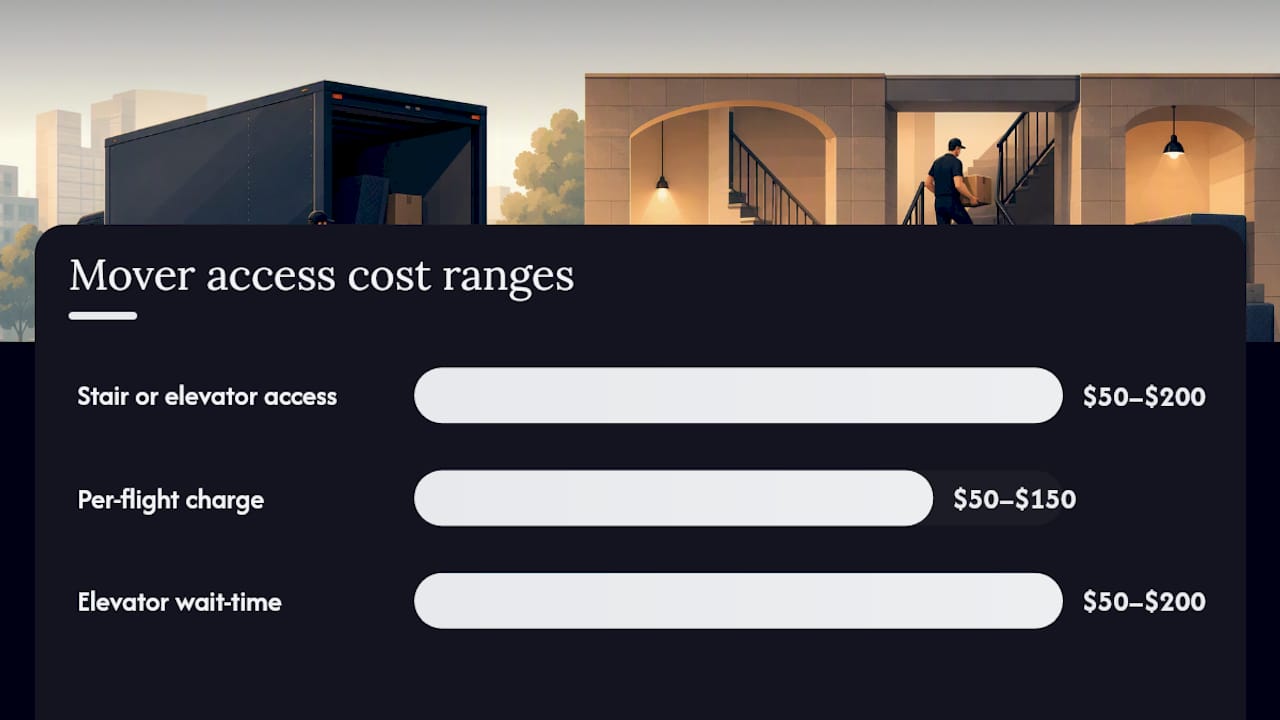
A few scenarios illustrate how this plays out. A ground-floor pickup delivered to a second-floor apartment often gets the first flight included at no extra cost. A third-floor walk-up adds one or two billable flights depending on how the mover counts. Narrow, winding staircases push toward the higher end of the range because crews move slower and more carefully. Elevator jobs with wait-time billing can land anywhere in that same $50 to $200 band, depending on building rules.
Specialty items break this pattern entirely. Pianos, gun safes, and oversized fitness equipment typically require a separate quote rather than a standard per-flight fee, since they may need rigging equipment or extra crew, a pattern confirmed across multiple stair cost guides. Regional pricing varies too, and if your mover bills hourly, stair time simply lengthens the invoice rather than appearing as its own charge.
What factors make stair fees higher or lower?
Two moves with the same number of stairs can end up with very different bills. Here’s what actually drives the variation:
- How the mover defines a “flight.” Most companies benchmark a flight at 12 to 16 steps, so a staircase with more risers per flight, or oddly split half flights, can shift the fee up or down depending on how the estimator counts.
- Item weight and shape. A queen mattress and a solid oak dresser move very differently on stairs. Heavy or awkward items that require disassembly or rigging raise both time and risk, and that’s reflected in the price.
- Stair geometry. Tight turns, low ceilings, and narrow landings force crews to slow down and sometimes reroute furniture, which adds labour time even without adding fees per flight.
- Access complications. A long carry from the truck to the door, elevator size restrictions, mandatory building move windows, or insurance and deposit requirements from a condo board can all stack on top of a stair fee.
- Weather and safety conditions. Icy steps, rain-soaked landings, or poor lighting slow every trip up and down, which matters most when the crew bills by the hour.
If you’re dealing with a genuinely awkward staircase, our guide on moving heavy furniture down stairs covers techniques that reduce both time and risk on the day itself.
What should you disclose and ask before booking?
The single best way to avoid a surprise stair fee is over-disclosure at the quote stage, not under-disclosure. Before you agree to anything, tell the estimator:
- The exact number of flights at both your pickup and delivery addresses.
- Whether either building has an elevator, and any reservation or booking rules attached to it.
- Roughly how far the truck will need to park from your door, since long-carry distances often stack with stair charges.
- Any bulky or specialty items, from a piano to a sectional couch that won’t fit around a tight stairwell corner.
Then flip the script and ask the estimator directly: how many flights are included in the base price? Is the stair charge per-flight or a flat fee, and what’s the exact dollar amount? Does elevator wait time get billed separately? Do pickup and delivery flights both count toward the total? And can multiple accessorial fees, like stairs plus a long carry, stack on the same move?
Insist on a written estimate that lists every accessory charge, and clarify whether it’s binding or non-binding, a distinction our guide to transparent moving estimates breaks down in more detail.
Pro Tip: Send the estimator a short video walk-through of your stairwell, elevator, and front entrance before move day. A documented survey tied to your signed estimate is one of the most effective ways to stop a company from adding accessorial charges on the spot, since accessorial fees for stairs, long carries, and elevator delays commonly stack on the same invoice.
How can you reduce or avoid stair-related charges?
A few practical steps can shave real dollars off a stair-heavy move without cutting corners on safety.
- Disassemble large furniture yourself ahead of time. Fewer bulky pieces on the stairs means less labour and lower risk.
- Carry lighter boxes down to the ground floor before the crew arrives, effectively giving yourself a self-service credit on part of the job.
- Reserve the building elevator and any required parking permit in advance so the crew isn’t wasting billable time waiting.
- Photograph every access point (stairwell, elevator, entrance) and send it with your quote request so nothing gets discovered on move day.
- Ask about a flat hourly or flat move rate instead of per-flight billing. Some companies will trade a slightly higher base rate for the certainty of no stacked accessorials.
Whatever you agree to, make sure it appears on the signed estimate. A mover who pressures you to pay an unplanned stair charge on move day, without it ever being discussed or documented beforehand, is a red flag worth walking away from.
Why do movers actually charge for stairs?
Stair work isn’t an arbitrary upcharge. It’s a direct response to how much slower and riskier the job becomes once furniture leaves flat ground. Carrying a couch down two flights takes measurably longer than rolling it across a driveway, and that lost efficiency has to be accounted for somewhere, whether as extra crew, specialty equipment like straps and dollies, or simply more billed hours.
Even moving companies that advertise “no stair fees” are rarely giving stairs away for free. The cost typically gets absorbed into a longer hourly total instead of appearing as its own line item, according to industry reporting on stair and elevator access charges.
The company has built its pricing approach around avoiding that ambiguity. With flat-rate pricing and extensive experience handling residential, commercial, and specialty moves, their estimators are trained to walk through stair counts, elevator access, and long-carry distances before quoting, so the number you see is the number you pay.
When is a stair fee fair, and when isn’t it?
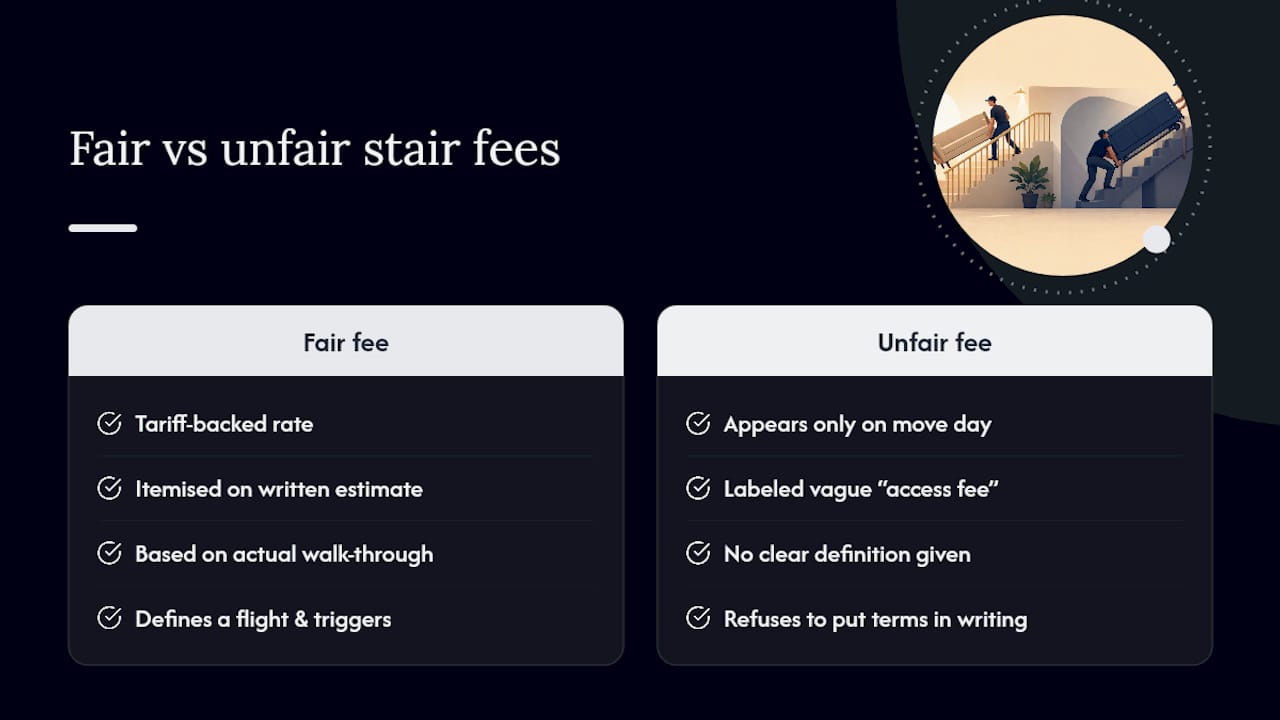
A stair fee is fair when it’s tariff-backed, itemised on your written estimate, and grounded in an actual walk-through of your stairwell rather than a guess. The mover should be able to tell you exactly how they define a flight and exactly what triggers the charge.
It stops being fair the moment it appears out of nowhere on move day, gets described only as a vague “access fee” with no real definition, or comes from a company that refuses to put anything in writing. Before you sign anything, compare the full billed total across quotes, insist on written terms, and confirm your valuation coverage actually protects items handled on stairs.
— Ali
Get a transparent stair fee estimate before you book
If your move involves a walk-up apartment, a townhouse staircase, or an elevator with tight booking rules, this moving company is built to quote it honestly from the start. They offer flat-rate pricing with no hidden fees, meaning the stair count and access details you disclose during your quote get written into the estimate itself, not added as a surprise on moving day.

For readers still prepping their space, our bin rental service can help you stage boxes on the ground floor ahead of time, cutting down on stair trips before the crew even arrives. And if you’re ready to see what your specific stairwell, elevator, or long-carry situation will actually cost, request a residential moving quote and ask our team for a written breakdown of every accessory charge before you commit.
Sources
For readers who want to verify these figures directly, consult FreightWaves on stair and elevator charges, HireAHelper’s stair cost guide, and check your carrier’s own tariff for binding-estimate rules before disputing a charge.
- Do movers charge stairs & elevator access? (FreightWaves)
- Do movers charge extra for stairs and elevators? (Local.Yahoo)
- The ‘Stair tax’ and other hidden moving fees: checklist (MoveSmart)
- Do movers charge extra for stairs? Full cost guide (HireAHelper)
FAQ
How much does it cost to move a set of stairs?
Per-flight stair fees typically run $50 to $150 per flight, while stair or elevator access overall can add $50 to $200 to a local move depending on whether it’s billed as a fee or as extra hours. Specialty items like pianos or safes usually need a separate quote outside these ranges.
Is $100 each a good tip for movers?
Tipping isn’t the same as a stair fee. It’s a separate, optional gesture for good service and has no connection to accessorial charges listed on your estimate. Whatever you choose to tip, confirm your stair and access fees are already settled in writing so the two never get confused on move day.
Is it expensive to move up or down stairs?
It can add real cost, but the amount depends heavily on the pricing model. A move billed hourly may absorb stair time into a longer total, while a per-flight or flat accessorial model states the cost upfront, which is why comparing full quotes matters more than comparing a single line item.
What are red flags with movers?
The biggest warning signs are an undisclosed fee introduced only on moving day, a vague “access charge” with no defined trigger, and a refusal to provide a written or binding estimate. A documented walk-through tied to your signed estimate, as recommended in moving fee checklists, is one of the strongest defences against this kind of surprise.