

TL;DR:
- Accessorial charges in moving are fees for services beyond standard transportation, such as stairs and long carries. Knowing and disclosing property details upfront helps prevent unexpected costs and ensures accurate, binding estimates. Regulatory protections like the mover’s tariff and licensing ensure transparency and legal limits on charges.
Accessorial charges in moving are defined as fees applied for services that fall outside the standard scope of transporting your belongings from one address to another. Every base moving quote covers labour and truck time. The moment your move involves stairs, a long carry from the truck to your door, a shuttle vehicle, or temporary storage, additional moving costs apply. Understanding these charges before you book protects your budget and removes the most common source of post-move frustration. This guide covers what accessorial fees are, what they typically cost in Canada, how they are regulated, and how to avoid being caught off guard.
What are common types of accessorial charges in moving?
Accessorial charges cover a specific list of services that require extra labour, equipment, or logistical effort. Knowing each category helps you spot them on a quote before you sign anything.
Long carry fees
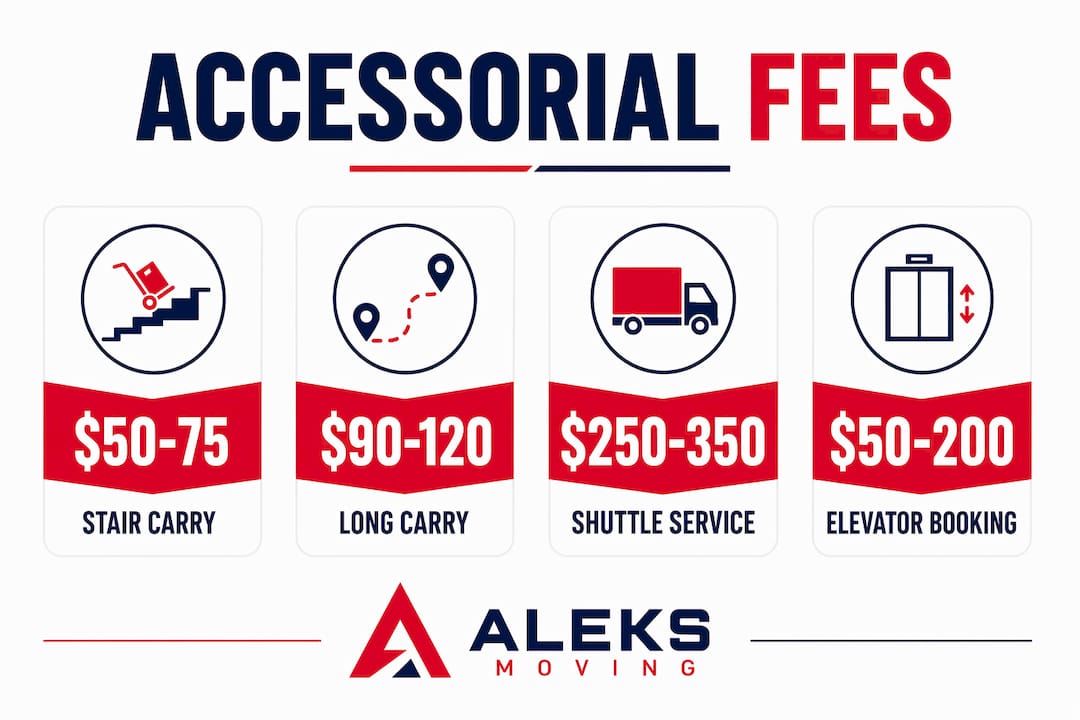
A long carry fee applies when movers must travel more than a set distance between the truck and your front door. Long carry fees range from $90 to $120 per 75 feet. That means a building with a distant loading bay or a property with a long driveway can add over $100 to your bill before a single box is unpacked.
Stair carry fees
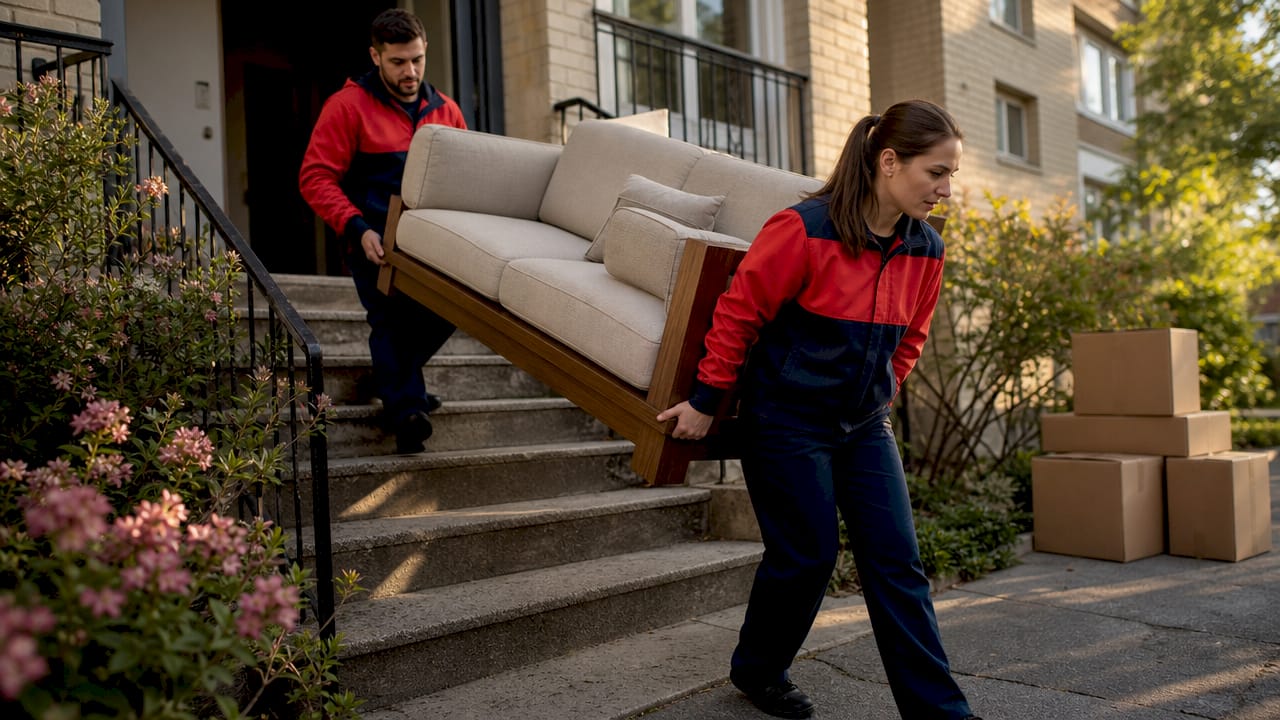
Stair carry fees apply when movers must navigate one or more flights of stairs. Stair fees typically run $50 to $75 per flight. A three-storey walkup without an elevator can therefore add $150 to $225 in stair charges alone.
Shuttle vehicle fees
A shuttle fee applies when the primary moving truck cannot access your street or building. The crew transfers your belongings to a smaller vehicle to complete the delivery. Shuttle services typically cost $250 to $500. Narrow laneways, low-clearance parkades, and restricted urban streets are the most common triggers.
Elevator reservation fees
Apartment buildings often require movers to book the service elevator in advance. Elevator reservation fees range from $50 to $100 per reservation. Missing this detail during booking is one of the fastest ways to face a charge you did not expect.
Other common moving extra fees
Several additional charges appear regularly on moving invoices:
- Fuel surcharges: These add 5–10% of the total moving cost when fuel is not bundled into an all-inclusive rate. Diesel prices averaged $4.15 per gallon in early 2025, which directly influences how movers calculate this surcharge.
- Packing and unpacking fees: Charged per hour or per box when the mover supplies labour and materials.
- Bulky item fees: Applied to pianos, safes, pool tables, or oversized furniture requiring special equipment.
- Cancellation fees: Last-minute cancellations within five days of the move average $300 or the full deposit amount.
- Storage fees: Charged per day or per month when delivery is delayed or when items need temporary warehousing.
Pro Tip: Ask every mover to send you a written list of all accessorial fees before you request a quote. A mover who refuses to share this list upfront is a mover worth avoiding.
How do regulations and billing transparency affect moving charges?
Regulatory frameworks exist to protect you from arbitrary or undisclosed fees. Understanding them gives you real leverage when reviewing a quote.
The mover’s tariff
The mover’s tariff is a legally required master price list that contains every fee a carrier is permitted to charge. Fees not listed on the tariff cannot legally be billed to you. This is a critical protection that most customers never think to ask about. A reputable mover will share their tariff on request without hesitation.
Binding estimates and what they mean
A binding estimate locks in your total moving cost by contract. The mover cannot charge beyond the agreed amount unless you authorise additional services in writing through a formal change order. This is the strongest financial protection available to you as a customer. Non-binding or “not-to-exceed” estimates offer less certainty and leave room for charges to climb.
Licensing and regulatory oversight
Licensed movers operating across provincial or international borders are registered with regulatory bodies such as the USDOT and carry a Motor Carrier (MC) number issued by the FMCSA. Verifying these numbers before booking confirms that a mover operates under enforceable rules. Unlicensed movers have no obligation to honour a tariff or a binding estimate.
A mover’s tariff is not a formality. It is the legal boundary of what a mover can charge you. If a fee appears on your invoice but not in the tariff, you have grounds to dispute it. Always request the tariff in writing before signing any contract.
Key protections to confirm before booking:
- Written, itemised estimate that lists all potential accessorial fees
- Confirmation of the mover’s licence number and registration
- A copy of the tariff on request
- Binding estimate status clearly stated on the contract
- A written change-order process for any services added on moving day
Why do accessorial charges surprise customers and how can you avoid them?
Surprise fees arise mainly from undisclosed property conditions. Movers price a job based on what they know. When they arrive and find three flights of stairs, a narrow street, or no parking within 100 metres, they apply the relevant accessorial charges. The customer is surprised. The mover is not.
Proactive disclosure of property constraints is the most effective way to receive an accurate quote. Tell your mover about every stair, every elevator, every parking restriction, and every narrow corridor before they send you a number. The quote will be higher, but it will be real.
A second cause of surprise fees is the low-ball quote. Accessorial charges are sometimes used to keep base quotes artificially low. The mover wins the booking with a competitive number, then adds fees on moving day. Comparing itemised bids from multiple movers exposes this pattern quickly.
Follow these steps to protect yourself:
- Describe your property in full. Include floor number, stair count, elevator availability, parking distance from the entrance, and any narrow access points.
- Request an itemised quote. Every potential accessorial fee should appear as a line item, not buried in a footnote.
- Compare at least three written estimates. Comparing three binding estimates reduces the risk of low-ball quotes that omit likely additional fees.
- Ask specifically about fuel surcharges. Confirm whether fuel is included in the flat rate or charged separately.
- Verify the mover’s tariff. A mover without a published tariff has no defined fee structure, which is a serious warning sign.
Pro Tip: If a quote is significantly lower than every other estimate you received, ask the mover to explain which accessorial fees they excluded. The answer will tell you everything you need to know about their pricing approach.
How to budget effectively for additional moving costs
Budgeting for a move means accounting for more than the base rate. Base moving quotes typically cover only labour and truck time. Fuel, tolls, travel time, stairs, long carries, and specialty handling are all potential additions unless an all-inclusive rate is confirmed in writing.
Use this checklist when reviewing any moving quote:
- Confirm what is included. Ask the mover to state explicitly whether fuel, tolls, and travel time are in the base rate.
- Identify your property’s risk factors. Stairs, distance from parking, elevator access, and narrow streets each carry a potential fee.
- Account for specialty items. Pianos, large safes, pool tables, and antiques often trigger bulky item fees. Aleksmoving, for example, offers specialty item handling for these situations with clear pricing upfront.
- Build a contingency buffer. Add 10–15% to your estimated total to cover any accessorial charges that arise from conditions discovered on moving day.
- Choose all-inclusive pricing when available. A flat firm rate that bundles all foreseeable fees removes ambiguity and makes budgeting straightforward.
- Request a binding estimate in writing. This is the single most effective step you can take to cap your total moving cost.
Getting transparent moving estimates from the start is the foundation of a well-managed moving budget. Businesses relocating offices face the same risks as residential movers, with the added complexity of IT equipment, filing systems, and tighter timelines that can trigger after-hours or weekend surcharges.
Key takeaways
Accessorial charges in moving are defined, regulated fees for services beyond basic transport, and disclosing your property’s full details upfront is the most reliable way to keep your total cost predictable.
| Point | Details |
|---|---|
| Accessorial fees are specific and defined | Charges like stair fees ($50–$75), long carry ($90–$120), and shuttle ($250–$500) are not arbitrary. |
| The tariff is your legal protection | Any fee not listed on a mover’s tariff cannot legally be charged to you. |
| Binding estimates cap your cost | A binding estimate prevents charges beyond the agreed amount unless you authorise changes in writing. |
| Disclosure prevents surprises | Telling your mover about stairs, parking, and elevator access upfront produces a more accurate quote. |
| Compare at least three estimates | Comparing multiple itemised bids exposes low-ball quotes that omit likely accessorial fees. |
What I have learned about accessorial charges after years in the moving industry
The single biggest mistake I see customers make is assuming a quote is complete. A number on a page feels final. It rarely is, unless you have asked the right questions and received a binding estimate in writing.
I have watched budgets overrun by hundreds of dollars because a customer forgot to mention the parking situation at their building, or assumed the mover knew about the freight elevator being out of service. These are not traps set by movers. They are gaps in communication that both sides could have closed before moving day.
My honest advice is this: treat your moving quote like a contract negotiation, not a shopping receipt. Ask what is excluded. Ask to see the tariff. Ask whether the estimate is binding. If a mover becomes evasive at any of those questions, that tells you something important about how they will behave when a dispute arises.
The movers worth hiring are the ones who welcome those questions. Transparency is not a selling point for a good mover. It is simply how they operate. When you find a company that hands you an itemised quote, explains every potential accessorial fee, and offers a binding estimate without being asked, you have found a mover you can trust.
One more thing: saving on moving costs is genuinely possible when you plan ahead. The customers who end up paying the most are almost always the ones who booked the cheapest quote without reading the fine print.
— Ali
How Aleksmoving handles accessorial charges for Ontario clients
Aleksmoving has built its reputation over 18 years on one principle: no surprises on moving day. Every quote we provide is itemised, with all potential accessorial fees listed before you commit to anything.

We offer binding estimates that protect your budget from the moment you book to the moment the last box is placed. Our team asks the right questions upfront, including stair counts, elevator access, parking distance, and specialty items, so your quote reflects your actual move. Whether you are planning a local residential move or a full commercial relocation across Ontario, we give you a clear, honest number you can plan around. Contact Aleksmoving today for a free, detailed quote with no hidden fees.
FAQ
What are accessorial charges in moving?
Accessorial charges are fees applied for moving services beyond basic transportation, such as stair carries, long carries, shuttle vehicles, elevator reservations, and packing. They are defined in the mover’s tariff and must be disclosed before the move.
How much do accessorial fees typically cost?
Common fees include stair carries at $50–$75 per flight, long carries at $90–$120 per 75 feet, shuttle services at $250–$500, and elevator reservations at $50–$100. Fuel surcharges add 5–10% of the total move cost when not bundled into the base rate.
Can a mover charge fees not listed in their tariff?
No. The mover’s tariff is a legally required document listing every fee a carrier is permitted to charge. Any fee that does not appear in the tariff cannot legally be billed to you.
What is the difference between a binding and a non-binding estimate?
A binding estimate locks in your total cost by contract, preventing additional charges unless you authorise new services in writing. A non-binding estimate is an approximation and can increase on moving day.
How do I avoid surprise accessorial charges?
Disclose all property details upfront, including stair counts, elevator access, and parking distance. Request an itemised, binding estimate and compare at least three written quotes from licensed movers before booking.