Skip to content


Most office moves run on a crew of 2 to 4 movers for a small office of 1 to 10 staff, 4 to 8 for a medium office of 11 to 50 staff, and multiple 4 to 8 person crews working in stages for anything larger. The number that usually matters more than headcount is freight elevator throughput: building access can cap how many movers actually help you, no matter how big your budget is.
TL;DR:
- A freight elevator carrying one cart on a four minute round trip handles roughly 15 trips per hour; extra crews queue, so reserve access weeks ahead.
- Moves involving more than roughly 15–25 employees, significant IT systems, or modular furniture benefit from a move manager to coordinate building access, vendors, and IT timing.
- Hourly billing charges for each mover, so a larger crew can raise costs without shortening the move when elevator access is the bottleneck.
- A mover can typically clear one standard workstation in 15–20 minutes when it is boxed and ready, but heavy items, stairs, long carries, and unfinished packing require added labor.
Table of Contents
- Recommended crew sizes by office size, with examples
- Factors that increase or reduce required crew size
- Scheduling, staging and building constraints that set your real ceiling
- Cost and billing implications of crew size
- When to bring in a move manager or full-service movers
- How to calculate crew size from your own inventory and layout
- How crew experience and skill affects the right number
- Coordination and communication tips for office move crews
- Safety considerations tied to crew size
- What we see on-site, and three things to do this week
- How Aleks Moving sizes your crew and locks in your rate
- FAQ
- Sources
Recommended crew sizes by office size, with examples
Crew size follows staff count, but it bends hard around furniture type, how much is pre-packed and how far items have to travel from desk to truck. Treat the ranges below as a starting point, then adjust using the checklist.
A small office with 1 to 10 employees, mostly standard desks and a handful of filing cabinets, typically moves with 2 to 4 movers in a single day. Two people can usually handle a space this size if everything is boxed and labelled ahead of time; a third or fourth joins when there’s furniture disassembly, a second floor with stairs, or a tight timeline.
A medium office with 11 to 50 employees usually calls for 4 to 8 movers, sometimes split into two smaller teams working different zones of the building at once. One team might focus on workstations and general contents while another handles a server room, a boardroom with oversized furniture, or a reception area with awkward pieces that need extra hands.
A large office, 50 or more employees, rarely moves as a single event. Instead, the work gets staged across multiple 4 to 8 person crews, often over a weekend or several evenings, with a move manager coordinating the sequence so one crew isn’t waiting on another to clear a hallway or an elevator.
Here’s a simple way to land on a starting crew size before you call anyone:
- Count your staff and note how many have a private office versus an open desk.
- Tally large or heavy items separately, filing cabinets, boardroom tables, safes, server racks.
- Check whether packing is done, partly done, or needs to be handled by the crew.
- Note the building access type: ground-level loading dock, single elevator, or stairs only.
- Match your numbers to the small, medium, or large range above, then add one or two movers if packing isn’t finished or access is tight.
An office sized for about 30 people that’s fully pre-packed with standard furniture might move comfortably with a moderate-sized crew of movers. The same office with unpacked desks, three filing rooms and a single slow elevator often needs 7 or 8, split across a staged schedule rather than packed into one long day.
Factors that increase or reduce required crew size
The headcount range is a starting point. What actually moves the number up or down is what’s in the space and how it’s set up.
- Modular furniture and heavy file systems add time because panels, connectors and lateral filing units need disassembly tools and extra hands, not just lifting strength.
- IT racks, servers and fragile electronics slow a crew down since these items need careful handling, labelling and sometimes a separate small team dedicated just to the technology.
- Pre-packing versus mover-led packing changes labour hours directly: a crew that arrives to find desks still full will spend hours boxing before they lift anything.
- Stairs, narrow doors, long carries and security screening all add non-lifting time that a bigger crew can’t fully solve, since only so many people can fit in a hallway or a security line at once.
A smart move manager can walk the space with you and flag these before moving day. Our office move success guide covers what that walkthrough typically catches, from loose cabling to furniture that won’t fit through a standard doorway.
Pro Tip: Separate your server room and electronics into their own packing and labelling pass, even if the rest of the office is handled by the general crew. A dedicated IT sequence almost always saves more time than adding bodies to the main team.
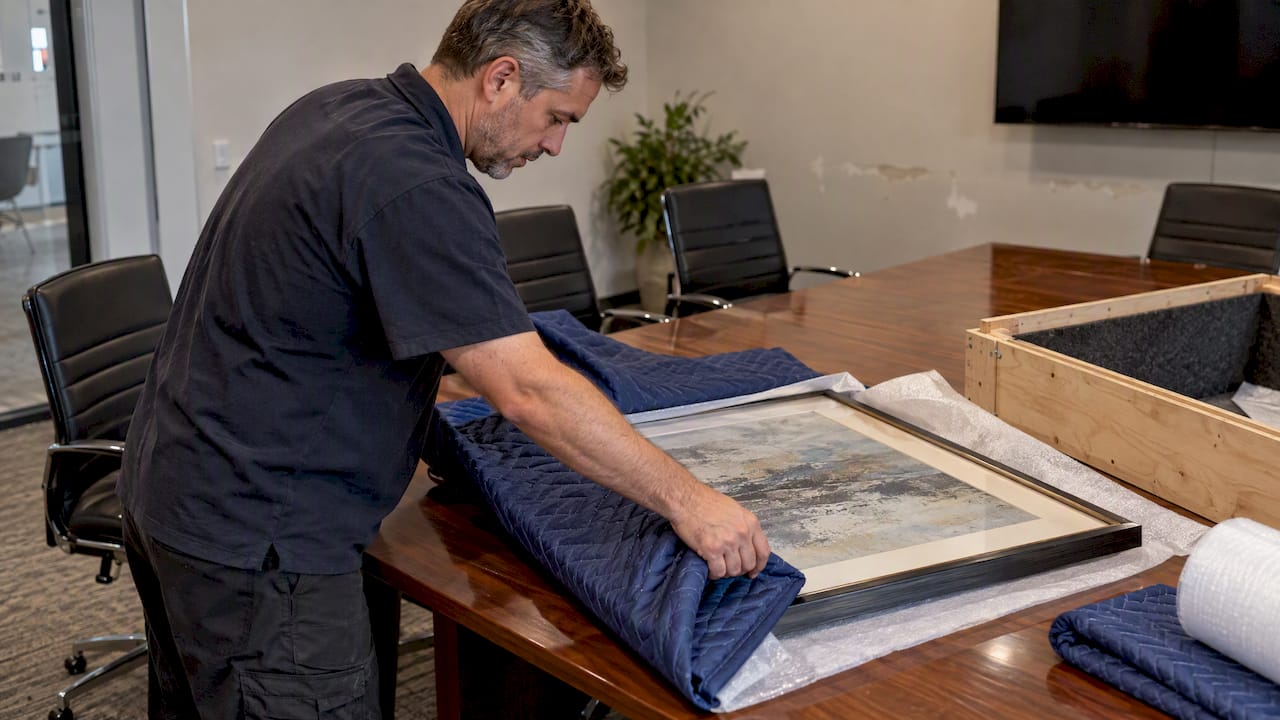
Specialty items like boardroom art, antique furniture or display pieces also change the math. These need padding, crating or extra care that a standard crew member isn’t necessarily set up to handle quickly, which is part of why we treat specialty office items as their own line item when we size a crew, rather than folding them into general furniture counts.
Scheduling, staging and building constraints that set your real ceiling
Freight elevator capacity is often the single biggest limit on how fast an office move goes, and it’s one that more movers can’t fix. If your building’s freight elevator holds one cart and takes four minutes round trip, you get roughly 15 trips an hour no matter how many people are waiting at either end. Add a second or third crew and you mostly create a queue in the lobby instead of a faster move.
Tenant improvement manuals for commercial buildings commonly require elevator and loading dock bookings in advance, along with sign-off from a base-building consultant for larger relocations, according to guidelines in building tenant manuals. These bookings, not crew headcount, often dictate your actual move-day schedule.
A practical sequencing plan for a tight weekend window looks like this:
- Book the freight elevator and loading dock weeks ahead, confirming exact start and end times with building management.
- Schedule a smaller team first for sensitive IT disconnection and server handling, ahead of the general crew.
- Bring in the main crew once the elevator window opens, loading in the order that matches your new floor plan so unloading doesn’t require re-sorting.
- Reserve a buffer crew or extra hour near the end of the window in case the elevator queue runs long, since even well-booked buildings see delays.
If your building only offers a two-hour elevator window on a Saturday, a staged approach, splitting the move across that window and an evening slot, usually gets more done than cramming extra movers into the same short block.
Cost and billing implications of crew size
How you’re billed changes what a bigger crew actually costs you, and it’s worth confirming before move day rather than after.
- Hourly per-crew-member billing is the standard model for most local and regional moves, where your total cost scales with both the number of movers and the hours worked.
- Flat-rate quotes are more common for larger commercial jobs where the scope, including crew size and timeline, is defined upfront after a site visit.
- Adding movers to shorten the day can backfire if the building’s elevator or loading dock becomes the bottleneck, since you pay for more hours per mover without actually finishing sooner.
- Overtime and access fees are the two line items most likely to surprise a budget if they’re not spelled out ahead of time.
Most movers bill hourly per crew member, with a typical team for a small to medium office move running three to five workers depending on size and complexity. That means the crew size written into your quote is directly tied to your total bill, which is exactly why it’s worth asking for that number in writing rather than a rough estimate.
Before you sign anything, insist on a written quote that names the specific crew count, the booked lift or elevator time, any access fees, and how overtime is calculated if the move runs long. A detailed, written quote that specifies crew size and timeline reduces the risk of surprise charges or delays, a point echoed in provincial guidance on office relocations. A flat-rate quote, where the price is set after a site survey rather than tracked by the hour, removes most of that uncertainty entirely.
When to bring in a move manager or full-service movers
Provincial guidance on office relocations recommends engaging a dedicated move manager or project lead for moves involving more than about 15 to 25 employees, particularly where IT systems, modular furniture or multiple departments are involved, according to Ontario’s office moving guidance. Below that threshold, a smaller team can often coordinate directly with the crew leader on-site.
A move manager or full-service mover typically handles:
- A site survey of the current and new space, checking access points, elevator specs, and item counts before quoting a crew size.
- A written crew-size guarantee tied to the quote, so you know the exact team you’re paying for.
- Vendor and building coordination, booking elevator and dock time and liaising with property management on your behalf.
- IT cutover sequencing, timing server and network disconnection and reconnection around the rest of the move.
Pro Tip: Ask any prospective mover for their site survey process before you ask for a price. A company that walks your space and gives you a crew count in writing is giving you a far more reliable number than one quoting off a square-footage formula.
We run site surveys for office and commercial relocations and quote a flat rate with the crew size specified upfront, which is the approach our commercial moving services are built around.
How to calculate crew size from your own inventory and layout
Start with a room-by-room inventory rather than a staff count alone. List workstations, filing units, shared equipment and any oversized or fragile pieces, then note which items need two people versus one.
A rough guide: each mover can typically clear one standard workstation, boxed and ready, in around 15 to 20 minutes including the walk to the truck. Divide your total workstation count by the hours you have available, then divide that by the per-mover rate to get a baseline crew size. Add movers for every heavy or two-person item beyond what a standard desk requires, and add more for every flight of stairs or long interior carry that slows the walking distance.
Layout matters as much as inventory. An open-plan floor with wide aisles lets a crew move faster per person than a warren of private offices and narrow corridors, even with the same item count. If your new space has a different layout than your old one, factor in extra time for movers to confirm placement rather than just dropping items near the door, since re-sorting later costs more than planning the unload order now.
How crew experience and skill affects the right number
A newer crew often needs more people to match the output of a smaller, experienced team, simply because disassembly, wrapping and loading take longer when techniques aren’t second nature. Experienced movers also tend to make better real-time calls about what can be moved together safely, which cuts down on trips.
Skill matters most on the items that aren’t simple box-and-carry jobs, server racks, boardroom tables, antique or specialty furniture. A crew with specific experience in these categories can often do the job with fewer people than a general-labour team would need, since they know the disassembly points and handling techniques without trial and error on-site. That experience gap is part of why two companies quoting the “same” crew size can deliver very different move-day timelines.
Coordination and communication tips for office move crews
A single point of contact on your side, usually the office manager or move coordinator, keeps instructions consistent and prevents crew members from getting conflicting directions from different staff. Share a floor plan with the crew lead before move day showing where major furniture and departments land in the new space, so loading order matches unloading order.
Daily or hourly check-ins during a staged move help catch problems early, especially around elevator timing or an area that’s running behind schedule. Label boxes and furniture by destination zone rather than just department name, since movers unloading at the new site often work faster from a colour or number system than from text alone. Clear communication about where sensitive items, like server equipment or confidential files, need extra handling also prevents mix-ups between the general crew and any specialized team.
Safety considerations tied to crew size
Enough movers on hand for two-person lifts matters more for safety than it does for speed. Manual handling injuries are one of the most common hazards flagged in office relocation planning, particularly around repetitive lifting and awkward carries through doorways or stairwells, per guidance from the Canadian Centre for Occupational Health and Safety.
A crew that’s understaffed for the items involved tends to improvise, single-person lifts on heavy furniture, rushed carries to make up time, which raises injury risk and the odds of property damage. Clear walkways, free of trip hazards like loose cabling or stacked boxes, also matter as much as headcount, since even a well-sized crew can’t work safely through a cluttered path. Planning for ergonomic handling of heavy or oversized items, rather than assuming extra hands will compensate, is part of why experienced crews size for the job rather than the clock.
What we see on-site, and three things to do this week
In our own site surveys, the crew-size question almost always comes back to the same two things: how much is actually packed, and what the building’s elevator or dock can handle in a given window. Offices that get these two answers right before move day tend to finish on schedule and on budget.
Three steps worth taking now: book a site survey so someone walks your space before you commit to a number, confirm your elevator or loading dock windows directly with building management, and get your crew size and timeline written into the quote rather than discussed verbally.
— Ali
How Aleks Moving sizes your crew and locks in your rate
We run a site survey for every office and commercial move, then quote a rate with the crew size written in, so there’s no guessing and no hourly surprise once moving day arrives.

- We handle local and long-distance office relocations with crews sized to actual inventory and building access, not a generic headcount.
- Our pricing aims to be clear and straightforward.
- We have extensive experience sizing crews for small offices and multi-floor corporate moves alike.
If you’d like a crew count and a firm price before you commit to a date, our office and commercial moving page is the fastest way to request a site survey and get both in writing.
FAQ
How many movers do I need for a small office move?
A small office with 1 to 10 employees typically needs 2 to 4 movers, assuming standard furniture and a reasonably accessible building. Add a mover or two if items aren’t pre-packed or if stairs are involved.
What crew size is standard for a medium-sized office relocation?
Offices with 11 to 50 employees generally use 4 to 8 movers, sometimes split into two teams handling different zones of the space at the same time. The exact number depends on furniture type and how much packing is already done.
Does a bigger crew always make an office move faster?
Not necessarily. Building constraints like freight elevator capacity can limit how many movers are actually useful at once, since Ontario’s office moving guidance notes that adding people beyond that throughput limit creates diminishing returns rather than a faster move.
When should I hire a dedicated move manager instead of just a crew?
Moves involving more than roughly 15 to 25 employees, or significant IT and modular furniture, generally benefit from a dedicated move manager who coordinates vendors, building access and IT cutover timing. Below that size, most offices can work directly with the crew lead on-site.
What should be included in a written moving quote?
A solid quote specifies the exact crew size, booked elevator or dock time, any access fees, and how overtime is calculated if the move runs long. Getting these details in writing before move day is one of the clearest ways to avoid unexpected charges.