Skip to content


Moving in snow is entirely doable, but only if you treat three things as non-negotiable: clear and grit every walking path before anyone carries a box, keep heaters and running engines away from packed materials and enclosed spaces, and prepare your vehicle and driving approach for reduced traction. Beyond that, hire movers who have handled Canadian winters before and who put weather delays in writing.
TL;DR:
- Clearing and gritting walkways, ramps, and driveways is crucial, especially in shaded or metal areas where ice hides and salt alone may be insufficient.
- Hiring a winter-experienced crew with a written weather delay policy and proper sequencing reduces slip risks and prevents weather-related delays or damage.
- Transporting electronics and cold-sensitive items should be done in a heated vehicle, while cardboard boxes must be wrapped in plastic to prevent weakening from melting snow.
- Slower braking distances and smooth driving techniques are essential, and drivers should check winter tires, brake health, and load balance before moving day.
- Preparing a safety kit, including warm layers, waterproof boots, and essential tools, helps manage snow hazards and cold conditions during the move.
Table of Contents
- Quick, ordered move-day checklist
- Planning your move date and locking in weather contingencies
- Clearing and treating walkways, ramps and driveways
- Packing and protecting belongings from snow and cold
- Vehicle and driving safety for snowy moves
- Loader safety, heaters, carbon monoxide and fire risk
- Emergency kit and handling cold-sensitive items
- How Aleks Moving handles winter relocations
- What conventional winter-moving advice gets wrong
- Hire a winter-ready crew for your snowy move
- Authoritative resources on winter driving and moving safety
- Sources
- FAQ
Quick, ordered move-day checklist
A winter move goes sideways when small hazards stack up unnoticed. This order keeps everyone safe from the first box to the last.
- Clear and grit a wide path at both properties, then walk it yourself before any carrying starts.
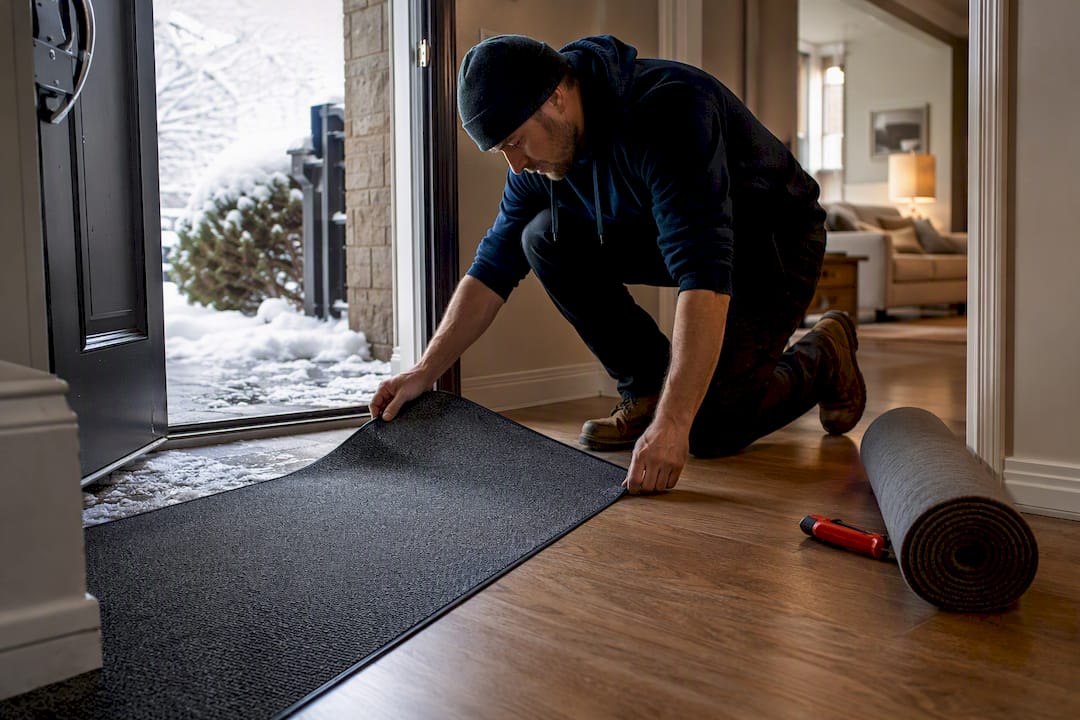
- Lay floor protection at both entrances and swap out mats once they’re saturated with snow melt.
- Load essentials, electronics, and anything cold-sensitive into a heated vehicle rather than the truck.
- Post a spotter at ramps and stairs for every heavy carry.
- Confirm everyone on the crew and in the household has waterproof boots with real tread, not just winter fashion boots.
Skipping step one is the most common mistake. A path that looks clear from the porch can still hide a slick patch near the driveway where sun and shade meet.
Planning your move date and locking in weather contingencies
Steady, cold, dry snow is often easier to manage than a warm afternoon followed by an overnight freeze. That freeze-thaw cycle creates some of the slipperiest surfaces of the season, so a forecast showing melt-then-refreeze deserves more caution than one showing consistent cold.
Before booking, cover these points:
- Ask your moving company for a written weather clause that spells out how delays or rescheduling are handled.
- Check your municipality’s winter parking rules and reserve a flat, cleared area for the truck days in advance.
- Confirm utilities will be live at the new address at least a day early, since starting heat and power before arrival helps you catch a failed furnace before it becomes a frozen-pipe problem.
- Keep heat running at the property you’re leaving until the truck is fully loaded.
Clearing and treating walkways, ramps and driveways
Ice hides in predictable spots: shaded corners of a driveway, the run-off zone under a downspout, and the metal surface of a truck ramp itself. Salt works the fastest on bare ice, while sand or a sand-salt blend gives better traction on packed snow without the corrosive residue salt leaves on floors.
- Treat the full width of the path, not just a single-file line, since two people often need to pass each other carrying furniture.
- Use texture mats, sand, or adhesive traction strips on the truck ramp, since metal ramps ice over faster than concrete.
- Salt the exact route the crew will walk beside the truck, not just the front walkway.
- Walk the entire route yourself in your own boots before the first heavy item leaves the house.
Pro Tip: Truck ramps need a trained spotter as much as they need traction treatment. On professional jobs, nobody carries a heavy load onto a ramp until the spotter confirms it’s safe underfoot.
Packing and protecting belongings from snow and cold
Plastic bins beat cardboard boxes in winter conditions because slush and melting snow weaken cardboard fast, sometimes enough that a box splits open mid-carry. If cardboard is what you have, wrap each box in plastic sheeting and unpack it as soon as it’s indoors rather than letting it sit.
- Tape down ram board or carpet film across main traffic routes, and pair it with a heavy absorbent mat at every entrance.
- Swap that entrance mat for a dry one once it’s saturated. A soaked mat becomes its own slip hazard.
- Transport electronics, batteries, and anything cold-sensitive in the heated car, not the truck, since cold can affect battery performance and screens.
- Keep moving blankets dry in sealed bins between uses, and skip loose plastic sliding sheets underfoot, since they turn a solid floor into a skating rink.
Vehicle and driving safety for snowy moves
Stopping distances on snow and ice can run much longer than on dry pavement, which means the following distance you’d use on a clear day simply isn’t enough once the roads turn white.
By the numbers: Braking distance on snow or ice can stretch to many times what it would be on dry asphalt, according to RAC Drive. Give yourself a much longer gap than instinct suggests.
Drive like you’re carrying a cup of scalding coffee on the dash: smooth throttle, gentle steering, gradual braking. That mental image, recommended by Car and Driver, does more to prevent skids than any single piece of equipment.
- Check winter tyres, battery health, and all lights before moving day.
- Carry a shovel, tow strap, and traction aids such as snow socks or sand bags in the vehicle.
- Load the truck with weight distributed evenly, since a poorly balanced load handles worse on slick roads.
- Steep, ungritted driveways may simply be unusable for a loaded truck. Confirm access before booking day.
Brake condition matters more in winter than any other season, and worn pads or fluid issues turn a routine stop into a slide. Have brakes checked the week before the move, not the week after something goes wrong.
Loader safety, heaters, carbon monoxide and fire risk
Ice underfoot is the single biggest physical hazard for anyone carrying a couch or a dresser down a driveway. Clearing and gritting the path isn’t a courtesy for the crew. It’s core risk management on a job site that happens to be your driveway.
- Keep a clear radius around any portable heater and never run one in an empty room.
- Plug heaters directly into a wall outlet, never into an extension cord buried under boxes.
- Never idle a truck or car in an attached garage, and don’t park the truck’s rear facing an open door for long stretches.
- Keep exhaust pipes clear of snowbanks and keep a carbon monoxide alarm accessible near the work zone.
Pro Tip: A heater surrounded by cardboard is one of the fastest ways a winter move turns into an insurance claim. Give it three feet of open space, minimum, on every side.
Emergency kit and handling cold-sensitive items
Pack this kit before the truck is loaded, not after someone’s already cold.
- Warm layers and a spare set of dry gloves for everyone on the crew.
- Waterproof boots with real grip, not smooth-soled work shoes.
- A shovel, a bag of grit or salt, and a flashlight.
- A basic first-aid kit and a fully charged phone charger.
- A short list of what to do if the furnace hasn’t kicked in by the time you arrive: check the thermostat, locate the shutoff valve, and have your utility provider’s number saved.
Label boxes that got wet during transport so they’re unpacked first, and keep a couple of spare absorbent mats by the door in case the first ones soak through before the truck’s even empty.
How Aleks Moving handles winter relocations
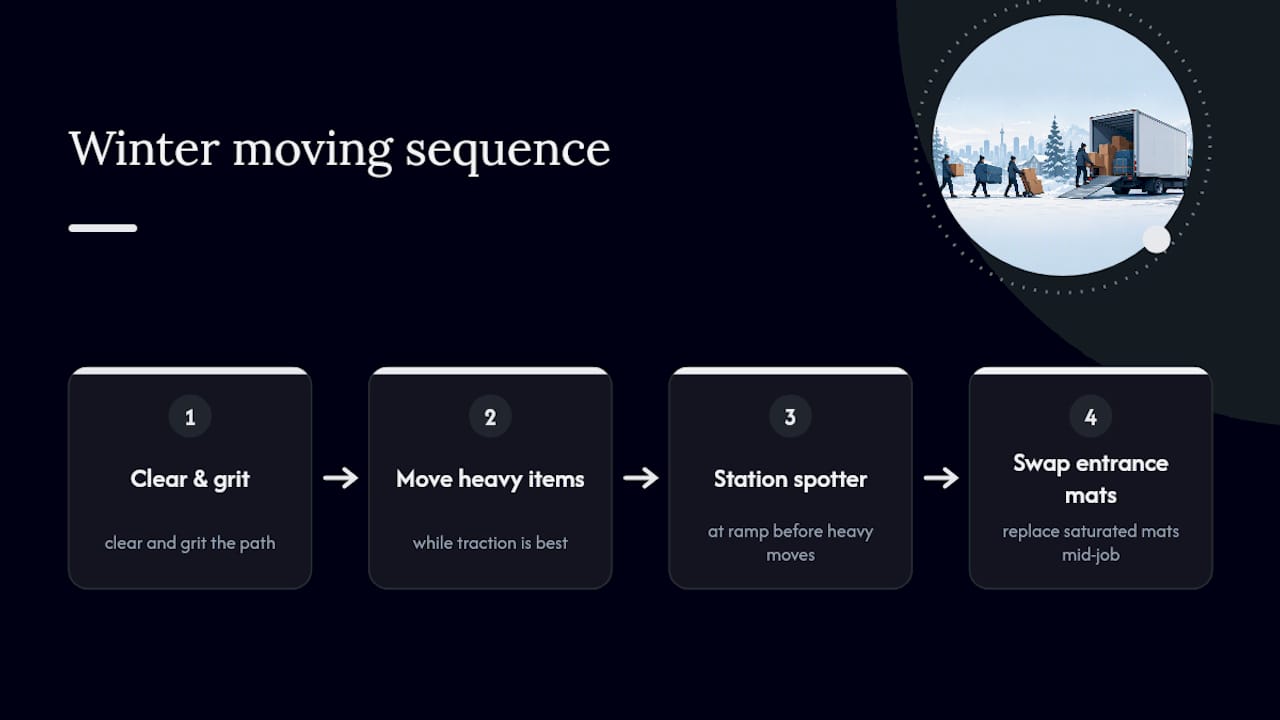
Winter jobs run on sequence. Crews clear and grit the path first, carry the heaviest and most awkward pieces while traction is at its best, and post someone at the ramp before anything heavy goes up or down it. Saturated entrance mats get swapped mid-job rather than left to turn a doorway into a hazard.
A written estimate should include a line something like: “Delays caused by severe weather (snow accumulation over X cm, ice storm warnings, or road closures) will be rescheduled at no additional charge, with priority booking for the next available date.” That single sentence protects both sides.
Winter jobs sometimes carry a modest extra charge for clearing, added floor protection, and extra time on site, and that fee is almost always cheaper than a slip-and-fall claim or a scratched hardwood floor from an untreated mat.
What conventional winter-moving advice gets wrong
Most winter-moving checklists treat weather as a scheduling inconvenience. Reschedule if it snows, they say, as if snow itself were the enemy. That misses the actual pattern: a steady, cold, dry snowfall is often more manageable than a mild, sunny afternoon that refreezes overnight into a sheet of ice nobody planned for. The date matters less than the freeze-thaw pattern around it.
The bigger gap in DIY advice is what it leaves out entirely: carbon monoxide risk from an idling truck, the fire hazard of a space heater surrounded by cardboard, and the simple fact that a truck ramp needs a spotter as much as it needs traction treatment. These aren’t afterthoughts on a professional crew. They’re written rules, because someone learned the hard way why they needed to be.
If you’re planning your own winter move, prioritize the boring stuff first: the written weather clause, the cleared path, the heater rules. The furniture always makes it. The hazards you didn’t think about are what actually cause problems.
— Ali
Hire a winter-ready crew for your snowy move
Professional moving crews bring flat-rate pricing with no hidden winter surprises, along with the floor protection, clearing supplies, and sequencing experience that come from many years of Canadian relocations.
Before you book anyone for a winter move, ask three questions: Is a weather delay clause included in writing? Who’s responsible for clearing and gritting the path, you or the crew? And is there a plan for truck parking if the street hasn’t been ploughed? Aleks Moving answers all three upfront on every residential moving quote.
If your move date is anywhere near a forecast that worries you, request a winter-ready quote now and get the weather clause in writing before the snow arrives.
Authoritative resources on winter driving and moving safety
For deeper reading on the topics covered here, RAC Drive’s guide to driving in snow covers stopping distances in detail, Car and Driver’s winter driving tips explains smooth-input technique, and ReloPeak’s cold-weather moving plan walks through move-day hazard management.
Sources
- How to drive in snow | RAC Drive
- How to Move in Winter: A cold-weather moving plan | ReloPeak
- How to drive in snow safely | Car and Driver
FAQ
How Long Before Moving House Should You Start Packing?
Start packing non-essentials three to four weeks out, and add extra time in winter for wrapping fragile items and sourcing plastic bins, since cardboard performs poorly once it’s exposed to snow or slush.
What 4×4 Mode Should I Use in Snow?
Use a low or dedicated snow setting if your vehicle has one, since it limits wheelspin by sending power more evenly to all four wheels, but smooth steering and braking still matter more than the mode selected.
Is It Okay to Walk While It’s Snowing?
Walking in falling snow is fine as long as the ground underneath is cleared and treated. The bigger risk is packed or melting snow underfoot, not the snowfall itself.
What Do Movers Not Recommend to Move in Winter?
Professional movers generally avoid transporting freeze-sensitive liquids, aerosols, and electronics in an unheated truck, and recommend keeping those items in a heated personal vehicle instead.