

Yes, you can move your houseplants, and most survive the trip just fine when you keep them with you in a climate-controlled vehicle rather than a moving truck. The single most important rule: check CFIA and CBSA requirements before crossing any provincial or international border. Beyond that, success comes down to two things: keeping plants alive in transit and staying on the right side of Canadian import rules.
TL;DR:
- Moving plants with you in a climate-controlled vehicle significantly reduces stress and increases the likelihood of survival during transit.
- Proper packing involves lightweight pots, loose leaf cushioning, soil containment, and open ventilation, with careful handling of tall or top-heavy plants.
- It is crucial to prioritize checking CFIA and CBSA requirements before crossing borders or provinces to avoid plant confiscation and ensure compliance.
- Most plants tolerate transportation better if kept in stable environments and are not exposed to extreme temperatures or prolonged outside conditions.
- Hiring professional movers for plant-heavy or long-distance relocations is advisable, especially when requesting climate-controlled transport and minimal loading and unloading time.
Table of Contents
- Your pre-move checklist for moving with plants
- How do you pack plants so they survive the trip?
- What’s the best way to transport plants across Canada?
- What Canadian rules apply to moving plants?
- Caring for plants after you arrive
- When should you hire movers for plant-heavy relocations?
- Why most plant-moving advice misses the point
- Let Aleks Moving handle the rest of your move
- Sources
- FAQ
Your pre-move checklist for moving with plants
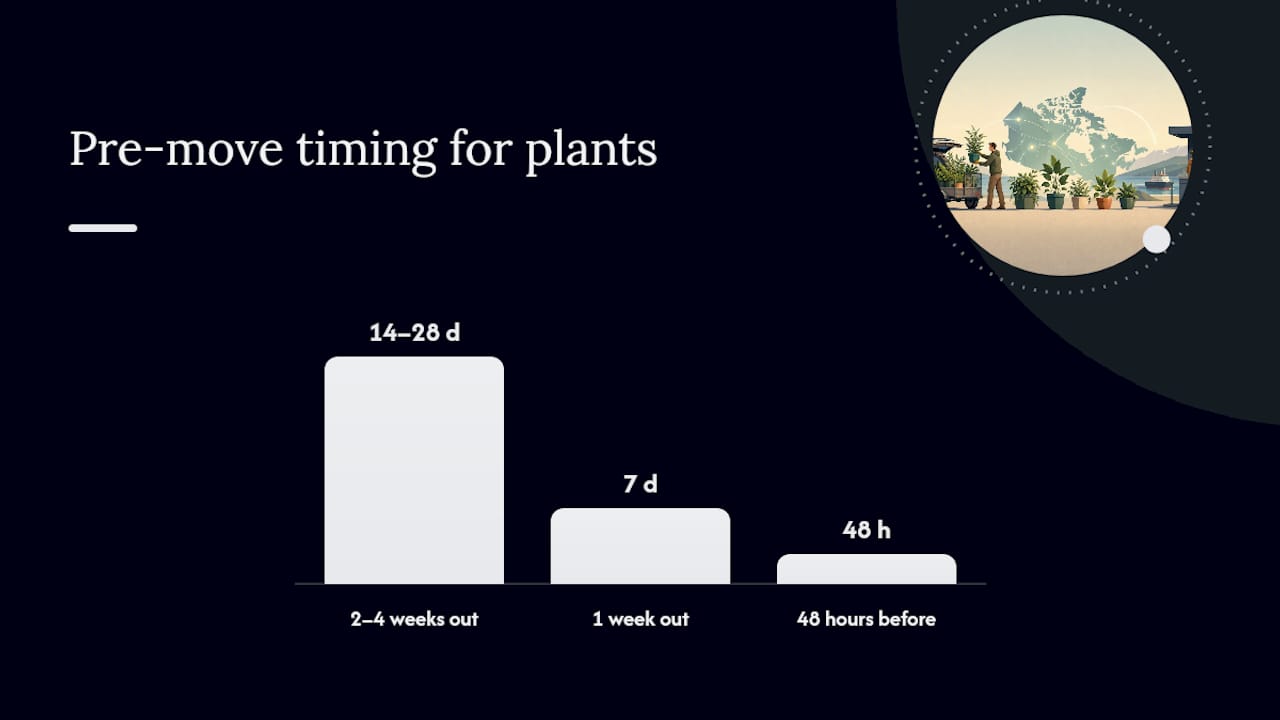
Plants don’t like surprises, so give them a runway. A staged timeline catches problems early and keeps moving day from turning into a scramble.
Two to four weeks out:
- Inspect every plant closely for pests. Aphids and spider mites hitch rides easily, and you don’t want them following you into a new home.
- Skip repotting during this window. A plant recovering from root disturbance has less reserve energy for the stress of a move.
- Decide which plants are actually coming. Large, low-value, or high-risk specimens may be better gifted to a neighbour than dragged across the country.
One week out:
4. Prune dead or yellowing leaves so you’re not hauling dead weight.
5. Ease off watering slightly. A slightly drier root ball is lighter and less prone to rot in transit.
6. Gather supplies: sturdy boxes, plastic collars, bags for soil, and packing tape.
48 hours before the move:
7. Water thoroughly one to two days ahead, never the morning of. Wet soil is heavy and more likely to slosh.
8. Stop fertilizing several weeks before moving day. Fresh fertilizer pushes new, tender growth right when the plant needs to conserve energy.
9. Label each pot with its name and any special handling notes, and pack a small “plant survival kit” (spray bottle, extra bags, scissors) separately from the rest of your boxes.
How do you pack plants so they survive the trip?
Packing plants for relocation is really about containment and airflow, not sealing everything up tight. A plant needs to breathe even while it’s boxed.
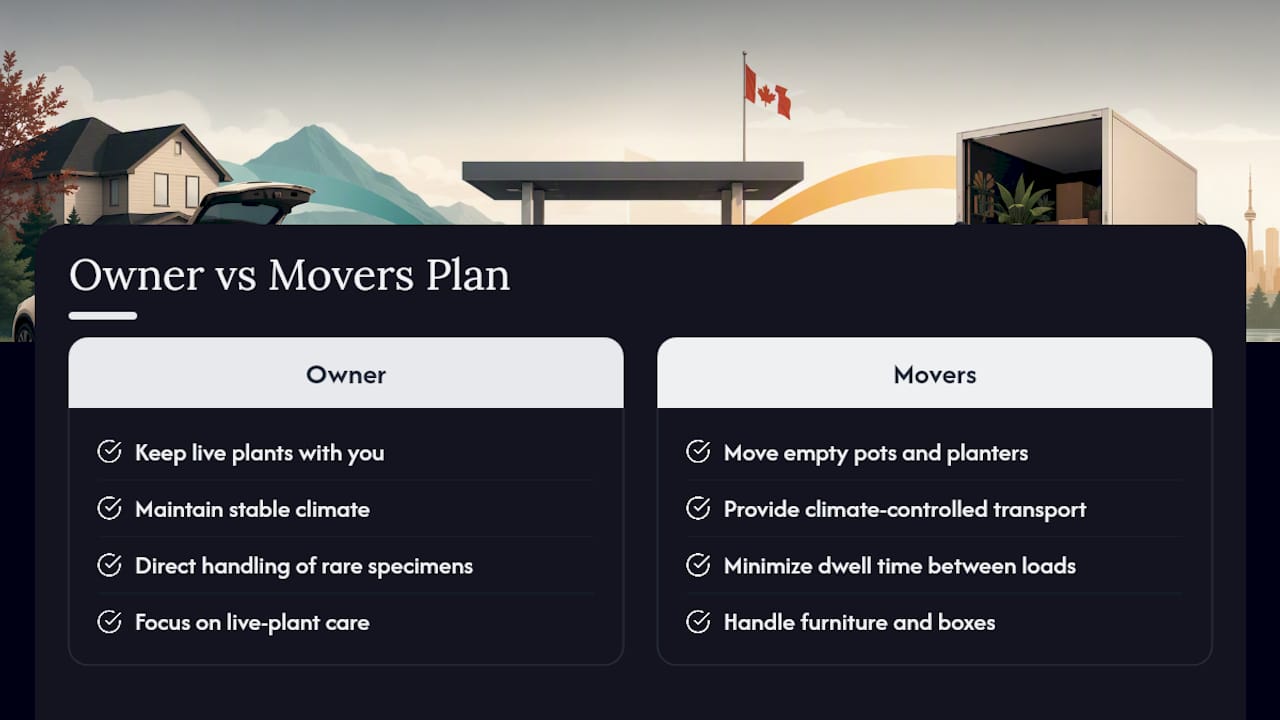
- Swap heavy ceramic or terracotta pots for lightweight plastic nursery pots before the move, and let the movers handle the empty decorative pots separately.
- Contain soil with a plastic bag taped snugly around the stem at soil level, or use a cardboard collar with a layer of stretch wrap over the top.
- Stake tall or top-heavy plants so they don’t snap during sudden stops.
- Cushion leaves loosely with tissue paper or soft cloth. Never wrap foliage in airtight plastic. Trapped humidity breeds mould within hours.
- Leave box tops open, or cut ventilation holes, and label each box “Live Plant, This Side Up.”
- Group plants with similar light and humidity needs together so you can unload and place them logically at the other end.
Pro Tip: Pack a spray bottle of water in your car’s front seat. A quick misting for humidity-loving plants like ferns or Calatheas during long stretches on the highway can make the difference between wilted leaves and a plant that barely notices the trip.
What’s the best way to transport plants across Canada?
Your own vehicle beats every other option for most moves. It gives you a stable, heated or air-conditioned environment, and you can check on your plants at every gas stop. If you’re overnighting on a long-distance move, most hotels don’t mind a few pots coming in for the night, which a moving truck simply can’t offer.
Moving trucks are riskier than most people expect. They’re uninsulated metal boxes that can swing from freezing to sweltering within a single Canadian afternoon, especially in a prairie winter or an Ontario summer. If a climate-controlled truck isn’t available, keep plants out of the cargo hold entirely and bring them with you instead.
A few other transport notes worth knowing:
- Flying with plants domestically is possible on most Canadian carriers as carry-on items, though bare-rooting (removing soil and wrapping roots in damp paper towel) is often required for security screening.
- Succulents and snake plants tolerate a full day of transit with no issue. Humidity-loving plants like ferns tolerate far less time without added moisture, so plan your route and stops around your most sensitive specimens.
- Avoid scheduling any plant transport during extreme cold snaps or heat warnings if you can help it. Even ten minutes in a parked, unheated car in a January cold snap can be fatal to a tropical plant.
What Canadian rules apply to moving plants?
This is where a lot of movers get caught off guard, particularly on long-distance and cross-border moves. Indoor houseplants in ordinary commercial potting soil are generally fine for personal relocation within Canada, but some species and certain soil conditions face restrictions depending on where you’re headed, according to the Canadian Food Inspection Agency’s import primer.
The CFIA’s Directive D-08-04 lays out the personal-use exemptions that let travellers bring plants into Canada, provided the plants accompany the importer and meet species and soil conditions. If you’re arriving from outside Canada, the Canada Border Services Agency requires you to declare plant material at the border, and undeclared items that could carry pests or disease can be seized on the spot.
A quick checklist for the border-adjacent or interprovincial move:
- Confirm your destination province’s agricultural rules before you leave. Some regions restrict specific ornamental or invasive-prone species.
- When you’re not sure whether a plant qualifies, declare it anyway and follow the inspection officer’s direction.
- Call ahead to a provincial agriculture department or the CFIA if a species seems unusual or was recently imported itself.
Provincial restrictions are the detail most movers miss entirely because there’s no single federal list that covers every plant and every province. When your itinerary crosses a border of any kind, five minutes on the phone with an agriculture office beats a plant confiscated at a checkpoint.
Caring for plants after you arrive
The move itself is only half the job. What you do in the first few weeks determines whether your plants bounce back or quietly decline.
- Unpack plants first, before furniture and boxes if possible, and get them out of dark, sealed containers as soon as you’re through the door.
- Keep shade-adapted plants out of direct sun for the first few days. A plant that’s been in a dim box for two days will scorch fast under a bright new window.
- Quarantine any plant that looks stressed, or any new acquisition, for a few weeks in a separate room, checking regularly for pests before reuniting it with the rest of your collection.
- Hold off on repotting for at least a week or more. Give roots time to settle before disturbing them again.
- Resume fertilizing only once you see new, healthy growth, which is the clearest sign a plant has stabilized. Delayed transplant shock can surface a few weeks after arrival, so resist the urge to over-correct with heavy feeding or repotting the moment a leaf droops.
When should you hire movers for plant-heavy relocations?
If you’re managing a large collection, rare specimens, or a long-distance move on a tight schedule, professional help changes the equation. Aleks Moving has spent more than 18 years handling residential relocations across Ontario and beyond, including long-distance moves and specialty handling for delicate items, all under flat-rate pricing with no hidden fees.
When you book movers, ask specifically for climate-controlled transport, minimal dwell time between loading and delivery, and clear handling instructions for any oversized specimens. Keep your live plants riding with you whenever you can. Let the crew focus on empty pots, planters, furniture, and boxes instead.
Why most plant-moving advice misses the point
Most guides on this topic treat plants like fragile cargo and stop there. What the research actually supports is something a bit different: the biggest risk to your plants isn’t the bumps in the road, it’s time spent outside a stable environment. A plant that sits in a hot truck for six hours is in far more danger than one that gets jostled around in a well-padded box for the same stretch.
That’s why I’d push back on the conventional wisdom that packing technique is the main event. Packing matters, but scheduling matters more. Reducing the number of minutes your ferns and orchids spend in a parked car, a loading dock, or a customs line does more for their survival than any amount of tissue paper.
If you take one thing from this guide, prioritize the CFIA and CBSA checks first, since a plant seized at a checkpoint doesn’t get a second chance regardless of how well you packed it. Everything else, from watering schedules to leaf cushioning, is damage control by comparison.
— Ali
Let Aleks Moving handle the rest of your move
You’ve got the plant plan sorted. The other 90% of your move, the furniture, the boxes, the appliances, is where a professional crew actually saves you time and stress. Aleks Moving offers flat-rate pricing with no hidden fees on long-distance moves, a dedicated packing service for fragile and awkward items, and bin rentals if you need a few days of staging space while your plants settle in.

When you request a quote, mention that you’re travelling with live plants. Ask about climate-controlled transport for the truck, tight loading and unloading windows, and whether the crew can work around your schedule to keep vehicle time short. Reach out to Aleks Moving for a free, no-obligation quote and get your whole move, plants included, mapped out properly before moving day arrives.
Sources
- Plant import primer — Canadian Food Inspection Agency
- Bringing food, plant and animal products into Canada — CBSA
FAQ
Do plants get stressed when moved?
Yes. Most plants experience some transplant shock from changes in light, temperature, and handling, and symptoms like drooping or leaf drop can appear immediately or show up two to three weeks later as delayed shock.
What is the best way to pack plants for moving?
Use lightweight plastic pots, contain soil with a taped plastic bag or cardboard collar, cushion leaves loosely without sealing them in plastic, and leave box tops open for airflow.
Is it okay to move plants around within a vehicle or home?
Occasional repositioning is fine, but frequent moves between very different light or temperature conditions add stress on top of an already disruptive relocation, so settle plants into a stable spot once you arrive.
Can I fly with plants domestically in Canada?
Most Canadian carriers allow plants as carry-on items, though you may need to bare-root the plant, removing soil and wrapping the roots in damp paper towel, to get through security screening.
Does Aleks Moving help with plants during a move?
Aleks Moving can advise on plant-safe handling and offers services like long-distance moving and packing support, though live plants are best kept with you rather than in the moving vehicle.