Skip to content


TL;DR:
- Employee relocation involves legal, tax, housing, and logistical considerations beyond just moving items.
- Relocation packages vary for homeowners, renters, and small businesses, covering different costs and support.
- Understanding tax rules, legal protections, and choosing between managed services and lump-sum payments ensures a smooth transition.
Most people assume employee relocation simply means loading a truck and heading to a new address. In reality, it involves a layered process touching legal rights, tax obligations, housing decisions, and family logistics. Whether you are a homeowner selling your property, a renter navigating a lease break, or a small business owner coordinating a team transfer, the details matter enormously. Employee relocation is the process where an employer facilitates a move to a new work location, often providing financial and logistical support. This guide walks you through every key consideration so you can approach your Ontario relocation with confidence and clarity.
Table of Contents
- Defining employee relocation and how it works in Ontario
- What relocation packages typically include for homeowners, renters, and small businesses
- Legal rights, tax implications, and compliance in Ontario relocations
- Choosing the right relocation solution: Managed services vs lump-sum payments
- The hidden factors most relocation guides miss
- Ready to make your relocation seamless?
- Frequently asked questions
Key Takeaways
| Point | Details |
|---|---|
| Relocation is comprehensive | Employee relocation in Ontario covers logistics, legal, and financial aspects far beyond basic moving services. |
| Packages vary by situation | Homeowners, renters, and small business owners receive tailored relocation benefits depending on their needs. |
| Tax and legal impacts matter | Know the 40 km rule, tax deduction opportunities, and legal protections against forced moves in Ontario. |
| Choose support method wisely | Assess if a managed service or lump-sum payment best fits your relocation’s complexity. |
Defining employee relocation and how it works in Ontario
Employee relocation is far more than a change of address. It is a coordinated process involving three main parties: the employer, the employee (and often their family), and the service providers who make the move happen. Each plays a distinct role, and understanding who is responsible for what can save you from costly surprises.
Employers initiate relocations for several reasons. They may need to attract skilled talent from another city, support business continuity after an office closure, or expand into a new Ontario market. Project-based transfers are also common, particularly in sectors like technology, finance, and construction that are active across the province.
“Employee relocation is the process where an employer facilitates an employee’s move to a new work location, often providing a relocation package to cover costs and support the transition.”
For employees, relocation triggers vary. A new job offer in Toronto, a lateral transfer to Ottawa, an interprovincial move from Alberta, or a return-to-office mandate after remote work are all common scenarios. Each situation carries its own set of pressures and practical requirements.
Ontario presents unique considerations that other provinces do not. The real estate market in the Greater Toronto Area is among the most competitive in Canada, meaning homeowners relocating here face bidding wars and tight timelines. Families must also account for school district changes, healthcare provider transitions, and community integration. These are not small adjustments.
Service providers, including professional moving companies, real estate agents, and relocation consultants, bridge the gap between employer intent and employee reality. Choosing the right partners early is critical. If your situation involves an urgent timeline, reviewing an emergency relocation guide can help you prioritise the right steps without missing anything important.
Understanding this full picture is what separates a smooth relocation from a stressful one. The physical move is just one piece of a much larger puzzle.
What relocation packages typically include for homeowners, renters, and small businesses
Now that you understand what employee relocation means, let’s unpack what actual support looks like for each affected group. Relocation packages are not one-size-fits-all. Coverage depends on your employment level, the company’s budget, and your specific circumstances.
There are three common package structures. Expatriation assistance covers international or long-distance moves with comprehensive support. Third-party managed services involve a relocation company handling logistics on your behalf. Lump-sum payments give you a fixed amount to manage your own move. Each has trade-offs, and knowing which one you are being offered matters before you sign anything.
Typical components for homeowners include real estate assistance for selling the old home and buying a new one, moving services, temporary housing, and travel reimbursement. Renters, by contrast, tend to receive support for lease cancellation penalties, short-term accommodation, and moving costs. Small businesses coordinating team moves often need managed logistics, storage solutions, and flexible scheduling.
| Element | Homeowners | Renters | Small businesses |
|---|---|---|---|
| Real estate support | Yes | Rarely | No |
| Lease break assistance | No | Yes | Varies |
| Moving services | Yes | Yes | Yes |
| Temporary housing | Yes | Yes | Sometimes |
| Storage solutions | Sometimes | Sometimes | Often |
| Tax guidance | Recommended | Recommended | Essential |
Here is what each group should prioritise when reviewing a package:
- Homeowners: Real estate commissions typically run 3 to 5 percent of the sale price. Confirm whether your package covers this, along with legal fees and land transfer taxes.
- Renters: Clarify whether the employer will cover lease break penalties. Some Ontario leases require 60 days notice, and penalties can be significant.
- Small businesses: Look for managed service options that handle complex logistics. For a realistic sense of what moving costs look like, reviewing business moving costs in Ontario is a smart starting point.
Pro Tip: Always request written package details before accepting any verbal offer. Verbal commitments are difficult to enforce, and written documentation protects everyone involved.
For guidance on negotiating relocation packages, it helps to know the market standard before entering any conversation with your employer. You will be in a much stronger position with that knowledge in hand. Reviewing residential moving tips can also help you prepare practically once the package details are settled.
Legal rights, tax implications, and compliance in Ontario relocations
Understanding what is in a package is just the start. The legal and financial landscape can be equally significant, and this is where many employees and business owners make costly mistakes.
Under Canadian federal rules, employer-provided relocation benefits are generally taxable unless the move qualifies as an eligible relocation. An eligible relocation means your new home is at least 40 km closer to your new workplace than your old home was. If you meet this threshold, you may be able to deduct qualifying moving expenses on your tax return.
| Benefit type | Taxable? | Deductible by employee? |
|---|---|---|
| Moving allowance (lump-sum) | Yes | Possibly, if eligible |
| Direct moving cost reimbursement | Yes | Possibly, if eligible |
| Temporary housing (employer-paid) | Yes | No |
| Real estate commission coverage | Yes | No |
| Storage costs | Yes | Possibly, if eligible |
For employees unsure whether their move qualifies, reviewing moving expenses tax eligibility is a helpful first step before filing.
On the legal side, Ontario employees have important protections. Unilateral workplace relocation demands can constitute constructive dismissal, meaning your employer cannot simply force you to move without your agreement if the change is substantial enough to alter the terms of your employment.
Here is a practical compliance checklist before and after your move:
- Confirm whether your move meets the 40 km eligibility rule.
- Keep all receipts for moving expenses, travel, and temporary housing.
- Request a written relocation agreement from your employer.
- Consult an employment lawyer if the relocation feels coerced or unreasonable.
- File your moving expense claim with the Canada Revenue Agency in the tax year the move occurred.
- Notify the CRA of your new address promptly to avoid benefit disruptions.
The financial consequences of misunderstanding these rules can be significant. Employees who treat taxable relocation benefits as non-taxable income may face reassessments and penalties. Getting this right from the start is well worth the effort.
Choosing the right relocation solution: Managed services vs lump-sum payments
Once you are clear on legal and package details, your final choice is what relocation model best fits your needs. Two main options dominate the market: managed relocation services and lump-sum payments.
A managed relocation involves a third-party company coordinating everything on your behalf. They handle moving logistics, temporary housing bookings, school searches, and sometimes even vehicle transport. The employer pays the provider directly, and you receive guided support throughout the process.
A lump-sum payment gives you a fixed amount of money to organise your own move. You keep whatever you do not spend, but you also absorb any cost overruns. Lump-sum offers flexibility but risks underspending on important services, leaving legal or tax issues unaddressed.
Factors to consider when choosing:
- Complexity of the move: Families with children, pets, or large homes benefit more from managed services.
- Timeline: A last-minute move with a 30-day window is difficult to self-manage effectively.
- Budget awareness: If you are unfamiliar with Ontario moving costs, a lump-sum can feel adequate but fall short quickly.
- Business moves: Companies relocating multiple employees simultaneously almost always benefit from a managed approach.
- Personal preference: Some people prefer control; others prefer delegation.
Pro Tip: Ask your employer whether a hybrid option is available. Some companies will provide a partial managed service for the physical move while offering a smaller lump-sum for incidentals. This gives you the best of both models.
Consider a real-world scenario: a small Ontario business receives a 45-day notice to vacate its leased office space. A lump-sum approach would require the owner to simultaneously manage vendor quotes, packing, storage, and staff coordination. A managed service through experienced commercial relocation providers removes that burden and reduces the risk of disruption to daily operations. For homeowners preparing independently, reviewing packing tips for homeowners can make a real difference in how smoothly moving day unfolds.
The hidden factors most relocation guides miss
Most relocation guides focus heavily on paperwork, package values, and logistics checklists. What they rarely address is the human side of the move, and in our experience, that is often where transitions succeed or fall apart.
Emotional readiness matters. Employees who feel pressured into a relocation, or who have not had honest conversations with their families, often struggle to settle into a new city even when the logistics go perfectly. Family disruption, particularly for children changing schools or partners leaving jobs, creates stress that no package can fully offset.
Community integration is another underrated factor. Moving to a new neighbourhood in Ontario without any local knowledge can feel isolating. Employers who invest in post-move support, like community introductions or local resource guides, see faster productivity recovery from relocated employees.
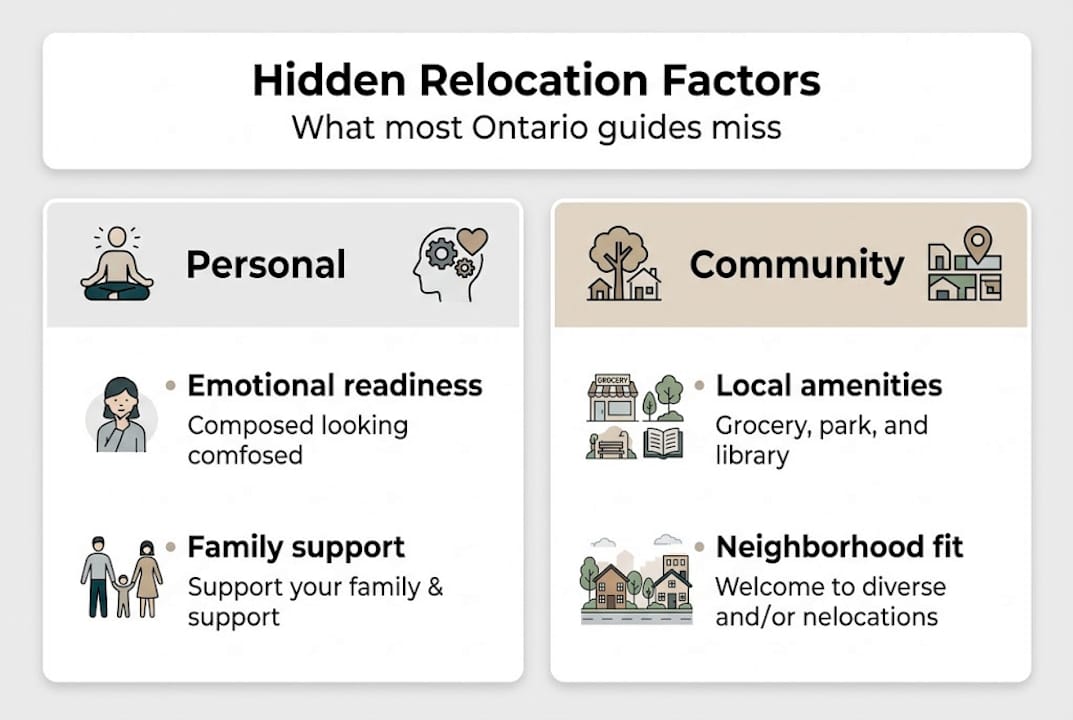
For businesses navigating sudden return-to-office demands or quick pivots, adaptability is everything. Rigid relocation plans that cannot flex with changing circumstances tend to create more problems than they solve. The best relocations we have seen build in contingency time and local partnerships from the start.
Pro Tip: Invest time in scoping neighbourhoods and local services before committing to a new address. Visiting the area, even virtually, helps you make a more informed decision and reduces post-move regret.
For anyone managing a longer journey across the province, reading about insights on long-distance moves can help you plan with more realistic expectations.
Ready to make your relocation seamless?
If you want your next relocation to avoid common missteps, here is how to get reliable, local support.
At Aleks Moving, we have spent over 18 years helping Ontario homeowners, renters, and businesses navigate relocations of every size and complexity. Our full-service moving solutions cover everything from packing and transport to storage and specialty items, all with flat-rate pricing and no hidden fees. Whether you need time to plan or are facing a tight deadline, our emergency relocation planning support ensures nothing falls through the cracks. As your local moving experts, we understand Ontario’s unique real estate landscape, traffic patterns, and seasonal challenges. Reach out today for a free upfront quote and let our team take the stress off your shoulders.
Frequently asked questions
Is employee relocation taxable in Ontario?
Employer-provided relocation benefits are taxable unless your new home is at least 40 km closer to your new workplace, in which case qualifying moving expenses may be tax-deductible.
Can my employer force me to relocate in Ontario?
If a relocation substantially changes your employment terms, you may have grounds to claim constructive dismissal rather than being compelled to accept the move.
What should I ask for in a relocation package as a homeowner?
Request real estate support, packing and moving services, travel reimbursement, and temporary housing. Typical homeowner components in a strong package cover all four of these areas.
What is an ‘eligible relocation’ under Canadian tax rules?
An eligible relocation is a move where your new residence is at least 40 km closer to your new job location, which allows you to claim qualifying moving expenses on your tax return.
Are lump-sum relocation payments better than managed services?
Lump-sum payments offer flexibility but can leave you under-supported on complex moves. Managed services provide expert guidance that is especially valuable for families, businesses, or tight timelines.
Recommended
- Emergency relocation workflow: your step-by-step Ontario guide
- How to prepare for a move: Ontario’s essential guide
- How moving companies streamline tenant turnover in Ontario
- Long-Distance Commercial Moving: Impact on Ontario Offices
- Guide to relocation logistics: smooth and stress-free moves