
TL;DR:
- Eco-friendly movers use reusable crates, cleaner fuels, and waste reduction practices, making moves more sustainable. These companies offer benefits like less damage, faster loading, and comparable costs, emphasizing operational discipline and environmental responsibility. Planning ahead with decluttering, smart packing, and route optimization maximizes the ecological benefits of your relocation.
Most people plan their move around cost, timing, and reliability. What rarely enters the conversation is the environmental footprint of the move itself. Cardboard boxes fill dumpsters, diesel trucks idle in traffic, and packing foam ends up in landfill. If you care about reducing your impact, the question of why choose eco-friendly movers becomes very practical, very fast. Sustainable moving, the industry’s emerging term for waste-aware relocation logistics, offers real advantages beyond a feel-good label. This guide breaks down what it actually means, what you gain, and how to find a mover who genuinely delivers on the promise.
Table of Contents
- Key takeaways
- Why choose eco-friendly movers: what it actually means
- Benefits beyond the environmental impact
- Innovations shaping green moving in 2026
- How to evaluate a truly green moving company
- Planning your move for maximum sustainability
- My take on the future of sustainable moving
- Move sustainably with Aleksmoving
- FAQ
Key takeaways
| Point | Details |
|---|---|
| Eco-friendly moving is operationally different | Green movers use reusable crates, optimised routes, and cleaner fuel, not just recycled cardboard. |
| Benefits go beyond the environment | Uniform crates reduce damage, save loading time, and often keep costs comparable to traditional moves. |
| Not all green claims are equal | Ask specific questions about fleet fuel types, crate rental programmes, and waste management practices. |
| Technology is raising the bar | Electric trucks and route optimisation tools are making sustainable moves faster and more efficient in 2026. |
| Decluttering first multiplies the impact | Donating and reducing load before booking maximises the sustainability gains of any green move. |
Why choose eco-friendly movers: what it actually means
The phrase “eco-friendly moving” gets used loosely, so it helps to understand what separates genuine sustainable movers from companies that just recycle a few boxes at the end. True sustainable moving is built around waste-aware logistics, which means applying the reduce-reuse-recycle hierarchy at every stage, not just as an afterthought.
Here is what that looks like in practice:
- Reusable plastic crates replace single-use cardboard boxes. These crates are rented, returned, sanitised, and used again, keeping tonnes of corrugated board out of recycling streams and landfill.
- Biodegradable and compostable packing materials substitute for plastic bubble wrap and foam. Some companies use recycled newsprint, cornstarch-based cushioning, or textile wraps.
- Fuel-efficient and alternative energy vehicles form the backbone of a green fleet. This includes hybrid trucks, biodiesel options, and increasingly, fully electric moving vehicles.
- Donation and recycling coordination as part of the service. Reputable green movers will arrange pickups for items you no longer need and sort recyclables at move time.
The critical distinction, as the EPA’s waste-management framework makes clear, is between companies that prevent waste upfront versus those that simply handle it at the back end. A mover who ships you 40 cardboard boxes and then offers to recycle them is operating at the lowest rung of the sustainability ladder. A mover who arrives with reusable crates and no disposable materials is working at the top.
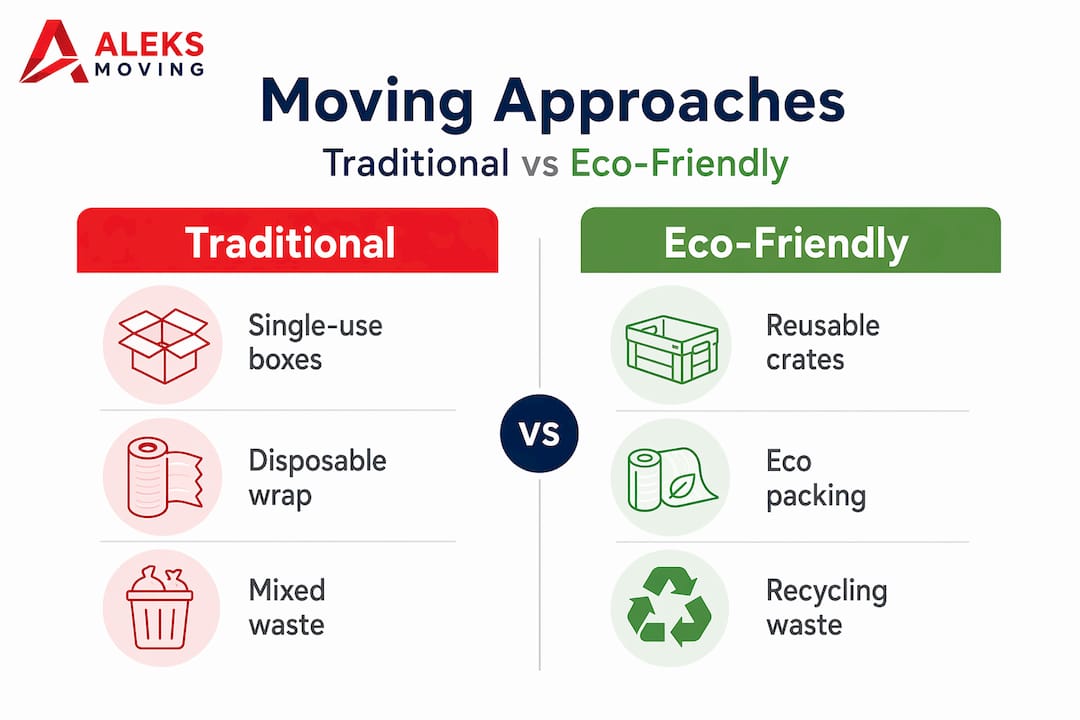
| Traditional moving | Eco-friendly moving |
|---|---|
| Single-use cardboard boxes | Reusable plastic crate rental |
| Plastic tape, foam, bubble wrap | Biodegradable or textile alternatives |
| Standard diesel fleet | Hybrid, electric, or biodiesel trucks |
| No waste coordination | Donation and recycling services included |
| No route planning for emissions | GPS and AI route optimisation |
Understanding professional packing supplies and how they differ from consumer-grade materials is a good starting point when comparing what different movers actually bring to your door.
Benefits beyond the environmental impact
The practical case for sustainable movers is stronger than most people expect. Here are the key advantages, ranked by how often clients notice them:
- Less damage to your belongings. Uniform crate sizes improve efficiency and reduce damage because stackable, weather-resistant containers protect contents far better than flimsy cardboard that collapses when wet or overloaded.
- Faster loading and fewer trips. Efficient packing systems with uniform crates improve stacking and reduce the number of trips required. Fewer trips mean less fuel consumed and less time on the clock for you.
- Comparable or lower overall costs. Eco-friendly moves often cost about the same as traditional moves. The savings on disposable materials and labour time frequently offset the small premium on crate rental.
- Reduced stress on move day. When everything is packed into uniform, weather-proof containers, the loading process is more predictable. There is less improvising, less repacking, and less anxiety about whether a box will survive the trip.
- Peace of mind. Knowing your move did not generate a dumpster worth of waste matters. For many people, that peace of mind is worth a small cost premium on its own.
Pro Tip: Ask your mover for a breakdown of what materials they use and what happens to them after the move. A company that cannot answer this clearly is probably not as green as it claims.
A company’s commitment to sustainable practices also signals something about its broader professionalism. Movers who invest in route planning technology, maintain a modern fleet, and train staff on responsible packing are generally more organised and reliable across the board. Sustainability, in this sense, is a quality indicator as much as an environmental one. You can read more about how smart packing protects your belongings while also supporting logistics efficiency.
Innovations shaping green moving in 2026
The sustainable moving sector has moved well past reusable crates. In 2026, several technologies and practices are reshaping what green moving services can deliver.
- Electric moving trucks are the most visible change. Electric trucks produce zero tailpipe emissions, a significant improvement over diesel fleets in urban areas where idling and short trips waste the most fuel.
- Route optimisation through GPS and AI is rapidly becoming standard practice among forward-thinking movers. These systems cut mileage, reduce fuel consumption, and get your belongings to the destination faster.
- Biodegradable packing alternatives have expanded considerably. Mycelium-based packaging, recycled denim padding, and plant-starch films are showing up in premium green moving kits as replacements for foam and plastic.
- Carbon offset programmes let movers and clients calculate the emissions from a specific move based on distance and weight, then fund verified projects like reforestation to balance the carbon footprint. These are a complement to emission reductions, not a substitute.
- Energy-efficient warehousing and storage with LED lighting, solar panels, and smart climate controls rounds out the picture for movers who offer storage alongside relocation.
It is worth noting that 60% of consumers favour providers who demonstrate measurable sustainability commitments. That shift in consumer preference is pushing more moving companies to invest in genuine green infrastructure rather than simply adding “eco-friendly” to their marketing.
How to evaluate a truly green moving company
Green claims are easy to make. Here is what to look for when assessing whether a mover’s sustainability practices are real:
- Crate rental programmes. Ask whether the company offers reusable crate rentals as a standard service or only as an add-on. Companies that default to reusables have built sustainability into their operations.
- Fleet fuel types. Request specifics about the trucks serving your route. A mix of hybrid and biodiesel vehicles is a good sign. A company that cannot tell you what fuel its trucks run on has likely not thought seriously about emissions.
- Waste management practices. Find out whether they coordinate donation pickups, provide recycling sorting at move time, or have take-back programmes for boxes. These services reduce landfill impact and simplify your move significantly.
- Certifications and accreditations. Look for memberships in sustainability organisations or certifications that require verified environmental standards, not just self-reported claims.
- Customer reviews mentioning sustainability. Reviews that specifically mention the reusable crates, clean trucks, or donation services are a reliable indicator that the green practices are real and consistent.
Pro Tip: Search for reviews that specifically mention eco-friendly practices. If no customers mention it, the company may not be delivering on its green claims in any meaningful way.
Comparing pricing is still worthwhile. Moving costs can be managed without sacrificing sustainability, especially when you factor in the reduced need for packing materials and the time savings from a more organised system.
Planning your move for maximum sustainability
Choosing the right mover is only half the equation. Here is how to set up your move to get the most out of eco-conscious relocation services:
- Declutter before you book. Every item you do not move reduces fuel consumption, labour time, and packaging needs. Donate, sell, or responsibly dispose of anything you have not used in the past year before your moving date.
- Request reusable crates and confirm the pickup schedule. Book the crate return at the same time you book the move. Leaving this as an afterthought leads to crates sitting in your new home and defeats the purpose.
- Pack smartly to minimise void fill. Reusable crates save significant time when packed efficiently. Fill containers fully, use towels and clothing as padding, and avoid leaving empty space that requires foam or paper filler.
- Coordinate donation and recycling pickups with your move date. Schedule collection for furniture and appliances you are leaving behind on the same day so everything is handled in a single, organised sweep.
- Ask about route optimisation. Confirm that your mover plans routes to minimise total distance, particularly for multi-stop moves. A short conversation about this before booking tells you a lot about how seriously a company takes its environmental commitments.
- Consider carbon offsets if offered. If your mover provides an offset option, it is a straightforward way to balance the emissions from a longer-distance relocation while the industry continues building cleaner fleets.
My take on the future of sustainable moving
I’ve been watching the moving industry for a long time, and I’ll say this plainly: eco-friendly moving is not a niche trend. It is the direction the entire industry is heading, and the companies that treat it as a box-ticking exercise will get left behind.
What I’ve found consistently is that the best sustainable movers are also the most operationally disciplined. The same rigour that goes into managing a reusable crate fleet and planning fuel-efficient routes shows up in how they handle your belongings, how they communicate, and how they follow through on commitments. Sustainability, in my experience, is a proxy for overall quality.
The misconception I encounter most often is that going green costs more. It sometimes costs marginally more upfront. But when you count the labour time saved by uniform crates, the reduction in damaged items, and the materials you do not buy, the numbers usually come out comparable or better. Customers who understand this stop asking whether they can afford a sustainable mover and start asking whether they can afford not to use one.
My caution to consumers is this: push back on vague language. “We care about the environment” is not a policy. Ask for specifics. The movers who deserve your business will have specific answers.
— Ali
Move sustainably with Aleksmoving
If you are planning a move in Ontario and want a mover that takes your environmental values as seriously as your furniture, Aleksmoving is ready to help. We work with reusable packing systems, plan routes to reduce fuel consumption, and coordinate donation and recycling services so your move leaves the smallest footprint possible.
Over 18 years of experience in residential and commercial relocations across Ontario means we know how to make a move efficient, reliable, and responsible. Our flat-rate pricing means no surprises, and our team is trained to handle your belongings with care from the first box to the last. Explore our full moving services or request a free quote today. We would be glad to show you that dependable and sustainable are not mutually exclusive.
FAQ
What is eco-friendly moving?
Eco-friendly moving, also called sustainable moving, refers to relocation services that apply the reduce-reuse-recycle hierarchy through reusable crates, biodegradable packing materials, fuel-efficient vehicles, and waste coordination practices like donation and recycling pickups.
Are eco-friendly movers more expensive?
Eco-friendly moves often cost about the same as traditional moves. Savings on disposable materials and faster loading with uniform crates frequently offset the small premium on reusable systems.
How do I know if a mover is genuinely green?
Ask specific questions about crate rental programmes, truck fuel types, and waste management practices. Look for customer reviews that specifically mention sustainable services, and check for verified certifications rather than relying on self-reported claims.
Do eco-friendly movers operate in Canada?
Yes. Sustainable moving services are available across Canadian cities, including throughout Ontario. Demand for green moving services has grown significantly, and reputable companies are investing in electric fleets, route planning, and reusable materials to meet that demand.
Can I make my move greener even without an eco-certified mover?
Absolutely. Decluttering before you book, using reusable bins and textile padding, coordinating donation pickups, and asking your mover about route optimisation all reduce your move’s environmental impact regardless of the company’s formal certifications.