Skip to content


TL;DR:
- Office moving regulations in Ontario encompass insurance, licensing, workers’ compensation, and building permits, which companies must comply with to avoid penalties and operational disruptions. Proper vetting of commercial movers involves verifying carrier status, insurance, and adherence to building policies before scheduling the move. Early planning for permits, IT provisioning, lease obligations, and compliance ensures a smooth relocation and minimizes costly surprises.
Office moving regulations are the legal, insurance, and safety requirements that govern how businesses must plan, execute, and document a commercial relocation. For Ontario business owners, these rules cover everything from the minimum liability coverage your mover must carry to the permits required for loading dock access. Ignoring them is not just an administrative oversight. It can expose your company to financial penalties, lease disputes, and operational shutdowns. Planning your move 6 to 12 months in advance can reduce relocation costs by up to 20%, avoiding the roughly $900,000 in lost productivity that poorly planned moves can generate. This guide covers what office moving regulations actually require, and how to stay on the right side of them.
What are the main regulatory requirements for office moves in Ontario?
Office move legal requirements in Ontario fall into four categories: insurance, licensing, workers’ compensation, and building access permits. Each one carries real consequences if overlooked.
Insurance certificates
Most commercial buildings in Ontario require your moving company to provide a Certificate of Insurance (COI) before they will grant access to freight elevators or loading docks. General liability coverage typically ranges from $2 million to $5 million, and some Class A office buildings require up to $10 million. That figure is not arbitrary. It reflects the cost exposure a building owner faces if a mover damages shared infrastructure, injures a third party, or causes a fire suppression system to trigger. Beyond general liability, the COI must often include an additional insured endorsement naming the property management company directly.
Licensing and carrier registration
For moves that cross provincial or international borders, movers must hold active federal registration. Interstate movers must carry at least $750,000 in public liability coverage and cargo coverage of $100,000 or more per load. Within Ontario, provincial licensing requirements apply, and you should verify that any mover you hire holds the appropriate operating authority before signing a contract.
Workers’ compensation
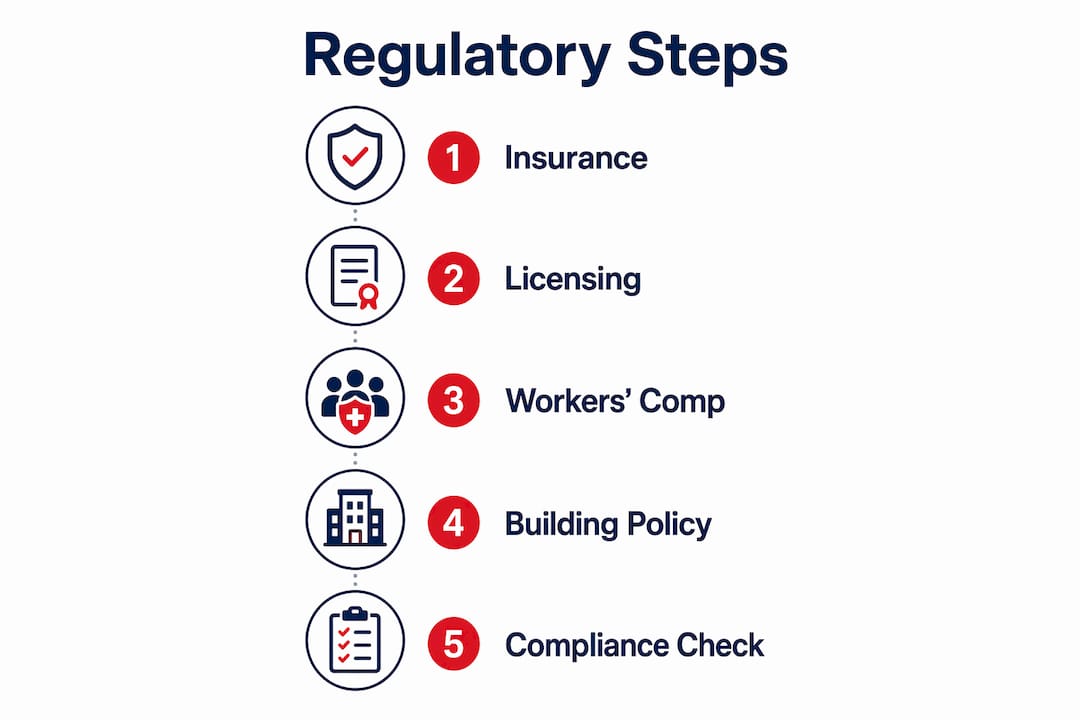
Proof of statutory workers’ compensation coverage is mandatory for movers operating in Ontario. If a mover’s employee is injured on your premises and the company lacks valid WSIB (Workplace Safety and Insurance Board) coverage, your business could be held liable for those costs. Always request a WSIB clearance certificate before your move date.
Building access and permits
Building management rules vary significantly across Ontario’s commercial districts. Common requirements include:
- Advance reservation of freight elevators and loading docks (often 2 to 4 weeks notice)
- Temporary parking permits for moving trucks on city streets, obtained through your local municipality
- Written approval from building management for after-hours access
- Floor protection and elevator padding requirements, sometimes enforced by building security
Pro Tip: Request a copy of your building’s moving policy from the property manager at least 30 days before your scheduled move. Some buildings in Toronto’s financial district require a separate damage deposit from the moving company, which can delay your move if not arranged early.
How do regulations impact the selection and vetting of commercial movers?
Choosing the wrong mover is one of the fastest ways to create a compliance problem. The vetting process for commercial movers is more structured than most business owners realise, and the distinctions matter legally.
Here is a reliable process for vetting a commercial mover in Ontario:
- Confirm carrier vs. broker status. An asset-based carrier owns its trucks and employs its crew directly. A broker arranges moves through third-party carriers. Asset-based carriers must provide the same employee crew roster for building access protocols, while brokers often cannot meet this requirement. Building managers in regulated commercial properties specifically require asset-based status to authorise freight elevator and loading dock use.
- Verify credentials on the FMCSA database. Check any mover’s legitimacy at safer.fmcsa.dot.gov to confirm their operating status, liability coverage, and complaint record. This database is publicly accessible and takes less than five minutes to use.
- Confirm IT equipment handling protocols. Moving IT equipment requires specialised protocols including anti-static materials, serial number tracking, and dedicated damage liability coverage. Standard residential movers frequently lack the expertise to handle servers, workstations, and networking equipment safely. Ask specifically whether the mover carries separate coverage for electronic equipment.
- Request proof of WSIB clearance and COI. Do not accept verbal assurances. Ask for documents and forward them to your building manager for approval before confirming your booking.
- Watch for red flags. Unusually low quotes, refusal to provide written contracts, and inability to supply a COI on request are all warning signs. A mover who cannot produce insurance documentation within 24 hours of your request is not compliant.
Pro Tip: When reviewing a mover’s COI, check the expiry date carefully. A certificate that expires before your move date provides no protection at all, and this detail is easy to miss under the pressure of relocation planning.
What are the legal and lease-related considerations affecting office relocations?
Lease obligations are where many Ontario businesses encounter their most expensive surprises during a relocation. The legal framework around commercial leases creates compliance requirements that begin long before moving day.
Lease restoration clauses are among the most underestimated costs in any office move. Common clauses require returning the space to “base building” condition, which can include removing custom cabling, non-standard lighting, partition walls, and even flooring. These restoration costs can run 3 to 5 times the actual moving costs, making them a material financial risk that belongs in your relocation budget from day one.
Key legal and lease considerations include:
- Notice periods. Most commercial leases in Ontario require 6 to 12 months written notice of termination. Missing this window can trigger automatic lease renewal, leaving you paying rent on two spaces simultaneously.
- Overlap rent risk. If your new space is ready before your old lease ends, or if delays push your move past your termination date, you may owe double rent. Build a buffer of at least one month into your timeline.
- Municipal bylaws. Toronto, Ottawa, and other Ontario municipalities have bylaws governing truck idling, noise during evening hours, and temporary road occupancy. Violations can result in fines that fall on your business, not the mover, if you have not confirmed compliance in writing.
- Restoration documentation. Photograph every wall, floor, and fixture in your current space before you vacate. This protects you from landlord claims that pre-existing damage was caused by your move.
The legal consequences of non-compliance are concrete. Failure to obtain a temporary parking permit in Toronto, for example, can result in fines and towed vehicles, which stops your move entirely. Lease disputes over restoration can take months to resolve and often end in arbitration.
What are the best practices to ensure compliance and minimise disruptions?
Compliance in office moving is not a checklist you complete once. It is an ongoing coordination effort across your internal teams, your mover, your building manager, and your legal counsel.
Assigning a dedicated cross-functional relocation team that includes IT, HR, and finance is the single most effective structural decision you can make. Treating the move as a business continuity event rather than a facilities project changes how every department prepares. IT begins provisioning internet circuits. HR communicates timelines to staff. Finance tracks deposits, permits, and restoration reserves.
The table below outlines the core compliance tasks and the responsible party for each:
| Task | Responsible party | Timing |
|---|---|---|
| Obtain COI from mover | Office manager / mover | 30 days before move |
| Reserve freight elevator and loading dock | Office manager | 2 to 4 weeks before move |
| Apply for temporary parking permits | Office manager / mover | 2 to 3 weeks before move |
| Order internet circuits for new space | IT department | Immediately after lease signing |
| Document current space condition | Facilities / legal | 2 weeks before vacating |
| Obtain WSIB clearance certificate | Office manager | 2 weeks before move |
One point on IT provisioning deserves particular attention. Internet circuits can take 60 to 120 days to provision in buildings that are not already on-net with your carrier. Ordering connectivity the week before your move is a guaranteed disruption. The moment you sign your new lease, your IT team should be on the phone with your internet service provider.
Scheduling your move on weekends or evenings minimises disruption and aligns with many building regulations that restrict freight elevator use during business hours. The modest surcharge for after-hours moving is almost always less than the productivity cost of a daytime move.
Key takeaways
Compliance in office moving requires early action on insurance, permits, lease obligations, and IT provisioning to avoid financial and operational penalties.
| Point | Details |
|---|---|
| COI is non-negotiable | Your mover must provide a Certificate of Insurance with $2M to $5M in general liability before building access is granted. |
| Lease restoration costs are material | Restoration clauses can cost 3 to 5 times your moving budget; review them before signing off on any relocation plan. |
| Verify movers on FMCSA | Confirm operating status, insurance, and complaint history at safer.fmcsa.dot.gov before signing any contract. |
| IT provisioning takes months | Order internet circuits immediately after lease signing; off-net buildings can take 60 to 120 days to provision. |
| After-hours moves reduce risk | Weekend and evening scheduling complies with most building bylaws and reduces productivity loss during the move. |
What I have learned from watching Ontario office moves go wrong
After years of working alongside Ontario businesses through commercial relocations, the pattern I see most often is not a failure of logistics. It is a failure of timing. Business owners treat the regulatory side of an office move as something to handle in the final two weeks, when in reality the compliance clock starts the moment you sign your new lease.
The two mistakes I see most frequently are late internet provisioning and underestimated restoration costs. A company will spend months selecting the right neighbourhood, negotiating lease terms, and sourcing furniture, then discover three weeks before move-in that their new building is not on-net with their ISP. Suddenly a carefully planned move becomes a crisis. The IT infrastructure planning piece is not glamorous, but it is the one that most reliably derails an otherwise well-organised relocation.
On the mover vetting side, I have seen businesses hire brokers who presented themselves as carriers, only to have a different crew show up on moving day without the building-approved COI. The building management refused access. The move was delayed by a full day, at significant cost. Verifying asset-based carrier status before you book is a five-minute task that prevents a very expensive problem.
My honest view is this: treat your office relocation as a legal and operational project from day one, not a logistics exercise you hand off to a facilities coordinator. The businesses that do this consistently spend less, move faster, and arrive at their new space ready to work.
— Ali
How Aleksmoving helps Ontario businesses move with confidence
Navigating workspace relocation rules is straightforward when you have a mover who already meets every requirement before you ask.
Aleksmoving brings over 18 years of commercial relocation experience to every Ontario office move. Our team carries full general liability insurance and WSIB coverage, provides COI documentation on request, and operates as an asset-based carrier so your building manager will approve access without hesitation. We handle sensitive IT equipment with anti-static protocols and serial number tracking, and we offer flexible after-hours and weekend scheduling to keep your operations running. Flat-rate pricing means no surprises on your invoice. Request a free quote through our commercial moving services page and let us take the compliance burden off your plate.
FAQ
What insurance does a mover need for an Ontario office building?
Most Ontario commercial buildings require a Certificate of Insurance with general liability coverage between $2 million and $5 million, plus an additional insured endorsement naming the property manager. Proof of WSIB coverage is also mandatory.
How do I verify a moving company’s credentials?
Check the mover’s operating status, insurance coverage, and complaint history at safer.fmcsa.dot.gov. For Ontario-based moves, also request a current WSIB clearance certificate directly from the mover.
What are the biggest lease-related risks in an office relocation?
Restoration clauses are the most common financial risk, as they can cost 3 to 5 times your actual moving budget if you are required to return the space to base building condition. Missing your lease termination notice period can also trigger automatic renewal and double rent obligations.
How far in advance should I start planning an office move?
Start planning 6 to 12 months before your target move date. This timeline allows for proper permit applications, IT provisioning, mover vetting, and lease negotiations without creating costly last-minute pressures.
What is the difference between an asset-based carrier and a broker?
An asset-based carrier owns its trucks and employs its crew directly, which allows it to provide consistent documentation for building access compliance. A broker arranges moves through third-party carriers and often cannot guarantee the same crew or meet building-specific COI requirements.