
TL;DR:
- Shuttle service in moving involves a smaller vehicle transferring belongings between your property and the main truck due to access restrictions. It costs between $200 and over $3,000, depending on volume and distance, and is often necessary when large trucks cannot navigate narrow streets, steep driveways, or low clearances. Early communication with your mover, including sharing photos and access details, helps prevent unexpected fees and ensures a smoother, more cost-effective move.
A shuttle service in moving is defined as the use of a smaller vehicle to transfer your belongings between your home and the main moving truck when the large truck cannot safely park or access your property. Known in the industry as an accessorial charge, this service is separate from your base moving quote and costs range from $200 to over $3,000 depending on volume and distance. Whether you are relocating a condo in downtown Toronto or a rural property outside Ottawa, understanding when and why shuttle services apply puts you in control of your moving budget before moving day arrives.
What is shuttle service in moving and when does it apply?
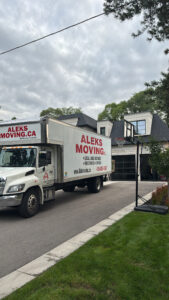
A shuttle service in moving is triggered when a full-size tractor-trailer or large moving truck physically cannot reach your front door. Most shuttle needs arise because full-size moving trucks cannot safely navigate residential constraints like narrow roads or steep driveways. The solution is a smaller truck or cargo van that acts as a relay vehicle, carrying your goods from the accessible parking point to your home and back again.
This situation is far more common than most people expect, particularly across Ontario’s older neighbourhoods and rural properties. The standard carry distance for movers is 75 feet. Charges apply beyond that distance, which means even a moderately long driveway can trigger an accessorial fee if the truck cannot get closer.
Common access challenges that require shuttle service include:
- Narrow residential streets where a 53-foot trailer cannot make the turn
- Low-clearance bridges or overpasses on the route to your property
- Steep or unpaved driveways that a heavy truck cannot safely climb
- Gated communities with restricted vehicle size policies
- Overhead obstacles such as low-hanging tree limbs or utility wires
- Restricted parking zones in dense urban areas like downtown Hamilton or midtown Toronto
Pro Tip: If your street feels tight when you drive a standard SUV, it is almost certainly too narrow for a 26-foot moving truck. Take note of this early and mention it to your mover during the quote process.
When do movers decide a shuttle is necessary?
Movers assess shuttle needs during the initial site survey or quote call, but the final decision often happens on moving day when the driver arrives and evaluates the approach. Major causes for shuttle need include tight turns, low-hanging tree limbs, or steep unpaved driveways that a large truck cannot navigate. This means a mover who quoted you without a shuttle may still add one on the day if conditions are worse than anticipated.
The driver’s judgement is the deciding factor. If parking the large truck would block traffic, damage property, or create a safety risk, a shuttle becomes mandatory. This is not a discretionary upsell. It is a practical response to a physical constraint, and reputable movers treat it as such.
How does shuttle service work step by step?
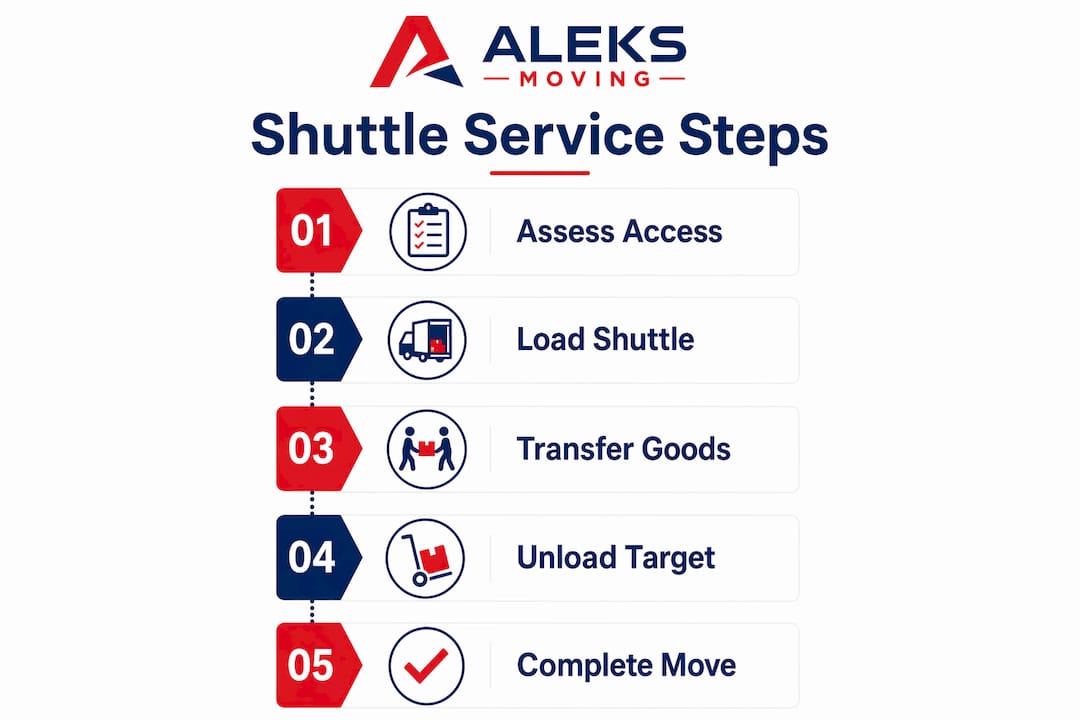
Understanding the shuttle process helps you set realistic expectations for your moving day timeline. Here is how a typical shuttle operation unfolds:
- The main truck parks at the nearest accessible location. This could be a nearby parking lot, a wider street, or a commercial loading zone. The driver secures the vehicle and prepares for transfer operations.
- A smaller shuttle vehicle is brought to your property. This is usually a cargo van, a 16-foot truck, or a box truck that can navigate the restricted access point.
- Movers load your belongings onto the shuttle vehicle. Items are packed carefully into the smaller vehicle, often in multiple loads depending on the volume of your move.
- The shuttle drives between your home and the main truck. Each trip covers the distance between your front door and where the large truck is parked. Multiple trips are standard for a full household move.
- Goods are transferred from the shuttle into the main truck. Movers unload the shuttle and reload everything into the tractor-trailer for the long-distance leg of the journey.
- The process reverses at the destination. If the delivery address also has access restrictions, the shuttle operates again at the other end.
Double-handling every item in shuttle moves increases labour, fatigue, and damage risk, making shuttle services a logistical challenge. This is why movers use extra padding, blanket wrapping, and careful stacking protocols during transfers. The added handling steps also extend your moving day by several hours, so plan accordingly.
What does shuttle service cost in moving?
Shuttle service pricing varies by company and region, but the structure follows a few consistent models. Reviewing full service moving costs alongside shuttle fees gives you the clearest picture of your total moving budget.
| Pricing model | How it works | Typical range |
|---|---|---|
| Per cubic foot | Charged based on the volume of goods shuttled | Approximately $0.75 per cubic foot |
| Flat fee | A fixed charge regardless of volume | $200 to $500 for small moves |
| Distance-based | Fee increases with the distance between truck and property | Varies widely by provider |
| Full shuttle package | Covers multiple trips and both origin and destination | $1,000 to $3,000 or more |
Shuttle fees are an accessorial charge separate from base quotes, which means they will not appear in your initial estimate unless you disclose the access situation upfront. This is the single most common source of surprise charges on moving day. Payment for shuttle service is typically due upon delivery, so you will not see the final number until your goods arrive.
Pro Tip: Ask your mover to include a shuttle service estimate in writing during the quote stage. If they cannot confirm access without a site visit, request a conditional clause in your contract that caps the shuttle fee at a stated maximum.
Knowing how to spot hidden moving fees in Ontario is one of the most practical steps you can take before signing any moving contract.
How to prepare and reduce shuttle service fees
The most effective way to reduce shuttle costs is to give your mover accurate access information before they arrive. Transparent communication with movers early in the process drastically reduces shuttle-related surprises and fees. Here is how to do that practically:
- Use Google Maps satellite view and Street View to assess your street width, driveway length, and any overhead obstacles. Self-assessing property access via online tools empowers you to engage proactively with movers about shuttle needs before the quote is finalised.
- Take photos of your driveway, street entrance, and any low clearances. Send these directly to your moving coordinator. A picture of a tight corner communicates more than a verbal description.
- Measure your driveway width and note the surface type. Gravel or soft ground may not support a heavy truck even if the width is adequate.
- Check for seasonal restrictions. Some Ontario municipalities post weight restrictions on residential roads during spring thaw, which can force shuttle use even on normally accessible streets.
- Ask your building manager or strata council about vehicle size restrictions if you live in a condo, townhouse complex, or gated community.
- Request a written shuttle estimate as part of your moving contract, not as a verbal assurance.
- Discuss alternatives with your mover. Sometimes parking the large truck one block away and using a smaller primary truck for the whole move is more cost-effective than a shuttle add-on.
Providing photos and detailed info about property access reduces shuttle surprises by enabling movers to prepare accurate quotes. This one step alone can save you hundreds of dollars and hours of moving day stress.
Shuttle service vs. alternative moving options
Not every access problem requires a shuttle. Understanding your options helps you choose the most cost-effective approach.
| Scenario | Shuttle service | Alternative option |
|---|---|---|
| Narrow residential street | Smaller shuttle vehicle relays goods | Book a smaller primary truck for the whole move |
| Long steep driveway | Shuttle carries loads in stages | Portable storage container placed at street level |
| Gated community with size limits | Shuttle operates within the gate | Coordinate with building management for a temporary exemption |
| Urban no-parking zone | Shuttle parks legally nearby | Schedule move during off-peak hours with a parking permit |
| Remote rural property | Shuttle bridges unpaved section | Use a two-truck move with a smaller local vehicle |
Shuttle service is generally seen by movers as a last resort due to increased labour, handling risk, and logistics. When a smaller primary truck can do the job without a relay, most professional movers will recommend that route instead. Portable storage options, like a container placed at the end of your driveway, can also eliminate the need for a shuttle entirely in some cases. You can explore storage unit alternatives to understand how staging your goods affects both cost and access logistics.
The key trade-off is time versus cost. A shuttle adds hours to your move and increases the risk of damage through extra handling. A smaller primary truck may cost more per hour but keeps your move simpler and faster.
Key takeaways
Shuttle service in moving is a necessary accessorial charge that arises from physical access constraints, not a discretionary fee, and early communication with your mover is the most reliable way to control its cost.
| Point | Details |
|---|---|
| Shuttle service definition | A smaller vehicle relays goods between your home and the main truck when access is restricted. |
| Cost range | Fees run from $200 to over $3,000 and are billed separately from your base moving quote. |
| Common triggers | Narrow streets, steep driveways, low clearances, and gated communities are the leading causes. |
| Best preparation step | Send photos and access details to your mover before the quote is finalised to avoid surprises. |
| Alternatives exist | A smaller primary truck or portable storage container can eliminate shuttle needs in many cases. |
Why shuttle fees catch people off guard more than they should
From my experience working with clients across Ontario, shuttle service is the fee that generates the most frustration, not because it is unreasonable, but because it almost always comes as a surprise. People focus on the base moving rate and forget to ask about accessorial charges. By the time the driver arrives and determines a shuttle is needed, the client is already committed to the move and has little negotiating room.
What I find telling is that shuttle services are mostly a logistical necessity rather than a profit centre for moving companies. Movers genuinely dislike them. The extra handling steps slow down the crew, increase fatigue, and raise the risk of damage to your belongings. No professional mover wants to run three shuttle trips when one clean load would do the job.
The clients who handle shuttle situations best are the ones who bring it up first. They send a photo of their driveway in January when the snow makes the slope obvious. They mention the low bridge on their rural road. They ask the right questions during the quote call. That kind of preparation does not just reduce fees. It builds a working relationship with your mover that makes the whole day go more smoothly. If you are moving in or out of a property with any access complexity, treat the shuttle conversation as a required part of your planning, not an afterthought.
— Ali
Plan your move with Aleksmoving’s transparent pricing
Aleksmoving has over 18 years of experience handling residential and commercial relocations across Ontario, including moves that require careful access assessment and shuttle coordination. We assess your property’s access conditions upfront, include any shuttle requirements in your written quote, and never surprise you with fees on moving day.
Whether you are moving a downtown condo, a rural home, or a commercial office, our team provides flat-rate pricing with no hidden charges. Reach out today to discuss your move, share your property details, and get a clear, written estimate that accounts for every aspect of your relocation. Visit our moving services page to learn more or request a free quote directly.
FAQ
What is a shuttle service in moving?
A shuttle service in moving is when a smaller vehicle transfers your belongings between your home and the main moving truck because the large truck cannot safely access your property. It is billed as an accessorial charge, separate from your base moving quote.
How much does shuttle service cost?
Shuttle service costs range from $200 to over $3,000 depending on the volume of goods and the distance between your property and the main truck. Some companies charge approximately $0.75 per cubic foot.
Is shuttle service necessary for every move?
No. Shuttle service is only required when a full-size moving truck cannot safely park near your property due to physical constraints like narrow streets, steep driveways, or parking restrictions.
How can I avoid unexpected shuttle fees?
Provide your mover with photos and detailed access information before your quote is finalised. Clear communication is key to transparency and avoiding unexpected fees on moving day.
Does shuttle service slow down my move?
Yes. Shuttle service adds time because every item is handled twice, once onto the shuttle and once onto the main truck. Plan for several additional hours on moving day if a shuttle is required.