

TL;DR:
- Workplace relocation is a strategic process that improves operational efficiency, talent retention, and long-term competitiveness.
- Productive moves involve cross-functional planning, employee engagement, and data-driven space optimization.
Workplace relocation is defined as the deliberate, planned movement of an organisation’s physical operations to a new location to better serve its people, processes, and growth goals. Why workplace relocation matters goes well beyond swapping one office address for another. A well-executed move directly shapes operational efficiency, talent retention, and long-term competitiveness. Industry data shows that only about 25% of workers strongly agree their current office enables their best work. That gap between what employees need and what most offices deliver is exactly the problem a thoughtful relocation can solve.
Why workplace relocation matters for organisational efficiency
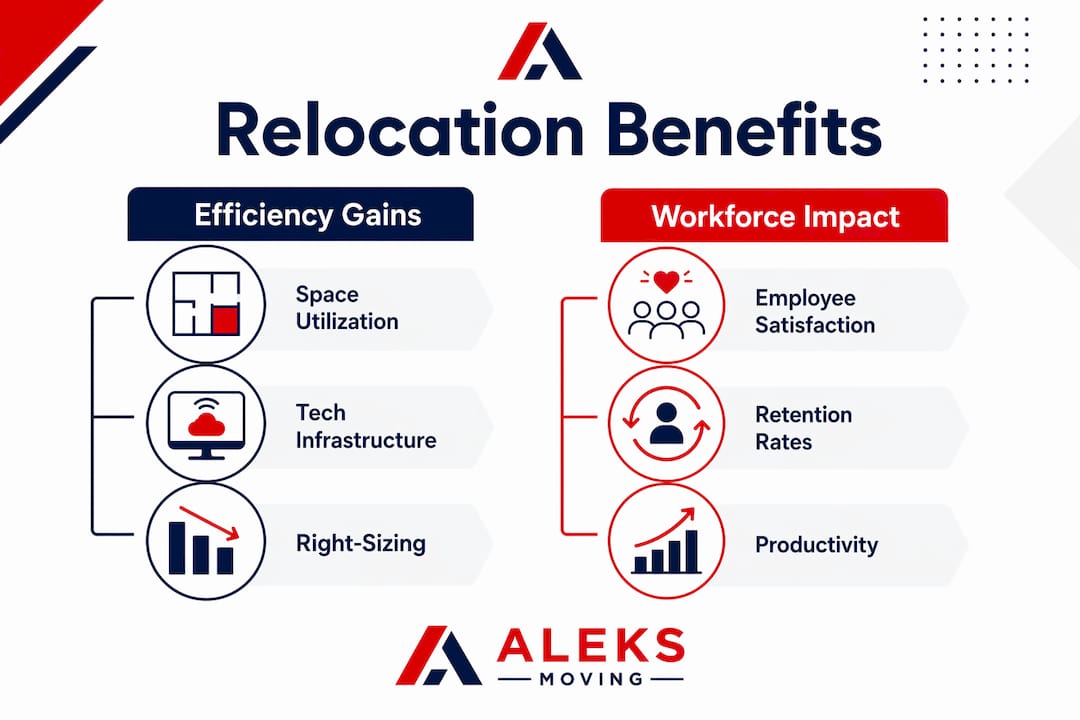
Relocation gives business leaders a rare opportunity to right-size their physical footprint based on real usage data rather than historical habit. Most organisations carry far more space than they actually use. Average office utilisation rates hover around 54%, meaning roughly half of leased space sits empty on any given day. Paying for unused square footage is a direct drain on operating budgets.
Right-sizing with desk-to-employee ratios
Industry standards recommend desk-to-employee ratios between 0.6:1 and 0.8:1 for hybrid workplaces. That ratio reflects the reality that not all employees are in the office simultaneously. A company with 100 staff members needs 60–80 desks, not 100. Applying this standard during a relocation cuts lease costs while preserving a comfortable, functional workspace.
Infrastructure and technology readiness
A new location also creates the chance to build technology infrastructure from the ground up rather than patching legacy systems. Outdated cabling, insufficient power capacity, and poor internet connectivity are common in older offices. Relocation lets IT teams specify exactly what the new space needs before anyone moves in. This is also the moment to adopt booking and occupancy systems that generate the utilisation data needed for continuous space improvement.
Pro Tip: Commission a workplace utilisation audit at least three months before signing a new lease. The data will confirm whether you need more space, less space, or simply a different layout.
| Efficiency factor | What relocation enables |
|---|---|
| Space utilisation | Right-size to 0.6:1–0.8:1 desk-to-employee ratio based on hybrid attendance |
| IT infrastructure | Build fibre, power, and network capacity to spec rather than retrofitting |
| Occupancy data | Install booking systems from day one to track real usage patterns |
| Lease cost | Eliminate spend on underused square footage identified through utilisation audits |
How does relocation affect employee satisfaction and retention?
The quality of a physical workplace has a measurable effect on whether employees stay or leave. Employees in high-quality workplaces are nearly three times more likely to remain with their organisation. That retention multiplier makes the office environment one of the most cost-effective talent tools available to a business leader.
The risk of getting relocation wrong is equally significant. Poorly executed corporate relocations can lose 30–40% of existing staff. Well-managed moves, by contrast, protect 80–85% of the workforce through deliberate planning and employee support. The difference between those two outcomes is almost entirely a function of how well the organisation communicates and involves its people.
Involving employees early in layout decisions reduces disengagement and accelerates adjustment to the new environment. Organisations that treat relocation as something done to employees, rather than with them, consistently see higher turnover and longer recovery times.
The human factors that determine relocation success include:
- Early communication: Announce the move well in advance and explain the reasoning clearly. Uncertainty breeds anxiety and rumour.
- Employee input: Invite teams to participate in layout decisions, amenity choices, and commute impact assessments.
- Individual support: Provide practical assistance for employees whose commutes change significantly, including transit information and flexible start times.
- Change management: Assign a relocation champion in each department to answer questions and relay feedback to leadership.
Pro Tip: Run a short pulse survey two weeks before the move and again four weeks after. The before-and-after comparison gives you concrete data on whether the transition is landing well.
Most organisations experience a 1–4 week productivity dip after moving. That dip is normal and manageable. What makes it worse is when employees feel blindsided or unsupported. Early involvement and clear communication compress the adjustment period significantly.
What are the most common workplace relocation challenges?
The most frequent reason office relocations go wrong is treating the move as a facilities project rather than a cross-functional business initiative. Successful moves require alignment across IT, HR, finance, and operations from the very beginning. When those teams work in silos, critical dependencies get missed and timelines collapse.
The following pitfalls appear most often in corporate relocation projects:
- Underestimating IT provisioning timelines. Internet circuits take 30–120+ days to provision depending on whether the building is already on-net or requires new infrastructure. Missing this deadline means employees arrive at a new office with no connectivity. Start the ISP conversation the moment a new location is shortlisted.
- Ignoring lease overlap costs. Running two leases simultaneously is expensive. Build the overlap period into the budget from the start rather than treating it as a surprise line item.
- Failing to communicate the “why.” Employees who understand the business rationale for a move are far more likely to support it. A one-page summary of why the organisation is relocating, shared early and often, prevents the rumour mill from filling the information gap.
- Skipping individual relocation support. Employees whose commutes lengthen significantly are the most likely to resign. Structured support, including transit subsidies, flexible hours, or temporary remote arrangements, reduces that risk materially.
- Losing institutional knowledge. Poorly managed moves can require 18 months to rebuild the relationships and operational workarounds that experienced employees carry in their heads. Protecting that knowledge starts with protecting the people who hold it.
Pro Tip: Build a relocation project plan in a shared tool that all department leads can access and update. Visibility across teams catches conflicts before they become crises.
For a detailed breakdown of how to navigate these risks, the office relocation planning guide from Aleksmoving covers the full planning sequence for business owners.
Strategic approaches to workplace relocation for lasting results
The most effective office relocation strategy aligns the physical move with the organisation’s long-term direction, not just its current lease expiry. Leaders who treat relocation as a pure cost exercise consistently underdeliver on its potential. The better framing is “return on place”: what does this location do for our brand, our people, and our ability to grow?
Phased moves and staggered transitions
Staggered employee moves across 60–90 days outperform single cutover days on every operational measure. Moving departments in waves keeps at least part of the organisation fully functional at all times. It also reduces the pressure on IT support, facilities teams, and HR to handle every problem simultaneously. For businesses with more than 50 employees, a phased rollout is the standard best practice, not an optional upgrade.
Refurbishment versus relocation
Not every workplace problem requires a full move. The decision between refurbishing the current space and relocating to a new one depends on three factors: whether the current building can meet modern infrastructure requirements, whether the lease terms allow meaningful modification, and whether the location still serves the workforce’s commute patterns. When all three factors point to limitations, relocation delivers more value than renovation.
| Decision factor | Favour refurbishment | Favour relocation |
|---|---|---|
| Infrastructure | Building supports modern IT and power needs | Legacy systems cannot be cost-effectively upgraded |
| Lease flexibility | Landlord permits significant modifications | Lease restricts structural changes |
| Location fit | Commute patterns remain suitable for staff | Workforce distribution has shifted significantly |
| Growth trajectory | Current footprint accommodates 3-year headcount plan | Organisation has outgrown or significantly downsized |
Measuring ROI after the move
Post-move measurement is where most organisations fall short. Set baseline metrics before the move: utilisation rates, employee satisfaction scores, and absenteeism data. Measure the same metrics at 30, 90, and 180 days post-move. The comparison reveals whether the relocation delivered its intended benefits and where further adjustments are needed. Organisations that use data from booking and occupancy systems for continuous improvement consistently get more value from their new space over time.
For businesses looking at how office moves connect to growth and branding, the connection between physical presence and organisational identity is increasingly well-documented.
Key takeaways
Workplace relocation delivers the greatest return when it is planned as a cross-functional business initiative, not a logistics exercise, with employee engagement and data-driven space planning at its core.
| Point | Details |
|---|---|
| Utilisation drives right-sizing | Average office use sits at 54%; apply 0.6:1–0.8:1 desk ratios to cut wasted lease spend. |
| Retention depends on execution | Well-managed moves retain 80–85% of staff; poorly managed ones lose 30–40%. |
| IT provisioning is the hidden risk | Internet circuits take 30–120+ days; start the process the moment a site is shortlisted. |
| Phased moves reduce disruption | Staggered transitions across 60–90 days keep operations functional and support teams manageable. |
| Measure before and after | Set utilisation and satisfaction baselines pre-move and track them at 30, 90, and 180 days post-move. |
What I have learned from watching relocations succeed and fail
Relocation projects that go well share one trait: the leadership team treated the move as a cultural moment, not just a logistical one. The organisations I have seen struggle are almost always the ones that handed the project entirely to facilities management and assumed the rest of the business would follow along. That assumption is expensive.
The counterintuitive insight is this: the physical move is actually the easy part. Trucks, boxes, and floor plans are manageable. What is genuinely hard is maintaining trust with employees who are anxious about change, protecting the institutional knowledge that lives in long-tenured staff, and keeping productivity from cratering during the adjustment period. Those outcomes are determined by decisions made months before moving day, not on the day itself.
My honest advice to any business leader planning a relocation is to front-load the investment in communication and individual support. The cost of a structured employee assistance programme during a move is a fraction of the cost of replacing even two or three experienced people who resign because they felt ignored. Relocation is one of the few moments when an organisation can genuinely reset its workplace culture. The leaders who recognise that opportunity and act on it come out ahead every time.
— Ali
Aleksmoving: your partner for commercial relocation in Ontario
Planning a workplace move in Ontario is a significant undertaking, and having an experienced partner on the logistics side frees your leadership team to focus on the people and strategy side.
Aleksmoving has over 18 years of experience managing commercial relocations across Ontario, with flat-rate pricing and no hidden fees so your budget stays predictable from quote to completion. Whether you are moving a small office or coordinating a multi-department transition, the team handles packing, transport, and placement with care. Aleksmoving also supports employee relocation in Ontario for businesses that need to move individual team members as part of a broader workplace change. Request a free quote and get a clear plan before your move begins.
FAQ
What is workplace relocation?
Workplace relocation is the planned move of an organisation’s physical operations to a new location to better align space, infrastructure, and location with business and workforce needs.
Why does office relocation matter for employee retention?
Employees in high-quality workplaces are nearly three times more likely to stay with their organisation. Poorly managed moves can cost 30–40% of existing staff, while well-planned ones retain 80–85%.
How long does IT provisioning take during an office move?
Internet circuit provisioning takes 30–120+ days depending on whether the building already has fibre infrastructure. Starting this process early is the single most common way to avoid move-day delays.
What is the biggest risk in a corporate relocation?
The biggest risk is treating relocation as a facilities project rather than a cross-functional initiative. Missing alignment between IT, HR, finance, and operations causes the most costly delays and staff disruption.
How do you measure the success of a workplace move?
Set baseline metrics for utilisation rates, employee satisfaction, and absenteeism before the move. Measure the same data points at 30, 90, and 180 days post-move to confirm whether the relocation delivered its intended benefits.