Skip to content


TL;DR:
- Emergency moving requires completing a relocation within 24 to 72 hours due to urgent circumstances. Professionals prioritize high-value items, assess the home quickly, and offer rapid scheduling, packing, and transportation services. Accurate communication and clear deadlines are crucial for a successful emergency move.
Emergency moving is defined as a relocation that must be completed within 24 to 72 hours due to urgent, external circumstances beyond your control. Standard residential moves require 2 to 4 weeks of planning. Emergency moves compress that entire window into a matter of days or even hours. Triggers include evictions, sudden job transfers, domestic safety concerns, and property damage from fire or flooding. Knowing what qualifies as an emergency move, and how professionals handle one, is the first step toward getting through it calmly.
What is emergency moving and how does it differ from a standard move?
Emergency moving is the industry term for an urgent relocation, sometimes called a crisis move, that bypasses the normal planning cycle entirely. Where a planned move gives you weeks to sort, pack, and schedule, an emergency move demands decisions in hours. The core difference is not just speed. It is the complete reordering of priorities, from perfection to function.
The most common triggers for emergency moves in Canada include:
- Eviction or lease termination with little notice
- Sudden job relocation requiring you to start in a new city within days
- Medical emergencies that require a family member to move closer to care
- Property damage from fire, flood, or mould making a home uninhabitable
- Domestic safety situations requiring immediate departure
Each of these scenarios shares one feature: you cannot wait. The goal shifts from a well-organised move to a safe, functional one. Emergency movers focus on mitigation, protecting high-value and essential items rather than moving every possession. That distinction matters enormously when you are standing in your living room with 18 hours to leave.
How do professional emergency moving services operate?

Professional emergency moving services offer 24/7 phone support, but physical crew arrival depends on fleet capacity and distance. That distinction is critical. You can call at 2 a.m. and speak to someone immediately. Whether a truck arrives that same morning depends on scheduling and geography. Same-day service is possible in many urban Ontario markets. Next-day arrival is more realistic in smaller cities or rural areas.
Once a crew is confirmed, the operational approach differs sharply from a planned move. Speed and prioritisation replace completeness. Crews are trained to assess a home quickly, identify high-value and essential items, and load efficiently under time pressure. Services typically include:
- Packing assistance for essential and fragile items
- Furniture disassembly for large pieces that cannot move whole
- Transport of priority loads, with secondary loads following if time allows
- Short-term storage when the destination is not yet ready
Pro Tip: Tell your moving company the hard deadline first, before anything else. Movers can build a realistic plan around a fixed end time. They cannot fix a plan built on vague timelines.
Accurate inventory and honest communication are the two things that most directly affect whether your emergency move succeeds. Movers who know the true scope of your belongings and your actual deadline can schedule resources correctly. Clients who understate their inventory or overstate their flexibility create problems that no amount of professionalism can fully correct.
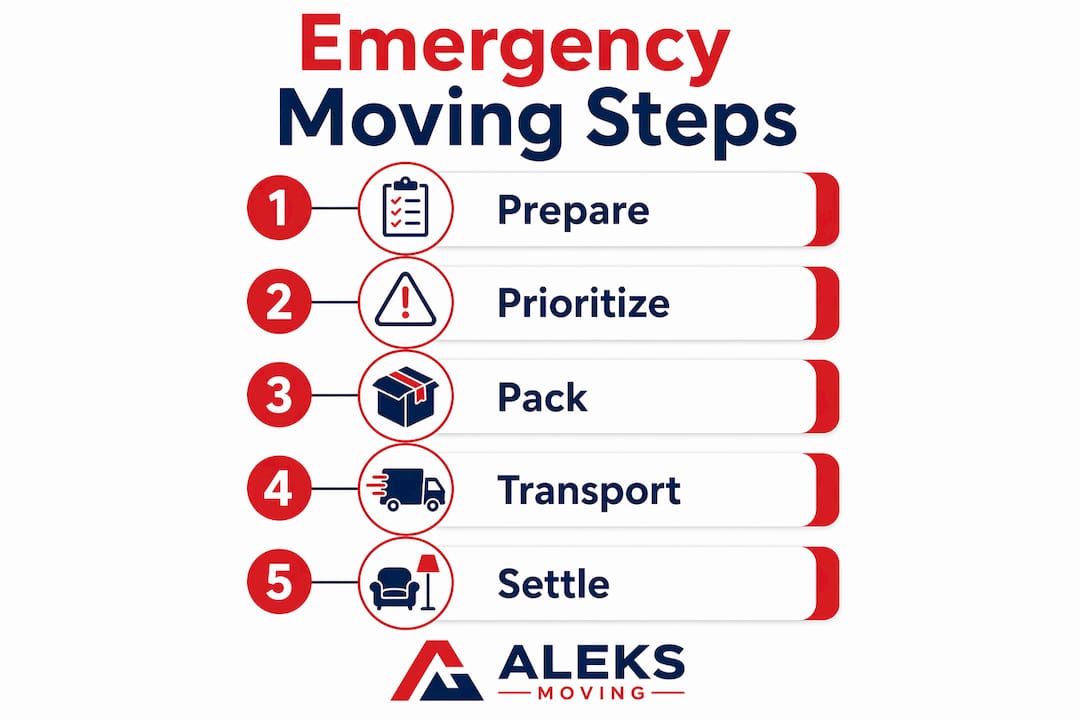
How to plan an emergency move step by step
Planning an emergency move means replacing a detailed multi-day checklist with a fast, hour-by-hour triage system. The triage packing method prioritises essential items within the first 2 hours, with remaining necessities packed in the following 8 hours. This approach ensures you can function immediately upon arrival, even if secondary items follow later.
-
Secure your destination first. Before packing a single box, confirm where you are going. Temporary housing, a short-term rental, or a family member’s home all work. You need an address before movers can schedule a delivery.
-
Pack a go-bag and keep it with you. Your go-bag should contain government-issued ID, passports, financial documents, medications, phone chargers, and a change of clothes. This bag stays with you, not in the moving truck.
-
Triage your belongings by priority, not by room. Pack critical items first: medications, important documents, children’s essentials, and valuables. Pack functional items second: bedding, a few days of clothing, kitchen basics. Everything else is secondary and can follow in a second load or storage.
-
Contact a professional mover immediately. The sooner you call, the more scheduling options exist. Aleksmoving offers last-minute moving services across Ontario with rapid response and flat-rate pricing.
-
Handle administrative tasks in parallel. While packing, set a mail forwarding request with Canada Post, notify your bank and employer of your new address, and arrange utility transfers. These tasks take minutes online and prevent weeks of problems later.
-
Communicate your timeline clearly to everyone helping. Whether it is professional movers, friends, or family, everyone needs to know the hard deadline. Confusion about timing is the most common cause of last-minute delays.
Pro Tip: Use large, clear labels on every box: “Open First,” “Storage,” or “Secondary Load.” This saves significant time when movers are unloading at the destination and you are too tired to direct traffic.
Common misconceptions about emergency moving services
The biggest misconception about emergency moving is that “24/7 service” means a truck arrives within the hour. 24/7 availability refers to call support, not instant physical deployment. Actual move start times depend on fleet availability and crew scheduling. Setting this expectation correctly prevents frustration and helps you plan realistically.
Several other myths regularly cause problems:
- “I need to pack everything before movers arrive.” Professional emergency crews are trained to pack quickly. Attempting to pack everything yourself often causes delays and poor organisation.
- “Emergency moves cost double a standard move.” Costs are higher due to short notice and expedited scheduling, but reputable companies offer transparent flat-rate pricing. Ask for a clear quote upfront.
- “I can sort and decide what to keep while packing.” Sorting during an emergency move creates analysis paralysis. Pack essentials now. Decide what to keep later, from a calmer position.
- “Movers will handle everything perfectly under pressure.” Emergency moves are about mitigation, not perfection. Some items may need to follow in a second trip or go into short-term storage.
“Emergency moving is not about perfection. It is about mitigating loss and relocating high-priority items quickly and safely.” This framing, drawn from professional moving practice, is the most useful mindset shift you can make before the process begins.
Honest disclosure to your mover is non-negotiable. Clients who provide accurate move details allow movers to tailor their service realistically. Overpacking, understating inventory, or hiding a hard deadline creates risk for both you and the crew.
Emergency moving options for different situations
Emergency moving services adapt to a wide range of client types and circumstances. The scope of service changes based on urgency, inventory size, and destination readiness. Same-day, next-day, and short-notice moves are available for both residential clients and small commercial operations, with options including furniture disassembly, room placement, and short-term storage.
Residential emergency moves
Residential emergency moves cover individuals, couples, and families leaving a home under urgent conditions. Common scenarios include eviction, domestic safety situations, and property damage. The priority is always people first, then essential belongings, then furniture and secondary items. Families with children benefit most from professional packing assistance, since managing children and packing simultaneously is genuinely difficult.
Small business and commercial emergency moves
Small businesses facing lease termination, office damage, or sudden relocation needs require a different approach. Equipment, client files, and technology assets take priority over furniture. Commercial emergency moves often involve tighter access windows, building regulations, and the need for short-term storage while a new space is prepared. A professional mover with commercial experience handles these constraints far more efficiently than a residential-only crew.
Short-term storage as part of emergency relocation
When your destination is not ready, short-term storage bridges the gap. Many emergency moving services include access to storage options for relocations so your belongings are secure while you finalise housing. This is particularly useful after property damage, where repairs may take days or weeks.
| Scenario | Priority items | Typical timeline | Storage needed? |
|---|---|---|---|
| Eviction | Documents, clothing, valuables | 24–48 hours | Often yes |
| Job relocation | Work equipment, essentials | 48–72 hours | Sometimes |
| Property damage | Undamaged valuables, documents | 24–48 hours | Usually yes |
| Medical emergency | Medications, personal care items | 48–72 hours | Depends |
| Domestic safety | Personal documents, clothing | Under 24 hours | Often yes |
Key takeaways
Emergency moving is defined by a compressed timeline of 24 to 72 hours, a triage-based packing approach, and the goal of safe relocation over perfect organisation.
| Point | Details |
|---|---|
| Definition and timeline | Emergency moves must be completed within 24 to 72 hours due to urgent external circumstances. |
| Triage packing method | Pack critical items in the first 2 hours, then functional essentials in the next 8 hours. |
| Go-bag rule | Keep documents, medications, and ID with you at all times, never in the moving truck. |
| 24/7 service reality | Around-the-clock call support does not guarantee immediate truck arrival; fleet availability determines timing. |
| Honest communication | Accurate inventory and clear deadlines are the most important things you can give your mover. |
What I have learned from watching emergency moves up close
After years of working alongside professional moving crews in Ontario, the pattern I see most often is not logistical failure. It is the freeze. People stand in the middle of their home, overwhelmed by the volume of decisions, and stop moving entirely. The greatest risk in an emergency move is not the timeline. It is the mental shutdown that happens when the timeline feels impossible.
The clients who get through emergency moves well share one trait: they make fast, imperfect decisions and keep moving. They do not agonise over whether to take the second bookshelf. They leave it. They do not try to pack every room perfectly. They grab what matters and trust the process. That mindset is a skill, and you can practise it right now by asking yourself: “If I had two hours, what would I take?” The answer to that question is your emergency moving plan.
Professional movers reduce stress by absorbing the logistical load. When you hand off the packing and transport to a trained crew, you free up mental capacity for the decisions only you can make: where you are going, who needs to know, and what your next 48 hours look like. That division of labour is the real value of hiring professionals for an urgent relocation. It is not just about lifting boxes. It is about giving you space to think clearly when clarity matters most.
— Ali
Aleksmoving is ready when you need to move fast
When an urgent situation forces you to relocate on short notice, having a dependable moving partner makes all the difference. Aleksmoving has over 18 years of experience handling residential and commercial moves across Ontario, including same-day and next-day urgent relocations with flat-rate pricing and no hidden fees.

Whether you are facing an eviction, a sudden job transfer, or property damage, Aleksmoving’s team is available to book around the clock and deploy quickly. Our residential moving services cover packing, transport, furniture disassembly, and short-term storage, everything you need to move safely and efficiently under pressure. Contact Aleksmoving today for a fast, free quote and let our experienced crew take the weight off your shoulders.
FAQ
What counts as an emergency move?
An emergency move is any relocation that must be completed within 24 to 72 hours due to urgent circumstances such as eviction, property damage, or sudden job relocation. It differs from a standard move, which typically requires 2 to 4 weeks of planning.
How quickly can emergency movers arrive?
Most professional emergency moving services offer 24/7 phone booking, but physical crew arrival depends on fleet availability and distance. Same-day service is common in urban areas; next-day arrival is more typical in smaller markets.
What should I pack first in an emergency move?
Pack critical items within the first 2 hours: government ID, passports, medications, financial documents, and children’s essentials. Keep these in a go-bag that stays with you, not in the moving truck.
Is emergency moving more expensive than a standard move?
Emergency moves typically cost more than planned moves due to short-notice scheduling and expedited service. Reputable movers offer flat-rate pricing upfront so you know the full cost before the crew arrives.
Can emergency movers help with packing?
Yes. Professional emergency moving crews are trained to pack quickly and efficiently under time pressure. Hiring movers to assist with last-minute packing is often faster and safer than attempting to pack everything yourself.