

TL;DR:
- Tenant relocation assistance provides financial support to tenants forced to move due to no-fault events like demolition or government orders. Eligibility depends on local laws, documentation, and timely claim filing, with options including moving costs, rent differences, and temporary housing. Knowing your rights and preparing proper records helps ensure you receive the benefits you are entitled to.
Tenant relocation assistance is defined as financial aid or support services provided to tenants who must move due to circumstances beyond their control. This includes no-fault evictions, building demolition, major repairs, or government-ordered vacate notices. Frameworks like the Uniform Relocation Act set federal baselines, while provincial and municipal ordinances layer additional protections on top. Understanding what is tenant relocation assistance matters because it determines whether you receive money for moving costs, temporary housing, or rental differences when a landlord or government forces you to leave your home.
What is tenant relocation assistance and what triggers it?
Tenant relocation assistance is financial compensation or moving support given to tenants displaced through no fault of their own. The standard industry term for this is “displacement assistance,” though “tenant relocation assistance” is the phrase most renters and housing advocates use in practice. Both terms refer to the same protections.
Relocation assistance is triggered.pdf) by no-fault events such as substantial repairs, government vacate orders, or demolition. That means the cause of your move must originate with the landlord or a government body, not with your own actions. A lease violation or non-payment of rent does not qualify.
Common triggers include:
- No-fault evictions where the landlord reclaims the unit for personal use or sale
- Building demolition or redevelopment approved by municipal authorities
- Substantial renovations that require the unit to be vacant for an extended period
- Health and safety code orders issued by a government inspector declaring the unit uninhabitable
The party responsible for paying assistance depends on the trigger. When a federally funded project displaces you, the government agency overseeing the project carries the obligation. When a private landlord initiates a no-fault eviction, local ordinances determine whether that landlord must pay. No single law requires all private landlords to pay relocation assistance. Requirements depend on specific local or federal conditions, which is why your city or municipality is the first place to check.
Many jurisdictions require landlords to provide relocation assistance payments within 15 calendar days after serving eviction notices. Missing that window can give tenants grounds to dispute the eviction process entirely.
Pro Tip: Keep a written record of every notice you receive from your landlord, including the date it was delivered. That date starts the clock on your landlord’s payment obligation.
What types of moving assistance for tenants are available?
Relocation assistance comes in three main forms: moving cost reimbursement, rental differential payments, and temporary housing support. Each type addresses a different financial pressure that displacement creates.

Moving cost reimbursement covers the direct expense of physically transporting your belongings to a new home. This includes hiring professional movers, renting a vehicle, and purchasing packing materials. Some programmes reimburse actual costs; others pay a fixed schedule amount based on the number of rooms in your unit.
Rental differential payments cover the gap between what you paid at your old address and what comparable replacement housing costs in your area. The Uniform Relocation Act entitles eligible tenants displaced by federally funded projects to rental differential payments covering up to 42 months. That is a significant protection. It means a tenant paying $1,200 per month who can only find comparable housing at $1,700 per month could receive up to $500 per month for 42 months.
Temporary housing support applies when a tenant must vacate immediately due to a health and safety order but has not yet secured a permanent replacement. This covers short-term hotel or rental costs while the search continues.
The table below summarises the three main assistance types and how amounts are typically calculated.
| Assistance type | What it covers | How the amount is calculated |
|---|---|---|
| Moving cost reimbursement | Transport, packing, and labour costs | Actual receipts or a fixed schedule by unit size |
| Rental differential payment | Gap between old rent and new comparable rent | Difference in monthly rent multiplied by covered months (up to 42 under federal rules) |
| Temporary housing support | Short-term hotel or rental costs | Actual costs up to a local maximum, usually capped by ordinance |
Calculation methods vary by jurisdiction. Some cities base payments on length of tenancy, awarding longer-term tenants higher amounts. Others tie payments to income levels, providing larger amounts to low-income households. Local ordinances in cities with strong tenant protections often set minimum payment floors that exceed federal baselines.
One detail many tenants miss: landlords in some areas may credit the last month’s rent toward relocation assistance payments when clearly documented in the eviction notice. If your landlord does this, confirm it is disclosed in writing before you accept it as full payment.
Pro Tip: Request a written breakdown of how your relocation payment was calculated. If the figure seems low, compare it against your local ordinance’s minimum payment schedule before signing any release.
Who is eligible and how to apply for relocation assistance?
Eligibility for tenant relocation assistance rests on three core conditions. You must be a tenant displaced through no fault of your own, you must hold a valid lease or documented rental agreement, and you must provide proof of residence at the affected address.
Tenants should maintain comprehensive documentation such as leases, utility bills, and proof of residence to support their claims. Housing advocates call this a “displacement file.” Build yours the moment you receive any notice from your landlord.
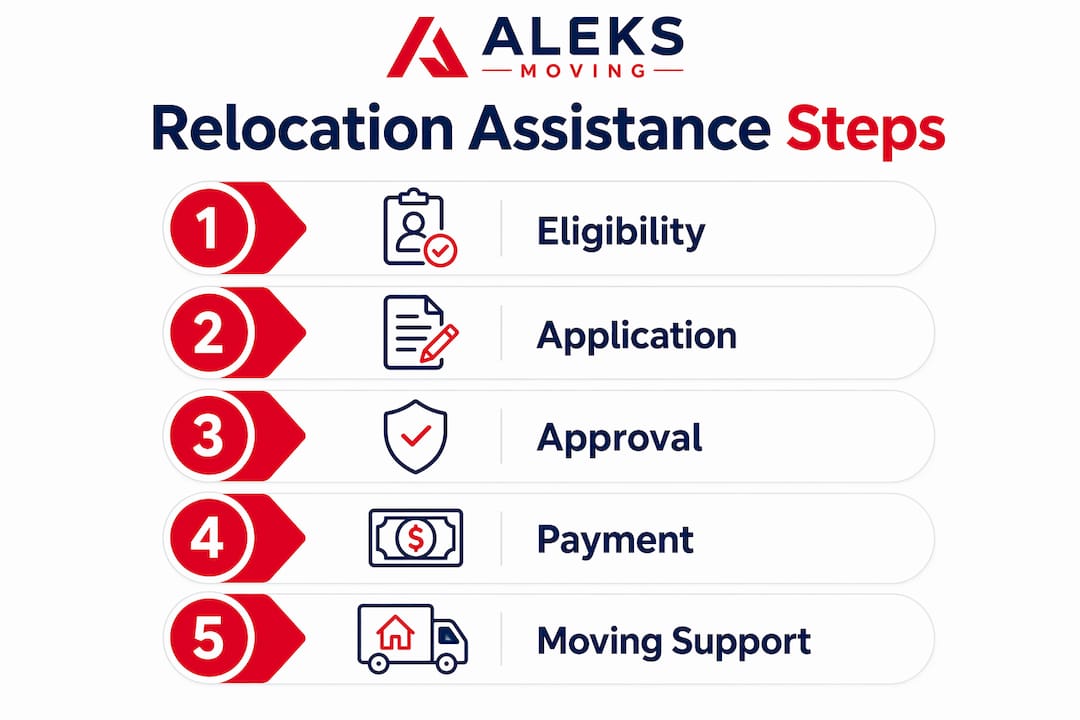
The application process follows these steps:
- Confirm the trigger qualifies. Review your eviction notice against your local ordinance to verify the reason for displacement is a covered no-fault event.
- Contact the responsible party. For federally funded projects, contact the displacing agency directly. For private landlord evictions, contact your city’s housing or tenant services office to confirm local requirements.
- Gather your documentation. Collect your signed lease, the last three months of utility bills, government-issued photo ID, and the eviction notice with its delivery date.
- Submit your claim promptly. There is no federally mandated timeframe to process relocation claims, so missing documents often cause delays. File a complete claim as early as possible.
- Follow up in writing. Confirm every conversation with an email or letter summarising what was discussed and agreed upon.
The most common pitfall is an incomplete claim. A missing utility bill or an unsigned lease copy can stall processing for weeks. Disputed claims are also more common than tenants expect. If your landlord contests your eligibility or the amount owed, you have rights. Tenants can review their case files and hire representatives to assist with contested relocation claims. Many tenants do not realise this option exists until it is too late to use it effectively.
For guidance on the types of rental property relocations that commonly trigger assistance, reviewing a full breakdown of displacement scenarios can help you confirm whether your situation qualifies.
How do tenant relocation programs vary across jurisdictions?
There is no universal federal law mandating landlord-paid relocation assistance. Laws vary greatly by jurisdiction in a patchwork system. The Uniform Relocation Act provides a federal baseline, but it applies only when a federally funded project causes the displacement. Private landlord evictions fall entirely under provincial, state, or municipal rules.
This patchwork creates real differences in what tenants receive depending on where they live. Some cities require landlords to pay the equivalent of two to three months’ rent as a flat relocation payment. Others require rental differential payments calculated over many months. A few jurisdictions have no mandatory landlord relocation assistance at all for private evictions.
Relocation assistance is designed to complement Just Cause Eviction protections, which typically do not provide financial compensation for displacement. Just Cause laws limit the reasons a landlord can evict you. Relocation assistance laws go further by requiring financial support when those permitted evictions occur. The two protections work together but address different problems.
The table below compares key features across three regulatory levels.
| Regulatory level | Who it covers | Key features |
|---|---|---|
| Federal (Uniform Relocation Act) | Tenants displaced by federally funded projects | Up to 42 months of rental differential payments; moving cost reimbursement |
| Provincial or state ordinances | Varies; often covers no-fault evictions by private landlords | Minimum payment floors; notice requirements; eligibility criteria |
| Municipal ordinances | Tenants in cities with strong tenant protections | Higher payment minimums; broader trigger events; shorter landlord payment windows |
In Canada, provincial residential tenancy legislation governs most private landlord evictions. Ontario’s Residential Tenancies Act, for example, sets out specific compensation rules for no-fault evictions such as demolition or major repairs. Tenants in Ontario are entitled to one month’s compensation or the right to move back after renovations, depending on the situation. Municipal programmes in cities like Toronto layer additional support on top of provincial rules.
Understanding how logistics providers coordinate with municipalities during large-scale displacement events illustrates why local knowledge matters when planning your move. The rules, timelines, and payment structures differ enough that what applies in one city may not apply in the next.
Key takeaways
Tenant relocation assistance is the most direct financial protection available to displaced renters, and its value depends entirely on knowing your local rules, filing complete documentation, and acting before deadlines pass.
| Point | Details |
|---|---|
| Definition is clear | Relocation assistance covers moving costs, rental differences, and temporary housing for no-fault displaced tenants. |
| Triggers matter | Only no-fault events like demolition, major repairs, or government orders qualify; lease violations do not. |
| Documentation is critical | A complete displacement file with lease, utility bills, and ID prevents claim delays and disputes. |
| Laws vary by location | Federal, provincial, and municipal rules each apply differently; always check your local ordinance first. |
| Dispute rights exist | Tenants can review their claim files and hire representatives during contested relocation assistance appeals. |
What I’ve learned about relocation assistance that most guides skip
Most articles on tenant relocation assistance focus on the rules. Few talk about the gap between knowing your rights and actually receiving what you are owed.
The biggest challenge I see is timing. Tenants often wait to gather documentation until after they have already moved. By then, utility accounts are closed, forwarding addresses are set up, and proving residence at the original address becomes harder. The displacement file needs to be built the day the notice arrives, not the day the claim is filed.
The second issue is the assumption that landlords will volunteer information. Most will not. A landlord who owes relocation assistance rarely leads with that fact. You need to ask directly, in writing, citing the specific ordinance that applies. That one step changes the entire dynamic of the conversation.
Emotional pressure also plays a role that financial guides ignore. Facing an involuntary move is stressful. That stress leads tenants to accept the first offer they receive just to end the uncertainty. Taking a few days to verify the calculation against your local ordinance is worth it. The difference between an underpaid and a correctly paid claim can be several months of rent.
Getting professional moving support through a trusted provider like Aleksmoving reduces one major source of that stress. Knowing the physical move is handled by experienced hands frees you to focus on the paperwork and the claim. The role of movers in rental transitions is more than logistics. It is one less thing to manage during an already difficult period.
— Ali
Aleksmoving is here when you need to move
Facing a forced move is hard enough without worrying about who will handle your belongings. Aleksmoving has supported residential tenants across Ontario for over 18 years, providing flat-rate pricing with no hidden fees and a team that treats your home with care.

Whether your move is triggered by a landlord’s renovation notice, a building demolition, or a government order, Aleksmoving offers packing, moving, and storage options for relocations to cover every stage of your transition. Our trusted moving services are designed to fit the specific timelines and pressures that tenant relocation creates. Contact Aleksmoving today for a free upfront quote and let our team take the physical burden off your plate.
FAQ
What is tenant relocation assistance in simple terms?
Tenant relocation assistance is financial support given to renters who must move due to no-fault reasons such as demolition, major repairs, or government orders. It typically covers moving costs, rental differences, and sometimes temporary housing.
Does every landlord have to pay relocation assistance?
No. There is no universal law requiring all private landlords to pay relocation assistance. Your entitlement depends on your city’s ordinance, provincial legislation, or whether a federally funded project caused your displacement.
How much relocation assistance can a tenant receive?
The amount varies by jurisdiction. Under the Uniform Relocation Act, eligible tenants can receive rental differential payments for up to 42 months. Local ordinances may set flat payment minimums ranging from one to three months’ rent.
What documents do I need to apply for relocation assistance?
You need your signed lease, recent utility bills, government-issued photo ID, and the eviction notice with its delivery date. Filing a complete claim from the start prevents processing delays.
Can a tenant dispute a relocation assistance decision?
Yes. Tenants have the right to inspect their claim files and may hire a private representative to assist during disputes or appeals, a right many tenants overlook until it is too late.