
TL;DR:
- Coordinating bulk move-outs requires at least eight weeks of planning, with a 30% fleet buffer to handle delays and volume spikes. Effective strategies include digital inventory tracking, cluster scheduling, stakeholder alerts, and real-time GPS monitoring to improve efficiency and reduce errors. Proper communication, inspections, and contingency plans are essential for a smooth large-scale relocation process.
Coordinating bulk move-outs is defined as the structured process of managing multiple simultaneous relocations across shared timelines, resources, and stakeholder groups. Property managers, corporate relocation teams, and housing coordinators all face the same core challenge: too many moving parts, not enough margin for error. The good news is that a clear bulk relocation strategy, built on proven scheduling methods and the right tools, turns what feels like chaos into a repeatable process. This guide covers preparation, scheduling, communication, and risk management so you can run large-scale move-outs with confidence.
How to coordinate bulk move-outs: preparation and tools
Effective bulk move-out coordination starts at least eight weeks before the first truck arrives. Optimal large-scale move planning requires an 8-week timeline to avoid rush fees and scheduling conflicts, with packing of non-essential items beginning six weeks out. That window gives you time to build a proper bulk move-out checklist, assign responsibilities, and confirm every vendor.
Digital inventories and QR-coded labelling
The single biggest time-saver in organizing a large move is a digital, searchable inventory. Room mapping with QR-coded boxes enables rapid inventory tracking and accurate placement, reducing unload errors and speeding up move-ins. Each box gets a unique QR code linked to a digital record showing its contents, origin room, and destination. Crews scan boxes on and off the truck, so nothing gets lost in transit and placement at the destination is immediate.
Pro Tip: Assign a dedicated inventory manager per building or floor. One person owns the QR scan log and flags discrepancies in real time, rather than discovering missing items two days after the move.
Fleet sizing and equipment buffers
Fleet capacity is where bulk moves most often fail. Best practices for bulk move logistics call for maintaining a 30% fleet buffer above projected need. That means if your plan calls for 10 trucks, you book 13. Breakdowns, traffic delays, and last-minute volume increases are predictable in aggregate, even when you cannot predict which specific unit will cause the problem.
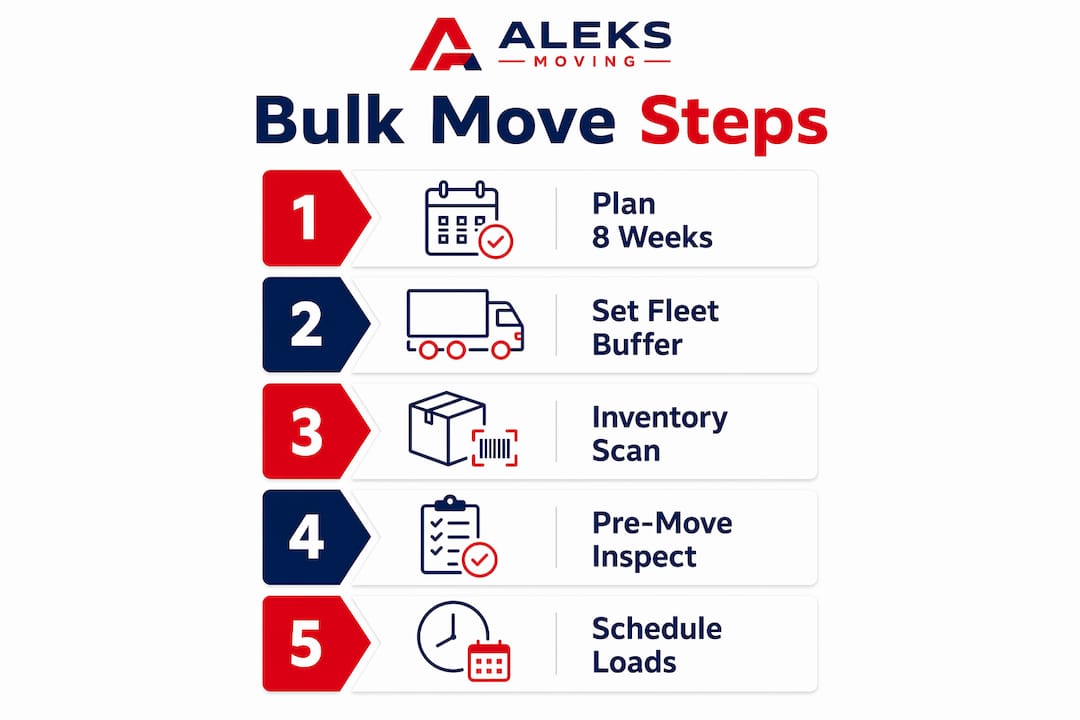
Pair fleet buffers with a formal equipment checklist: dollies, furniture pads, straps, and lift gates per vehicle. Confirm equipment the day before, not the morning of the move.
Pre-move inspection protocols
Formal inspections protect everyone involved. Digital pre-vacate inspections should be completed 14 days before move-out, with damage reconciliation finished within 24 hours after. For bulk moves, this means building an inspection schedule into your master timeline, not treating it as an afterthought. Use a standardized digital form with timestamped photos so disputes are resolved with evidence, not memory.
| Preparation task | Recommended timing |
|---|---|
| Build master move-out checklist | 8 weeks before |
| Begin packing non-essential items | 6 weeks before |
| Complete pre-vacate inspections | 14 days before |
| Confirm fleet and equipment | 1 day before |
| Final damage reconciliation | Within 24 hours after |
How to schedule and execute bulk move logistics efficiently?
Scheduling is the backbone of any efficient move-out planning effort. The goal is to group moves by geography and time window so trucks travel the shortest routes and crews work without gaps or overlaps.
Cluster scheduling by geography
Cluster scheduling means grouping move-outs by physical proximity. If you manage a multi-building complex, schedule all moves from the north wing on the same day, then the south wing the next. This cuts drive time between stops and lets the same crew handle multiple units without repositioning across the city. For corporate relocations spanning multiple office floors, cluster by floor rather than department.
GPS fleet tracking and route planning tools give coordinators live visibility into truck positions, estimated arrival times, and idle periods. That data lets you reassign vehicles mid-day when one cluster finishes ahead of schedule.
Stakeholder alerts and micro-depot strategy
Bulk move logistics best practices require 24-hour advance alerts to all stakeholders confirming pickup and delivery windows. Send these alerts via automated SMS and email so building managers, receiving teams, and residents all know exactly when to expect activity. Surprises on move day cost time and create conflict.
Micro-depots reduce van dwell time at busy drop-off points. Instead of every truck queuing at the same loading dock, stage a temporary holding area nearby where crews transfer loads to smaller vehicles or carts for final placement. This is especially effective in urban Ontario buildings where loading access is limited to one or two bays.
- Confirm cluster schedule with all building managers 48 hours before.
- Send automated 24-hour alerts to residents, receiving teams, and vendors.
- Assign a crew lead per cluster with authority to adjust timing on site.
- Deploy micro-depot staging at high-traffic drop-off points.
- Run a real-time dashboard showing truck locations and completion status.
- Debrief each cluster lead at day’s end to capture delays for the next day’s plan.
A well-run moving day logistics plan treats scheduling as a living document. Conditions change, and the coordinator who adapts fastest loses the least time.
What communication strategies improve coordination and reduce errors in bulk moves?
Poor communication is the leading cause of errors in large-scale relocations. A bulk relocation strategy without a clear communication plan produces missed pickups, utility conflicts, and frustrated residents.
Pre-move briefings and standardized timelines
Run a pre-move webinar or in-person briefing for all stakeholders at least one week before the first move date. Cover the master schedule, packing standards, and escalation contacts. Distribute a standardized packing and move timeline so every household or office unit follows the same sequence. Consistency across units is what makes bulk coordination possible.
Pro Tip: Create a one-page visual timeline for residents showing exactly what to do each day in the final two weeks. Plain language and a clear calendar format reduce inbound questions by a significant margin.
Utility synchronisation and vendor access
Synchronising utility cut-offs and vendor access requires scheduling access codes and arrival times weeks in advance. A utility that cuts off two days early leaves a unit without power during packing. A vendor who arrives without an access code wastes an hour at the front desk. Both problems are preventable with a shared vendor access schedule distributed to building management and the move coordinator.
- Schedule utility transfers at least three weeks before move-out.
- Provide all vendors with building access codes and parking instructions in writing.
- Confirm elevator bookings and loading dock reservations for each move date.
- Set up a centralized hotline or group chat for real-time support on move day.
- Assign one coordinator as the single point of contact for vendor queries.
Automated milestone alerts keep everyone on track without requiring manual follow-up. Set triggers for key dates: packing start, inspection day, move day, and post-move reconciliation. Teams that use automated alerts report fewer missed handoffs and faster issue resolution.
How to troubleshoot common challenges during bulk move-outs?
Even the best-planned bulk move encounters problems. The difference between a smooth recovery and a costly delay is preparation.
Managing last-minute changes and no-shows
Fleet buffers handle vehicle breakdowns. Crew buffers handle no-shows. Build at least one spare crew team into your staffing plan for every ten active units. When a crew calls in sick, the spare team deploys without disrupting the cluster schedule. For moves spanning multiple days, rotate spare teams so fatigue does not compound across the week.
Last-minute changes in large moves are best handled by assigning a dedicated logistics coordinator with authority to reassign resources on the spot. That person needs live access to the fleet dashboard, crew contacts, and the master schedule.
Packing safety and box quality
Box quality directly affects safety. Used boxes lose compressive strength by 20–30% after one use cycle, increasing the risk of dropped items and crew injury. For bulk moves involving dozens or hundreds of units, standardize on new, uniform boxes. The cost difference is small compared to a workers’ compensation claim or a damaged item dispute.
Follow a consistent packing workflow across all units. Overpacked boxes cause back injuries and crushed contents. Set a maximum weight per box, label every box with its destination room, and use colour-coded tape by floor or unit number.
Conducting final inspections within 24 hours of move-out completion is the single most effective way to resolve damage disputes before they escalate. Digital pre-vacate and post-move inspection protocols create a timestamped record that protects both the property manager and the moving team.
Sensitive and high-value items
Last-mile deliveries for sensitive items such as keys, contracts, and fragile valuables should be handled by specialized couriers rather than the main fleet. This reduces double-handling and keeps the primary move schedule clear of time-sensitive detours. For corporate moves, this applies to server equipment, legal files, and artwork. Aleksmoving’s team handles specialty items including antiques and art with dedicated protocols, keeping them separate from general freight.
Key takeaways
Coordinating bulk move-outs successfully requires an 8-week planning window, a 30% fleet buffer, QR-coded inventory tracking, and a centralized communication system to prevent errors and delays.
| Point | Details |
|---|---|
| Start planning 8 weeks out | Book fleet, confirm vendors, and begin packing non-essentials six weeks before move day. |
| Use QR-coded inventories | Link every box to a digital record to reduce unload errors and speed up placement. |
| Maintain a 30% fleet buffer | Book more vehicles than projected to absorb breakdowns and last-minute volume increases. |
| Automate stakeholder alerts | Send 24-hour advance SMS and email confirmations to all building managers and residents. |
| Inspect within 24 hours post-move | Complete digital damage reconciliation the day after move-out to resolve disputes quickly. |
What I’ve learned from coordinating large-scale moves
After years of working through bulk relocations, the pattern I see most often is this: coordinators plan the logistics well but underestimate the communication load. The trucks are booked, the boxes are labelled, and then move day arrives and nobody told the building manager that three trucks need the loading dock at 7:00 AM. That single missed conversation costs two hours.
The technology piece matters more than most people expect. GPS tracking on every vehicle changes how you manage a multi-cluster day. You stop guessing and start making decisions based on what is actually happening. Pair that with a live dashboard and automated alerts, and your team spends less time on the phone and more time solving real problems.
The other lesson is that contingency planning is not pessimism. It is professionalism. A 30% fleet buffer sounds expensive until the day a truck breaks down at 6:00 AM and you have a spare ready. The same logic applies to crew, packing materials, and inspection time. Build the slack in before you need it, because you will need it.
The Ontario property manager checklist is one of the most practical tools I have seen for keeping bulk move-outs on track. It covers inspection timing, vendor coordination, and resident communication in one place. If you are managing multiple units, that kind of structured reference saves real time.
— Ali
Aleksmoving’s support for large-scale move coordination
Managing multiple move-outs across a building or portfolio is a significant undertaking. Aleksmoving brings over 18 years of experience in residential and commercial relocations across Ontario, with flat-rate pricing that removes budget uncertainty from the equation.
Whether you are coordinating a multi-unit residential building or a full office relocation, Aleksmoving’s team handles professional residential moves and commercial relocations with the same attention to scheduling, packing, and logistics that bulk moves demand. From tailored packing services to specialty item transport, every detail is covered under one dependable plan. Contact Aleksmoving for a free upfront quote and get your bulk move-out on a clear, manageable timeline.
FAQ
What is the ideal timeline for planning a bulk move-out?
An 8-week planning window is the industry standard for large-scale move-outs. Packing of non-essential items should begin at the 6-week mark to avoid last-minute rushes and rush-fee penalties.
How many extra trucks should you book for a bulk move?
Book at least 30% more fleet capacity than your projected need. That buffer absorbs vehicle breakdowns, traffic delays, and unexpected volume increases without disrupting the schedule.
When should pre-move inspections be completed?
Digital pre-vacate inspections should be completed 14 days before move-out. Final damage reconciliation must be finished within 24 hours after the move to protect all parties.
How do QR codes help with bulk move coordination?
QR-coded boxes link each item to a digital inventory record showing contents, origin, and destination. Crews scan boxes on and off trucks, which reduces placement errors and speeds up the entire unloading process.
What is the best way to handle sensitive items in a bulk move?
Route time-sensitive and fragile items through specialized couriers rather than the main fleet. This prevents double-handling, keeps the primary schedule clear, and reduces the risk of damage or loss.