Skip to content


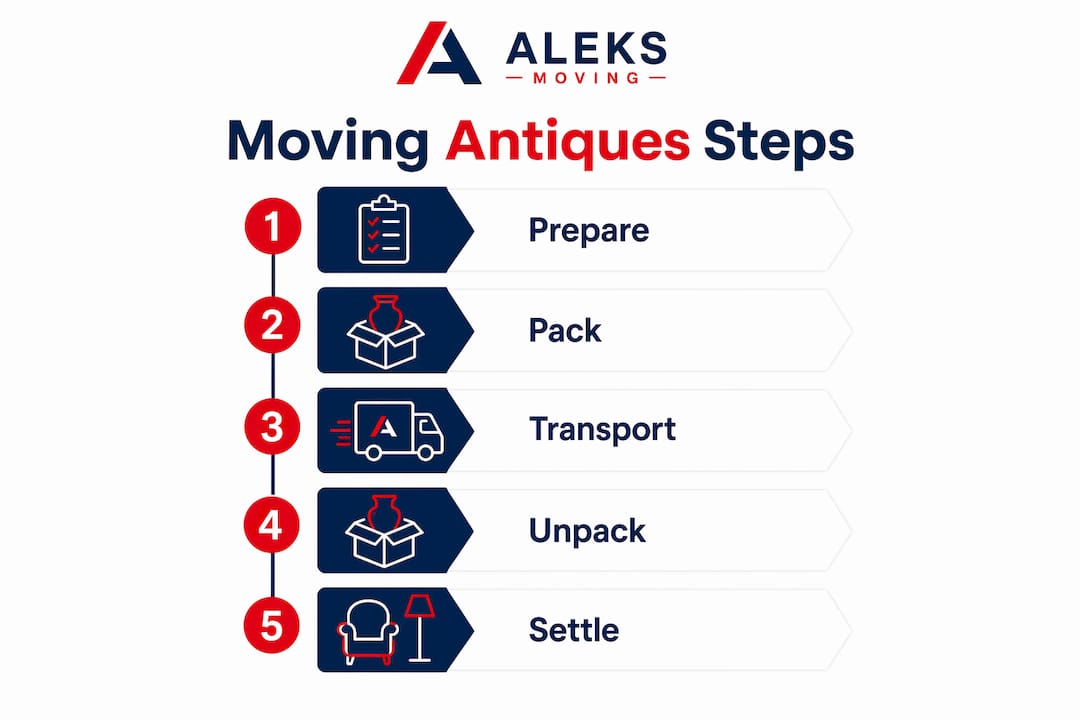
Moving antiques safely comes down to seven non-negotiable steps: document every piece before packing, use layered acid-free materials, consider custom crating for high-value items, choose professional packing for fragile or irreplaceable pieces, arrange full replacement value insurance, plan moving day logistics carefully, and unpack in reverse order at your destination.
- Document first. Photograph each piece from multiple angles and note existing condition before anything is wrapped or moved.
- Layer your packing. Start with a breathable, acid-free barrier directly on the finish, then add cushioning, then an outer protective wrap. Tape goes on outer layers only.
- Custom crate high-value pieces. Wooden crates with foam inserts are the only reliable protection for antiques that cannot be replaced.
- Choose professional packing for fragile items. Trained crews carry specialised materials and liability coverage that DIY packing cannot match.
- Insure at full replacement value. Standard mover liability covers $0.60 per pound, which falls far short of what most antiques are worth.
- Plan moving day logistics. Load antiques last, secure them with soft straps, and minimise exposure to temperature extremes during loading and unloading.
- Unpack carefully. Remove outer layers first, inspect each piece against your pre-move photos, and document any damage before the crew leaves.
Each of these steps is covered in detail below, with Canadian-specific guidance drawn from Aleksmoving’s 18-plus years of experience moving antiques across Ontario and beyond.
Table of Contents
- Why custom crating and layered packing protect antiques best
- Professional packing vs. DIY: how to decide what each piece needs
- How to document, value, and insure your antiques before a move
- Moving day best practices that keep antiques safe
- Expert insights from Aleksmoving on safely packing antiques for moves in Canada
- How to handle and secure fragile antique components
- Which transportation method is right for your antiques?
- Climate and environmental considerations during transit
- How to unpack and set up antiques safely at your destination
- Aleksmoving makes antique moves in Canada straightforward
- Key takeaways
Why custom crating and layered packing protect antiques best
The single biggest cause of antique damage during moves is contact between the wrong material and an aged finish. Plastic shrink wrap placed directly on antique finishes traps humidity and can cloud or lift original shellac, a problem that is often irreversible. The solution is a strict layering sequence, and it applies whether you are packing a Victorian sideboard or a delicate marquetry writing desk.
The professional layering sequence:
- Barrier layer: Soft 100% cotton or acid-free tissue directly against the finish. Glassine works well for painted or varnished surfaces. Never let plastic or printed newsprint touch the wood.
- Cushioning layer: Unprinted newsprint, then at least two thicknesses of moving pad. Reinforce corners with cut corrugated cardboard.
- Outer protective wrap: Shrink wrap or a second moving pad as the outermost layer only, never touching the finish.
- Securing: Use cotton twill tape to hold doors and drawers closed. Adhesive tape on original wood surfaces causes finish damage.
- Glass, mirrors, and marble tops: These travel in specialty mirror cartons with corner protectors, or in their own custom crate, never just bubble-wrapped inside a standard box.
- Climate-controlled transport: Veneers and marquetry are especially vulnerable to temperature and humidity swings, making climate-controlled vehicles the right choice for long-distance moves.
For the most fragile or valuable pieces, custom wooden crates with foam cradle inserts provide a level of rigid, vibration-isolated protection that no amount of blanket-wrapping can replicate. The foam cradle suspends the piece so it does not bear its own weight on weak joints during transit.
Pro Tip: Ask your mover about “floating” the crate, which means building a foam base inside the wooden box so the antique never contacts the crate walls directly. This technique, used in museum-grade transport, dramatically reduces the shock transmitted from road vibration.
Professional packing vs. DIY: how to decide what each piece needs
Not every antique requires a professional packer, but some absolutely do. The decision comes down to three factors: the fragility of the piece, its monetary and sentimental value, and your honest access to the right materials.
When professional packing is the right call:
- Pieces with fragile joinery, lifting veneer, hand-carved ornamentation, or original gilding
- Any antique appraised above $1,000, where a single damage incident could cost more to restore than the entire packing service
- Glass-fronted cabinets, marble-topped commodes, and large mirrors
- Items you simply cannot replace, regardless of dollar value
When careful DIY packing may suffice:
- Smaller, sturdier collectibles where you have access to acid-free tissue, clean moving pads, and double-wall boxes
- Budget-constrained moves where you are willing to accept a higher personal risk
- Pieces with no original finish concerns and no fragile joinery
Critical DIY pitfalls to avoid:
- Never use plastic shrink wrap as the first layer against any antique finish
- Never use printed newspaper, which transfers ink onto china, glass, and painted surfaces
- Never lift by legs, arms, or decorative elements. Always lift from structural points such as aprons or stretchers
- Never force apart joints that rely on original glue or pegged mortise-and-tenon construction. Forcing a centuries-old joint open can destroy the piece’s value entirely
- Never leave voids inside boxes. Empty space is where items shift, and shifting is what breaks them
Professional packing typically adds some additional cost to a move’s total price. For antiques with original finishes or fragile structure, that cost is almost always worth it.
Checklist to guide your decision for each piece:
- Is the finish original shellac, lacquer, or oil? → Professional packing recommended
- Does the piece have veneer, inlay, or marquetry? → Professional packing recommended
- Is the appraised value above $1,000? → Professional packing recommended
- Is it a solid, stable piece with a modern finish? → Careful DIY may suffice
- Do you have acid-free tissue, clean cotton, and double-wall boxes on hand? → DIY is possible for lower-risk items
How to document, value, and insure your antiques before a move
Documentation is your financial safety net. A thorough pre-move inventory with photographs, condition notes, and provenance information protects you in any insurance claim and gives packers a clear baseline for every piece.
What your documentation should include:
- Photographs from at least six angles: front, back, both sides, top, and any ornate detail such as carved cresting or inlay
- Written condition notes describing existing damage, hairline cracks, missing hardware, or prior repairs
- Measurements of each piece, which you will need for custom crating and to confirm items fit through doorways at the destination
- Provenance records, maker’s marks, and any appraisal documents you already hold
- Labels on all removed parts such as drawers, shelves, and hardware, with unique tags and photos showing original placement
For antiques valued above $5,000, a current written appraisal is strongly recommended before the move. Appraisals establish the insurance replacement baseline and simplify claims considerably if something goes wrong. The American Society of Appraisers maintains a directory of certified appraisers, and Canadian appraisers can be found through the Canadian Personal Property Appraisers Group.
Understanding your insurance options:
- Basic mover liability: Covers $0.60 per pound per article. A 60-pound chair worth $8,000 would be covered for just $36 under this default.
- Full replacement value coverage: Covers repair or replacement at the declared value. Always request this in writing and declare each high-value piece individually on the inventory.
- Homeowner’s or renter’s insurance transit rider: Check whether your existing policy extends to items in transit and during unpacking. Many do not, without a specific rider or fine art floater.
- Third-party fine art policy: For collections with significant value, a standalone fine art policy covering agreed value, in-transit handling, and storage periods offers the most complete protection.
A condition report signed by both you and the moving crew at pickup is your strongest protection. It establishes a clear before-and-after record that accelerates any claim and removes ambiguity about when damage occurred.
Moving day best practices that keep antiques safe
Moving day is where preparation either pays off or falls apart. A brief walkthrough with your crew before anything is touched sets the tone for the entire day.
What to do on moving day:
- Walk through your home with the lead mover and point out every piece that needs special handling. Do not assume the crew knows which items are antiques.
- Confirm the loading order. Antiques should be loaded last and unloaded first, which limits the time they spend in the truck and reduces the chance of other items shifting against them.
- Watch that soft straps, not ratchet straps, are used to secure antiques inside the truck. Ratchet straps apply too much pressure and can crack frames or compress fragile joints.
- Check that every box and crate is clearly labelled with “Fragile,” orientation arrows, and “Do Not Stack” where applicable.
- Carry the most irreplaceable antiques personally in your own vehicle when possible. Even expert transport carries some risk, and keeping a truly irreplaceable piece with you eliminates that variable entirely.
- Minimise the time antiques spend in open air during loading and unloading, particularly in Canadian winters or during summer heat. Temperature shock is a real risk for veneered and lacquered surfaces.
At the destination:
- Inspect crates and outer boxes for any visible damage before unpacking. Photograph anything that looks compromised.
- Unpack one piece at a time, removing layers in reverse order: outer wrap first, cushioning second, barrier layer last.
- Compare each piece against your pre-move photographs while the crew is still on site. If you find damage, document it immediately with photos and note it on the delivery paperwork before signing.
- Give yourself time. Rushing the unpacking process is how secondary damage happens.
For antiques weighing over 200 kg, mechanical lifting equipment and two to four operators are required to protect both the piece and the crew. Confirm your mover has the right equipment before booking.
Expert insights from Aleksmoving on safely packing antiques for moves in Canada
Aleksmoving has been handling antique moves across Ontario and broader Canada for over 18 years. That experience has shaped a set of protocols that go well beyond standard residential moving practice.
What Aleksmoving’s approach looks like in practice:
- Every antique move begins with a pre-move survey to assess access routes, document conditions, and identify pieces that need custom crating or climate-controlled transport.
- Crews are trained to assess joinery, veneer condition, and finish type before any wrapping begins. Antiques’ aged joinery is brittle, and incorrect lifting points can cause irreparable structural damage. Aleksmoving crews lift from aprons and stretchers, never from legs or decorative elements.
- Museum-grade materials are standard: acid-free tissue, glassine for painted surfaces, clean cotton pads, and custom foam-lined crates for high-value pieces.
- For long-distance moves, climate-controlled transport is recommended for any piece with veneer, marquetry, or an original finish. Canadian winters and summers both create conditions that stress aged wood and adhesives.
- All hardware, drawers, and removable parts are bagged, tagged, and photographed in place before removal. Reassembly at the destination follows the same documented sequence.
- A signed condition report at pickup and delivery creates a clear chain of custody and removes any ambiguity if a claim is needed.
For peak moving season in Canada, which runs from May through August, book at least 8–10 weeks in advance to secure a crew with genuine antique experience. Off-peak bookings typically need 4–6 weeks of lead time.
How to handle and secure fragile antique components
Fragile components are where antique moves most often go wrong. Drawers, glass panels, marble tops, finials, and decorative hardware all need individual attention before the main piece is wrapped.
Remove drawers and pack them separately. Empty drawers reduce stress on dovetail joints during transport, and the contents can be packed more safely on their own. Secure doors with cotton twill tape looped around the piece, never with adhesive tape pressed against the original wood. Marble tops travel best in their own crate, standing upright with foam blocking on all sides, not lying flat where they can flex and crack.
For pieces with glass panels, tape an X across the glass with painter’s tape before wrapping. If the glass cracks in transit, the tape holds the shards together and prevents secondary damage to the finish beneath. Wrap glass panels in glassine or acid-free tissue first, then add a layer of bubble wrap, and pack the panel on edge inside a mirror carton.
Fragile joinery deserves particular care. Aged joinery is brittle, and a loose mortise-and-tenon joint that looks stable at rest can fail under the lateral forces of a truck in motion. Support fragile joints with foam blocking inside the crate so the piece does not carry its own weight on a weak connection during the ride. Never disassemble fixed dovetails or pegged joints. Forcing them apart destroys the piece’s structural integrity and often its value.
Which transportation method is right for your antiques?
The right vehicle and transport arrangement depends on the distance, the value of your pieces, and the environmental sensitivity of the materials involved.
For local moves within Ontario:
A standard moving truck with air-ride suspension is adequate for most antiques, provided pieces are properly wrapped and secured with soft straps. The key is minimising time in the truck and avoiding overnight storage in an unheated or uncooled vehicle. Canadian winters can drop temperatures in a parked truck well below freezing, which stresses veneered surfaces and aged adhesives.
For long-distance or cross-country moves:
Climate-controlled transport is the right choice for any antique with veneer, marquetry, an original finish, or upholstery. A dry-van trailer at extreme temperatures during a July or January Canadian long-haul can cause veneer cracking and finish crazing that no amount of wrapping will prevent. Climate control typically adds a modest percentage to the transport cost, and for pieces of real value, it is a straightforward decision.
For extremely high-value or fragile pieces:
Dedicated transport, where the truck carries only your antiques rather than a mixed load, eliminates the risk of other cargo shifting against your pieces. Some antique owners also choose to transport irreplaceable items personally in their own vehicle, which removes transit risk entirely for the pieces that matter most.
For cross-border shipments:
Canadian customs requires a detailed packing list, declared value for insurance, and a fragile-handling annotation on the waybill for antiques crossing the border. Certain materials, including some regulated woods and ivory substitutes, may require export permits. Confirm documentation requirements with your mover well before the move date.
Climate and environmental considerations during transit
Canada’s climate creates specific risks for antiques that movers in more temperate regions rarely have to address. Temperature swings between seasons, high humidity in summer, and dry heated air in winter all affect aged wood, finishes, and adhesives in ways that can cause permanent damage.
Wood expands and contracts with changes in humidity. A piece that is stable in a climate-controlled home can develop cracks or lifting veneer if it spends hours in a cold truck in January or a hot one in July. Climate-controlled transport stabilises temperature and humidity throughout the journey, which is particularly important for pieces with veneers, marquetry, or original finishes that have not been refinished with modern sealers.
Silica gel desiccant packs inside crates help manage moisture during transit, especially for pieces moving through humid summer conditions or being stored temporarily. For climate-sensitive antiques going into storage between moves, always request a climate-controlled storage unit rather than a standard warehouse bay. The difference in conditions can be dramatic, particularly in Ontario’s summer months.
Loading and unloading in extreme weather should be done as quickly as possible. Prolonged exposure to cold or heat during the transition between a climate-controlled truck and a building is one of the most overlooked risks in antique transport. If you are moving in winter, have the destination space warmed to a stable temperature before antiques arrive, and allow pieces to acclimatise gradually rather than moving them directly from a cold truck into a heated room.
How to unpack and set up antiques safely at your destination
Unpacking is not the time to rush. The discipline you applied during packing needs to carry through to the final placement of each piece.
Begin by inspecting every crate and outer box before opening anything. Photograph any visible damage to packaging, then open crates carefully, removing the outer layer first and working inward. Never use a box cutter near the final layers, where a slip can score a finish. Use your hands or a flat tool to separate the last wrapping from the surface.
Compare each piece against your pre-move photographs as you unpack it. Look for new scratches, finish ghosting, veneer lifting, or structural changes. If you find damage, document it with photos immediately and note it on the delivery paperwork while the crew is still present. Most insurance claims depend on damage being documented at delivery, not days later.
Allow antiques to acclimatise to the humidity and temperature of their new space before placing them in direct sunlight or near heat sources. A piece that has been in a cold truck needs time to stabilise before you assess its condition fully. Some minor surface changes, such as slight condensation on a cold piece brought into a warm room, will resolve on their own within a few hours.
Reassemble removed components using your labelled hardware bags and placement photographs. Reattach drawers, shelves, and hardware in the reverse order of disassembly. For pieces that were professionally packed, the packing antiques for long-distance moves guidance from Aleksmoving covers reassembly protocols in detail.
Aleksmoving makes antique moves in Canada straightforward
Antique moves require a level of care and preparation that standard residential moves simply do not. Aleksmoving brings over 18 years of experience handling exactly these kinds of moves across Ontario and broader Canada, with trained crews, museum-grade packing materials, and flat-rate pricing that includes no hidden fees.
Whether you are moving a single heirloom piece or an entire estate collection, Aleksmoving’s antique moving services cover every step: pre-move condition surveys, custom crating, climate-controlled transport options, and signed condition reports at pickup and delivery. The team works with you to identify which pieces need professional packing, which can be handled with careful DIY preparation, and how to document everything for insurance purposes. For a residential move that includes antiques, fine art, or other specialty items, reach out to Aleksmoving for a free, transparent quote and let an experienced team take the worry out of the process.
Key takeaways
Safely moving antiques in Canada requires layered acid-free packing, full replacement value insurance, and a signed condition report at both pickup and delivery to protect every piece from preparation through to final placement.
| Point | Details |
|---|---|
| Layer packing correctly | Start with acid-free tissue or cotton against the finish; never let plastic touch an original surface. |
| Custom crate high-value pieces | Wooden crates with foam inserts are the only reliable protection for fragile or irreplaceable antiques. |
| Insure at full replacement value | Standard mover liability at $0.60 per pound is far too low for most antiques; always request full replacement value coverage in writing. |
| Document before and after | Photograph every piece from six angles and sign a condition report with your mover at pickup and delivery. |
| Aleksmoving for Canadian antique moves | Aleksmoving offers 18-plus years of experience, custom crating, climate-controlled transport, and flat-rate pricing across Ontario and Canada. |