

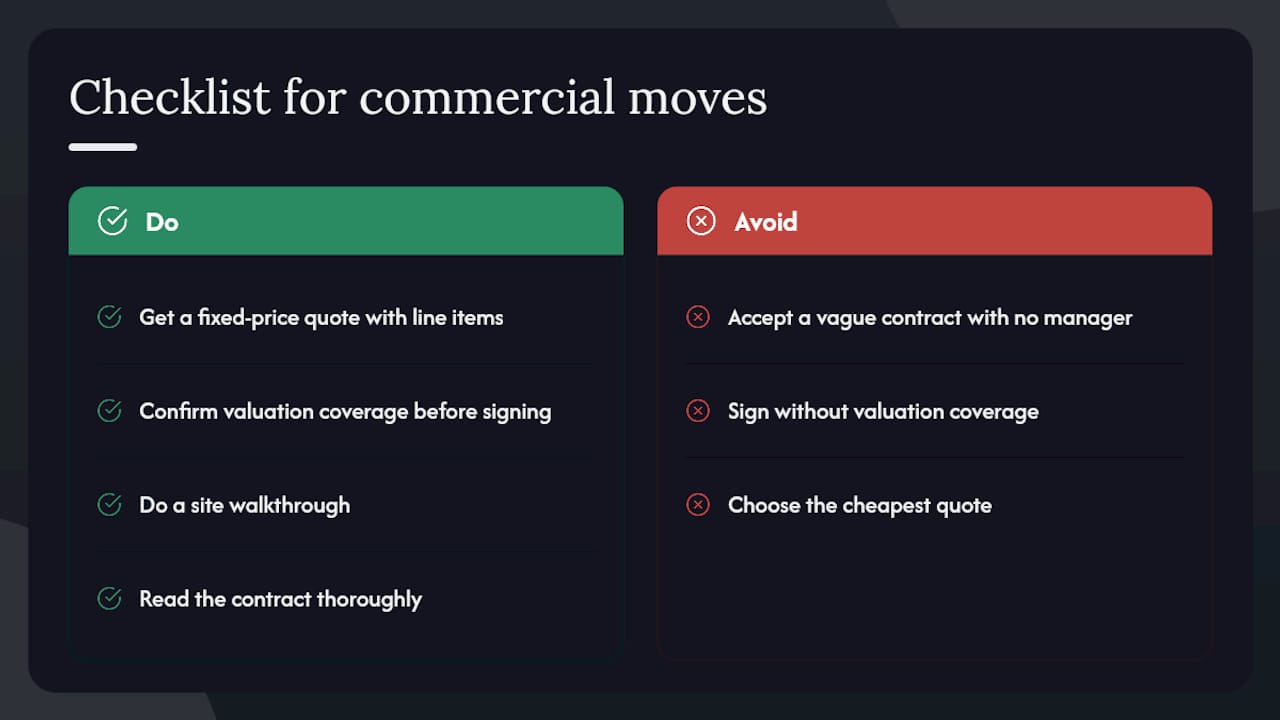
For most Ontario businesses, the right call is to hire a licensed commercial mover that offers a fixed-price, project-managed office relocation. Comparing moving services for businesses on price alone misses the factors that actually protect your operation: contract clarity, valuation coverage, and a dedicated project manager who manages the move from walkthrough to final placement. Here are three things to do before you sign anything:
- Schedule a site walkthrough with at least two movers so they can assess floor plans, elevator access, and any specialty items before quoting.
- Request a flat-rate quote with full line-item pricing covering labour, packing materials, transportation, IT/AV handling, and any after-hours surcharges.
- Lock your move dates in a written contract that names the carrier, states valuation coverage limits, and outlines the claims process.
Aleksmoving is a recommended option for Ontario businesses seeking transparent flat-rate pricing and project-managed commercial moves. The SHRM vendor directory lists many corporate relocation providers if you want to survey the broader market before shortlisting.
Key takeaways
Choosing the right commercial mover in Ontario comes down to three non-negotiables: a fixed-price contract with full line-item detail, confirmed valuation coverage, and a named project manager who owns the move from start to finish.
| Point | Details |
|---|---|
| Fixed-price quotes protect your budget | Insist on flat-rate, line-item pricing covering labour, packing, transport, IT/AV, and surcharges. |
| Valuation coverage is non-negotiable | Confirm full-value protection in writing before signing; released-value coverage is rarely sufficient for business assets. |
| Direct movers outperform brokers | A carrier who executes the move with their own crew gives you one accountable contact and clearer liability. |
| Plan 8 weeks ahead | Shortlisting vendors, completing walkthroughs, and locking dates early prevents last-minute cost increases. |
| Aleksmoving for Ontario businesses | Aleksmoving offers flat-rate, project-managed commercial moves across Ontario with after-hours scheduling and confirmed valuation coverage. |
Table of Contents
- What do commercial movers actually include in their service?
- What does a business move actually cost in Ontario?
- How do you compare commercial movers and choose the right one?
- What does a realistic office move timeline look like?
- What happens after the move, and how do you resolve disputes?
- What 18 years of Ontario commercial moves has taught us
- Aleksmoving makes your Ontario business relocation straightforward
- Sources
What do commercial movers actually include in their service?
The term “commercial moving” covers a scope broader than most office managers expect when they first start collecting quotes. A full-service commercial mover handles far more than loading boxes onto a truck.
Core services you should expect on any commercial quote:
- Project management: a named coordinator who manages scheduling, crew, and building access on both ends
- Full-service or partial packing and unpacking, including labelling systems tied to your floor plan
- IT and AV disconnection, careful transport, and reinstallation at the destination
- Furniture disassembly and reassembly, including modular workstations and boardroom tables
- Short-term and long-term storage for items that cannot move on the same day
- Specialty handling for art, antiques, lab equipment, or high-value assets requiring custom crating
Service variants that affect price and scope:
- After-hours and weekend moves to minimise business downtime
- Crate and bin rentals as an alternative to cardboard boxes (reduces packing time and damage)
- Specialised rigging for server racks, heavy machinery, or medical equipment
- Inventory tracking for large multi-site relocations
When you review a quote, every one of these services that applies to your move should appear as a named line item. A quote that bundles everything into a single “commercial move” figure gives you no way to compare it against another bid. The SHRM vendor directory shows that corporate relocation providers include a range from domestic household-goods specialists to global mobility firms, indicating a broad market. What matters is matching the vendor’s actual scope to your specific needs.
One distinction worth understanding early: a commercial mover performs the move with its own crew and equipment, while a moving broker arranges a carrier but does not execute the move itself. Direct commercial movers give you a single point of accountability and clear liability; brokers can offer wider carrier access but add a coordination layer that creates gaps if contractual responsibility is not spelled out precisely.
Pro Tip: Ask every vendor to confirm in writing whether they are the carrier or a broker. If they are a broker, request the name of the actual carrier and verify that carrier’s insurance independently.
Aleksmoving’s office and commercial moving services cover project management, after-hours capability, and specialised commercial handling across Ontario.
What does a business move actually cost in Ontario?
Cost ranges for commercial moves in Ontario vary considerably depending on office size, distance, services included, and timing. Typical market pricing for Ontario-based moves varies; your actual quote will depend on a site walkthrough.
For concrete Ontario-specific examples and a breakdown of what drives price in each scenario, Aleksmoving’s business moving cost examples page walks through real quote structures and the line items that caused prices to rise or fall.
What actually moves the needle on price:
- Labour hours are the single largest variable. After-hours or weekend moves carry a premium but protect revenue by keeping the office operational during business hours.
- IT and AV handling adds cost but also reduces damage risk on servers, monitors, and cabling. Budget this as a separate line item.
- Specialty items such as art, antiques, or lab equipment require custom crating. These should never be lumped into a general packing rate.
- Long carries and elevator wait times in high-rise buildings add billable hours that a flat-rate quote should account for upfront.
- Storage between lease end and new-space availability is a common hidden cost. Confirm whether storage is included or billed separately per day or week.
Cost insight: Reducing move volume before the move date is one of the most reliable ways to lower cost. Disposing of surplus furniture, outdated equipment, and bulky waste before the mover arrives shortens labour time and may reduce truck size. Business rubbish removal handled in advance can meaningfully reduce the final bill.
Fixed-price contracts protect you from labour overruns. A quote that itemises labour, packing, transportation, insurance, and potential surcharges is the only format that allows a genuine apples-to-apples comparison across vendors.
How do you compare commercial movers and choose the right one?
A structured comparison across consistent criteria is the only way to evaluate bids fairly. Use the dimensions below as your framework.
The six dimensions that matter most
- Pricing model. Flat-rate (fixed-price) contracts allocate risk to the mover and protect your budget. Hourly pricing transfers that risk to you. Volume-based pricing suits large multi-site moves but requires careful scope definition.
- Best-fit use case. A mover strong in small office relocations may lack the project management depth for a 50-person floor move. Confirm the vendor has completed moves of your size and complexity.
- Services included. Packing, IT/AV, white-glove handling, and storage should be confirmed as included or excluded, not assumed.
- Insurance and claims handling. Confirm the valuation coverage limit, the claims process, and the timeline for resolution. Some providers advertise coverage up to $2 million; others offer basic released-value protection that pays cents per pound.
- Timeline and scheduling flexibility. Can the mover accommodate after-hours or phased moves? What is the lead time to book?
- Geographic reach. Local, provincial, cross-Canada, or cross-border capability matters if your business has multiple sites or a long-distance component.
Questions to ask during the walkthrough and on the quote
- Are you the carrier, or will a third-party carrier execute the move?
- What is the valuation coverage limit, and how do I file a claim if something is damaged?
- Is the quoted price fixed, or can it change after the move?
- Who is my named project manager, and how do I reach them on move day?
- What surcharges apply for long carries, elevator waits, or after-hours work?
- How do you handle IT and AV equipment specifically?
- What is your cancellation and rescheduling policy?
- Can you provide references from moves of similar size in Ontario?
Red flags to watch for
- No written valuation coverage or a refusal to state coverage limits
- Vague line items such as “miscellaneous fees” or “packing as required”
- A broker who will not name the actual carrier
- No dedicated project manager named in the contract
- A quote provided without a site walkthrough
- Pressure to pay a large deposit before a contract is signed
Pro Tip: Request a sample contract before committing. The contract should name the carrier, state the fixed price, list every service included, and specify the claims process. If a vendor hesitates to share contract language in advance, that hesitation is informative.
For a deeper look at common pitfalls, Aleksmoving’s guide on corporate moving challenges covers the planning considerations that catch decision-makers off guard.
What does a realistic office move timeline look like?
Planning a commercial move without a phased timeline is the most common reason businesses experience downtime they did not budget for. The milestones below apply to a typical single-floor or small multi-site Ontario office move.
| Milestone | Timeframe before move day | Key actions |
|---|---|---|
| Initial planning | 8 weeks | Confirm new lease dates, appoint internal move coordinator, begin vendor shortlisting |
| Vendor selection | 6–8 weeks | Complete site walkthroughs, collect fixed-price quotes, confirm insurance and contract terms |
| Pre-move preparation | 3–5 weeks | Notify staff, order packing materials or bins, begin decluttering and surplus disposal |
| Final confirmation | 1–2 weeks | Confirm move-day schedule with vendor, brief IT team, notify building management at both sites |
| Move day | Day of | Supervise crew, confirm inventory at origin and destination, sign off on delivery |
| Post-move | 1–3 days after | Reconnect IT/AV, confirm no damage, file any claims within the contract window |
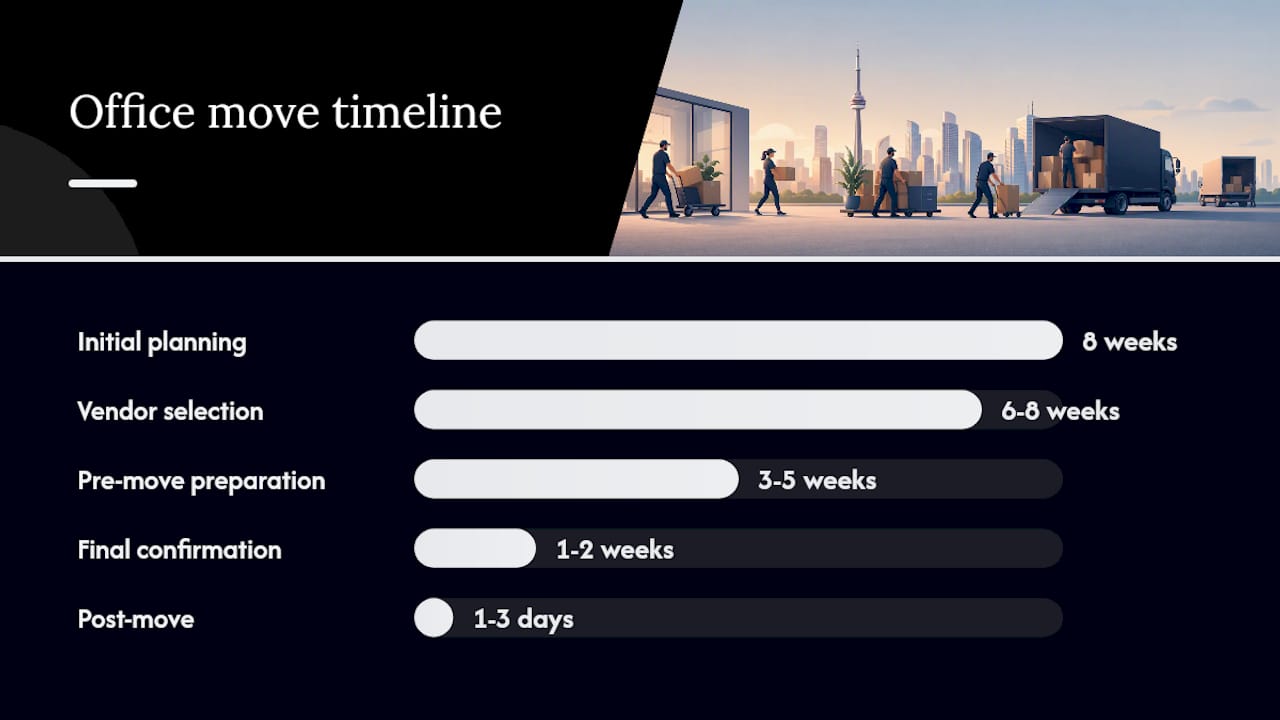
Aleksmoving’s Ontario commercial relocation guide provides a detailed planning checklist aligned to these milestones.
Stakeholder responsibilities
- Facilities/office manager: building access, elevator bookings, parking permits, floor plan for new space
- IT team: server shutdown sequence, cable labelling, reinstallation priorities
- HR: staff communication, remote work arrangements for move day
- Procurement: contract review, insurance verification, vendor payment terms
- External mover: project management, crew coordination, inventory tracking
Move-day quick checklist
- Designated internal contact present at both origin and destination
- Building access confirmed (elevator, loading dock, parking)
- Inventory list signed at origin before loading begins
- IT equipment packed and labelled separately from general office items
- Signed delivery confirmation at destination before crew departs
If a problem arises on move day, the most common issues are elevator conflicts with other tenants, parking restrictions, and items that were not on the original inventory. A mover with a named project manager resolves these on the spot; a broker arrangement often means a phone call to someone who is not physically present.
Reducing surplus before the move date also keeps the timeline clean. Pre-move disposal planning for bulky items and outdated furniture can shorten loading time and prevent last-minute complications.
What happens after the move, and how do you resolve disputes?
Post-move support is where the quality gap between commercial movers becomes most visible. A dependable mover does not consider the job complete when the last box is unloaded.
What good post-move support looks like:
- A follow-up call or site visit within 48 hours to confirm everything is in place
- IT and AV reinstallation verified and signed off by your IT team before the crew leaves
- A clear process for reporting damage, including the timeframe within which claims must be filed (typically 30–90 days depending on the contract)
- Written confirmation of the final invoice matching the fixed-price quote, with any approved variations documented
How to handle a dispute:
If an item is damaged or missing, document it immediately with photographs and note it on the delivery receipt before signing. Most commercial moving contracts require written notice of a claim within a specific window. Missing that window can void your right to compensation, so read the claims clause before move day, not after.
For valuation coverage, understand the difference between released-value protection (minimal, often included at no extra cost) and full-value protection (the mover is liable for repair or replacement at current market value). For a business move involving servers, custom furniture, or specialty equipment, full-value protection is worth the additional cost.
If a dispute cannot be resolved directly with the mover, the Ontario Consumer Protection Act provides recourse for consumers, and the Better Business Bureau maintains complaint records for moving companies operating in Ontario. For larger commercial disputes, a written contract with clear liability language is your strongest tool.
What 18 years of Ontario commercial moves has taught us
After more than 18 years handling commercial relocations across Ontario, the pattern we see most often is this: businesses that struggle with their move almost always skipped one of two steps. They either did not get a fixed-price quote with full line-item detail, or they did not confirm valuation coverage before signing.
The businesses that move smoothly are not necessarily the ones with the biggest budgets. They are the ones who treated the vendor selection process the same way they would treat any other procurement decision: with a checklist, a site walkthrough, and a contract they actually read.
We have completed commercial moves for small professional offices, multi-floor corporate tenants, and businesses relocating across Ontario on tight timelines. After-hours moves are a regular part of our work because most of our business clients cannot afford a full day of downtime. That operational reality shapes how we quote, how we plan, and how we staff every commercial job.
The one thing I would tell any office manager starting this process: the cheapest quote is rarely the most expensive mistake. The most expensive mistake is a vague contract with no named project manager and no valuation coverage. Get the contract right first.
Aleksmoving makes your Ontario business relocation straightforward
Ontario businesses comparing commercial moving options consistently face the same friction: quotes that are hard to compare, contracts that leave liability unclear, and movers who are not reachable on move day. Aleksmoving addresses all three directly.
Our commercial moving services are quoted at a flat rate with full line-item detail, so you know exactly what you are paying before the truck arrives. Every commercial move includes a named project manager, after-hours scheduling options to protect your business hours, and valuation coverage confirmed in writing. Whether you are relocating a small professional office or a multi-floor corporate space anywhere in Ontario, we handle packing, IT/AV, furniture, and storage as part of a single coordinated plan.
Ready to get a fixed-price quote for your business move? Request your commercial moving quote and we will arrange a site walkthrough at a time that works for your team.
Sources
- Top Moving Companies Providers | Compare 88 Companies


