Skip to content


The simplest way to get a smooth moving day with movers is to show up prepared, verify the paperwork before anyone lifts a box, and keep your essentials with you. That means confirming the arrival window and crew contact ahead of time, checking and keeping copies of the written quote, bill of lading and inventory before you sign anything, and packing your valuables and documents separately from the truck.
TL;DR:
- Confirm the mover’s arrival window, parking, and access details the day before to prevent delays and ensure a smooth start.
- Keep valuables, important documents, and an essentials bag in your car to avoid loss or damage during loading and unloading.
- Photograph furniture and note damages on the inventory sheet before loading to protect yourself in case of damage claims.
- Supervise loading by marking fragile items and understanding the order of loading without directing the crew, to avoid slowing down the process.
- Review the bill of lading and inventory thoroughly before signing, and document the condition of belongings immediately upon delivery to facilitate damage claims.
Table of Contents
- Moving day checklist you can use the morning of
- What to do before movers arrive: last-hour prep that saves time
- When movers arrive: walkthrough, paperwork and inventory checks
- During loading: how to supervise without slowing the crew
- Transit and delivery: preparing the new place and managing unloading
- Final walkthrough, payment and time-sensitive claims
- Red flags and how to avoid rogue movers
- Tipping and basic moving-day etiquette
- Aleks Moving perspective: common last-minute fixes
- Our take on what actually makes moving day smooth
- How Aleks Moving can help you get moving day right
- Sources
- FAQ
Moving day checklist you can use the morning of
A little structure in the first hour saves you from chasing loose ends later. Before the crew’s truck pulls in, walk through your home with this short list in hand.
- Pack a first-night essentials bag with chargers, medications, basic tools and any pet or child supplies, and keep it in your car rather than on the truck, since a well-stocked bag makes the first night in your new place far easier, according to West Homes’ moving day checklist.
- Confirm parking, elevator access and the crew’s direct phone number the night before.
- Print copies of your contract, inventory list and identification, and photograph anything of high value.
- Set aside essentials and valuables in a separate bag or box.
- Confirm access logistics with your building or street.
- Print your paperwork and photograph valuables before the crew arrives.
For a broader rundown of homeowner responsibilities across the whole day, our moving day logistics guide walks through each stage in order.
What to do before movers arrive: last-hour prep that saves time
The hour before your crew arrives decides how the rest of the day unfolds. Finish packing every non-essential item the night before and label each box with its destination room, since a crew that can read your labels moves faster and makes fewer wrong turns through your home.
- Clear hallways and doorways of rugs, plant stands and anything that could catch a dolly wheel.
- Reserve visitor parking or a loading zone, and book the freight elevator window if your building requires one.
- Confirm the arrival window, the crew leader’s phone number and any building access codes or concierge instructions.
If you are still short on packing help, our guide on preparing your house for movers covers room-by-room prep in more detail, and our packing service can take that whole task off your plate.
When movers arrive: walkthrough, paperwork and inventory checks
When the truck pulls up, the crew leader should walk your home with you before anything gets loaded. Ask them to explain the bill of lading and inventory line by line, and never sign a form that has blank sections or unclear totals.
- Confirm which valuation or insurance option you selected and whether any part of the move involves subcontractors.
- Photograph furniture and boxes, and note any pre-existing scratches or dents directly on the inventory sheet.
- Ask who is liable if a subcontractor causes damage, since responsibility can get murky when brokers are involved.
Consumer protection guidance recommends getting your quote and contract in writing and confirming whether you’re dealing with a broker or the actual mover, according to the Office of Consumer Affairs, a step that protects you if a dispute comes up later.
During loading: how to supervise without slowing the crew
Your job during loading is to answer questions fast and stay out of the walking path, not to direct traffic. Stand somewhere visible but clear of the doorway, and flag fragile or priority items as soon as the crew brings them into view.
- Point out anything fragile, irreplaceable or needed first at the new place before it disappears into a box stack.
- Learn the basic loading order (heavy furniture and appliances first, boxes and soft goods later) so you notice quickly if something looks off.
- Keep valuables in your own bag and have basic tools ready if a bed frame or shelving unit needs a quick disassembly.
Pro Tip: Answer the crew’s questions the moment they’re asked. A five-second delay on “where does this go?” adds up fast across dozens of trips.
Transit and delivery: preparing the new place and managing unloading
Try to arrive at the new place before or with the truck so doors are unlocked and rooms are clear when the crew starts unloading. Walk through beforehand and decide roughly where large furniture will land, so you’re not making decisions on the spot while boxes pile up in the entryway.
- Label each room with a name or colour sticker, and match the same labels on your boxes so placement goes fast.
- Direct large furniture to its final spot the first time, since re-carrying a couch across the house costs everyone time.
- Inspect each item as it comes off the truck and note any visible damage on the inventory immediately, rather than after the crew has left.
Final walkthrough, payment and time-sensitive claims
Before you sign off and pay, walk every room with the crew leader and confirm nothing was left on the truck or forgotten at the old place.
- Do a room-by-room check against your inventory before signing the final paperwork.
- Ask for an itemized receipt and clarify anything added to the bill before you pay.
- Keep your signed copy of the contract and inventory in a safe, findable spot.
Claims for damage or loss often carry strict deadlines, with 30 days common for local moves and longer windows for long-distance shipments, per the Office of Consumer Affairs, so photograph and document any issue the same day it appears.
Red flags and how to avoid rogue movers
Most moving-day problems trace back to shortcuts taken weeks earlier, not surprises on the day itself. Before you book, verify whether you are dealing with the actual mover or a broker, and check that they hold the permits your province requires.
- Be wary of phone-only quotes with no written estimate or contract to follow.
- Never sign a blank contract or agree to a large upfront cash payment before the move.
- Report suspected fraud to the Competition Bureau, your provincial consumer protection office or the Better Business Bureau.
The Competition Bureau warns that rogue movers often quote low prices by phone and then present different terms on arrival, which is exactly why a written agreement matters more than a friendly voice on the phone. For a closer look at how these scams unfold, see our piece on examples of moving scams and our explainer on who regulates moving companies.
Tipping and basic moving-day etiquette
Tipping isn’t required, but it’s customary when a crew handles your belongings with care. A common range is $20 to $40 per mover for a half-day move, $40 to $60 for a full day, and a bit more for long-distance jobs that involve extra hours or overnight travel.
- Offer water and a quick snack partway through, especially on a hot day.
- Give clear, simple placement directions instead of changing your mind repeatedly.
- Tip toward the higher end for careful, efficient work, and skip the cash if the crew caused avoidable damage or ignored your instructions.
Aleks Moving perspective: common last-minute fixes
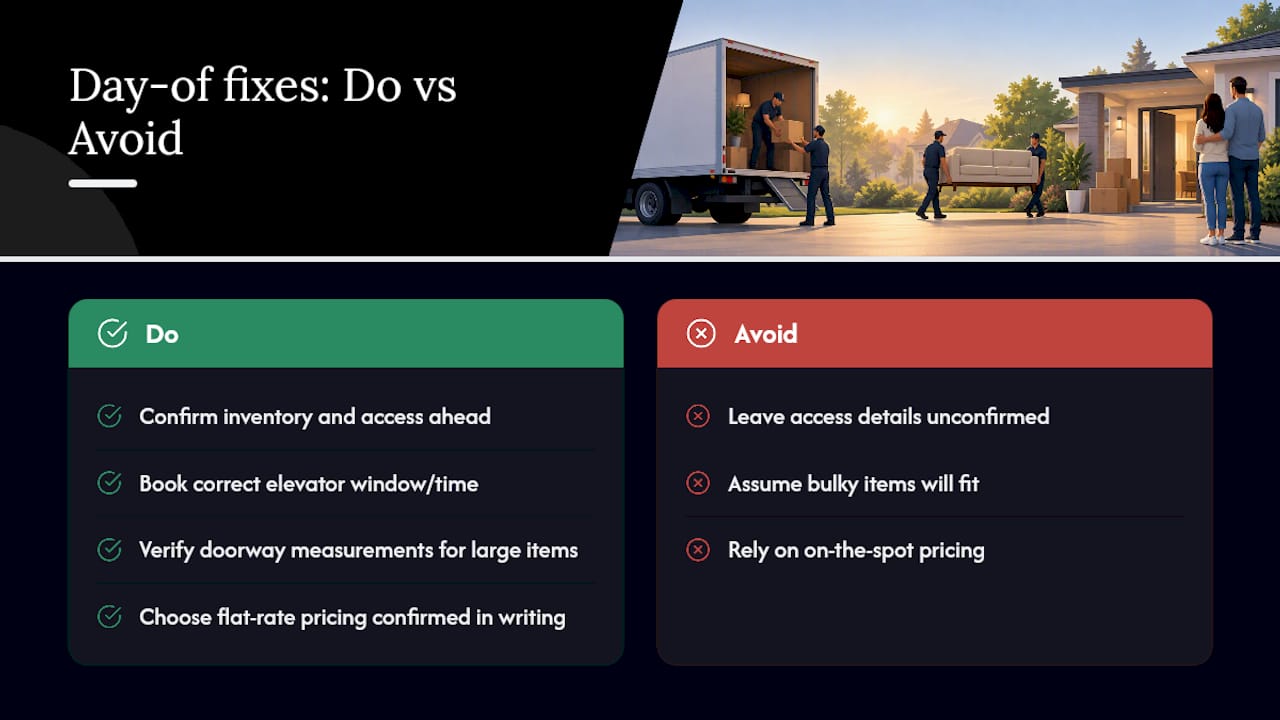
Most day-of headaches come down to the same three things: a door frame too narrow for a couch, a freight elevator booked for the wrong window, or a piece of furniture that needs a quick disassembly no one planned for. Experienced crews carry basic tools and expect at least one of these on any given job.
Flat-rate pricing, confirmed in advance, removes the guesswork that causes most day-of disputes over cost. When you book a professional moving service, you can expect the crew to confirm your inventory and access details ahead of time, so surprises stay to a minimum.
Our take on what actually makes moving day smooth
Most moving-day advice focuses on packing hacks and box-labelling systems, but the real risk on moving day isn’t disorganized boxes. It’s paperwork signed too fast and damage caught too late to claim. The homeowners who have the smoothest experience aren’t the ones with the most colour-coded stickers. They’re the ones who read the bill of lading before signing it and who photograph their belongings before the truck door closes.

Conventional checklists also tend to overstate how much supervision helps during loading. Standing over the crew’s shoulder rarely speeds things up and sometimes slows them down. Your real leverage is in the ten minutes before loading starts and the ten minutes after it ends, the walkthroughs where inventory, damage and paperwork actually get locked in.
If you take one thing from this playbook, make it this: treat the bill of lading with the same seriousness as a lease. It’s the document that decides what happens if something goes wrong.
— Ali
How Aleks Moving can help you get moving day right
Whether you need a full residential move, help with a long-distance relocation, temporary bin rental, or short-term storage while you sort out your new place, professional moving companies often build each quote around flat-rate pricing with no hidden fees, backed by extensive experience in the business — learn more about marketing and growth for these experts from Moving Company SEO Services.

Request a free quote through our contact form, by phone, or over WhatsApp, and have your move date, approximate inventory and any access details (stairs, elevators, parking) ready when you call. Start with our residential moving services page or check local move and long-distance options to see what fits your move.
Sources
For deeper guidance, see the Office of Consumer Affairs and the Competition Bureau’s rogue mover advisory.
- Moving advice – Office of Consumer Affairs
- The next time you move, dodge the “rogue movers” who take your belongings hostage – Competition Bureau
- Move on weekdays save up to 40% on 2026 costs — MoveCost
- Moving day checklist — West Homes
FAQ
What is the cheapest day to hire movers?
Weekday moves, particularly Tuesday and Wednesday, tend to cost less than weekend slots. A 2026 industry sample found midweek bookings saved between 25% and 40% compared with peak Saturday rates.
Is $100 per mover a good tip?
That’s on the generous end for most moves. A typical range runs from $20 to $40 per mover for a half-day job and $40 to $60 for a full day, with higher amounts reserved for long-distance or especially demanding moves.
What are red flags with movers?
Watch for phone-only quotes with no written contract, requests to sign blank paperwork, and pressure for large upfront cash payments. The Competition Bureau notes that rogue movers often quote low over the phone and then change terms on arrival, so a written estimate matters more than a friendly sales call.
What are you supposed to do while movers are moving?
Stay available to answer questions, point out fragile or priority items, and keep clear of walkways so the crew can move efficiently. Your job is to supervise the paperwork and flag concerns, not to direct every step of the loading process.
How long does a typical moving day take?
Most local moves with a professional crew take between four and eight hours, depending on the size of the home and access conditions like stairs or elevators. Booking your arrival window, confirming parking, and having boxes packed and labelled ahead of time keeps the day closer to the shorter end of that range.