

TL;DR:
- A structured office relocation in Brampton requires early legal, IT, and project planning to minimize downtime. Proper team roles, timely vendor coordination, and contingency budgets are essential for a smooth move. Starting at least three months before the move date improves cost control, communication, and compliance.
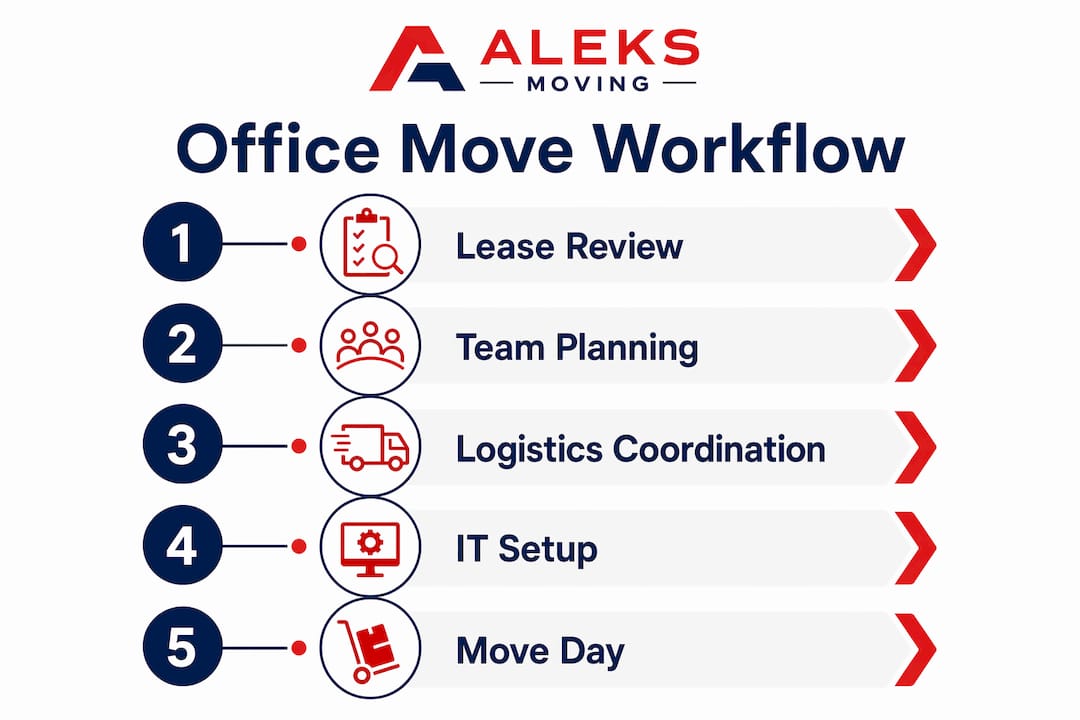
A well-executed office relocation workflow is defined as a phased, cross-functional plan that moves a business from its current premises to a new location with minimal downtime and no legal penalties. For Brampton businesses, this means coordinating the Ontario Commercial Tenancies Act requirements, IT infrastructure, and physical logistics under one structured process. Aleksmoving has supported commercial clients across Ontario for over 18 years, and the pattern is consistent: businesses that plan their Brampton office move process at least three months out avoid the costly surprises that derail last-minute moves. This guide walks you through every phase, from lease review to move-day execution, so your team arrives at the new space ready to work.
What are the legal and lease-related steps for a Brampton office move?
Lease management is the first and most time-sensitive part of any step-by-step office relocation. Miss a deadline here and the financial consequences can be severe.
Under the Ontario Commercial Tenancies Act, renewal notice periods run 6–12 months before lease expiry, and Ontario courts enforce these deadlines strictly. Missing the window can trigger overhold rent at up to 200% of your base rent. That penalty alone can cost more than the entire move.
Restoration obligations are the second legal trap. Many tenants discover at the end of their lease that they must return the space to bare-shell condition, removing all partitions, flooring, and electrical work they installed. Restoration costs can exceed the cost of the physical move itself. Budgeting for these liabilities should start at lease signing, not six months before departure.
Practical steps to protect your business:
- Review your lease at least six months before expiry. Identify every restoration clause and photograph the space as it looked on move-in day.
- Serve written renewal or termination notice on time. Calendar the deadline and assign one person to own it.
- Engage legal counsel early. Early legal advice strengthens your bargaining position and can reduce restoration scope through negotiation.
- Confirm building access rules for your new location. Class A office buildings in Brampton often require Certificates of Insurance from your moving company before granting elevator access.
- Request a landlord walk-through at both locations. Document condition with photos and written sign-off to avoid disputes later.
Pro Tip: Photograph every wall, floor, and ceiling fixture on your first day in the current space. That photo set is your strongest defence against inflated restoration claims when you leave.
For a broader look at Ontario office moving regulations, Aleksmoving has published a dedicated guide covering compliance requirements specific to commercial tenants.
How do you plan the timeline and team roles for an efficient Brampton office move?
The planning window for a commercial relocation scales directly with office size. Mid-sized offices under 2,500 square feet need at least 10–12 weeks. Offices over 10,000 square feet can require more than 12 months of preparation. Starting too late is the single most common reason Brampton office moves go over budget.
The second critical decision is who owns the project internally. Cross-functional teams should be assembled 6–12 months before the move date to align legal, IT, HR, and finance efforts. A move project without a dedicated team becomes everyone’s secondary priority and no one’s primary responsibility.
Build your relocation team around these four roles:
- Project lead. Owns the master timeline, vendor contracts, and final decisions. This person is the single point of contact for Aleksmoving and all other vendors.
- IT liaison. Manages network mapping, circuit ordering, and post-move system verification. IT decisions have the longest lead times and cannot be delegated to move week.
- HR representative. Handles employee communications, address updates, and any workspace change management. Staff who feel informed are far less disruptive during the transition.
- Facilities coordinator. Manages building access, freight elevator bookings, parking permits, and landlord communications at both locations.
Internal communications deserve their own plan. Employees who learn about a move through rumour rather than a formal announcement become anxious and unproductive. Send a structured update at each major milestone: lease signed, move date confirmed, packing schedule released, and post-move orientation scheduled.
Pro Tip: Build a shared project tracker in a tool your whole team already uses, whether that is Google Sheets, Microsoft Planner, or a simple shared document. A single source of truth prevents the “I thought you handled that” conversations that derail move week.
For detailed planning timelines and team structures specific to Ontario offices, Aleksmoving’s planning guide covers role assignments by office size.
What are the essential logistical steps in the office relocation workflow in Brampton?
Logistics is where a well-planned Brampton office moving process either holds together or falls apart. The decisions made here determine whether your team is operational on day one or scrambling for a week.

Vendor selection is the first operational decision. Commercial movers must carry adequate insurance and provide binding quotes before move day. Verify that your chosen mover can supply a Certificate of Insurance naming your building management as an additional insured. Without it, Class A buildings will deny access at the freight entrance, and your move stops before it starts.
Packing strategy directly affects how quickly your team can resume work. A room-by-room packing approach with colour-coded labels by department cuts unpacking time significantly. Assign each department a colour, label every box on two sides, and create a master inventory list before the first box is sealed.
| Logistical task | Recommended timing | Owner |
|---|---|---|
| Confirm mover insurance and binding quote | 8 weeks before move | Project lead |
| Complete full equipment inventory | 6 weeks before move | Facilities coordinator |
| Distribute packing materials by department | 3 weeks before move | Facilities coordinator |
| Book freight elevators at both buildings | 4 weeks before move | Facilities coordinator |
| Assign move-day contacts at each location | 1 week before move | Project lead |
Move-day coordination requires one designated contact at the old office and one at the new location. Clear departmental contacts on moving day ensure that questions get answered immediately rather than creating bottlenecks. Give both contacts a printed copy of the floor plan, the box inventory, and the mover’s direct contact number.
Common logistical pitfalls include booking freight elevators too late, failing to arrange parking permits for the moving truck, and not confirming building hours for weekend moves. Brampton’s commercial districts have specific bylaws around loading zone use, so confirm access rules with building management at least four weeks out.
How do you ensure zero-downtime IT setup during your Brampton office relocation?
IT infrastructure is the most technically complex part of any office move, and the most expensive to get wrong. Unplanned connectivity downtime can cost businesses over $100,000 per hour. That figure makes the cost of proper IT planning look negligible by comparison.
Follow this sequence to protect your connectivity:
- Order new internet circuits 4–6 weeks in advance. Telecom providers in the Greater Toronto Area regularly take this long to provision business-grade circuits. Starting late means your new office has no internet on day one.
- Keep your old ISP active for at least two weeks after the move. This gives your team a fallback if the new circuit has provisioning issues, and it allows for a clean data migration window.
- Map your full IT infrastructure before packing begins. Document every switch, router, server, VPN configuration, and cloud system. Infrastructure mapping reduces the risk of outages and lost productivity during the cutover.
- Pre-configure switches and VPNs before move night. Rack and stack equipment at the new location in advance where possible. The goal is to plug in and power on, not configure from scratch at 2:00 AM.
- Run a post-move verification checklist before staff arrive. Test every workstation, confirm VPN access, verify phone systems, and check cloud application connectivity. Resolve issues before the first employee walks in.
Pro Tip: Hire a specialist IT relocation firm for moves involving server rooms or complex network infrastructure. The cost is a fraction of one day of downtime, and the peace of mind is worth every dollar.
A rollback plan is not optional. Define in writing what triggers a rollback to the old location, who authorises it, and how long the old space remains accessible. Most businesses never need it, but having the plan prevents panic decisions under pressure.
What common challenges arise in office relocation workflows and how can Brampton businesses overcome them?
The most damaging mistakes in a Brampton office move process are predictable. Knowing them in advance is the most practical form of risk management available.
- Missed lease deadlines. A single missed renewal notice can lock your business into overhold rent at double the normal rate. Assign deadline ownership to one person and set calendar reminders 30 days before each critical date.
- Underestimated restoration costs. Tenants routinely budget for the physical move and forget that decommissioning the old space can cost as much or more. Review restoration clauses with legal counsel at least six months before departure.
- Communication breakdowns between departments. When IT, HR, and facilities each operate independently, critical tasks fall through the gaps. A weekly cross-functional check-in from the moment the move is announced prevents this.
- Vendor access failures on move day. A mover without the right insurance certificate, or a freight elevator that was never booked, stops the entire operation. Confirm every access requirement in writing two weeks before move day.
- No contingency budget. Unexpected costs appear in almost every commercial move. A contingency of 10–15% of the total move budget absorbs surprises without derailing the project.
“The businesses that handle office relocations well treat the move as a project, not an event. They assign owners, set deadlines, and review progress weekly. The ones that struggle treat it as something to handle when it comes up.”
Contingency planning means writing down what happens if the new space is not ready on move day, if a key vendor cancels, or if IT connectivity fails. These scenarios are not rare. Having a written response plan means your team acts rather than reacts.
Key takeaways
A structured office relocation workflow in Brampton requires legal preparation, a cross-functional team, and IT planning that begins months before move day.
| Point | Details |
|---|---|
| Start lease review early | Review your lease at least six months before expiry to avoid overhold penalties and restoration surprises. |
| Scale planning to office size | Offices under 2,500 sq ft need 10–12 weeks; larger offices over 10,000 sq ft need 12 months or more. |
| Build a dedicated move team | Assign a project lead, IT liaison, HR rep, and facilities coordinator before any vendor is contacted. |
| Protect IT connectivity | Order new internet circuits 4–6 weeks out and keep the old ISP active for two weeks post-move. |
| Plan for contingencies | Budget 10–15% above your estimated move cost and write down responses to likely failure scenarios. |
What I have learned from watching office moves go wrong
After working with businesses across the Greater Toronto Area for years, the pattern is clear. The moves that go smoothly are not the ones with the biggest budgets. They are the ones where someone took ownership early and refused to let the project drift.
The legal side catches businesses off guard most often. Restoration obligations in particular feel abstract until the landlord sends a bill. I have seen companies budget carefully for movers, packing, and IT, then get hit with a restoration invoice that wiped out months of savings. The fix is simple: read the lease, photograph the space, and talk to a lawyer before you sign the termination notice.
On the IT side, the mistake I see most is treating connectivity as a move-day problem. By the time you realise the new circuit is not provisioned, it is too late to fix it quickly. The businesses that come through IT transitions cleanly are the ones that started the telecom conversation six weeks before the truck arrived.
The human side matters too. Employees who feel informed and respected during a move settle into the new space faster. A brief weekly update from leadership, even just two sentences, does more for morale than a detailed FAQ document sent once. Keep people in the loop and the transition feels like progress rather than disruption.
— Ali
Aleksmoving’s office relocation services for Brampton businesses
Planning a Brampton office move is demanding work. Aleksmoving brings over 18 years of commercial moving experience to every project, with dedicated move coordinators, full insurance certificates for Class A building access, and flat-rate pricing with no hidden fees.

Whether your office is 1,000 square feet or 20,000 square feet, Aleksmoving’s office and commercial moving services are built around your timeline and your team’s needs. From packing coordination to move-day management, we handle the logistics so you can focus on keeping your business running. Request a free quote today and get a clear, binding number before anything moves.
FAQ
How far in advance should a Brampton business start planning an office move?
Mid-sized offices under 2,500 square feet need at least 10–12 weeks of planning. Larger offices over 10,000 square feet require 12 months or more.
What happens if a commercial tenant misses the lease renewal deadline in Ontario?
Missing the renewal notice window can trigger overhold rent at up to 200% of the base rent, enforced strictly by Ontario courts.
How early should a Brampton office order new internet circuits before moving?
New business internet circuits require 4–6 weeks lead time. Keep the old ISP active for at least two weeks after the move to prevent connectivity gaps.
What roles does a commercial move team need?
A well-structured move team includes a project lead, an IT liaison, an HR representative, and a facilities coordinator. Cross-functional teams assembled 6–12 months early prevent operational gaps.
Does a commercial mover in Brampton need to provide insurance documentation?
Yes. Commercial movers must supply a Certificate of Insurance, and Class A buildings require this document naming building management as an additional insured before granting freight elevator access.