Skip to content


Move a digital keyboard or small upright yourself if you have a clear, single-level path and two to three able helpers; call professional piano movers for any grand, spinet crossing stairs, or long-distance haul. Stairs cause most of the serious damage and injuries in piano relocations, so treat any staircase move as a hard stop for DIY. Before anything else, measure the piano’s width, depth, and height against every doorway, hallway turn, and stairwell on the route.
TL;DR:
- Moving a grand or antique piano requires disassembly, specialized equipment, and a crew of four or more, especially when stairs or tight turns are involved.
- Always measure doorways, hallways, and stairs beforehand to determine if DIY is feasible; avoid stairs and narrow passages unless you have professional help.
- Use a piano-rated dolly, thick moving blankets, ratchet straps, and floor protection; never substitute with equipment designed for appliances.
- Professional movers typically charge between $250 and $600 for local jobs, with higher costs for stairs, long distances, or disassembly, while DIY is cheaper but riskier.
- Wait two to four weeks post-move before tuning the piano to allow for acclimation, and carefully secure and protect it during transport to prevent damage.
Table of Contents
- Types of pianos and how weight changes your moving plan
- Should you move the piano yourself or hire a pro?
- Equipment checklist: what you actually need
- How do you prepare the piano and route before moving day?
- Moving on stairs and ramps: the highest-risk step
- Loading and securing the piano for transport
- What happens after the move: settling and tuning
- How much does moving a piano typically cost?
- What Aleksmoving has learned from real piano jobs
- Why most piano moving advice undersells the stairs problem
- Book a flat-rate piano move with Aleksmoving
- Sources
- FAQ
Types of pianos and how weight changes your moving plan
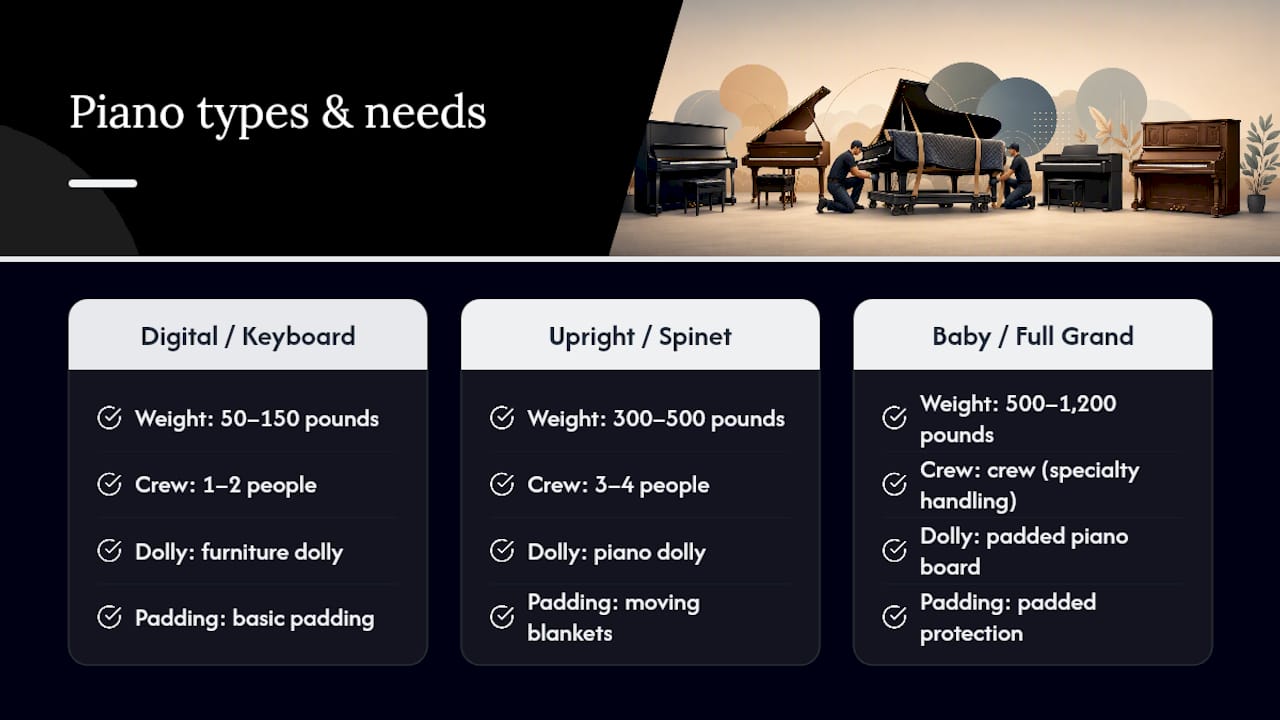
Digital pianos and keyboards weigh 50 to 150 pounds. One or two people can usually manage these with a furniture dolly and basic padding.
Upright, console, and spinet pianos run 300 to 500 pounds, tall and narrow with a high centre of gravity that makes them tip-prone through doorways and turns. These need a piano dolly, moving blankets, and a crew of three to four.
Baby grands and full grands weigh 500 to 1,200 pounds and require partial disassembly, removing the legs, lyre, and pedal lyre before loading the body onto a padded piano board. This is standard practice for grand transport; Aleksmoving’s own case work on grand piano transport shows why fragile legs and an off-centre balance point demand specialty handling, not brute strength.
Should you move the piano yourself or hire a pro?
Some moves are simple enough to handle with a rented dolly and a few strong friends. Others are not, no matter how confident your crew feels.
Hire professionals when any of these apply:
- The route includes stairs, a landing turn, or a tight hallway corner
- You’re moving a baby grand, grand, or antique instrument
- The piano is travelling more than a short local distance
- Your available crew is fewer than three physically capable adults
- You want cargo insurance covering damage in transit
For simple, flat, single-storey moves, three to four people handle most uprights safely, while a grand needs four or more. A licensed mover’s insurance and liability coverage matters more than people expect. Homeowner’s insurance rarely covers damage from a DIY piano drop. Book two to three weeks ahead during peak moving season, from May through September, when crews and trucks book up fast.
Equipment checklist: what you actually need
Skipping the right gear is how pianos get dropped. Here’s the minimum kit:
- Piano dolly or piano skid board (not a standard hand truck) rated for at least 500 to 1,000 pounds
- Moving blankets, four to six, thick enough to cushion every corner and panel
- Ratchet straps, at least two, to secure the piano to the dolly and later to the truck wall
- A loading ramp with a shallow enough angle for controlled walking, not sliding
- Floor protection, cardboard runners or rigid floor film for hardwood and tile
- Work gloves for grip and hand protection
- A basic tool kit with labelled bags for any hardware removed during disassembly, such as piano legs
Most equipment rental centres carry piano dollies and straps; if you’re unsure what to rent, ask a mover directly. Many, including Aleksmoving, will supply the correct equipment as part of a booked job.
Pro Tip: Never substitute a standard appliance dolly for a piano dolly. Pianos need a wider, lower platform to keep the centre of gravity stable, and a narrow dolly will tip under an uneven load.
How do you prepare the piano and route before moving day?
Preparation prevents almost every avoidable claim. Measure the piano’s width, depth, and height, then measure every doorway, hallway, stairwell, and the truck’s loading door against those numbers.
Before the crew arrives:
- Lock or tape down the keyboard lid to protect the keys
- Remove pedals only if the manufacturer’s design allows it. Otherwise leave them fixed and pad around them
- Lay floor protection along the entire path, not just the tight spots
- Prop doors open and pad doorframes where the piano’s width leaves little clearance
- Wrap the full piano in moving blankets, secured with stretch wrap rather than tape directly on the wood
- Assign one person as a dedicated spotter who watches corners and calls out hazards instead of lifting
Run through the lift sequence once with the crew before touching the piano. A five-minute walkthrough catches problems a rushed first attempt won’t.
Moving on stairs and ramps: the highest-risk step
Stairs are where most severe piano damage and injuries happen, and that’s exactly why professional crews avoid rolling a dolly down them at all. A dolly on stairs has nothing to grip and nowhere to stop if it starts moving.
Instead, the crew hand-carries the piano in a controlled sequence, with the strongest members positioned on the downhill side bearing most of the weight. Every step is a deliberate, called-out movement, not a continuous carry. On longer staircases or where a stairwell turns partway down, professionals sometimes use stair-rated skids or mechanised stair-climbing equipment built specifically for heavy furniture.
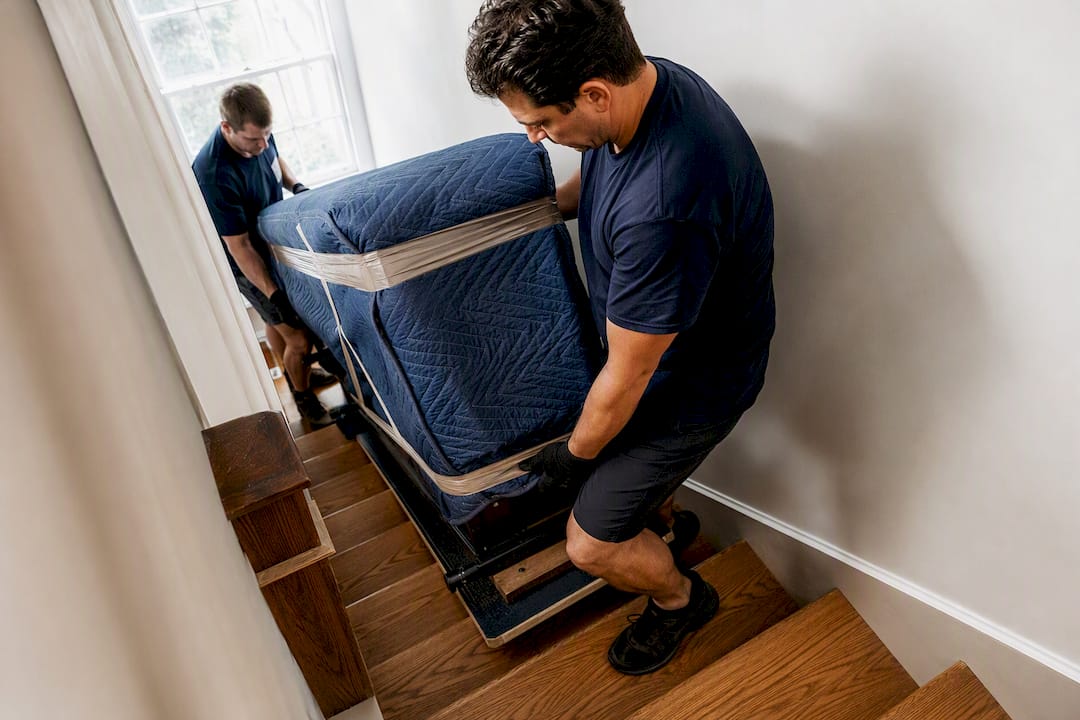
If your staircase has a landing turn, a low ceiling, or fewer than three strong adults available, that’s your line: stop and call a specialty crew. This is the single point in a piano move where a DIY attempt turns into an emergency room visit or a $10,000 instrument repair.
Loading and securing the piano for transport
Park the truck on level ground and set the ramp at a shallow, walkable angle. A steep ramp turns a controlled roll into a runaway slide.
Once inside the truck:
- Position the piano against the truck’s front wall, facing the wall for uprights, to use the vehicle structure as a stabilising anchor
- Pad every contact point between the piano and the truck wall with moving blankets
- Run ratchet straps from the piano’s frame to the truck’s built-in rails, tight enough to eliminate shifting but not so tight they crush the case
- Decide whether to leave the piano on its dolly. Removing it lowers the centre of gravity for transport, but leaving it on a locked dolly can speed up unloading on the other end
Drive gently. Hard braking or sharp turns put more stress on a piano than most of the loading process. In extreme heat or cold, avoid leaving the piano in the truck longer than necessary, since rapid temperature swings stress the wood and tuning stability.
What happens after the move: settling and tuning
Unload in reverse order from loading, checking that straps release evenly and the ramp angle stays consistent. Reassemble any removed legs, lyre, or pedals before setting the piano in its final position.
Place the piano away from direct sunlight, heating vents, and exterior walls prone to humidity swings. Then wait. Piano technicians recommend waiting two to four weeks before tuning, giving the instrument time to acclimate to the new room’s temperature and humidity before the tuning holds properly.
While you wait, inspect the case for scuffs, check that all keys respond evenly, and listen for buzzing or rattling that suggests internal movement. If anything seems off structurally, call a piano technician rather than a general handyman.
How much does moving a piano typically cost?
Local upright and digital piano moves through on-demand services typically run US$120 to $340, with jobs averaging around $210. Full-service professional piano movers, who bring specialized equipment and insurance, typically charge more, in the US$250 to $600 range for local jobs.
Price climbs with stairs, long carry distances, disassembly requirements for grands, and any need for temporary storage. A binding, itemized quote should specify crew size, equipment included, insurance coverage, and any stair or long-carry fees before the truck ever shows up.
A simple flat-ground upright move often takes under two hours. A grand piano requiring disassembly and stairs can take half a day once you include reassembly and careful placement.
What Aleksmoving has learned from real piano jobs
Every piano move comes down to one thing: controlling the centre of gravity, not lifting harder. A piano wants to tip the moment it’s off level ground, and a trained crew spends the whole move making tiny counter-adjustments rather than one big heave.
Written quotes lay out crew size, equipment, and insurance coverage before booking, so there are no surprises on move day. The most common DIY mistake we see is renting the wrong dolly, an appliance dolly instead of a piano-rated one, which fails exactly at the moment it matters most: a doorway threshold or a ramp transition. For grand piano moves specifically, our detailed case study on grand transport walks through the disassembly and padding sequence step by step.
Why most piano moving advice undersells the stairs problem
Most piano moving guides treat stairs as one bullet point among many. That’s backwards. Stairs are the single variable most likely to turn a manageable DIY project into a damaged instrument or an injured back, and they deserve to be the first question you ask yourself, not the fifth.
The conventional advice to “get a few strong friends and a dolly” works fine for a digital keyboard on a flat floor. It fails badly the moment stairs, a tight turn, or a grand piano enter the picture, because those situations require technique, not just muscle. A piano doesn’t get carried so much as continuously stabilized, and that skill comes from doing it repeatedly, not from a weekend’s worth of enthusiasm.
If you take one thing from this guide, let it be this: measure your route honestly before you commit to DIY, and be willing to change your plan if the measurements or the stairs don’t cooperate. The instrument, and your back, will thank you.
— Ali
Book a flat-rate piano move with Aleksmoving
Piano moves are often priced with a flat, upfront quote instead of hourly guesswork, avoiding surprise bills when stairs or tight hallways slow things down. Professional piano moves typically include rated equipment, padded and insured transport, and a crew experienced with specialized stabilization techniques.

Our residential moving services cover piano and specialty instrument handling alongside full packing and antiques transport, and our local moving service is built for exactly the kind of single-address relocation most piano moves involve. If your move includes a gap between homes, our storage service can hold the piano safely in the meantime. Request a free, no-obligation quote through our site or give us a call to get a crew and a firm price locked in before your move date.
Sources
For cost benchmarks and DIY risk data, see Lugg’s piano moving cost guide and NerdWallet’s piano moving breakdown. For step-by-step technique, consult wikiHow’s upright piano guide and U-Haul’s piano moving checklist.
- How to Move a Piano in 2026: Cost, Risks & DIY Guide | Lugg
- Piano moving: How to do it, what it costs – NerdWallet
- How to Move a Piano | U-Haul
FAQ
How much does it typically cost to move a piano?
Local moves through on-demand services typically run US$120 to $340 for uprights and digital pianos, while full-service professional piano movers charge roughly US$250 to $600 locally, more with stairs, long distances, or grand piano disassembly. Aleksmoving provides an exact flat-rate quote after reviewing your specific move.
What is the best way to move a piano myself?
Measure the piano and every doorway, hallway, and stairwell first, then use a piano-rated dolly, moving blankets, and ratchet straps with a crew of at least three people for an upright. Skip DIY entirely if the route includes stairs or a tight turn.
What not to do when moving a piano?
Never use a standard appliance dolly instead of a piano-rated one, never roll a dolly down stairs, and never attempt a grand or staircase move with fewer than three physically capable people. Also avoid tuning the piano immediately; wait two to four weeks for it to acclimate.
How do you move a piano from one house to another?
Disassemble removable parts if it’s a grand, wrap the piano fully in moving blankets, load it onto a padded dolly or piano board, secure it inside the truck against a wall with ratchet straps, and drive gently to avoid shifting. Reverse the process carefully on arrival and wait before tuning.